
Last updated on April 30th, 2026 at 11:04 am
How often do you gaze into the night sky and wonder if the incredible silence between the stars is actually a mirror, reflecting the quiet, aching distances within your own family? Alexandra Oliva’s The Radiant Dark posits that the discovery of extraterrestrial life wouldn’t automatically unite humanity in a neat, utopian bow; instead, it would act as a cosmic magnifying glass, intensifying our personal traumas, religious zealotry, and desperate need for earthly connection.
The Radiant Dark is essential reading for lovers of grounded, character-driven sci-fi and sweeping family sagas (think Mary Doria Russell’s The Sparrow or Lily Brooks-Dalton’s Good Morning, Midnight). It is decidedly not for readers seeking fast-paced alien invasions or laser-blasting space operas.
Table of Contents
1. Introduction
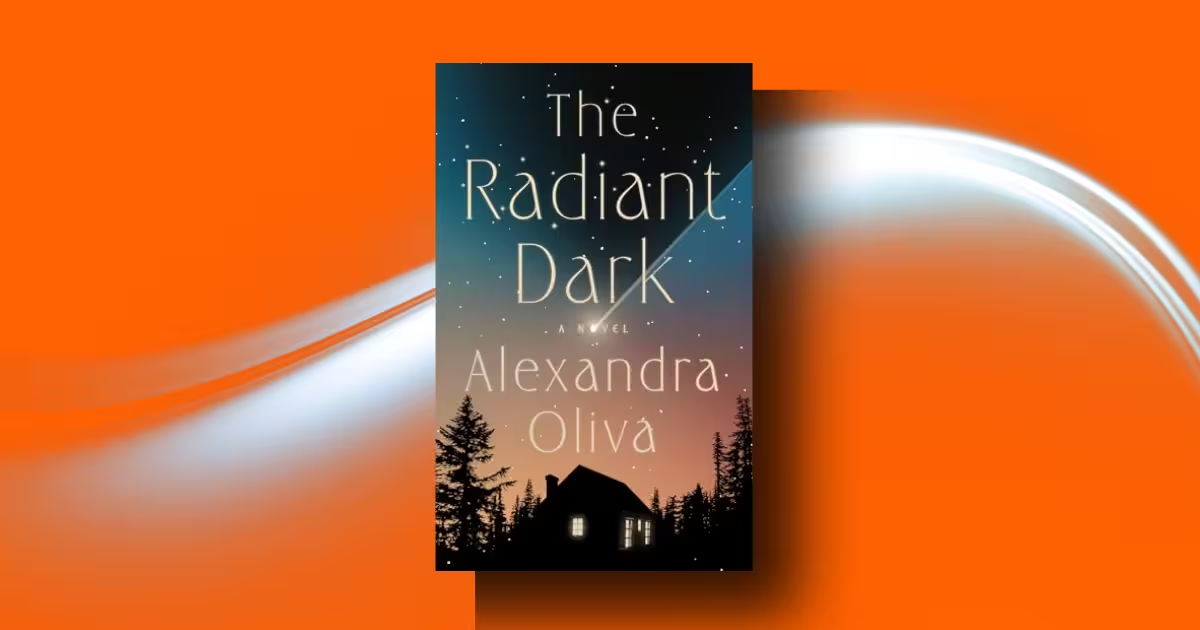
Title: The Radiant Dark
Author: Alexandra Oliva
Publication Date: April 28, 2026 (Zando / SJP Lit)
The Radiant Dark is a profoundly moving literary science fiction novel that chronicles over fifty years of a single family’s life following the discovery of an extraterrestrial transmission. It is an exploration of how cosmic milestones shape, fracture, and occasionally heal the most intimate human bonds.
2. Background
To fully appreciate this novel, one must understand the historical and cultural context Oliva sets up.
The story’s inciting incident occurs in March 1980, a time when humanity was already grappling with intense geopolitical tension—the Cold War, the Soviet invasion of Afghanistan, and the Iranian hostage crisis.
When astronomers decode a radio signal from Ross 128, a star system eleven light-years away, it forces a massive reshuffling of cultural norms.
The novel utilizes real-world scientific concepts—like prime numbers being used as a universal baseline for decoding visual bitmaps—to ground its speculative premise in hard reality.
3. The Radiant Dark Summary
Part 1: The Arrival and The Fracture (1980–1982)
The narrative opens in 1980, focusing intimately on Carol Girard, a young mother in the Adirondacks suffering from severe, undiagnosed postpartum depression following the premature birth of her son, Michael.
She feels entirely disconnected from her husband, Jake, who is largely indifferent to her struggles. The crushing mundanity of Carol’s isolation is shattered when President Jimmy Carter announces that scientists have decoded a radio signal—dubbed “the Beacon”—originating from the Ross 128 star system.
The signal, decoded by Dr. Patricia Frey’s team using prime numbers (263 and 653), forms a bitmap image of a star and five planets, proving humanity is not alone.
In the bewildered, euphoric aftermath of the announcement, Carol and Jake share a rare moment of intimacy, resulting in the conception of their second child, Rosanna (Ro). Carol comes to view Ro as her “Rossian gift,” a child inextricably linked to the cosmos.
On New Year’s Eve 1982, Earth sends its official response via the Arecibo Observatory—a transmission containing mathematical constants and a map of our solar system. Carol, overwhelmed by the chaos of a toddler and a teething baby, misses the live broadcast of the transmission, a moment of profound, lingering resentment.
Part 2: The Departure and The Silence (1993–1998)
The story jumps to 1993, specifically the two-week window when Earth’s 1982 reply is calculated to finally reach Ross 128. Ro, now twelve, is a brilliant, space-obsessed student.
Michael, thirteen, is a quiet, anxious boy who finds solace by constantly escaping into the surrounding forest to hide in a makeshift shelter.
The marital rot between Carol and Jake finally reaches a breaking point.
During a vicious argument where Carol demands Jake leave the house, Jake punches a hole in the door inches from Carol’s head. Terrified, Michael begs his mother to leave for her own safety. Carol flees, essentially abandoning her children to Jake’s custody.
Five years later, in 1998, the unthinkable happens: The Rossian Beacon abruptly ceases transmitting. While Ro, now seventeen and applying to Yale, rationalizes this scientifically, Carol has fallen deep into a spiritual cult known as Universalism.
Led by a charismatic fraud named Hector Thomas, Universalists believe human souls travel on light and that Hector is the reincarnation of a Rossian.
Carol marries a devout Universalist named Theodore Verity, fully severing her old life.
Simultaneously, tragedy strikes Ro’s life.
At a sketchy graduation party, Ro’s childhood best friend, Elaine Kadner, snorts cocaine provided by two older men. While intoxicated, Elaine falls over a second-story railing to her death. Ro is utterly traumatized, blaming herself for not stopping it. Shortly after the funeral, the Rossian Beacon inexplicably turns back on.
Part 3: Discoveries and New Connections (2005)
By 2005, Ro is a PhD student in astrophysics at the University of Arizona. She is brought into a secretive, elite project team (PEHT) led by none other than Dr. Patricia Frey. The Rossians have sent a second massive transmission.
Reviewing the data, Ro brilliantly deduces that a specific chart isn’t mapping stars, but rather exoplanet atmospheres containing water and methane—the building blocks of organic life.
The chart reveals that while organic life is common in the universe, technologically advanced life (capable of sending radio waves) is incredibly rare; only Earth and Ross 128 are ticked on the chart.
Professionally soaring, Ro also meets and falls deeply in love with Charles Zambrano, a kind-hearted writer. However, her relationship with her mother remains a toxic wasteland of passive-aggression and cult rhetoric.
Part 4: The Brink of Tragedy and The Secret Message (2018–2020)
In 2018, Ro and Charles welcome a baby girl, Lydia. Ro suffers from severe postpartum rage and anxiety, terrified of SIDS and overwhelmed by the evolutionary weight of motherhood. Against Ro’s better judgment, Carol and Theodore visit Seattle to meet the baby.
The trip goes disastrously wrong. Theodore, desperate to curry favor with his cult leader Hector, attempts to hold baby Lydia hostage, demanding Ro use her connections to force Patricia Frey to beam a Universalist message to Ross 128. In the ensuing scuffle, Theodore drops the baby, fracturing her skull.
Lydia survives, but Ro permanently cuts her mother out of her life. Shaken by the violence, Carol finally sees Theodore for the fanatic he is and leaves him, moving into an assisted living facility.
Meanwhile, a massive scandal rocks the astronomy world. It is revealed that in 2007, Patricia Frey paid an array operator in Chile to beam an unauthorized English language primer and encyclopedia to Ross 128.
Disgraced, Frey is forced into retirement, and Ro takes over as the head of PEHT. Shortly after, PEHT’s crowning achievement—an interstellar light-sail probe named Shu destined for Proxima Centauri—explodes catastrophically upon launch, effectively ending Ro’s career in space exploration.
Part 5: The Final Transmissions and The Future (2034–2138)
In 2034, a third transmission arrives from Ross 128. Because of Frey’s rogue 2007 message, the Rossians now understand English. The message includes a “Rosetta stone” matching English color words to the electromagnetic spectrum, proving the Rossians perceive light differently than humans.
More importantly, the message contains a blueprint for a massive Rossian light-sail ship. Dimitri, Ro’s brilliant colleague, calculates that the ship was launched in 1982 and is traveling at 10% the speed of light—meaning the Rossians will physically arrive in our solar system in the year 2092. Ro realizes she will not live to see them arrive, but her daughter, Lydia, will.
The novel’s epilogue jumps forward to the year 2138. Ro’s descendant, Mica Zambrano-Tamura, is a geologist living on a space station orbiting the Moon. The Rossians have long since arrived and integrated; Mica’s best friend is a Rossian named Drull.
While cleaning out the quarters of her recently deceased mother (Lydia), Mica discovers a first-edition book signed by Patricia Frey, containing an old photograph of the Girard family.
Looking at the faces of her ancestors—the people who lived through the agonizing, beautiful “Age of First Contact”—Mica decides to uncover their history, bringing the generational saga full circle.
4. The Radiant Dark Analysis
4.1. The Radiant Dark Characters
Carol Girard: Carol is the tragic, beating heart of the novel. Her arc from a depressed, isolated mother to a brainwashed cult member is painfully realistic. Oliva brilliantly utilizes Carol to explore how the human mind desperately seeks meaning and structure to cope with trauma.
Her ultimate redemption—sacrificing her marriage to Theodore to protect her granddaughter—is a powerful testament to maternal instinct.
Rosanna (Ro) Girard: Ro represents the triumph of intellect and the burden of ambition. Her journey from a traumatized teenager to a leading astrophysicist is inspiring, yet she is deeply flawed.
Her absolute refusal to empathize with her mother’s mental illness, while demanding grace for her own postpartum struggles, makes her a complex, occasionally frustrating, but utterly human protagonist.
Michael Girard: The quiet observer. Michael internalizes the chaos of his parents’ divorce by retreating into nature. His evolution into an environmental conservationist serves as a stark, necessary contrast to Ro’s obsession with the stars; he reminds the reader that Earth is a planet worth saving, too.
Patricia Frey: The unapologetic renegade. Frey is the quintessential “ends justify the means” scientist. Her decision to illegally transmit human knowledge to Ross 128 alters the course of history, acting as the catalyst for true interstellar understanding.
4.2. The Radiant Dark Themes and Symbolism
Light as Connection and Isolation: The novel constantly plays with the electromagnetic spectrum.
To the Universalists, light is a literal spiritual tether connecting souls. To Ro, it is a tool for spectroscopic analysis. Symbolically, the “Radiant Dark” refers to the space between people—how we can be surrounded by the light of others yet remain entirely in the dark regarding their internal pain.
The Weight of Motherhood: Oliva does not shy away from the visceral, ugly realities of postpartum depression and rage.
The novel draws a brilliant parallel between the terror of bringing a fragile human life into the world and the terror of humanity realizing it is a fragile, infant species in a vast, dark universe.
The Inevitability of Extinction vs. Human Resilience: Ro theorizes that mass extinction events might be a necessary crucible for the evolution of advanced intelligence.
This macro-level scientific theory mirrors the micro-level family dynamics: It takes the “extinction” of Carol’s marriage and Elaine’s tragic death for Ro and Michael to evolve into their ultimate selves.
5. Evaluation
The Radiant Dark is an incandescent, generation-spanning masterpiece that brilliantly anchors the terrifying vastness of the cosmos to the intimate, agonizing reality of a crumbling kitchen table.
Strengths: The absolute triumph of this book is its pacing and its refusal to rely on cheap sci-fi tropes. The aliens (until the very end) are entirely off-screen, existing only as data points and radio waves. This restraint forces the narrative focus onto the human condition. The depiction of early motherhood is staggeringly accurate and deeply empathetic.
Weaknesses: The introduction of the Universalism cult, while thematically resonant, occasionally verges on melodrama. Theodore Verity’s sudden pivot from a manipulative zealot to an active physical threat feels slightly rushed.
Impact: This is a book that stays in your bones. It forces you to look up at the stars not just with wonder, but with a profound appreciation for the fragile, flawed humans sitting right next to you.
Similar works: The Radiant Dark aligns more with intimate, idea-driven sci-fi than plot-heavy narratives. Like Arrival, it treats alien contact as an emotional and linguistic experience rather than a spectacle.
Similar to Station Eleven, it focuses on how ordinary lives adapt to world-altering events. It also echoes The Left Hand of Darkness in prioritizing human relationships and identity over technological drama.
6. Personal Insight with Contemporary Educational Relevance
What strikes me most profoundly about The Radiant Dark is its piercing examination of the psychological toll of isolation, framed against the ultimate isolation: humanity’s loneliness in the cosmos.
In contemporary society, we are currently living through a loneliness epidemic. Despite being hyper-connected via the internet and social media, statistics continually show rising rates of depression, anxiety, and interpersonal disconnection.
Oliva mirrors this societal truth in Ro’s struggle with Postpartum Rage (PPR)1. While Postpartum Depression (PPD)2 is widely discussed, PPR remains a largely taboo subject, leaving mothers suffering in silence, convinced they are failing.
Just as humanity in the novel stares into the void of space hoping for a signal that they aren’t alone, modern individuals stare into the void of their daily lives desperate for genuine connection.
The book brilliantly argues that while we pour billions into instruments like the James Webb Space Telescope to decode the atmospheres of exoplanets, we often entirely fail to decode the emotional atmospheres of the people sleeping in the next room.
It is a vital, empathetic lesson in prioritizing human grace.
7. The Radiant Dark Quotes
- “When we look up, some of the light we see is older than human civilization.”
- “Her ear rejecting silence to seek her child’s cry.”
- “Her job is to prepare her child for the world. She no longer knows what kind of world that’s going to be.”
- “Human history is just a series of attempted exterminations.”
- “It’s not striving if you might not fail.”
- “The Radiant Dark reminds us that the vastness of the cosmos is most deeply felt in the quiet rooms of our own lives.”
8. Conclusion
The Radiant Dark is a monumental achievement in speculative fiction.
By intertwining the cold, hard math of astrophysics with the messy, bleeding reality of family trauma, Alexandra Oliva has crafted a novel that is both intellectually thrilling and emotionally devastating.
Recommendation: I highly recommend this to fans of literary sci-fi, multi-generational family dramas, and anyone who appreciates a story that respects its audience’s intelligence.
If you loved Station Eleven by Emily St. John Mandel or The Overstory by Richard Powers, this book deserves an immediate place at the top of your reading list.
It is a stunning reminder that while we may look to the stars for answers, the most important discoveries are the ones we make about each other.
Notes
- Postpartum rage is a common, intense mood disruption occurring after childbirth, characterized by sudden outbursts of anger, irritability, and violent thoughts ↩︎
- Postpartum depression (PPD) is a serious, common medical complication of childbirth, affecting 10–20% of mothers. ↩︎







