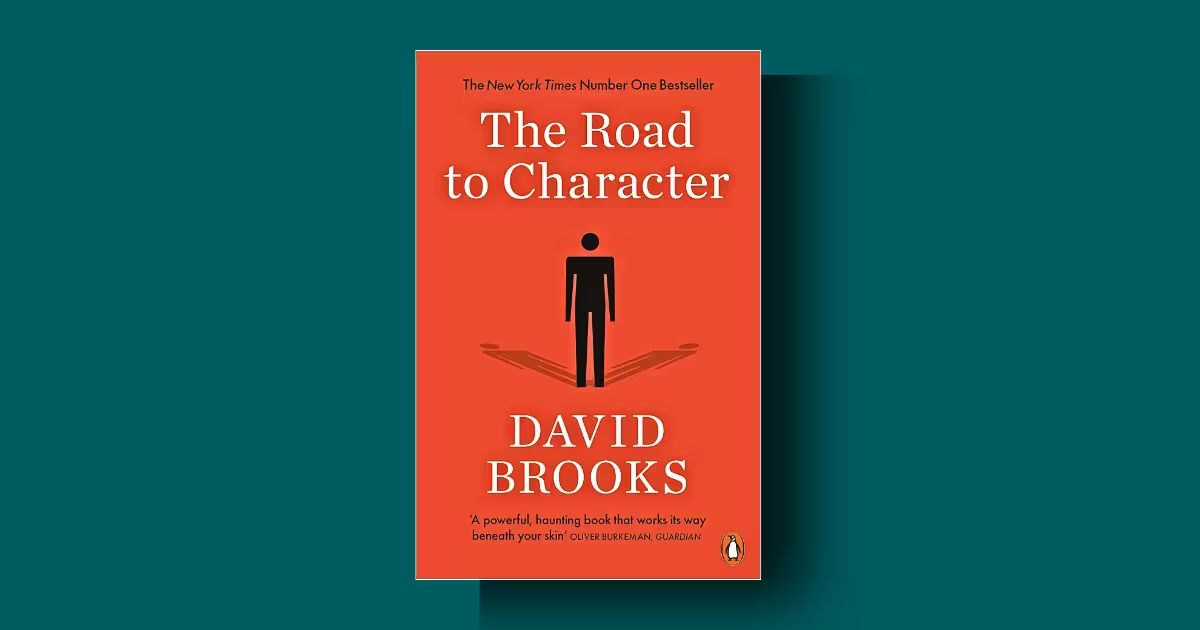

Ever wonder why you feel accomplished on paper but empty inside when you stop to think about who you’ve actually become? David Brooks’s The Road to Character forces you to confront this uncomfortable question head-on.
After spending decades as a New York Times columnist observing the human condition, Brooks noticed something disturbing about modern life: we’ve become experts at building impressive careers but have lost the language and the tools to build genuine character.
This book is his attempt to fix that, both for himself and for the rest of us.
Overview
The Road to Character is not your typical self-help book filled with seven easy steps to becoming a better person. Instead, it’s a deeply researched, biography-driven exploration of what character actually means and how it gets built.
Brooks draws on the lives of historical figures, Frances Perkins, Dwight Eisenhower, Dorothy Day, George Marshall, A. Philip Randolph, Bayard Rustin, George Eliot, Saint Augustine, and Samuel Johnson, to illustrate what he calls the “crooked timber” approach to life.
Who will actually love this book? If you’ve ever felt that your life lacks depth despite outward success, if you’re tired of the culture of self-promotion and constant comparison, or if you want to understand how humility, struggle, and self-confrontation can lead to genuine fulfillment, this book will speak directly to you.
It’s written for people in their thirties, forties, and beyond who are asking deeper questions about meaning and legacy.
Who should bounce? If you’re looking for quick fixes, practical step-by-step plans, or affirmations that you’re already wonderful just the way you are, skip this one. Brooks won’t tell you to follow your passion or trust your inner voice. He’ll tell you to distrust yourself and start a long, difficult campaign against your own weaknesses.
1. Introduction
Book Title: The Road to Character
Author: David Brooks
Publication Details: Originally published in hardcover in 2015 by Random House. The trade paperback edition was released in 2016.
Pages: Approximately 320 pages (including notes and index)
Context: What The Road to Character Is About
The Road to Character sits at the intersection of psychology, philosophy, biography, and moral criticism. Brooks, a prominent New York Times op-ed columnist and author of previous bestsellers like Bobos in Paradise and The Social Animal, turns his analytical lens inward.
He describes himself as someone born “with a natural disposition toward shallowness”, and this book is his attempt to understand how depth and character are actually cultivated.
Brooks draws on the work of Rabbi Joseph Soloveitchik, who distinguished between two conflicting sides of human nature: Adam I and Adam II. Adam I is the external, career-oriented self who wants to build, achieve, and conquer the world. Adam II is the internal self who wants to embody moral qualities, love intimately, and serve a transcendent purpose.
The book argues that modern culture has become dangerously unbalanced. We’ve become experts at nurturing Adam I while neglecting Adam II. We know how to build careers but not souls. We can achieve success but can’t articulate why it matters.
Purpose: The Central Thesis
Brooks’s central argument is that character is not innate or automatic, it must be built through struggle, self-confrontation, and humility. The road to character, he writes, “often involves moments of moral crisis, confrontation, and recovery”.
The people we admire for their depth didn’t get that way through talent alone. They descended into what Brooks calls “the valley of humility” and, through that descent, found their way to genuine strength.
“The central fallacy of modern life,” Brooks declares, “is the belief that accomplishments of the Adam I realm can produce deep satisfaction. That’s false”. Only Adam II can experience deep satisfaction, and that satisfaction comes not from achievement but from moral struggle and the quiet joy of becoming better than you used to be.
2. Background
To understand The Road to Character, you need to understand where David Brooks is coming from. He’s spent decades as a public intellectual, writing about politics, culture, and social trends. But this book emerges from a personal crisis of sorts.
Brooks admits in the introduction that he wrote this book “to be honest, to save my own soul”. He describes himself as someone who works as a pundit and columnist, paid “to be a narcissistic blowhard, to volley my opinions, to appear more confident about them than I really am, to appear smarter than I really am, to appear better and more authoritative than I really am”.
This isn’t false modesty, it’s a recognition that his professional life actively works against the kind of depth he’s come to value.
The book grew out of a specific moment of insight. Brooks describes listening to a rebroadcast of Command Performance, a World War II-era radio show broadcast the day after V-J Day in 1945.
The show featured celebrities like Frank Sinatra and Bing Crosby, but its tone was strikingly humble. Nobody was chest-beating or celebrating their own awesomeness.
Instead, the mood was one of gratitude and self-effacement.
Brooks contrasts this with a football game he watched later that night, where a player celebrated a two-yard gain with a self-puffing victory dance. “It occurred to me that I had just watched more self-celebration after a two-yard gain than I had heard after the United States won World War II”.
This contrast sparked a chain of thoughts about how our culture has shifted from one of humility to one of what Brooks calls “the Big Me.” The book is his attempt to recover what we’ve lost.
Table of Contents
3. The Road to Character Summary
The Two Adams Framework
Brooks’s entire argument rests on the distinction between Adam I and Adam II, borrowed from Rabbi Joseph Soloveitchik’s 1965 essay “The Lonely Man of Faith.”
Adam I is the external, career-oriented self:
- Wants to build, create, produce, and discover things
- Seeks high status and victories
- Lives by utilitarian logic: effort leads to reward, practice makes perfect
- Motto: “Success”
Adam II is the internal, moral self:
- Wants to embody moral qualities
- Seeks a serene inner character, a sense of right and wrong
- Wants to love intimately and sacrifice self in service of others
- Lives by inverse logic: you have to give to receive, surrender to gain strength
- Motto: “Charity, love, and redemption”
The hard truth, Brooks argues, is that these two selves live by different logics and are not fully reconcilable. We’re forever caught in a tension between them. The problem is that modern culture nurtures Adam I while neglecting Adam II. “We live in a society that encourages us to think about how to have a great career but leaves many of us inarticulate about how to cultivate the inner life”.
The Shift from Humility to Self-Promotion
Brooks documents a massive cultural shift using concrete data. Between 1948 and 1954, psychologists asked more than 10,000 adolescents whether they considered themselves “a very important person.”
At that point, only 12 percent said yes. When the question was revisited in 1989, 80 percent of boys and 77 percent of girls said yes.
The narcissism test, which asks people whether statements like “I like to be the center of attention” apply to them, has shown a 30 percent rise in median scores over two decades. Ninety-three percent of young people today score higher than the middle score from just twenty years ago.
Fame used to rank low as a life ambition. In a 1976 survey, fame ranked fifteenth out of sixteen life goals. By 2007, 51 percent of young people reported that being famous was one of their top personal goals.
Girl Scout handbooks show the same shift. Early editions preached self-sacrifice and self-effacement, warning that “the chief obstacle to happiness comes from the overeager desire to have people think about you.” By 1980, the handbook was telling girls to “put yourself in the ‘center stage’ of your thoughts”.
The Humble Path and Moral Realism
Against this culture of self-promotion, Brooks offers what he calls the “crooked timber” tradition. The phrase comes from Immanuel Kant: “Out of the crooked timber of humanity, no straight thing was ever made”.
People in this tradition:
- Have an acute awareness of their own flaws
- Believe character is built in the struggle against weakness
- See life as a moral drama, not just a career trajectory
- Distrust their own impulses and seek external guidance
Brooks quotes David Foster Wallace’s famous Kenyon College commencement speech to illustrate our natural self-centeredness:
“Everything in my own immediate experience supports my deep belief that I am the absolute center of the universe; the realest, most vivid and important person in existence. We rarely think about this sort of natural, basic self-centeredness because it’s so socially repulsive. But it’s pretty much the same for all of us. It is our default setting, hard-wired into our boards at birth”.
The humble person, Brooks argues, recognizes this default setting and fights against it. They understand that “we are all built from crooked timber” and that character emerges from the struggle against our own weaknesses.
The Biographical Essays
The heart of the book consists of biographical essays that illustrate different aspects of character-building. Each figure exemplifies one of the activities that lead to character.
Frances Perkins: The Summoned Self
Perkins was the first woman to serve in a U.S. presidential cabinet, as Franklin Roosevelt’s Secretary of Labor. But Brooks focuses on her transformation after witnessing the Triangle Shirtwaist Factory fire in 1911.
The fire killed 146 workers, mostly young immigrant women. Perkins watched in horror as people jumped from the burning building to their deaths.
The experience changed her from a conventional social worker into a fierce advocate. “It was as though we had all done something wrong. It shouldn’t have been. We were sorry. Mea culpa! Mea culpa!” she later recalled.
Perkins didn’t find her purpose by looking inward and asking what she wanted. She was summoned by circumstances. As Brooks explains, “In this scheme of things we don’t create our lives; we are summoned by life. The important answers are not found inside, they are found outside”.
Perkins learned to suppress her own identity and pride in service of a larger cause. She dressed like a mother to win the trust of male legislators. She took half-loaves when she couldn’t get the whole thing. She endured public humiliation and impeachment proceedings with stoic resolve.
Brooks summarizes her approach: “She suppressed her own identity so she could lobby for her cause. She took on every new challenge and remained as steadfast as her motto”.
Dwight Eisenhower: Self-Conquest
Eisenhower’s story is about learning to control a volcanic temper. As a boy, he flew into a rage when his older brothers were allowed to go trick-or-treating and he wasn’t. He pounded his fists against an apple tree until his hands were bloody.
His mother came to his room and quoted a Bible verse: “He that conquereth his own soul is greater than he who taketh a city”. She told him to beware the anger and hatred burning inside. “Of all her boys,” she told him, “he had the most to learn about controlling his passions”.
Eisenhower learned the lesson so well that he became famous for his sunny disposition, even though inside he was seething. He was, Brooks writes, “a passionate man who lived, as much as his mother did, under a system of artificial restraints”.
He developed techniques like writing the names of people who offended him on paper and then dropping them in the wastebasket to symbolically purge his anger.
His moderation was not bland equanimity but a hard-won balance between competing impulses. “The fundamental division in the soul or psyche,” Brooks writes, “is at the root of our need for moderation”.
Dorothy Day: Struggle
Day was a radical activist who converted to Catholicism and founded the Catholic Worker movement. Her life was marked by intense spiritual struggle and self-criticism.
As a teenager, she wrote in a letter: “Only after a hard bitter struggle with sin and only after we have overcome it, do we experience blessed joy and peace. … I have so much work to do to overcome my sins. I am working always, always on guard, praying without ceasing to overcome all physical sensations to be purely spiritual”.
Day’s conversion was not a moment of peace but the beginning of more struggle. She wrote: “I had no sense of peace, no joy, no conviction that what I was doing was right. It was just something that I had to do, a task to be gotten through”.
Brooks notes that Day’s experience of religion contradicts the popular notion that faith makes life easier: “She experienced it as difficult self-conflict”. He quotes Rabbi Joseph Soloveitchik, who wrote that the religious consciousness is “exceptionally complex, rigorous, and tortuous”.
Day spent decades serving the poor, living in the hospitality houses she founded, enduring the filth and chaos and ingratitude. She wrote: “The only answer in this life, to the loneliness we are all bound to feel, is community”.
George Marshall: Self-Mastery
Marshall was the U.S. Army Chief of Staff during World War II and later Secretary of State. He was famously self-effacing and disciplined.
As a boy, he overheard his brother saying he would disgrace the family if he went to the Virginia Military Institute. “I decided right then that I was going to wipe his eye. … The urgency to succeed came from hearing that conversation”.
Marshall learned to sublimate his ego completely. He refused to campaign for promotions, even when he desperately wanted them. When Roosevelt offered him command of Operation Overlord, the D-Day invasion, Marshall refused to express his preference, telling the president to do what was best for the country. He got the job of his life taken from him because he wouldn’t ask for it.
His biographer wrote: “Marshall was one of those controlled and disciplined people who find both incentive and reward deep within themselves, who require neither urging nor applause from many men”.
When he died, his instructions for his funeral were remarkable: “Bury me simply, like any ordinary officer of the U.S. Army who has served his country honorably. No fuss. No elaborate ceremonies”.
A. Philip Randolph and Bayard Rustin: Dignity
Randolph was the most prominent civil rights leader of the 1940s and 1950s. He embodied a kind of dignity and self-mastery that made him impossible to humiliate.
His parents taught him perfect elocution and a code of moral refinement. Throughout his life, “Randolph’s carriage was always proper and upright. … You almost never saw him leaning back, reclining”. He spoke in biblical cadences and used archaic words like “verily” and “vouchsafe”.
Rustin was Randolph’s protégé, an openly gay man who was forced to work behind the scenes because of his sexuality. He learned the lesson that “the only way to reduce ugliness in the world is to reduce it in yourself”.
Both men understood that the civil rights movement required not just political action but moral struggle. They were influenced by Reinhold Niebuhr’s idea that we are “never as virtuous as we think we are, and that our motives are never as pure as in our own accounting”.
George Eliot: Love
Eliot was the great Victorian novelist who, as a young woman named Mary Anne Evans, desperately craved love and approval. She threw herself at one unavailable man after another, only to be rejected.
Then she met George Lewes, a married man whose wife was living with another man. Their decision to live together cost Eliot her family, her friends, and her social standing. But it also redeemed her. Lewes encouraged her to write fiction, and she became one of the greatest novelists of her age.
Brooks writes: “Eliot’s mind at that juncture seems to have been in a state of convulsive change. She was aware that her life was about to take an irreversible new form”.
Love, Brooks argues, is a transformative force that humbles us, decenters the self, and impels us to service. “Love is a surrender. You expose your deepest vulnerabilities and give up your illusions of self-mastery”.
Saint Augustine: Ordered Love
Augustine’s story is about learning to love the right things in the right order. As a young man, he was consumed by ambition and lust. He felt fragmented and restless. “I was not yet in love, but I was in love with love,” he wrote in his Confessions.
His mother Monica prayed for his conversion for years. When it finally came, in a garden in Milan, it wasn’t a decision Augustine made so much as something that happened to him. He heard a voice saying “Take up and read,” opened a Bible, and felt “a light flooding his heart and erasing every shadow”.
Brooks explains Augustine’s insight: “The problem, Augustine came to believe, is that if you think you can organize your own salvation you are magnifying the very sin that keeps you from it. To believe that you can be captain of your own life is to suffer the sin of pride”.
Augustine concluded that “the way to inner joy is not through agency and action, it’s through surrender and receptivity to God”. The point is not to achieve but to receive.
Samuel Johnson: Self-Examination
Johnson was a brilliant writer who struggled his entire life with depression, physical afflictions, and what we would now call Tourette’s syndrome. He was “large, ugly, scarred, and ogrelike”.
He fought against his weaknesses through relentless self-examination. His diaries are filled with self-criticism and vows to do better. From 1738: “Oh lord, enable me … in redeeming the time which I have spent in Sloth”.
Brooks writes that Johnson “built a consistent point of view. It began with an awareness of the constant presence of egotism, self-centeredness, and self-deception”. He turned his rebellious spirit against his own nature. “Self-combat was his path to redemption”.
The Humility Code
In the final chapter, Brooks summarizes what he calls the “Humility Code”, a set of propositions derived from the crooked-timber tradition. Here are the key points:
1. We don’t live for happiness, we live for holiness. “The best life is oriented around the increasing excellence of the soul and is nourished by moral joy”.
2. We are flawed creatures. “We have an innate tendency toward selfishness and overconfidence. … We know less than we think we do”.
3. We are also splendidly endowed. “We are divided within ourselves, both fearfully and wonderfully made”.
4. Humility is the greatest virtue. “Humility is having an accurate assessment of your own nature and your own place in the cosmos”.
5. Pride is the central vice. “Pride blinds us to the reality of our divided nature. Pride blinds us to our own weaknesses”.
6. The struggle against sin is the central drama of life. “No external conflict is as consequential or as dramatic as the inner campaign against our own deficiencies”.
7. Character is built in the course of inner confrontation. “Character is a set of dispositions, desires, and habits that are slowly engraved during the struggle against your own weakness”.
8. No person can achieve self-mastery on his or her own. “Everybody needs redemptive assistance from outside, from God, family, friends, ancestors, rules, traditions, institutions, and exemplars”.
9. We are all ultimately saved by grace. “The shape is advance-retreat-advance. In retreat, you admit your need and surrender your crown”.
10. Defeating weakness often means quieting the self. “Only by quieting the self, by muting the sound of your own ego, can you see the world clearly”.
11. Wisdom starts with epistemological modesty. “The world is immeasurably complex and the private stock of reason is small”.
12. No good life is possible unless it is organized around a vocation. “A vocation is not found by looking within and finding your passion. It is found by looking without and asking what life is asking of us”.
4. The Road to Character Analysis
The Road to Character is an important and deeply moving book. It’s not perfect, some of the biographical chapters feel rushed, and Brooks occasionally leans too heavily on the same few sources, but its central argument is both timely and urgent.
What makes this book stand out is Brooks’s willingness to turn the lens on himself. He admits his own shallowness, his own complicity in the culture he’s critiquing. This isn’t a book written from a position of moral superiority. It’s a book written by someone who knows he’s failed and is trying to figure out how to do better.
Brooks effectively supports his arguments with a mix of psychological research, historical biography, and personal reflection. The two-Adams framework is simple enough to be memorable but deep enough to be useful. The biographical essays bring the abstract ideas to life.
The book fulfills its stated purpose: it provides a vocabulary and a set of examples for thinking about character in a culture that has largely abandoned the concept. Whether it can actually “save” anyone’s soul is another question, Brooks himself admits he’s not sure he can follow the road he’s mapped out.
Contribution to the Field
The book contributes to a growing literature on what philosopher Charles Taylor calls the “culture of authenticity”, the idea that each of us has a unique inner self that we must discover and express. Brooks argues that this framework, while liberating in some ways, has gone too far. We’ve become so focused on self-expression that we’ve forgotten self-restraint.
The book also connects to the work of psychologists like Jean Twenge, who has documented the rise of narcissism among young people. Brooks cites Twenge’s research showing that narcissism scores have risen 30 percent in two decades.
What I Felt Reading This Book
Reading The Road to Character was both inspiring and uncomfortable. Inspiring because the examples of Frances Perkins and George Marshall and Dorothy Day make you want to be better. Uncomfortable because you realize how far you fall short.
Brooks’s description of the “stumbler” at the end of the book captures this feeling perfectly. “The stumbler scuffs through life, a little off balance here and there, sometimes lurching, sometimes falling to her knees. But the stumbler faces her imperfect nature, her mistakes and weaknesses, with unvarnished honesty”.
I recognized myself in that description. And I recognized the truth of Brooks’s central claim: we’ve lost the language and the tools for building character. We know how to achieve but not how to become.
5. Strengths and Weaknesses
Strengths
The Two-Adams Framework is Powerful and Memorable. The distinction between the external, career-oriented self and the internal, moral self provides a useful lens for understanding our own lives. It’s simple enough to remember but deep enough to be meaningful.
The Biographical Approach Works. Instead of abstract moralizing, Brooks gives us concrete examples of people who struggled and grew.
These stories stick with you in ways that lists of virtues never could. As Brooks writes, “Example is the best teacher. Moral improvement occurs most reliably when the heart is warmed, when we come into contact with people we admire and love”.
The Book is Honest About Its Own Limitations. Brooks admits he’s writing this to save his own soul. He doesn’t pretend to have all the answers. This humility makes the book more persuasive than if he were lecturing from a position of moral superiority.
The Humility Code Provides a Useful Summary. The final chapter’s list of propositions offers a clear, memorable framework for thinking about character. It’s not a step-by-step plan, Brooks wisely avoids that kind of reductionism, but it provides direction.
The Research is Solid. Brooks draws on psychology, history, and philosophy in ways that are accessible without being superficial. The book is well-documented, with extensive notes.
Weaknesses
Some Biographical Chapters Feel Rushed. Given the depth of the material, some of the lives covered deserve more space. The chapter on A. Philip Randolph and Bayard Rustin, for example, covers two complex figures in relatively few pages.
The Book is More Diagnostic than Prescriptive. Brooks is better at describing what’s wrong with modern culture than at telling us what to do about it. The Humility Code provides some guidance, but it’s not a practical manual.
The Religious Emphasis May Not Appeal to Everyone. Brooks draws heavily on Christian thinkers like Augustine and Niebuhr. While he doesn’t insist that readers share his religious commitments, the book’s framework is clearly shaped by Christian theology.
The Critique of the “Big Me” Culture Can Feel One-Sided. Brooks acknowledges that the shift toward self-esteem and self-expression has been liberating for many groups, particularly women and minorities. But he doesn’t spend enough time exploring the benefits of this shift, focusing instead on its costs.
The Book Can Feel Elitist at Times. The biographical subjects are almost all extraordinary figures, cabinet secretaries, generals, saints, great novelists. It’s fair to ask whether ordinary people can learn from such exceptional lives.
6. Comparison with Similar Works
The Road to Character vs. The Power of Habit by Charles Duhigg
Both books explore how habits shape our lives, but they approach the topic differently. Duhigg focuses on the mechanics of habit formation, the cue-routine-reward loop, and how to change specific behaviors. Brooks is more interested in the moral dimension: how habits of self-control and consideration slowly engrave character into our souls.
The Road to Character vs. The Righteous Mind by Jonathan Haidt
Haidt explores the psychological foundations of morality, arguing that moral judgments are driven more by intuition than by reason. Brooks shares Haidt’s skepticism about pure rationality but focuses more on the practical question of how to become a better person.
The Road to Character vs. Man’s Search for Meaning by Viktor Frankl
Frankl’s classic argues that meaning comes from how we respond to suffering. Brooks’s book is in this tradition, emphasizing that character is forged in struggle. Brooks actually quotes Frankl: “It did not really matter what we expected from life, but rather what life expected from us”.
The Road to Character vs. The Death of Character by James Davison Hunter
Hunter’s book is a more academic treatment of similar themes, arguing that modern culture has lost the moral vocabulary and institutional structures needed to build character. Brooks cites Hunter and builds on his work, making it accessible to a general audience.
The Road to Character vs. The Seven Habits of Highly Effective People by Stephen Covey
Covey’s book is the quintessential self-help manual, offering practical steps for personal effectiveness. Brooks explicitly rejects this approach, arguing that “you can’t build Adam II out of a recipe book. There is no seven-point program”.
7. Conclusion
The Road to Character is essential reading for anyone who has ever felt that their life, despite outward success, lacks depth and meaning. It’s particularly valuable for people in their thirties, forties, and beyond who are asking deeper questions about legacy and purpose.
If you’re looking for practical steps to become a better person, this book will frustrate you. Brooks offers no checklist, no seven habits, no formula. What he offers instead is something more valuable: a way of thinking about character that has been largely lost in modern culture.
The book’s message is ultimately hopeful. Character can be built. The struggle against our own weaknesses, while painful, is also meaningful. And joy, Brooks writes, “is a byproduct experienced by people who are aiming for something else”.
Final Thoughts
Near the end of the book, Brooks writes about the “stumbler”, the person who faces her imperfections with honesty and keeps trying to become better. That’s the image I’ve carried with me since finishing this book. None of us will ever achieve perfection. But we can keep stumbling forward, learning from our failures, and slowly becoming more graceful as the years go by.
As Brooks puts it, “The good news of this book is that it is okay to be flawed, since everyone is. Sin and limitation are woven through our lives. We are all stumblers, and the beauty and meaning of life are in the stumbling”.