
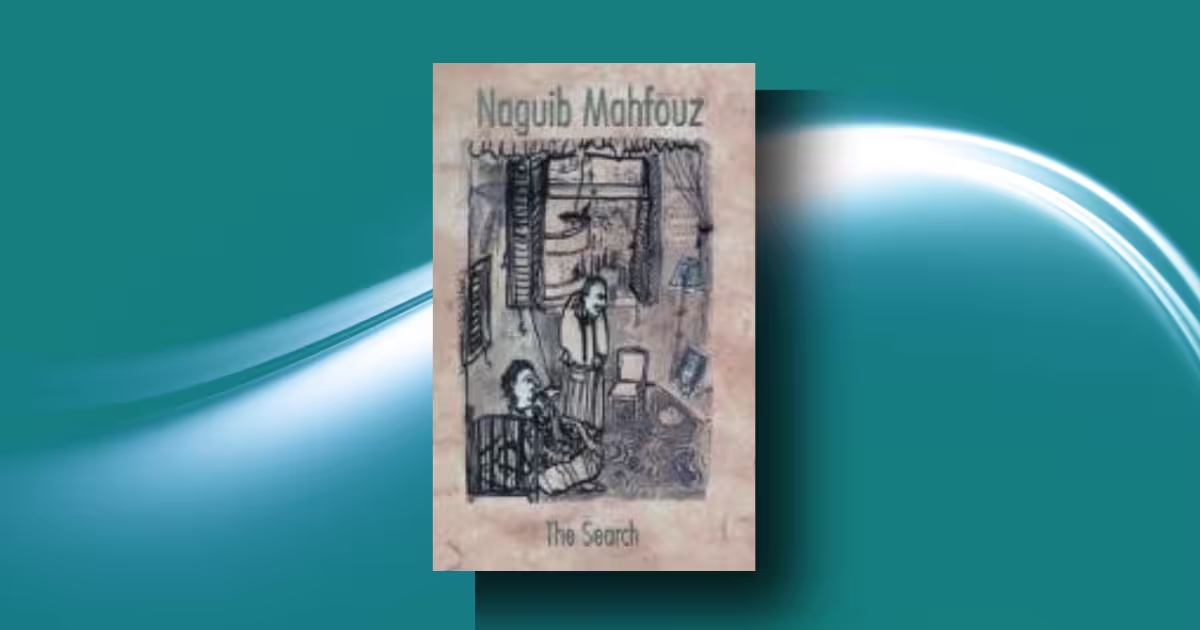

Did you ever wonder why a person can search for a father, a future, and God—yet lose himself before finding any of them? That is why The Search by Naguib Mahfouz stayed with me: it is not just a crime story, but a painful map of hunger, shame, desire, and spiritual emptiness.
The Search is a dark existential novel about Saber, a young man who looks for his unknown father as a way to escape poverty and disgrace, but instead finds love, lust, murder, betrayal, and the terrifying truth that salvation cannot be borrowed from another person.
The Search is best for readers of Egyptian literature, Nobel Prize fiction, psychological crime novels, existential fiction, moral tragedy, and symbolic novels about identity, fatherhood, and spiritual searching.
Not for readers who want a comforting family reunion, fast-paced thriller mechanics, or morally simple characters.
Table of Contents
1. Introduction
The Search is a novel by Egyptian Nobel laureate Naguib Mahfouz. The Arabic title is الطريق / al-Tariq, usually rendered as The Road, The Way, or The Search.
The edition I read is the English translation by Mohamed Islam, edited by Magdi Wahba, published by The American University in Cairo Press; the copyright page states that the English translation first appeared in 1987, while the Arabic original was first published in 1964.
Mahfouz matters here not merely because he won the 1988 Nobel Prize in Literature, but because his fiction turns Cairo’s streets, hotels, cafés, alleys, and rooms into moral laboratories. The Nobel Prize citation praised him for works “rich in nuance,” moving between clear realism and evocative ambiguity, and for forming an Arabic narrative art with universal reach.
Britannica also identifies him as the first Arabic writer to receive the Nobel Prize in Literature.
In The Search, Mahfouz gives us Saber Sayed Sayed el Reheimy, a man who thinks his father will save him. Yet, as I read it, the deeper question is more disturbing: what happens when a person mistakes rescue for meaning?
2. Background and Historical Context
Published in Arabic in 1964, The Search belongs to Mahfouz’s mid-career period, when his fiction often moved from social realism into darker psychological, philosophical, and symbolic territory.
Public sources and critical summaries commonly connect the novel with Mahfouz’s broader 1960s concern with alienation, existential crisis, and the search for God or meaning. One academic article describes al-Ṭarīq as a “philosophical symbolic novel” and reads Saber’s father as a symbol of God or spirituality.
The title itself matters. The Arabic al-Tariq can mean “the road” or “the way.” Some summaries note that this word also resonates with the idea of spiritual “ways” or paths, especially in Sufi vocabulary.
In that reading, Saber’s search for Sayed Sayed el Reheimy is not only a legal or biological quest; it becomes a search for origin, legitimacy, mercy, and metaphysical direction.
The novel also reflects mid-20th-century urban Egypt: Alexandria’s pleasure world, Cairo’s anonymity, newspapers, cafés, hotels, class anxiety, legal authority, and the moral ruins left by poverty and social hypocrisy. Saber’s mother, Basima Omran, has lived in the underworld of brothels, clients, police, and prison; Saber has inherited her appetites but not her survival skills.
From the beginning, the book asks whether a man shaped by corruption can simply step into “honor” by discovering a respectable father.
3. The Search Summary
The novel opens with a funeral. Saber is burying his mother, Basima Omran, and already the emotional temperature is strange: grief, disgust, pride, shame, anger, and loneliness all mix together.
He looks at her corpse and thinks of how she has wasted away; he is surrounded not by noble mourners but by people from the world she inhabited—drug peddlers, ruffians, hustlers, pimps, and women whose mourning cannot hide what Saber sees as a “licentious” gaze.
Basima’s death is not only a personal loss.
It is the collapse of Saber’s entire way of life. She had supported him, sheltered him, spoiled him, and kept him away from honest work. On her last night, recently released from prison and physically destroyed, she tells him a secret: his father is alive.
Saber had always believed his father was dead. Basima now reveals that she had once married a man named Sayed Sayed el Reheimy, a wealthy and important man, but she ran away from him while pregnant. Saber’s birth certificate and a wedding photograph are his only evidence.
This revelation becomes the engine of the novel. Saber’s life has narrowed to a brutal choice: work, crime, or a miraculous rescue through the father. Basima tells him, in effect, that he must search. One of the novel’s most important lines is her warning: “You have no alternative but to look for him.”
At first, Saber searches in Alexandria. He checks names, directories, local authorities, and possible contacts, but everything fails.
He has only a little money left, and each failed lead tightens the noose. The search is humiliating because Saber cannot even explain it honestly. He lies, saying the man is an old friend of his father.
Meanwhile, he senses that people around him expect him to slide back into the criminal and sexual underworld of his mother’s circle. When a woman hints that “someone like you should never be in want of money,” Saber understands the invitation: become what people already think you are.
Then he leaves for Cairo. This move matters symbolically. Alexandria is memory, sex, mother, sea, and old shame.
Cairo is possibility, anonymity, bureaucracy, temptation, and judgment. Arriving at the Cairo Hotel, Saber meets the old hotel owner Khalil Abu Naga and sees Khalil’s wife, Karima. She immediately awakens desire and memory in him.
He imagines she resembles a woman from his past, someone linked with youth, the sea, and erotic conquest. The hotel itself becomes a trap: a temporary lodging that turns into the stage of his moral destruction.
At the hotel, Saber starts placing advertisements and making inquiries about Sayed Sayed el Reheimy.
He meets Elham, a young woman working at a newspaper. Elham is calm, educated, self-respecting, and emotionally generous. She helps him with the advertisement and slowly becomes his moral counterweight. Saber begins lying to her almost immediately. He tells her the man in the photograph is his brother, not his father. Yet he is drawn to her because she represents something he has never known: clean affection, work, future, and ordinary respectability.
The novel then splits Saber’s soul between two women.
Elham is the “breeze”: clarity, tenderness, conscience, possibility. Karima is the “flame”: bodily hunger, danger, secrecy, and crime. Saber wants both because he is divided inside. He wants salvation without discipline, love without truth, pleasure without consequence, and honor without self-reform.
Karima soon comes to Saber’s room at night.
Their affair becomes intense, secret, and destructive. Khalil is old and wealthy; Karima says the hotel and money are in her name, but Khalil controls everything as long as he lives. Gradually, the affair shifts from passion to conspiracy. Saber’s father search begins to feel less urgent than his desire for Karima.
Yet his money is running out, and without father or fortune he has no future.
The turning point comes when Karima stops visiting him and then returns with fear and calculation. She tells Saber that her husband may suspect something. The lovers discuss waiting, escape, poverty, and death.
The conversation darkens until Saber says openly that he must kill Khalil.
Karima does not simply recoil; instead, she helps plan the crime. She instructs him how to enter the flat through the neighboring roof, where to hide, how to stage theft as a motive, and how to leave no traces. Her cold line—“we never hear of those that are not discovered”—is one of the book’s chilling moral pivots.
Saber kills Khalil.
The murder scene is claustrophobic and terrifying. Saber hides under the bed while Khalil prepares for sleep. When the old man finally lies down, Saber emerges with an iron bar. Khalil wakes and their eyes meet. Saber strikes him. The blow is final enough that he does not even check the body carefully.
He escapes through the window and across the roof, then disposes of the weapon and glove near the Nile.
And then Mahfouz’s irony becomes almost unbearable: immediately after the murder, Saber glimpses a man in a car who may be his father, Sayed Sayed el Reheimy. He runs after the car, but it disappears. The possible father appears only after Saber has already destroyed himself.
After the murder, Saber’s mind begins to unravel. He fears he has left traces everywhere. He discovers that he forgot one glove. He worries about blood, servants, witnesses, and the hotel staff.
Worse still, Karima does not become the loyal partner he imagined. Instead, suspicion, panic, and betrayal spread. Innocent Aly Seriakous becomes implicated, and Saber begins to understand that crime does not free him; it multiplies dependence, fear, and guilt.
Elham, meanwhile, continues trying to help him. Her love becomes painful because she is the life he might have had if he had told the truth, accepted work, and endured humiliation honestly. But Saber cannot step into that life.
He is too entangled with Karima, too soaked in lies, and now literally stained by murder.
The ending brings Saber to prison and judgment. His lawyer eventually reveals that Sayed Sayed el Reheimy was real: wealthy, libertine, still vigorous, and moving around the world. He had even been in Alexandria while Saber was searching there, which makes Saber’s tragedy even more bitter.
Saber had avoided advertising in Alexandria because he feared mockery; that pride may have cost him the only chance to find his father before committing murder.
The father turns out to be not a savior but a cruel absence. He is alive, rich, and almost mythic, but useless to Saber. Saber’s final recognition is devastating: “Everything is lost now; freedom, honor, peace of mind, Elham, Karima. Only the hangman’s rope remains.”
So, what does the ending mean? In plot terms, Saber fails to find his father in time, murders Khalil, loses Elham, loses Karima, and awaits execution.
In symbolic terms, the ending says that the search for meaning becomes fatal when it is outsourced to wealth, bloodline, lust, or fantasy. Saber wanted a father to give him legitimacy, but he never built a self capable of receiving it. By the time the father becomes real, Saber has become morally unreal to himself.
4. The Search Analysis
4.1 The Search Characters
Saber Sayed Sayed el Reheimy
Saber is not a simple villain. That is what makes him so disturbing. He is proud, sensual, violent, vain, frightened, and needy. He has been raised to enjoy life but not to earn it. His mother protected him from one kind of degradation but trained him for another.
He longs for “freedom, honor and peace of mind”, yet he looks for them in inheritance, erotic conquest, and murder rather than responsibility.
Basima Omran
Basima is one of Mahfouz’s most morally complicated maternal figures. She loves Saber fiercely, but her love is ruinous. She tells him the truth only when she has no money, no health, and no time left. She gives him a mission, but not a character strong enough to survive it.
Her last “gift” is both hope and poison.
Sayed Sayed el Reheimy
The absent father is the novel’s largest symbol. He is biological origin, class fantasy, masculine power, and possibly God-like absence. His name has been read as suggestive of lordship and mercy; public summaries note the symbolic resemblance between “el Reheimy” and religious language of compassion.
But Mahfouz refuses easy comfort: this father is not merciful in any practical way.
He is a rumor, a photograph, a name, a missed car, and finally a useless truth.
Karima
Karima is temptation, but she is not merely “the bad woman.” She is also trapped—by age, money, marriage, and fear. Still, she is coldly practical when crime becomes convenient. She turns Saber’s weakness into action. Her relationship with him is erotic, conspiratorial, and ultimately destructive.
Elham
Elham is the most painful figure for me because she is not naïve in a foolish way; she is decent in a world that makes decency look fragile. She works, studies, thinks, and loves with seriousness. When Saber lies to her, he is not only deceiving a woman; he is betraying the future.
Khalil Abu Naga
Khalil is old, observant, and strangely resigned. He owns the hotel, but symbolically he is the obstacle between Saber and Karima’s imagined life. His murder is not a heroic act against oppression; it is a cowardly act of impatience.
4.2 The Search Themes and Symbolism
1. The search for the father as the search for meaning
The literal plot is simple: Saber searches for his father. But the emotional and symbolic plot is larger: he searches for legitimacy. He wants someone to tell him he belongs somewhere. This makes the novel feel close to existential fiction. A critical article in JSTOR’s accessible snippet notes that the father-search/God-search analogy in Mahfouz’s 1960s fiction is “transparent.”
2. Freedom, honor, and peace of mind
These words form the spiritual hunger of the book. Saber repeats the idea as if it were a formula for salvation, but every choice he makes takes him further from it. The tragedy is that he knows what he wants, yet he cannot live in the way required to deserve it.
3. Cairo Hotel as moral limbo
Khalil says, “No one comes to this hotel to stay.” That line works almost like a key to the novel. The hotel is temporary, but Saber’s soul gets trapped there. It is a waystation that becomes a prison.
4. Elham and Karima: breeze and flame
Mahfouz builds a symbolic contrast between two forms of desire. Elham offers moral warmth; Karima offers consuming heat. Saber cannot integrate them because he cannot integrate himself.
5. Chance, fate, and missed timing
The cruelest irony is that Saber may see his father only after the murder. Later he learns Reheimy had been in Alexandria while Saber searched there. Fate in this novel is not theatrical coincidence alone; it is also character. Saber’s pride, secrecy, lust, and impatience help fate destroy him.
6. Law versus moral responsibility
Near the end, when Saber tries to frame his father’s abandonment as the “real reason” for the crime, the answer comes back: “The law is the law.” The line is blunt, almost cold. It does not solve the metaphysical problem, but it closes the legal one.
5. Evaluation and Personal Commentary
For me, The Search is a poignant, psychologically sharp, and quietly devastating novel. It does not shout its philosophy; it lets a man walk through streets, cafés, hotel corridors, beds, lies, and blood until the meaning becomes unavoidable.
Strengths:
The greatest strength is Mahfouz’s control of moral atmosphere. The novel feels humid with fear and desire. Saber’s divided attraction to Elham and Karima is especially powerful because it never feels abstract; it feels bodily, social, and spiritual at once.
Weaknesses:
Some readers may feel the female characters are too symbolically arranged—Elham as purity, Karima as temptation. Still, Mahfouz gives both enough social texture to prevent them from becoming only symbols.
Impact:
The book affected me because it shows how easily “I deserve a better life” can turn into “I am allowed to destroy another life.” That moral slide is frighteningly modern.
Comparison with similar works:
Readers of Mahfouz’s The Thief and the Dogs will recognize the same pressure of pursuit, social resentment, and doomed self-justification. Readers of Camus or Dostoevsky may also feel at home here, especially in the novel’s mix of crime, guilt, fate, and metaphysical hunger.
6. Adaptation: Film Version, Book vs Film, and Box Office
The Search was adapted into the Egyptian film Al-Tariq / The Road in 1964. Dhliz lists the film as black-and-white, 105 minutes, produced in 1964, directed by Hossam El-Din Mustafa, with Rushdy Abaza, Shadia, Soad Hosny, and Taheya Kariokka among the cast.
ElCinema similarly lists the release date in Egypt as 14 December 1964 and summarizes the plot as Saber searching for his father while becoming entangled with a hotel owner and a journalist.
The Arab British Centre, in its SAFAR Film Festival note, calls the adaptation a “pitch-perfect film noir” and describes it as one of the finest, lesser-known adaptations of Mahfouz’s work.
Book vs film:
The book is more inward, symbolic, and psychologically suffocating. The film, based on available descriptions, seems to emphasize noir atmosphere: the dangerous woman, the murder plot, the doomed man, and the fatal city.
That makes sense because the novel already has noir ingredients, but Mahfouz’s prose adds a spiritual unease that cinema must translate through faces, shadows, streets, and silence.
Box office:
I did not find reliable box-office figures in the public film database pages I checked. Dhliz and ElCinema provide production, cast, crew, date, and plot details, but not verifiable box-office revenue.
7. Personal Insight with Contemporary Educational Relevance
The most important contemporary theme: fatherlessness, identity, and the danger of outsourcing self-worth
What makes The Search feel contemporary is not only its crime plot; it is Saber’s belief that his life will become meaningful once someone powerful validates him. Today, many people do the same thing in different forms.
Some wait for a parent’s apology, a partner’s rescue, a job title, a visa, a viral post, a degree, or a social identity to finally make them “real.” Saber’s tragedy teaches the opposite: external recognition may help us, but it cannot replace moral formation.
This is why I would connect The Search with modern discussions of mental health, masculine identity, family breakdown, and social mobility. Saber is not poor only in money; he is poor in emotional discipline, honest work, and truthful relationships.
Elham offers him a route toward ordinary dignity—work, study, patience, love—but he rejects the slow road for the shortcut of possession. That is painfully relevant in a world where algorithms sell shortcuts to status, wealth, beauty, and belonging.
On Probinism, I have thematically related articles rather than a direct article on The Search: for example, pieces on The Midnight Library and Man’s Search for Meaning, both connected to regret, meaning, and inner survival.
These would pair well internally with a Mahfouz article because Saber’s story is also, tragically, a search for meaning—but without the discipline that meaning demands.
8. The Search Quotes
“You have no alternative but to look for him” — Basima gives Saber the mission that becomes his fate.
“Freedom, honor and peace of mind” — Saber’s deepest dream, repeated like a lost prayer.
“No one comes to this hotel to stay” — Khalil’s line turns the Cairo Hotel into a symbol of temporary lives and hidden purposes.
“The search is long and arduous” — a sentence that captures the emotional rhythm of Saber’s life in Cairo.
“The law is the law” — the hard legal answer to Saber’s attempt to turn abandonment into excuse.
“Only the hangman’s rope remains” — Saber’s final recognition that every imagined rescue has collapsed.
9. Conclusion
The Search by Naguib Mahfouz is a compact but heavy novel: part psychological crime story, part existential parable, part Egyptian noir, part spiritual tragedy. I would recommend it to readers who admire morally complex fiction and do not mind walking with a protagonist who is often weak, dishonest, and frighteningly human.
Its significance lies in its refusal to offer easy rescue. Saber searches for a father, but what he truly needs is a self. He searches for honor, but chooses murder.
He searches for peace, but feeds the very hungers that destroy peace. That is why the novel still hurts: Mahfouz shows that the road to meaning is real, but shortcuts can become gallows.


