
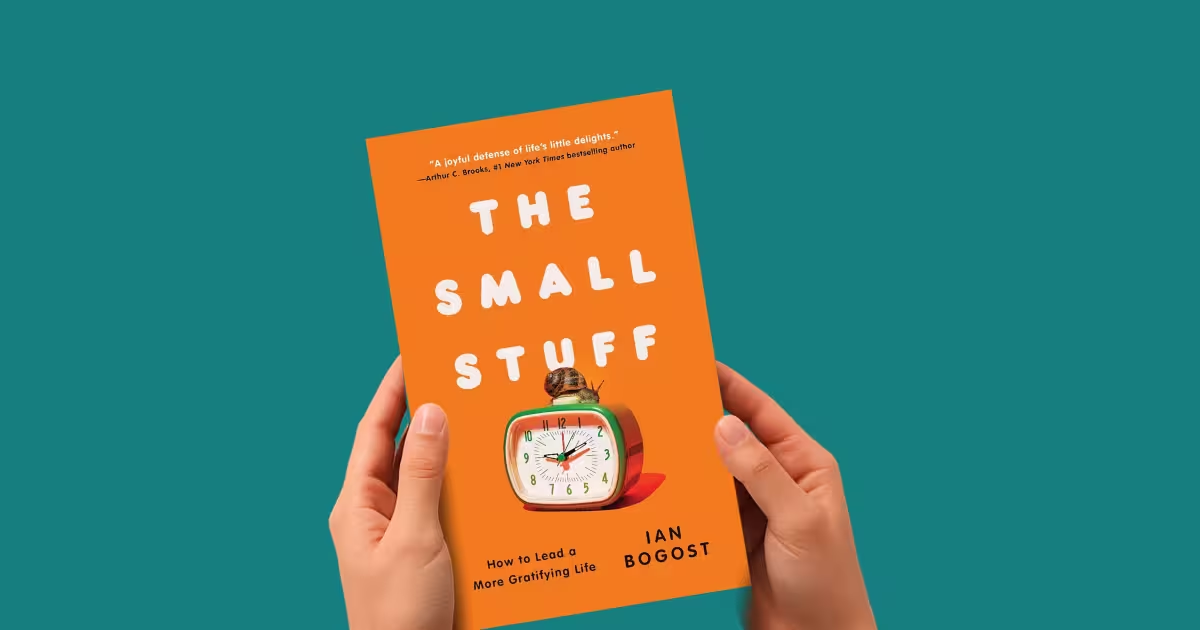
Do you ever feel like you’re doing everything right—career, relationships, goals—yet still feel oddly disconnected from your own life? According to Ian Bogost’s provocative new book, The Small Stuff, the problem isn’t you. It’s that we’ve been sold a lie about where contentment actually comes from. And the solution is simpler—and weirder—than you think.
The Small Stuff: How to Lead a More Gratifying Life (Atria Books, July 7, 2026) is a philosophical yet deeply practical manifesto arguing that our obsessive pursuit of “big” happiness and satisfaction has blinded us to the thousands of tiny sensory pleasures that surround us every day.
Bogost—an Atlantic contributing writer, game designer, and academic—makes a compelling case that modern life has been “dematerialized,” stripping away the tactile encounters that once made daily existence gratifying.
Through engaging anecdotes about everything from masonry paint to Diet Coke cups, he shows that contentment isn’t found in promotions, relationships, or achievements alone—it’s waiting in the shwak-chlupf of a paintbrush, the whisk of a steering wheel through your fingers, or the peel of protective film from a new appliance.
The Small Stuff is funny, sharp, and quietly revolutionary. It doesn’t tell you to abandon your big goals—it just reminds you that life happens in the moments between them.
The Small Stuff is best for anyone who feels vaguely dissatisfied despite having a “good” life. People who miss the tactile world. Those tired of self-help books that demand monumental effort.
Urban professionals, creatives, and knowledge workers who spend too much time on screens. Fans of Oliver Burkeman (Four Thousand Weeks), Matthew Crawford (Shop Class as Soulcraft), or Jenny Odell (How to Do Nothing).
Its not for readers seeking a traditional self-help book with step-by-step formulas. Those who believe happiness is purely a matter of mindset or positive thinking. Anyone allergic to philosophical digressions about door handles and ice machines.
Table of Contents
1. Introduction
The Small Stuff: How to Lead a More Gratifying Life is the eleventh book by Ian Bogost, a contributing writer at The Atlantic and the Barbara and David Thomas Distinguished Professor at Washington University in St. Louis, where he holds appointments in computer science and engineering, film and media studies, and art and design.
Bogost is also an award-winning game designer whose work has been played by millions and held in collections including the Smithsonian American Art Museum. His previous books include Play Anything: The Pleasure of Limits, the Uses of Boredom, and the Secret of Games (2016).
Published on July 7, 2026, by Atria Books (Simon & Schuster), the hardcover edition runs 240 pages.
Context
The Small Stuff arrives at a moment when happiness research has become big business.
The Small Stuff directly challenges the “milkshake model” of happiness popularized by figures like Arthur C. Brooks and Oprah Winfrey, who argue that happiness is composed of enjoyment, satisfaction, and purpose. Bogost doesn’t dismiss these elements—he just thinks they’re incomplete.
As Publishers Weekly notes, Bogost “makes a convincing case for reclaiming ‘the lost joy of everyday interactions’ with the sensory world”. Kirkus Reviews calls it “a timely and engaging analysis of digital life”, while Oliver Burkeman describes it as “humorous, thought-provoking and practical”.
Arthur C. Brooks himself praises it as “a joyful defense of life’s little delights”.
Purpose
The book’s central thesis is deceptively simple: We’ve been looking for contentment in the wrong places. Happiness (big-picture life satisfaction) and satisfaction (pride in accomplishment) require enormous effort.
But gratification—the sensory enchantment of everyday life—is immediate, easy, and always available. The problem is that contemporary culture has systematically “dematerialized” our lives, replacing tactile encounters with digital convenience.
Bogost’s goal is to help readers “see more clearly” the small pleasures they’ve been overlooking and to “appreciate them more deeply” once they do. This isn’t about stopping to smell the roses—it’s about realizing you’re already walking through a garden.
2. Background
The Small Stuff emerges from Bogost’s long-standing interest in how we interact with the physical world. His 2022 Atlantic article on the death of the manual transmission went viral, resonating with millions who felt something essential had been lost. That piece became the seed for The Small Stuff.
Bogost draws on a wide range of intellectual traditions: Aristotle’s distinction between hedonia (pleasure) and eudaimonia (the good life), the psychology of the marshmallow test, the philosophy of technology, and even Buddhist concepts of mindfulness. But he wears his learning lightly, weaving scholarship into vivid, often funny anecdotes.
The Small Stuff is structured in three parts: The Sensory Enchantment of Everyday Life (defining gratification), How You Got Dematerialized (diagnosing the problem), and The Path Back to Gratification (offering solutions). This structure mirrors Bogost’s argument: first understand what you’ve lost, then reclaim it.
3. Book Summary: What I Learned from The Small Stuff
Part One: The Sensory Enchantment of Everyday Life
Bogost opens with a scene that could be from a Seinfeld episode: a mother scolding her son for touching everything in a coffee shop, while she herself unconsciously delights in the ridged surface of her paper cup. This moment encapsulates the book’s central insight: we’re surrounded by sensory pleasures we’ve been trained to ignore.
The Three Types of Contentment
Bogost argues that we’ve lumped together three distinct experiences under the vague label “happiness”:
- Happiness is overarching, big-picture contentment. It’s amorphous and prolonged, requiring time and work to build.
- Satisfaction is the pride in accomplishment. It’s what you feel when you finish a project or achieve a goal.
- Gratification is the sensory enchantment of everyday life. It’s immediate, easy, and always available.
As Bogost puts it: “Happiness is amorphous and abstract, but it is also prolonged, requiring a long time and a lot of work to build or rebuild”. Satisfaction also takes time—Tom’s basement renovation required weeks of effort. But gratification happens right away. “All Tom had to do was apply a brushful of the coating to the wall to feel the delightful sensation, sight, and sound of its application”.
The Problem with the Marshmallow Test
Bogost devotes a chapter to the famous marshmallow test, arguing that it fundamentally misunderstands gratification. The test assumed that delaying gratification is virtuous and that immediate pleasure is suspect. But as Bogost points out, you can’t delay gratification—you can only forgo it.
“Gratification is not the pleasure that you indulge now at the expense of what you might do in the long run, but the pleasure you can encounter only if you do so right as it happens, or else it will pass you by forever”.
He also notes that more recent studies have debunked the marshmallow test’s claims about long-term success. Researchers found “no evidence that long-term success on a set of ‘capital formation’ factors—including education, income, net worth, lack of debt, and forward-looking behavior patterns—could be correlated in any way with the participants’ performance on the marshmallow test”.
The Marshmallow Itself
In a characteristically playful move, Bogost points out that the marshmallow test researchers completely missed the point of marshmallows: “A cloud of spun sugar, weightless, textured like leather but soft like petals. It floats on cocoa. It squishes monstrously”. The least interesting thing about a marshmallow, he suggests, is its suitability for longitudinal studies.
Part Two: How You Got Dematerialized
This section diagnoses the problem. Bogost argues that modern life has systematically stripped away the sensory encounters that once made daily existence gratifying.
The Decline of Sensory Life
The Small Stuff opens with a powerful example: the death of the manual transmission. Bogost’s viral Atlantic article on this topic became the seed for the book. He writes: “The stick shift’s practical benefits—cheaper price, better fuel economy, easier repair—are long gone, lost to the progress of engineering. Years ago, those advantages had become excuses to justify the real benefit of the manual: to deliver a sense of control over the machinery of human invention”.
But the loss goes far beyond cars.
Bogost catalogs dozens of examples: doors that are now too hard to open by hand because of accessibility regulations and fire codes; faucets and towel dispensers that have become automated; the replacement of physical tickets with QR codes; the shift from owning things to leasing or accessing them.
Why You Can’t Open Doors
In one of the book’s most memorable chapters, Bogost watches people struggle with the door to his office building. It’s motorized for accessibility, but the mechanism makes manual opening nearly impossible. “The door hinges and their associated button actuators don’t make life easier for occupants of buildings such as this one,” he writes. “Instead, they took away the opportunity to choose to open the door manually”.
He traces this to a confluence of factors: the Americans with Disabilities Act, fire codes, and the specific hardware choices of building managers. None of these factors alone is responsible, but together they’ve created a world where even opening a door has become a source of frustration rather than satisfaction.
Every Place Is the Same Now
Bogost argues that technology has made every place feel like every other place. You can work from anywhere, watch movies anywhere, shop anywhere—and in doing so, you lose the distinctive character of specific places.
Drawing on French anthropologist Marc Augé’s concept of “non-places,” Bogost observes that airports, hotels, and shopping malls were already anonymous. But now, even homes have become “superspaces” that can be fused with any other place through a screen. “The bathroom is a place to shower or to cast out human waste,” he writes. “Bring your phone in there, and it’s also an office… a theater… a classroom… and a travel agency”.
Adrift in the Data Sea
Bogost also critiques the way data systems have made everyday tasks more frustrating. Search engines no longer tell you when something isn’t available—they show you alternatives you didn’t ask for. Online shopping has become a swamp of sponsored results and third-party sellers. Even finding a bolt at the hardware store has become difficult because inventory systems have replaced the old bins where you could rummage with your hands.
Automated Away
The Small Stuff includes a poignant chapter on the disappearance of hotel ice machines. Bogost recalls going to get ice with his visually impaired father as a child—a simple ritual that offered sensory delight.
When he tried to share this experience with his own daughter, he found that the machine had been replaced by bags of ice in a freezer. “Mourning this modest example of lost gratification felt like an apt way to mourn my father,” he writes, “whose life had surfaced opportunities for gratification so constantly thanks to his disability”.
Part Three: The Path Back to Gratification
The final section offers practical strategies for reclaiming sensory life.
Reclaiming Sensory Life
Bogost acknowledges that dematerialization is here to stay. “The changes to daily life that have already contracted opportunities for gratification at home, at work, and everywhere in between are likely irreversible”. But that doesn’t mean we’re helpless.
The key, he argues, is attention—not effort. “Work is not the key to feeling gratified. Attention is a bit more important”. When Tom and Scarlett gave greater heed to their sensory lives, they became more aware of the gratifying sensations that paintbrushes and steering wheels offered.
Bogost compares gratification to laughter. “When you hear or see a good joke, your reaction is involuntary,” he writes. “The more open you are to letting it happen to you, the more receptive you become to it”.
Heap Wonder on Everything
Bogost draws inspiration from Andy Rooney’s 60 Minutes segments and Seinfeld—both of which found comedy and meaning in ordinary things. He also points to the popularity of videos showing mundane tasks: drain clearing, pressure washing, lawn mowing. Millions of people watch these videos not for information but for the simple pleasure of witnessing the material world in action.
Get a Haircut Every Day
This chapter explores ASMR (autonomous sensory meridian response) videos, which offer a kind of vicarious gratification. Creators like Tera and Gibi ASMR have built careers around folding towels, tapping objects, and simulating personal services.
Bogost observes that ASMR has separated the experience of services—like haircuts or dental exams—from their practical outcomes. “You can’t get your hair cut every day,” one creator tells him. “But you can do it online. You watch an ASMR video, and your hair isn’t actually cut, and you don’t actually get a coffee. But you got the other part of it”.
Talk About Anything
In one of the book’s most delightful chapters, Bogost and a colleague have an extended conversation about the best way to drink Diet Coke. The discussion ranges from packaging (plastic bottles are worst, cans are better, fountain drinks are best) to the physics of carbonation to the psychology of memory.
Bogost consults a food scientist who explains that flavor perception is “multimodal”—it involves not just taste but also sound, touch, and context. The scientist concludes: “If you like something because it brings you pleasure, then enjoy it. Use the kind of conversation we are having to enjoy it more deeply”.
Keep Some Junk Around
This chapter makes a case for physical mementos—ticket stubs, business cards, even junk. Bogost contrasts the tactile satisfaction of handling a physical ticket with the emptiness of a digital QR code. He also shares a personal memory of his father’s business cards, which had raised thermographic printing that he would run his fingers over as a child.
Live Your Life Sideways
Bogost introduces the concept of orthogonality—finding activities that complement, rather than replicate, your daily life. If you work at a computer all day, a tactile hobby like knitting or woodworking offers contrast. If your job is social, solitary activities can be restorative.
He profiles Alanna Okun, a writer who found knitting offered a “place for me” away from the chaos of digital media. She later realized that coding offered a similar gratification—each line of code felt like a stitch. Chris, a professor, finds fly-fishing gratifying because it allows him to “have no voices in my head”.
Spend Your Day in Its Moments
The final chapter profiles Dan, a tile setter who finds deep gratification in his work. Unlike knowledge workers who can’t see the results of their labor, Dan sees his work immediately. But more importantly, he finds the moment-to-moment process gratifying: “It’s a better feeling overall,” he says of his careful prep work.
Bogost contrasts Dan’s experience with that of office workers who “move symbols around on computer screens” all day. He suggests that even knowledge workers can find gratification by paying attention to the sensory aspects of their work—the click of a mechanical keyboard, the feel of chalk on a blackboard.
4. Analysis: My Commentary on The Small Stuff
The Small Stuff is a quietly revolutionary book—not because it tells you anything you don’t already know, but because it gives you permission to take seriously what you’ve been trained to ignore.
Bogost’s central insight is both obvious and profound: we’ve been looking for happiness in all the wrong places. We chase promotions, relationships, and achievements while ignoring the thousands of small sensory pleasures that are already available to us. As he writes, “You may live for the big stuff—your family, your career, your community, your goals.
These are the accomplishments that make your life meaningful. But those big deeds don’t tell the whole story, either”.
The book’s greatest strength is its specificity. Bogost doesn’t just tell you to “stop and smell the roses”—he shows you how a coffee cup’s ridges, a paintbrush’s squelch, or a steering wheel’s stitching can offer genuine delight. His examples are vivid and memorable: the shwak-chlupf of masonry paint, the tinkle of ice against glass, the whoosh of a towel being folded.
Bogost is also bracingly honest about the limits of his argument. He acknowledges that dematerialization is irreversible and that systemic problems like income inequality and housing affordability won’t be solved by paying more attention to door handles. But he argues that small changes can still make a difference: “A little every day will add up”.
The book’s humor is another strength. Bogost’s playful tone—he describes himself as “dadding out pretty hard” on the subject of doorbells—makes the philosophical material accessible. He’s not asking you to become a monk; he’s inviting you to join him in finding joy in the absurdity of ordinary life.
However, the book has limitations. The diagnosis of dematerialization is more compelling than the prescription for re-enchantment. Bogost offers many examples of gratification but fewer strategies for cultivating it systematically. The book occasionally reads like a collection of Atlantic articles rather than a unified argument.
Additionally, the book’s audience is somewhat narrow. It’s written for the educated, relatively privileged reader who has the luxury of worrying about sensory gratification.
Bogost acknowledges this implicitly—he notes that service workers and tradespeople don’t have the option of debating hybrid work arrangements—but he doesn’t fully address how his advice applies to people with less control over their lives.
Nevertheless, The Small Stuff is an important book. It offers a much-needed corrective to the happiness industry’s obsession with big goals and abstract purpose. As Oliver Burkeman writes, it’s “a manifesto for re-enchanting us with the world, by observing and enjoying the small moments that make up our lives”.
5. Strengths and Weaknesses
Strengths
Vivid, Memorable Examples: Bogost’s anecdotes—the shwak-chlupf of paint, the whisk of a steering wheel, the peel of protective film—stay with you long after you’ve finished the book.
Clear Conceptual Framework: The distinction between happiness, satisfaction, and gratification is both intuitive and useful.
Playful, Accessible Tone: Bogost writes with wit and warmth, making philosophical ideas feel approachable.
Intellectual Rigor: The Small Stuff draws on psychology, philosophy, and design theory without being pedantic.
Timely and Relevant: In an age of screens and AI, the call to reconnect with the physical world feels urgent.
Weaknesses
Limited Prescriptive Guidance: The book offers more diagnosis than practical advice. Readers looking for step-by-step strategies may feel frustrated.
Narrow Audience: The book assumes a level of privilege and leisure that not all readers possess.
Occasional Repetition: Some examples and arguments recur across chapters, giving the book a slightly episodic feel.
Underdeveloped Social Critique: Bogost acknowledges systemic issues like income inequality and housing affordability but doesn’t fully integrate them into his argument.
6. Comparison with Similar Works
The Small Stuff shares DNA with several recent books:
Oliver Burkeman’s Four Thousand Weeks (2021): Both books argue that our obsession with efficiency and productivity is making us miserable. Burkeman focuses on time; Bogost focuses on sensory experience.
Matthew Crawford’s Shop Class as Soulcraft (2009) and Why We Drive (2020): Crawford argues that manual work and skilled engagement with the physical world offer meaning that knowledge work cannot. Bogost shares this concern but applies it more broadly to everyday life.
Jenny Odell’s How to Do Nothing (2019): Odell critiques the attention economy and argues for reclaiming our capacity for idle attention. Bogost focuses more on sensory engagement than on attention per se.
Arthur C. Brooks and Oprah Winfrey’s Build the Life You Want (2023): Bogost explicitly challenges Brooks and Winfrey’s model of happiness, arguing that they’ve overlooked the importance of small, immediate pleasures.
What distinguishes Bogost’s book is its focus on the physical world. While other authors discuss attention, meaning, or purpose, Bogost insists on the primacy of sensory experience. As he writes, “We do not live in our hearts and heads alone. We do not live only among people—or even solely among living creatures”.
7. Conclusion: Who Should Read This Book?
The Small Stuff is for anyone who has ever felt that life should feel more real than it does. It’s for people who are tired of self-help books that demand monumental effort and offer abstract rewards. It’s for those who miss the physical world—the feel of a ticket stub, the sound of a manual transmission, the sight of a perfectly folded towel.
The Small Stuff is particularly valuable for knowledge workers who spend their days staring at screens. Bogost’s argument that we’ve been “dematerialized” will resonate with anyone who feels disconnected from the physical world.
But it’s also for anyone who wants to find more joy in ordinary life—not by adding more activities, but by paying more attention to the ones they’re already doing.
As Bogost writes in his conclusion: “The world doesn’t await our proof of its existence. We demonstrate its existence through our aptitude in doing things in it”. The Small Stuff doesn’t ask you to change your life—it asks you to notice the life you’re already living.
Recommendation: Read this book if you’re ready to stop chasing happiness and start finding it in the shwak-chlupf of everyday life.







