
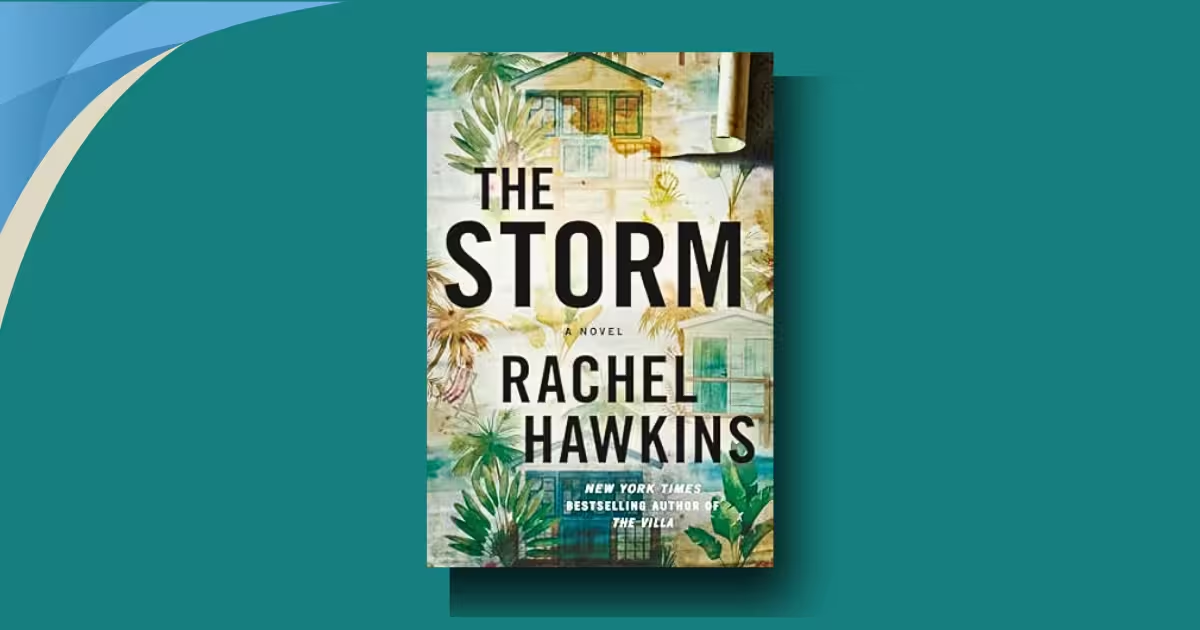
Ever wonder why the most beautiful places on earth often hide the ugliest secrets? Or how a storm can wash away a town but leave the skeletons in its closets perfectly intact? The Storm by Rachel Hawkins explores such querries brilliantly.
The Storm is a story about a struggling innkeeper in a hurricane-cursed Alabama town discovers her family’s dark connection to a 40-year-old political murder when the accused killer returns to write a memoir, unleashing a fresh tempest of lies, betrayal, and deadly revelations.
The Storm is best for fans of atmospheric Southern Gothics, dual-timeline mysteries, and complex female anti-heroes who do bad things for good reasons (think Sharp Objects meets Big Little Lies). Not for: Readers who prefer linear storytelling, dislike ambiguous endings, or get easily frustrated by characters who make consistently reckless decisions during natural disasters.
Table of Contents
1. Introduction
Published on January 6, 2026, The Storm is a thriller novel by American writer Rachel Hawkins
In The Storm, New York Times bestselling author Rachel Hawkins delivers a thunderous, atmospheric thriller that rips the roof off the Southern Gothic genre.
Set against the sweltering backdrop of St. Medard’s Bay, Alabama—a fictional town known as a “little jewel on Alabama’s Gulf Coast”—the novel explores the destructive power of nature and the even more devastating force of buried secrets.
Hawkins, known for her sharp wit and twists in books like The Wife Upstairs and The Villa, returns with a narrative that feels as heavy and charged as the air before a hurricane.
2. Background
The story is deeply rooted in the specific, humid dread of the American South’s hurricane season. St. Medard’s Bay is a place where time is marked not by years, but by disasters: Hurricane Delphine in 1965, Audrey in 1977, Velma in 1980, and the infamous Marie in 1984.
The setting is more than just a backdrop; it’s a character. The locals have an “uneasy truce with Mother Nature”, living with a constant, low-level dread that “makes you wait” and “plays with you”.
Historically, the novel draws on the trope of the “dead girl” or “dead boy” scandal that haunts a small town forever—reminiscent of real-life cases like Natalee Holloway, but flipped on its head.
Here, the victim is a powerful man, Landon Fitzroy, the son of an Alabama governor, and the accused is Lo Bailey, a local “teenage mistress”.
The book satirizes and utilizes the modern obsession with true crime, referencing podcasts and the “fire hose of content” that turns tragedy into entertainment.
3. The Storm summary
The Present: The Return of the Witch
The story opens in 2025 with Geneva Corliss, the weary, forty-year-old owner of the Rosalie Inn. The Rosalie is a pink, gingerbread-trimmed survivor, the “only beachfront building to survive the wind and waves for decades”.
Geneva is drowning in debt and taking care of her mother, Ellen, who suffers from early-onset Alzheimer’s. Her life is a cycle of “maxed-out credit cards” and broken air conditioners until a lifeline appears in her inbox: August Fletcher, a true-crime writer, wants to rent a room for a month to write a book about the town’s infamous 1984 murder scandal.
August doesn’t come alone. He brings the subject of his book: Gloria “Lo” Bailey. Now sixty but still possessing a “freak of nature” beauty, Lo is the woman accused (but never convicted) of murdering Landon Fitzroy during Hurricane Marie. Geneva is shocked to learn that Lo and her mother, Ellen, were once best friends, a fact her mother never mentioned.
Lo is charismatic, manipulative, and seemingly unbothered by her notoriety, joking that “if annnnyooooonnnne is gonna get paid off MY LIFE, it oughta be me”.
As August interviews Geneva and digs into the town’s history, the tension rises with the temperature. Geneva discovers that her trusted employee and friend, Edie, is actually Frieda Mason—the third member of Lo and Ellen’s childhood trio, who changed her identity after her family died in a storm caused, indirectly, by Lo’s reckless plans. Edie hates Lo, convinced she is a “murderous whore”.
The Past: The Witches of St. Medard’s Bay
Through flashbacks and manuscript excerpts, we learn the truth about the summer of 1984. Lo, Ellen, and Frieda called themselves the “Witches of St. Medard’s Bay”, believing they could control the weather.
But their magic was no match for Landon Fitzroy. Landon was the golden boy of Alabama politics, married to a beauty queen but obsessed with Lo. He was also secretly seducing Ellen.
While Lo was the public mistress, Ellen was the secret love. Landon, manipulative and entitled, wanted everything: the political career, the wife, the mistress, and the “good girl” friend. He tells Ellen that “this baby is a Fitzroy” when she reveals she is pregnant, planning to hide her away and then adopt his own child with his wife.
The Twist: The Murder
The night Hurricane Marie hits, all three women converge on the inn. Ellen tries to break things off with Landon, but he becomes violent, screaming that she is “nothing”. Lo intervenes, and a fight ensues. In a desperate move to save Lo from Landon’s rage, Ellen grabs a heavy, rusty anchor and strikes Landon in the head.
It wasn’t Lo who struck the first blow—it was Ellen. But they finished it together. Lo, seeing what her friend had done, helps Ellen drag Landon’s body to the beach to make it look like a storm casualty.
Edie (Frieda), watching from the shadows, sees it all. She later tries to move the body further into the water to protect her friends but flees in terror. The three women, bound by this secret, drift apart: Ellen raises her daughter (Geneva) alone, letting everyone believe her husband is the father; Lo takes the fall in the press but is acquitted; and Frieda disappears into Edie.
The Climax: Hurricane Lizzie (2025)
Back in the present, August discovers the truth: Geneva is Landon Fitzroy’s daughter. This revelation breaks him. He reveals that he is also Landon’s child, the product of another affair, making him and Geneva half-siblings. August is not just a writer; he is a man obsessed with the father he never knew and filled with rage at the woman (Lo) he believes robbed him of a “dynasty.”
As Hurricane Lizzie slams into the inn, August confronts Lo, blaming her for ruining his life. He attacks her, shattering a window and trying to push her out. Geneva, seeing August hurt Lo, grabs a hammer and strikes August in the back—echoing her mother’s action forty years prior.
August falls backward onto a shard of glass, which slices his throat, killing him instantly. The storm rips the roof off the Rosalie, leaving the survivors exposed.
The Aftermath
In the end, history repeats itself. The death of August is ruled a “freak accident” caused by the storm. Lo protects Geneva, just as she protected Ellen. The Rosalie Inn is rebuilt, battered but standing. Edie returns to live at the inn with Geneva.
The three women—Geneva, Lo, and Edie—form a new coven of sorts, bound by blood and secrets. Geneva finally understands that her mother wasn’t just a quiet innkeeper, but a woman capable of fierce, deadly protection. As Lo says, “We’ll make a witch of you yet”.
4. The Storm Analysis
4.1. The Storm Characters
Gloria “Lo” Bailey: Lo is the gravitational center of this novel, a character who refuses to be crushed by the weight of public opinion. Initially presented as the “Teenage Temptress” or “Scarlet Woman” , she is actually the story’s fierce protector.
She isn’t the villain; she is the shield. Her complexity lies in her loyalty; she takes the fall for a murder she didn’t commit to protect Ellen and her unborn child. She is a woman who realized early on that “you have to value honesty over everything else”, yet she lives a life defined by a massive lie. Her return isn’t about fame; it’s about closure and protecting the next generation (Geneva).
Geneva Corliss: Geneva starts as a woman “drowning in debt”, defined by her obligations to the Rosalie Inn and her sick mother. Her arc is one of awakening—realizing that the “boring” mother she thought she knew was actually a woman capable of lethal force. Geneva mirrors her mother’s strength when she kills August to save Lo.
She transitions from a passive victim of circumstance to an active participant in the town’s dark legacy, accepting that “I know the truth now, and she’s ready to be free from it. I know I fucking am”.
August Fletcher: August is the tragic mirror to his father, Landon. Driven by a sense of stolen “destiny”, he becomes the very monster he sought to expose. His motivation is heartbreakingly human—he just wanted a father—but his entitlement turns deadly. He believes “We could’ve been a family, but she took that from us”, revealing how grief can curdle into obsession.
Landon Fitzroy: Though dead for forty years, Landon haunts every page. He represents unchecked male privilege. He treats people like “toys” , believing his desires override everyone else’s reality. His declaration that “I’m a Fitzroy, and any child of mine is going to be one” triggers his own demise. He is the storm that destroys the women around him until they finally fight back.
4.2. The Storm Themes and Symbolism
The Storm as a Cleansing Force: The hurricanes (Delphine, Marie, Lizzie) are not just weather events; they are narrative devices that force secrets to the surface. As Mrs. Bailey notes, storms are “evil” because they “kill you with the things you love” .
However, the book flips this: the storm also provides cover. It hides the murder of Landon and later the death of August . It symbolizes the chaotic, uncontrollable nature of truth.
The “Witches” and Female Solidarity: The concept of the “Witches of St. Medard’s Bay” starts as a childhood game but evolves into a powerful symbol of female agency.
In a world run by men like Beau and Landon Fitzroy, these women create their own power. The ending, with Lo, Geneva, and Edie sitting together, reinforces that their loyalty to one another is stronger than any hurricane. They are a coven bound not by magic, but by shared trauma and survival .
The Rosalie Inn: The pink hotel is a symbol of resilience. It is “the only beachfront building to survive” , much like the women who inhabit it. It absorbs the violence (Landon’s blood seeping into the boards) and keeps standing, a testament to the idea that you can be battered and broken but still endure.
The Anchor and the Hammer: The anchor used to kill Landon represents the heavy, rusty weight of the past that drags the characters down. Geneva using a hammer to stop August parallels this, showing how the cycle of violence repeats itself—daughters doing what their mothers did to survive.
5. Evaluation
Strengths:
Hawkins excels at creating a suffocating, humid atmosphere. You can practically feel the “sweaty fist smacking into the sand” . The structure—alternating between Geneva’s perspective, podcast transcripts, and magazine articles—keeps the pacing brisk and peels back the layers of the mystery effectively.
The twist regarding Geneva’s parentage is genuinely shocking yet perfectly seeded with clues like the senior portrait . The character of Lo is a triumph; she is charismatic, flawed, and utterly compelling.
Weaknesses:
Some readers might find the coincidence of August also being Landon’s secret child a step too far into soap opera territory. It relies heavily on the “small world” trope. Additionally, the climax happens incredibly fast—August’s death and the roof ripping off occur in a blur, which, while realistic to the chaos of a storm, might leave some readers wanting a more drawn-out confrontation.
Impact:
This book resonated with me as a study of how history is written by the survivors. It challenges the “Perfect Victim” narrative. Lo wasn’t a perfect victim, nor was Ellen. They were messy, complicated women who made a brutal choice. It forces you to ask: What would I do to save my best friend?
Comparisons
Similar Works: It feels like the rebellious younger sister of Big Little Lies (Liane Moriarty) mixed with the atmospheric dread of Sharp Objects (Gillian Flynn). It also shares DNA with The Guest List (Lucy Foley) regarding a violent event during a storm.
6. Personal Insight
The Storm is a biting critique of the True Crime industrial complex. We see August Fletcher mining real human tragedy for “content,” turning Lo’s life into a “narrative”. It mirrors our current reality where TikTok sleuths and podcasters treat murder investigations like interactive games.
The book reminds us that behind every “juicy” headline is a human being bleeding out on a floor. It serves as a grim educational lesson on the ethics of storytelling: who owns a tragedy? The person who lived it, or the person who writes it down?
7. The Storm quotes
- “Natural disasters are like that, claiming lives in the aftermath, one final jump scare. A monster that never really dies.”
- “Hurricanes turn all that into the thing that blows off your roof… Killing you with the things you love? Tell me that don’t feel evil.”
- “We’ll make a witch of you yet, Ellen Chambers’s Little Girl.”
- “If you want ‘mature’ women, Landon, maybe don’t fuck nineteen-year-olds.”
- “I’m not a murderer, not a slut… But I found out the hard way that once people have an idea of you, they won’t let it go.”
8. Conclusion
The Storm is a masterclass in Southern Noir. It grabs you with the promise of a murder mystery but keeps you with its exploration of female rage and resilience. It is not just a whodunit; it is a “whydunit” that spans generations.
I highly recommend this to fans of Reese’s Book Club picks, psychological thrillers, and anyone who loves a story where the setting is as dangerous as the villain. If you enjoyed Where the Crawdads Sing but wished it had more edge and less nature poetry, this is for you.
This book is significant because it refuses to apologize for its female characters. They are messy, violent, and secretive, but they survive. And sometimes, survival is the only victory that matters.







