

Last updated on October 7th, 2026 at 01:10 pm
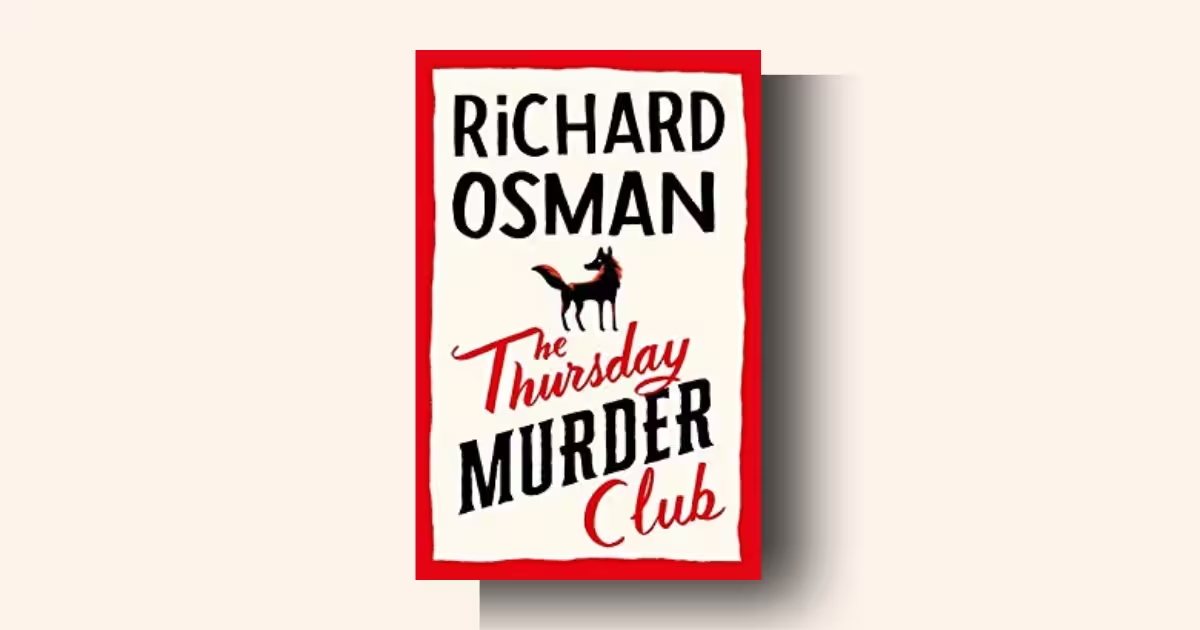
My The Thursday Murder Club review is ultimately less about asking whether Richard Osman has written a clever murder mystery and more about asking why four people approaching the end of life are so determined to keep living as if the story is only beginning.
Published in 2020, Osman’s debut novel places Elizabeth, Joyce, Ibrahim and Ron in Coopers Chase, a fictional luxury retirement village in Kent. They meet every Thursday to investigate old murder cases until a real murder brings their hobby dangerously close to home. The novel combines cosy crime, black humour, friendship, grief and questions about ageing.
For me, the most successful idea is not the central whodunit. It is Osman’s refusal to treat old age as narrative retirement. His characters have memories, professional skills, desires, prejudices, secrets, regrets and unfinished business. They are not waiting quietly for the end.
The Thursday Murder Club eventually reveals that Bogdan kills Tony Curran, while John Gray kills Ian Ventham to protect Penny’s secret. Decades earlier, Penny had killed Peter Mercer after discovering that he murdered Annie Madeley in 1973. The three murders therefore form a chain driven by justice, guilt and love rather than simple greed.
My verdict: a warm, funny and surprisingly sad crime novel whose real subject is not murder but what people do when they realise that time is running out.
Table of Contents
1. Introduction
Richard Osman’s The Thursday Murder Club was first published in Great Britain by Viking in 2020, with the US edition following in the same year. The edition I read identifies it as Osman’s debut novel and records its 2020 copyright and publication history.
Osman was already a familiar British television personality through programmes including Pointless, but the success of this novel established a second identity for him as a crime novelist. Penguin currently describes the series as a record-breaking, multi-million-copy bestseller, while the first book remains the starting point for the four original sleuths.
What interested me immediately was the setting. Instead of putting four young detectives in London, Osman puts four elderly amateur investigators in a retirement village. That single decision changes the atmosphere of the traditional mystery.
The characters already know something most fictional detectives spend their entire careers avoiding: they are getting older.
And that makes every investigation feel slightly different.
2. Background
The idea apparently came to Osman after visiting a real retirement community. He has explained that he looked around and thought it would be an unusually good setting for a murder, because the residents had interesting lives and enough experience to solve a crime.
That real-world observation becomes Coopers Chase.
The fictional village occupies the grounds of a former convent and contains roughly 300 residents. The site includes a nursing home, restaurant, swimming facilities, recreational rooms and, most importantly, the Jigsaw Room where the Thursday Murder Club meets.
There is also a dark irony in the setting. Coopers Chase is supposed to represent comfort in later life, yet the land is threatened by redevelopment. Ian Ventham wants to expand the property, including building over the cemetery. The residents therefore have to defend not only their homes but their memories.
That becomes important later.
The novel was also a remarkable commercial success. In December 2020, The Guardian reported that it became the first debut novel to reach Christmas No. 1 in the UK, selling 134,514 copies in a single week according to Nielsen BookScan.
The commercial success makes sense to me after reading it. Osman found a combination that is difficult to resist: a murder puzzle, four memorable personalities, British humour and just enough emotional darkness to stop the story becoming weightless.
3. The Thursday Murder Club Review Summary
The retirement village and the four investigators
The story begins by introducing Joyce Meadowcroft, a retired nurse who lives at Coopers Chase.
Joyce is apparently the least threatening member of the group. That is precisely why she works so well.
The other members are Elizabeth, Ibrahim Arif and Ron Ritchie.
Elizabeth is the group’s natural leader. She is mysterious, confident and clearly much more experienced with investigations than she initially admits.
Ibrahim is a retired psychiatrist whose analytical mind gives the group a different kind of intelligence.
Ron is a former trade-union firebrand. He is argumentative, politically opinionated and incapable of resisting a fight.
Joyce, meanwhile, writes a diary. Her apparently ordinary observations gradually become one of the novel’s most effective narrative devices.
The club originally grew from the friendship between Elizabeth and Penny Gray, a former Kent police inspector. Penny supplied old unsolved murder files, and the group examined them for mistakes the police might have missed.
Penny is now seriously ill in the nursing home, which gives the club a melancholy foundation.
The four members may joke about murder, but the cases remind them that some victims never received justice.
That matters enormously to the plot.
Ian Ventham enters the picture
Coopers Chase is threatened by Ian Ventham, a property developer who wants further development on the site.
Ventham is ambitious, wealthy and deeply unpleasant. His business partner is Tony Curran, a violent builder with his own criminal history.
The residents oppose the development because it involves destroying woodland and disturbing the Garden of Eternal Rest.
Ron naturally becomes one of the loudest opponents.
The meeting establishes an important contrast between the older residents and the men controlling the development. Ventham sees land as an asset. The residents see it as memory.
I found this one of the book’s quieter strengths. The property dispute is not just background decoration. It eventually becomes part of the murder mystery itself.
Tony Curran is murdered
Tony Curran is found murdered.
The police investigation begins, but the Thursday Murder Club is already several steps ahead.
The four friends have no official authority, yet they have something else: time, curiosity, professional experience and a willingness to ask questions that the police cannot always ask.
The group initially suspects Ian Ventham.
There is good reason for this. Ventham has a motive, an opportunity and a difficult relationship with Curran. For a while, the evidence seems to point toward him.
But Osman deliberately keeps shifting the ground beneath the reader. Jason Ritchie, Ron’s famous former-boxer son, becomes another suspect. His history with Curran and his connections to organised crime make him look dangerous.
A photograph also becomes important. It connects Jason to Curran and Bobby Tanner, a figure from the darker criminal past of Fairhaven.
The police, particularly Donna De Freitas and Chris Hudson, gradually become more involved.
Donna is especially important because she starts as a relatively inexperienced officer who wants to prove herself. Her relationship with the Thursday Murder Club becomes increasingly complicated because she is supposed to investigate them while also appreciating their help.
Ian Ventham is murdered
Then the story changes completely.
Ian Ventham dies suddenly during the confrontation surrounding the development.
At first, it looks like a heart attack.
It is not.
The cause is fentanyl poisoning, administered shortly before his death. The discovery immediately means that someone present at Coopers Chase could be the murderer.
The investigators calculate the number of people who were present. Ibrahim eventually narrows the enormous crowd down to thirty possible suspects.
This is classic Osman: the murder is serious, but the investigation is frequently funny.
The residents are not conventional detectives. They argue, gossip, eat biscuits and complain about each other’s methods.
Yet they are surprisingly good at detecting inconsistencies.
The investigation becomes personal
Elizabeth begins to suspect that Father Matthew Mackie may know more than he admits.
There are questions surrounding the cemetery and the development.
The Thursday Murder Club also investigates the history of Coopers Chase and discovers that the present-day murders may connect to events from decades earlier.
Meanwhile, Bernard Cottle, another resident, becomes increasingly important to Joyce.
Bernard eventually dies by suicide.
This is one of the moments when I felt Osman deliberately punctured the cosy-mystery atmosphere.
The book can be funny for several pages and then suddenly remind us that these characters live among illness, bereavement and death.
Joyce’s reaction is particularly painful because she has developed an emotional connection with Bernard.
His death also reinforces the central point of the novel: at Coopers Chase, death is not an abstract mystery. It is part of everyday life.
The bones in the cemetery
The investigation eventually uncovers human remains connected with an old murder.
The discovery changes the direction of the case.
The club begins investigating who could have been involved in a murder nearly fifty years earlier.
The name Annie Madeley becomes central.
In 1973, Annie was supposedly killed during a burglary. The official story was that an intruder surprised her, stabbed her and escaped.
But the story never made sense to Penny.
The wound, the timing and the boyfriend’s account did not fit.
Joyce’s medical knowledge becomes particularly important here. She had previously told Elizabeth that an unattended victim with such a wound could take roughly forty-five minutes to die, while someone with appropriate medical assistance could potentially have survived.
The boyfriend, Peter Mercer, had military experience.
That detail changes everything.
The truth about Peter Mercer
Elizabeth eventually discovers why Peter Mercer had been invalided out of the army.
He had suffered a gunshot wound to the leg.
That means the old story is not merely suspicious. It is deeply compromised.
Peter had been the person responsible for Annie’s death.
Penny knew.
The official investigation failed to bring him to justice.
Peter disappeared.
And Penny eventually found him.
She killed him.
Elizabeth’s discovery is devastating because Penny was not simply a former police officer with a secret. She had personally taken revenge after the justice system failed Annie.
This is where the novel’s morality becomes much more interesting.
Penny committed murder.
But Osman refuses to make the answer simple. Peter had murdered Annie. Penny had killed Peter. And John Gray, Penny’s husband, had helped conceal what happened.
The question is therefore not simply, “Who is the murderer?”
It becomes, “What do we call justice when the legal system fails?”
Who killed Tony Curran?
The answer is Bogdan.
Bogdan has appeared throughout the novel as a useful, apparently harmless builder.
That is exactly what makes the reveal effective.
His motive is connected to Tony’s past criminal activities. Tony had been involved in the shooting of a young boy, and Bogdan’s friend had been caught up in that history.
Bogdan eventually admits to Stephen that he killed Tony.
What I like about this reveal is that Osman does not turn Bogdan into a conventional supervillain.
He is a man carrying an old grievance.
The murder is revenge.
That makes the crime morally uncomfortable rather than simply shocking.
Who killed Ian Ventham?
John Gray killed Ian Ventham.
The reason is Penny.
Penny’s dementia had caused old memories to return. Eventually John understood what she had done to Peter Mercer.
He then realised that Penny’s secret was at risk.
John killed Ventham with fentanyl.
The action is an extension of his devotion to Penny.
In other words, one murder leads to another:
Peter Mercer murdered Annie Madeley.
Penny killed Peter Mercer.
John killed Ian Ventham.
Joyce eventually summarises this chain in her diary.
That is the central moral architecture of the novel.
Penny and John
The final revelations are heartbreaking.
Penny is dying, and John knows that he cannot continue without her.
He has spent years protecting her.
Elizabeth confronts the truth, but she also understands the depth of their relationship.
John ultimately chooses to die with Penny.
The ending is therefore not a conventional victory for the police.
There is no neat courtroom conclusion.
There is instead an old married couple reaching the end of their lives together.
Elizabeth understands what has happened.
And she lets them have their final private moment.
Elizabeth and Stephen
Elizabeth’s husband Stephen has dementia.
This storyline is easy to underestimate because Osman surrounds it with jokes and murder investigations.
For me, it is actually one of the emotional centres of the book.
Elizabeth is watching the man she loves gradually disappear while his body remains beside her.
At the end, after everything that has happened, Elizabeth thinks about Penny and John and then about Stephen.
She briefly reaches for Stephen’s medication before stopping herself.
That moment matters.
Elizabeth has spent the entire book solving other people’s problems, but there is one problem she cannot solve: mortality.
Joyce and the future of Coopers Chase
The final surprise concerns Joanna, Joyce’s daughter.
Earlier, Joyce and Elizabeth had examined Ian Ventham’s financial records and passed them to Joanna.
Joanna and her colleagues eventually become interested in the business.
After Ventham’s death, Joanna’s company buys Coopers Chase.
The reason is partly financial, but there is also a deeply personal motive.
Joanna realises that Coopers Chase gave her mother a new life after the death of Gerry.
So she buys the development partly as a thank-you.
Most importantly, the cemetery will remain protected and the Woodlands development is abandoned.
That is a lovely ending because Joyce’s new life has changed not only herself but the physical place where she lives.
4. The Thursday Murder Club Analysis
4.1 Characters
Elizabeth
Elizabeth is the most mysterious member of the club.
She knows how investigations work and understands people better than most of the characters realise.
What I find particularly interesting is that her greatest strength is also her weakness. She is exceptionally good at hiding things.
That makes her relationship with Penny complicated.
She wants truth, but she also understands why people sometimes hide it.
Elizabeth is therefore not simply a detective figure. She is the novel’s moral judge.
Joyce
Joyce is my favourite character.
Her apparent ordinariness is precisely what makes her effective.
She is a retired nurse, a widow and a mother. She often underestimates herself because everyone else appears more impressive.
Yet she notices people.
She remembers details.
She understands illness.
She also understands emotion.
The novel repeatedly demonstrates that being overlooked can be an advantage.
Joyce herself recognises this when she reflects that her special skill may be being underestimated.
That idea gives the novel one of its strongest messages.
Ibrahim
Ibrahim brings psychology and structure to the group.
His previous career means he understands behaviour, although Osman also uses him for some of the book’s funniest conversations.
He is perhaps the least immediately emotional of the four, but his friendship with the others becomes increasingly important.
Ron
Ron is loud, political and occasionally exhausting.
I would probably find him difficult in real life.
Yet he is also one of the most generous people in the novel.
The book makes a point of showing that his public identity as an argumentative activist is only one part of him.
He protects people who need help.
His anger is often rooted in loyalty.
Penny and John
Penny and John give the novel its tragic heart.
Their relationship asks a difficult question: how far should love go when the person you love has done something morally wrong?
Penny killed a murderer.
John protected Penny.
Neither decision is legally clean.
Yet Osman writes them as human beings rather than moral symbols.
That is why their ending hurts.
4.2 The Thursday Murder Club Themes and Symbolism
Ageing
The obvious theme is ageing, but I think the novel does something more interesting than simply saying “older people can be useful too.”
It asks what happens when society begins treating someone as though their important years are already behind them.
Coopers Chase is full of people who have already achieved something.
But they are still curious.
They still argue.
They still fall in love.
They still commit crimes.
They still want to be heard.
That matters in the real world because population ageing is not a minor demographic issue. The WHO reports that the number of people aged 60 and over is projected to rise from 1.1 billion in 2023 to 1.4 billion by 2030 and 2.1 billion by 2050.
Osman’s central idea is therefore more relevant than it may first appear.
Memory
Memory is everywhere in the novel.
Joyce writes memories down.
Penny’s dementia brings memories back.
Elizabeth remembers her past.
Ron remembers his political life.
Stephen loses pieces of his memory.
The cemetery literally contains buried memories.
The novel repeatedly asks what remains of a person when memory becomes unreliable.
Justice versus revenge
This is the book’s strongest moral theme.
Peter Mercer escapes justice.
Penny takes justice into her own hands.
Bogdan takes revenge for an old crime.
John kills to protect Penny.
The police investigate, but the final answers do not fit neatly inside the law.
Osman does not tell me that revenge is right.
Instead, he makes me understand why someone might believe it is right.
That distinction is important.
Friendship
The Thursday Murder Club begins as a pastime.
It becomes a family.
The characters do not have to be similar.
They simply have to care about each other.
That is perhaps the most emotionally persuasive part of the book.
5. My Evaluation of The Thursday Murder Club
For me, The Thursday Murder Club is a genuinely charming crime novel with more sadness underneath it than its jokes initially suggest. I would not call it a perfect mystery, but I would call it an unusually humane one.
What works
The characters are the major strength.
Joyce’s voice is especially effective, while Elizabeth provides the mystery, Ron supplies the political fire and Ibrahim provides analytical balance.
The setting is also excellent.
Coopers Chase could easily have been a gimmick, but Osman makes it feel like a real community.
The plotting is ambitious too. The novel connects several crimes across decades without losing the central quartet.
Most importantly, the humour rarely exists only for the sake of a joke. It often tells us something about the character making the joke.
What did not work as well for me
The novel has a lot of characters.
At times, I had to stop and remind myself who some secondary figures were and how they connected to the larger mystery.
The multiple investigations can also make the middle section feel busier than necessary.
In addition, some of the cosy tone occasionally clashes with the seriousness of the crimes.
That is partly the point, but it will not work equally well for every reader.
The Guardian similarly praised the originality of the setting and the distinctive central characters while noting that Ibrahim felt less developed than Elizabeth, Ron and Joyce.
My overall reaction
What stayed with me was not the identity of the killer.
It was the idea that the four protagonists refuse to behave like people whose lives are finished.
They are old.
They know they are old.
But they do not accept that this means they should become passive.
That is why the book works.
6. Comparison With Similar Works
The obvious comparison is Agatha Christie.
The connection is deliberate in spirit: a group of people with time, intelligence and secrets investigate a murder while the official investigators struggle to catch up.
But Osman is much more interested in ageing and friendship than Christie generally is.
I would also compare it with Only Murders in the Building, although the tone and medium are different. Both stories turn amateur enthusiasm for murder mysteries into an actual investigation.
The difference is that Osman makes mortality central to the premise.
The residents of Coopers Chase are not simply playing detectives.
They are investigating death while living very close to it themselves.
That gives the story a melancholy edge that many cosy mysteries do not have.
7. The 2025 Netflix Adaptation
The film adaptation arrived on Netflix on August 28, 2025, directed by Chris Columbus and starring Helen Mirren as Elizabeth, Pierce Brosnan as Ron, Ben Kingsley as Ibrahim and Celia Imrie as Joyce.
The cast is almost absurdly prestigious.
And that creates a fascinating comparison.
The book gives Joyce considerable narrative importance through her diary entries. The film largely removes that first-person diary structure, which changes how we experience the story.
The adaptation also removes or compresses several subplots and characters.
That was inevitable.
The novel contains enough material for a much longer production, while the film runs for approximately two hours. Netflix’s own behind-the-scenes material acknowledges that the story had to be simplified for the screen.
One major difference concerns Bogdan. His role and motive are changed in the film, and the ending gives his story a different consequence.
Book versus film
Book: richer character development, more subplots, more emotional detail and greater attention to Joyce’s diary.
Film: faster pacing, star performances, simplified mystery and a more conventional cinematic structure.
Personally, I would read the book first. The film can introduce the characters beautifully, but the book gives them more room to breathe.
8. Five Lessons I Took From The Thursday Murder Club
The theme I found most interesting is the social value of older people.
That may sound like a simple lesson, but the novel makes it much more uncomfortable and personal.
1. Experience is not the same as irrelevance
Joyce, Elizabeth, Ron and Ibrahim have spent decades learning how people behave.
Their age gives them information younger investigators do not possess.
2. Being underestimated can become a strength
Joyce is repeatedly treated as harmless.
That allows her to observe people without attracting attention.
In real life, people often reveal more when they believe nobody important is watching.
3. Community protects against isolation
The WHO identifies loneliness and social isolation as important risk factors for mental health problems in later life.
The Thursday Murder Club offers a fictional answer.
Keep meeting people.
Keep having something to discuss.
Keep being useful.
4. Justice and revenge are not identical
Penny’s decision may be emotionally understandable, but it is still murder.
That distinction matters. Understanding a person’s motive does not require approving their action.
5. A meaningful life does not stop at retirement
This is the lesson I remember most.
The characters do not suddenly become young. They simply refuse to become invisible. That distinction is important because the world is ageing rapidly. By 2030, WHO expects one in six people worldwide to be aged 60 or older.
Osman therefore gives us something more useful than a message about “staying young.”
He gives us a story about remaining engaged.
9. Quotable Lines From The Thursday Murder Club
I have kept these quotations brief because the novel is copyrighted.
“Killing someone is easy.”
That opening immediately establishes that the book is darker than its cosy reputation suggests.
“We’re the Thursday Murder Club.”
The simple declaration turns an eccentric hobby into the identity of the four protagonists.
“Everyone has to leave the game.”
For me, this is one of the most important ideas in the novel. The murder mystery becomes a metaphor for mortality.
“Love, John.”
John’s explanation is brutally simple.
“Penny killed Peter Mercer.”
The sentence captures the chain of revenge and protection that finally explains the book’s deepest mystery.
10. Conclusion
My final view of The Thursday Murder Club is that its greatest mystery is not who killed whom.
It is how people continue to matter when society begins assuming that their most important years are behind them.
Richard Osman gives us four elderly characters who investigate murder, fall into trouble, make mistakes, flirt, argue, grieve and laugh.
That is why the book works beyond the mechanics of its plot.
The murder mystery is good.
The characters are better.
And the emotional idea underneath them is better still.
I recommend The Thursday Murder Club particularly, if you love The Impossible Fortune and to readers who enjoy Agatha Christie-style mysteries but want more humour, friendship and contemporary character drama. I would also recommend it to readers who normally avoid crime fiction because they think cosy mysteries are too lightweight.
There is more darkness here than the cover suggests.
At the same time, readers who want a brutally realistic police procedural may find the tone too playful.
For me, the book is best understood as a murder mystery about people who refuse to let mortality make them irrelevant.
That is what made it memorable.
And that is also why I think the story has lasted beyond its original 2020 publishing moment.





