
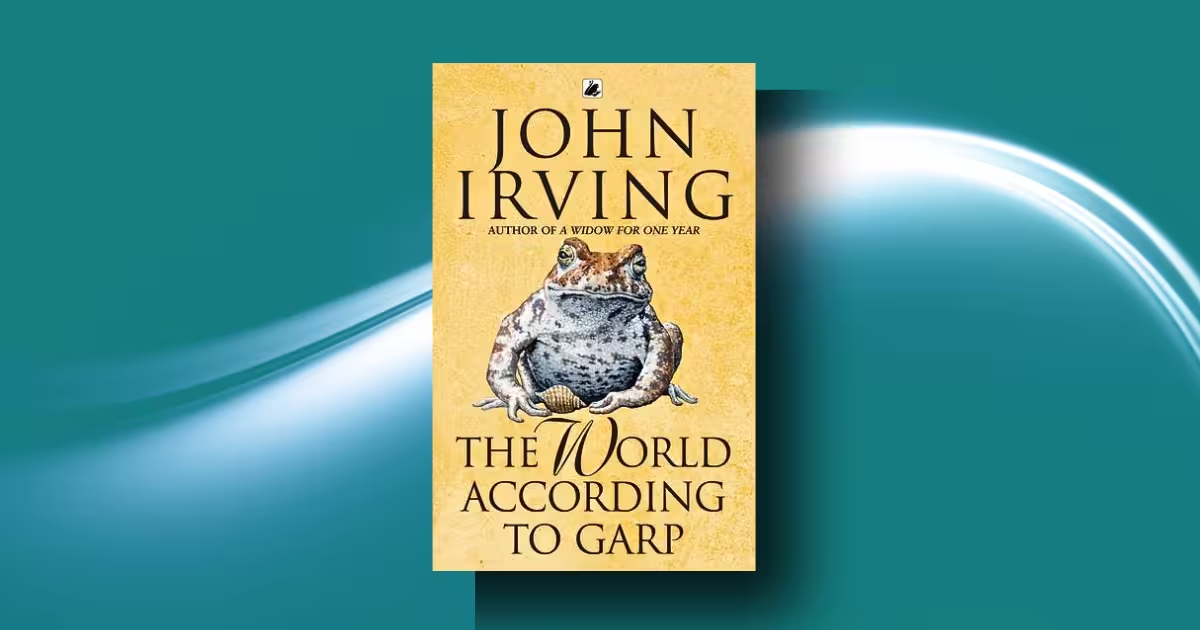
Have you ever felt that life’s most terrifying monster isn’t lurking under your bed, but rather the fear of losing the ones you love the most? The World According to Garp (E. P. Dutton) fits into the very nature of revealing answers to that question.
At its bleeding heart, John Irving’s The World According to Garp is a tragi-comic howl of rage against the randomness of death, the absurdity of our attempts to control it, and a surprisingly tender celebration of the messy, beautiful process of just getting on with it.
The World According to Garp is best for readers who appreciate sprawling, Dickensian plots, dark humor, transgressive fiction, and a no-holds-barred look at the politics of gender and parenthood. Not for those who prefer tidy, conventional narratives, have a low tolerance for sexual violence on the page, or are looking for a light, uplifting beach read.
Table of Contents
Introduction
Published in 1978 by E. P. Dutton, The World According to Garp was John Irving’s fourth novel but his true commercial and critical breakthrough. After three well-reviewed but modestly selling books, Garp became an international phenomenon, spending months on bestseller lists and winning the National Book Award for Fiction in 1980.
It follows the life of T. S. Garp, the illegitimate son of a radical feminist nurse, from his unusual conception through his own tumultuous adulthood as a writer, husband, and father.
The novel is famous for its audacious blend of slapstick comedy, graphic tragedy, and unflinching social commentary, which established Irving as one of the most imaginative—and controversial—writers of his generation.
Background
The novel is deeply, if perhaps inadvertently, autobiographical. Irving was himself born out of wedlock (his father was a fighter pilot who had died shortly before his birth) and was raised by his mother, a nurse, who had a strong sense of independence. This “single‑parent, mother‑as‑primary‑influence” dynamic mirrors the core relationship of Garp.
At the Phillips Exeter Academy, Irving was a standout wrestler—a sport that would become a signature motif in all his subsequent work. Garp also draws on his experiences living and writing in Vienna, the setting for the novel’s brilliant embedded story “The Pension Grillparzer.”
Furthermore, the character of Roberta Muldoon, a former NFL tight end who transitions to become a woman, was groundbreaking for its time, offering one of the first sympathetic and complex portrayals of a trans character in mainstream American fiction.
The World According to Garp Summary
Part I: The Unconventional Birth
Jenny Fields, an athletic‑looking and fiercely independent nurse in her early twenties, works at Boston Mercy Hospital during World War II. She has no interest in marriage or the typical expectations for women. In the book’s famous opening sentence, Garp himself would later write, “My mother, Garp wrote, was a lone wolf.”
One day, a brain‑damaged soldier nicknamed “Garp” (a ball‑turret gunner) is admitted to her ward. He is childlike, has a one‑word vocabulary (“Garp!”), and suffers from frequent erections. Jenny, who desperately wants a baby but wants “as little to do with a peter as possible,” decides to use this man. She climbs on top of him and effectively rapes him to achieve a pregnancy.
She later names her son “T. S.” (for Technical Sergeant) Garp.
Jenny takes a live‑in nursing job at the exclusive Steering Academy so that her son will have access to a first‑class education. She lives in the infirmary annex, reading voraciously and taking free courses, all the while insulating Garp from the world.
As a child, Garp is nearly killed when he climbs onto the roof to catch pigeons with a lacrosse stick and falls through a rain gutter; his mother famously catches him at the last moment.
Dean Bodger—a well‑meaning but myopic administrator—later mistakes a falling pigeon for Garp and claims to have “saved” the boy, a delusion that lasts for years.
Part II: Growing Up and Finding a Voice
As a teenager at Steering, Garp discovers two passions: wrestling and writing. He is a talented but not brilliant student, with a stubborn, humorless determination. He also has his first sexual encounters, notably with Cushman “Cushie” Percy, the daughter of a pompous, wealthy faculty family.
Garp becomes close to Helen Holm, the daughter of the wrestling coach, Ernie Holm. Helen is a voracious reader and intellectual; Garp works hard to impress her with his writing. In a pivotal scene, he tells her: “Well, maybe you’ll marry a writer.” She replies, “If I marry anybody, I’ll marry a writer. But I doubt I’ll marry anybody.”
After high school, Jenny decides that she and Garp need to experience Europe.
They settle in Vienna, where Jenny begins writing a memoir, A Sexual Suspect, and Garp, struggling with writer’s block, eventually composes a breakthrough short story titled “The Pension Grillparzer.”
The story, included in full in the novel, is a fable about a family of Austrian inn‑raters who encounter a sad, ragtag circus consisting of a dream‑teller, a singer, a man who walks on his hands, and a bear that rides a unicycle. It is a masterpiece of deadpan absurdism, and it reveals Garp’s central artistic theme: the tragicomic struggle of strange, damaged people to survive and find meaning.
Part III: Marriage, Parenthood, and the Under Toad
After their return to the United States, Garp marries Helen. They have two sons, Duncan and Walt. Helen pursues a career as an English professor; Garp becomes the stay‑at‑home parent and struggling writer.
Their marriage is tested by infidelities: Garp with a babysitter, Helen with a graduate student named Michael Milton.
The novel’s central tragedy occurs in one of the most devastating set‑pieces in modern literature. Garp, seething with jealousy after learning of Helen’s affair, takes the boys to a movie on a freezing, rainy night. As he coasts into his dark driveway (a dangerous habit he has), he crashes into Michael Milton’s huge, parked Buick.
The crash kills Walt instantly, blinds Duncan in one eye, and leaves Helen and Garp grievously injured. Garp later writes that “the Under Toad is strong today.” The “Under Toad” is a wonderful Irving invention: Walt’s childish mispronunciation of “undertow” becomes a family code for the lurking, all‑encompassing dread of random tragedy.
The family retreats to Jenny’s estate at Dog’s Head Harbor to heal. The loss of Walt haunts the entire second half of the novel.
Part IV: The Novel Within the Novel
As part of his own recovery, Garp writes a violent, controversial novel titled The World According to Bensenhaver. It is about a woman named Hope Standish who is kidnapped, raped, and then kills her attacker with his own knife.
The meta‑fictional novel is published to great scandal and becomes a bestseller, partly because its subject matter is mistaken for a “feminist” manifesto. Irving uses this device to satirize the publishing industry’s exploitation of trauma and the public’s appetite for sensationalism.
Meanwhile, Jenny Fields has become a public figure. Her autobiography is adopted as a sacred text by the nascent women’s movement.
She surrounds herself with damaged women, including a group called the “Ellen Jamesians,” who have their tongues cut out as a symbolic protest against a real child rape victim named Ellen James. Jenny, Garp, and Roberta Muldoon (a former NFL tight end who has transitioned) run a foundation for women at Dog’s Head Harbor.
Part V: The Assassinations
The novel’s final act is a brutal climax of political violence. Jenny Fields is shot and killed by a deranged man (a hunter named Kenny Truckenmiller) at a political rally. Garp, who has been embroiled in a public feud with the Ellen Jamesians, attends her “first feminist funeral” in drag.
There, he is publicly attacked by Bainbridge “Pooh” Percy, Cushie’s younger sister, who has herself become an Ellen Jamesian and blames Garp for Cushie’s death in childbirth.
Months later, after his own literary success, Garp is coaching wrestling in the Steering gymnasium. Pooh Percy, disguised as a nurse, enters the wrestling room and shoots Garp twice. He dies on the warm wrestling mats, with Helen at his side. The narrative never fully explains why Pooh has done this; it is as random and pointless as the collision that killed Walt.
The novel ends with an extended “epilogue” that traces the lives of the remaining characters: Helen, Duncan (who becomes a painter), Jenny Garp (who becomes a cancer researcher), Roberta Muldoon (who runs the foundation), and Ellen James (who becomes a poet).
The epilogue is a meditation on memory, survival, and the absurd persistence of life after trauma. The final line of the novel is: “In the world according to Garp, we are all terminal cases.”
The World According to Garp Analysis
Characters
T. S. Garp: The protagonist is a bundle of contradictions. He is a devoted father who is consumed by anxiety about his children’s safety, yet he is a serial adulterer.
He is a feminist ally (he supports his mother’s work and becomes a stay‑at‑home dad in the 1970s), yet he is also prey to the “lust” that his mother despises. He is a serious artist who craves fame and then is repulsed by it. He is a wrestler, a control‑freak, and a dreamer.
Irving never lets us fully like or fully condemn Garp; he is too real for that.
Jenny Fields: In many ways, Jenny is the novel’s moral center. She is asexual, possibly aromantic, and completely unapologetic about it. She chooses to have a child on her own terms, using a man purely as a means to an end.
Her famous line—“In this dirty‑minded world, you are either somebody’s wife or somebody’s whore”—captures her rejection of patriarchal labels. Yet her extreme, uncompromising feminism also attracts fanatics and ultimately gets her killed. Irving treats her with awe and a little bit of satire.
Roberta Muldoon: The former Philadelphia Eagles tight end who becomes a woman and Garp’s best friend. Roberta is the novel’s most purely lovable character: gentle, fierce, funny, and deeply loyal.
She is also a trojan horse for Irving’s progressive politics; in 1978, a sympathetic trans character was almost unheard of. Roberta’s arc—from a rejected lover to the head of Jenny’s foundation—is one of the novel’s few uncomplicated victories.
Helen Holm: Helen is Garp’s intellectual equal and the novel’s voice of ironic reason. She is a brilliant English professor who reads constantly, sees through Garp’s pretensions, but loves him anyway.
Her affair with Michael Milton is not excused, but it is contextualized by Garp’s own infidelities and his emotional unavailability. After Garp’s death, she becomes a fierce guardian of his legacy.
Walt Garp: The younger son is an innocent. His death—the result of his father’s foolish anger and a random crash—is the novel’s central wound. Walt’s childhood mispronunciation of “undertow” as “Under Toad” becomes the book’s most resonant image for the lurking, senseless threat of tragedy.
Ellen Jamesians: The cult of women who cut out their tongues in sympathy with a real rape victim. They are Irving’s most savage satire of extremism.
They are both ridiculous and terrifying; they make Garp “crazy” with their fanaticism. Yet Irving also allows a few individual Ellen Jamesians (like the real Ellen James, who hates the group) to be sympathetic.
The World According to Garp Themes and Symbolism
The Under Toad / Undertow: As noted, the “Under Toad” is the novel’s central metaphor for the hidden, ever‑present threat of random disaster. It is the car that runs the stop sign, the bullet that has no name, the cancer that arrives without warning. Garp spends his life trying to control the Under Toad, but it only tightens its grip.
Lust vs. Love: Jenny Fields sees lust as a destructive, male force; Garp sees it as an unavoidable part of his nature. Irving refuses to resolve this tension. The novel is full of sex that is ugly, funny, tender, and brutal—often in the same scene.
Fiction as Reality / Reality as Fiction: Irving is constantly blurring the lines. Garp’s novel The World According to Bensenhaver mirrors the real events of his life; the short story “The Pension Grillparzer” foreshadows the novel’s own themes; the epilogue treats the characters’ afterlives with the same narrative weight as their deaths. This meta‑fictional play suggests that storytelling is how we fight back against the chaos of existence.
The Absurdity of Control: Garp’s constant vigilance—chasing speeders, warning children about the “Under Toad,” building a “pre‑disastered” house—only makes tragedy more likely. The accident that kills Walt is directly caused by Garp’s own aggressive, paranoid behavior. Irving seems to say that the more we try to control fate, the more we invite it.
Feminism and its Discontents: The novel is both a celebration and a critique of second‑wave feminism. Jenny’s independence is admirable; the Ellen Jamesians’ self‑mutilation is grotesque. Irving walks a tightrope, honoring the movement’s core insights while satirizing its excesses. This ambiguity made the book controversial at the time and keeps it alive today.
The World According to Garp Evaluation
The World According to Garp is a sprawling, messy, extraordinary achievement—a novel that can make you laugh out loud on one page and weep on the next, often at the same time. It is not a perfect novel: it is too long, some subplots meander, and the violence can feel gratuitous.
But its imperfections are part of its charm. Irving writes with a wrestler’s discipline and a comedian’s timing, and he creates a cast of characters who feel more real than many real people. For all its darkness, the novel is ultimately affirming. It argues that life is a terminal case, but that doesn’t mean we should stop living, loving, or telling stories.
Strengths
Unforgettable Characters: Jenny, Garp, Roberta, and even the minor players like the bumbling Dean Bodger are etched in the reader’s mind with startling clarity.
Tonal Mastery: The whiplash between comedy and tragedy is handled with breathtaking skill. The scene where Walt explains the “Under Toad” is hilarious; the car crash that kills him is devastating.
Meta‑Fictional Brilliance: The story‑within‑a‑story structure is not just a gimmick; it deepens our understanding of Garp’s psyche and Irving’s themes.
Ahead of Its Time: The portrayal of Roberta Muldoon and the explicit discussion of feminist politics were groundbreaking in 1978 and remain remarkably fresh today.
Weaknesses
Over‑Length: At nearly 600 pages, the novel feels baggy. Some sections, such as the extended description of the “Pension Grillparzer” story, interrupt the main narrative’s momentum.
Gratuitous Violence: The rape scene in The World According to Bensenhaver and the novel’s own rapes (Jenny’s impregnation of Garp’s father, which is technically rape) can feel exploitative. Some critics have argued that Irving uses sexual violence as a plot device too freely.
Garp as an Uncomfortable Hero: Garp is often a self‑righteous, hypocritical jerk. His infidelities and his murder‑fantasies about Helen’s lover are off‑putting. Irving intends this complexity, but it can make the novel hard to love.
Impact and Controversy
The novel ignited immediate controversy. Some feminists embraced it as a pro‑feminist text; others attacked it as a male fantasy about women’s suffering. The Ellen Jamesians, in particular, were seen as a cruel caricature of real activist groups.
Conservative critics, meanwhile, were appalled by the book’s explicit sex and violence. The debate helped propel the novel to bestseller status, and it has never gone out of print.
Irving himself later admitted that he had “overdone it” in places, but he never apologized for the book’s core vision. Garp remains a flashpoint for discussions of gender, art, and trauma over forty years later.
Comparison with Similar Works
The World According to Garp belongs to a particular strain of big, baggy, darkly comedic American novels of the 1970s and 80s—works like Joseph Heller’s Catch‑22, Thomas Pynchon’s Gravity’s Rainbow, and John Kennedy Toole’s A Confederacy of Dunces, and The Extraordinary Life of Sam Hell by Robert Dugoni
Like those books, it is encyclopedic in scope, irreverent in tone, and obsessed with death. But Irving is more accessible than Pynchon and more sentimental than Heller.
His closest analogue might be Kurt Vonnegut, another writer who blended sci‑fi absurdism with deep humanism. Indeed, Garp shares Vonnegut’s belief that laughter is the only sane response to an insane world.
Adaptation
The 1982 film adaptation, directed by George Roy Hill and starring Robin Williams as Garp, Glenn Close as Jenny, and John Lithgow as Roberta, is a respectable but inevitably condensed version. It captures the novel’s quirky spirit but truncates many subplots (most notably the Ellen Jamesian feud).
Robin Williams gives a surprisingly restrained performance, hinting at the dramatic depth he would later display in films like Dead Poets Society and Good Will Hunting. Glenn Close, in her film debut, is perfection as Jenny. The movie was a modest box‑office success, earning over $30 million on a $17 million budget, but it has since become a cult classic.
Personal Insight with Contemporary Educational Relevance
Nearly fifty years after its publication, The World According to Garp remains astonishingly relevant. The novel’s central preoccupations—sexual politics, the nature of consent, the meaning of feminism, the anxiety of parenthood, and the randomness of violence—are daily headlines. Irving’s refusal to offer easy answers feels more vital than ever.
Five lessons we can learn from Garp today:
There is no “safe.” Garp’s attempts to create a bubble of safety for his children are doomed. The modern obsession with risk‑management, from child‑proofing to surveillance, may be a form of magical thinking.
Labels are traps. Jenny rejects the label “feminist” even as she is hailed as one. Garp hates being called a “house‑husband.” Irving suggests that identity is always more fluid and contradictory than any movement or ideology allows.
Laughter is a weapon. The novel’s darkest moments are also its funniest. Irving believed that comedy is not the opposite of tragedy but its companion. In a world full of horror, laughter is a way of staying human.
Art cannot save you. Garp’s writing does not prevent Walt’s death or his own murder. Art is not a solution; it is a way of bearing witness. That is both its limitation and its power.
The personal is political, and the political is personal. Irving shows that grand social movements (feminism, extremism) are made up of individual hurts and hopes. You cannot understand politics without understanding the messy, private lives of the people involved.
For a deep dive into the novel’s ongoing relevance, Ilana Masad’s 2019 Paris Review essay “Garp, Forty Years Later” is an excellent resource.
The World According to Garp Quotes
- “In this dirty minded world, you are either someone’s wife or someone’s whore. … but there is nothing wrong with me.” (Jenny Fields)
- “They were involved in that awkward procedure of getting to unknow each other.”
- “If you are careful, if you use good ingredients, and you don’t take any shortcuts, then you can usually cook something very good. … Cooking, therefore, can keep a person who tries hard sane.” (Garp)
- “Death, it seems, does not like to wait until we are prepared for it. Death is indulgent and enjoys, when it can, a flair for the dramatic.” (Garp)
- “In the world according to Garp, we are all terminal cases.” (Narrator)
- “All men are liars,” said Roberta Muldoon, who knew this was true because she had once been a man.
- “You know, everybody dies. … The thing is, to have a life before we die. It can be a real adventure having a life.” (Jenny Fields)
- “Imagining something is better than remembering something.”
- “Fucking men,” said Helen. “Fucking men.”
Conclusion
The World According to Garp is not a novel for the faint of heart. It is long, messy, often offensive, and sometimes gratuitous.
But it is also deeply humane, wildly inventive, and strangely, achingly beautiful. It is a book that rewards rereading, a book that grows with you. If you are willing to wrestle with its complexities—and you will have to wrestle—you will come away with a deeper understanding of what it means to be a parent, a partner, a citizen, and an artist.
Recommended for: fans of literary fiction, dark comedy, transgressive narratives, and anyone who has ever stared into the void and laughed.







