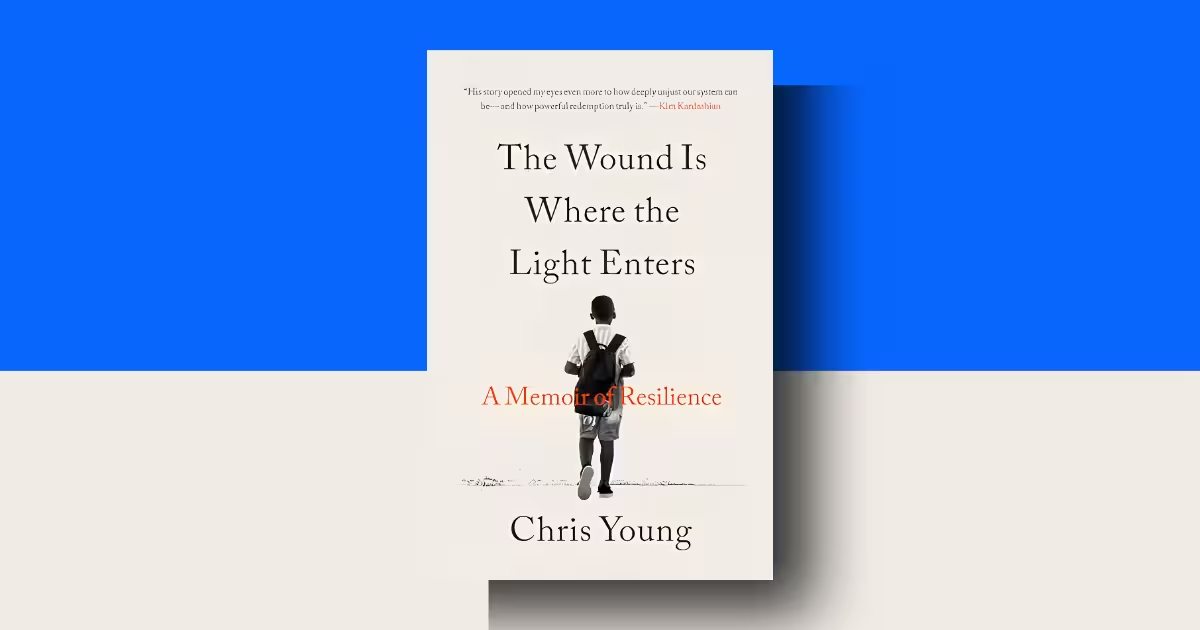

The Wound Is Where the Light Enters review: Can a person rebuild his life after being sentenced to life in prison? Chris Young’s memoir answers that question through a remarkable journey from poverty and incarceration to self-education, resilience, redemption, and freedom.
Young recounts how he was sentenced to life without parole at 26 after a nonviolent drug offense, then used books, philosophy, history, psychology, and relentless curiosity to transform his mind while behind bars. His story is not simply about surviving prison; it is about discovering human potential in a place designed to destroy it.
Table of Contents
Summary
The Wound Is Where the Light Enters is Chris Young’s memoir of surviving poverty, incarceration, loss, and a life sentence while transforming himself through reading, education, reflection, and resilience. Young describes being sentenced to life without parole after a nonviolent drug offense and spending more than a decade incarcerated.
During that time, he pursued an intensive self-education covering religion, philosophy, psychology, history, technology, art, and literature.
The memoir also examines the human consequences of poverty, mass incarceration, mandatory minimum sentencing, and the War on Drugs.
Young presents his imprisonment not only as a personal tragedy but as a challenge to a criminal-justice system that can fail to account for individual circumstances and human potential. Former federal judge Kevin H. Sharp’s foreword reinforces this dimension, explaining how Young’s case changed his own view of mandatory minimums and ultimately influenced his decision to leave the federal bench.
At its heart, The Wound Is Where the Light Enters is a memoir about resilience and transformation. Young’s central idea is that suffering does not have to become the final definition of a person’s life: wounds can become openings through which knowledge, love, self-understanding, and hope enter.
His story ultimately moves from incarceration toward clemency, freedom, education, and a commitment to rethinking how society invests in human potential.
The Wound Is Where the Light Enters Summary
I. What The Wound Is Where the Light Enters Actually Is
Chris Young didn’t write a victim story. He wrote a reckoning.
The Wound Is Where the Light Enters: A Memoir of Resilience dropped on August 4, 2026, through Little, Brown and Company. It runs 336 pages, and I finished it in four sittings. That’s unusual for me. Memoirs about incarceration tend to follow a template: wrong place, wrong time, redemption arc, the end. This one refuses that shape.
Young was 22 when he was arrested. He had two prior nonviolent drug convictions. Under the federal three-strikes provision, that triggered a mandatory life sentence without parole. He served over a decade in federal prison before receiving executive clemency from President Donald Trump in January 2021, after advocacy from Kim Kardashian, attorney Brittany K. Barnett, and, most improbably, Kevin H. Sharp, the federal judge who had sentenced him.
A quick note on the title. The phrase comes from Rumi, the 13th-century Persian poet. Young doesn’t overwork the reference, which I appreciated. He lets the metaphor sit without squeezing it dry.
The book’s foreword comes from Judge Sharp himself. If you’ve been following criminal justice reform, you know Sharp’s name. In 2017, he resigned from his lifetime appointment on the federal bench in the Middle District of Tennessee, telling The Tennessean that mandatory minimums had forced him to impose sentences he knew were wrong.
Young’s case was the catalyst. “I knew that the only difference between us was that I’d had opportunities that Chris never did,” Sharp writes. “And at the end of his speech, we both knew he would pay for that difference with his life.”
What Sharp is referring to is the moment at Young’s sentencing hearing when, against everyone’s advice, Young stood up and delivered a speech. Not a plea for mercy. Not an apology. A speech about American history, about financiers and philosophers and Black CEOs he’d studied in the jail library. It lasted nearly an hour. It changed the trajectory of both their lives.
This is not an innocence narrative. Young sold drugs. He says so plainly, without hedging or minimizing. “I’m writing it because so many of us are still locked away,” he writes in the introduction. “I’m writing it because so many are still acting out their pain in the streets.” The Wound Is Where the Light Enters is an indictment of a system, not a defense of a person.
The Numbers Behind the Story
I went looking for data after I finished The Wound Is Where the Light Enters, mostly because I wanted to check whether Young’s case was as anomalous as it felt. It wasn’t.
According to the U.S. Sentencing Commission’s 2025 Sourcebook, federal courts handled 66,662 criminal cases that fiscal year. Of those, 16,234 involved drug offenses. The Pew Research Center found that in fiscal year 2022, only 290 of 71,954 federal defendants, about 0.4%, went to trial and were acquitted. Roughly nine in ten pleaded guilty. The trial penalty is real, and it is brutal.
Young was offered a plea deal of 14 years. He turned it down and went to trial. After his conviction, prosecutor Sunny Koshy filed an 851 enhancement, the three-strikes provision, and added three new charges. The result: two mandatory life sentences plus five years, to be served consecutively. As Young writes: “The combined weight of the drugs involved was less than the weight of three pennies.”
That detail stopped me cold. Less than three pennies. Two life sentences.
The 851 enhancement isn’t automatic. Prosecutors choose whether to file it. Eric Holder, the first Black attorney general of the United States, sent a memo to prosecutors in 2013 discouraging its use except for violent drug kingpins or cartel-connected offenders. Koshy filed it anyway. As Young puts it: “Prosecutors don’t have to file the 851. To do so or not is completely up to them. Sunny chose to.”
The U.S. Sentencing Commission reports that the average sentence for federal drug offenses carrying a mandatory minimum is 144 months, versus 29 months for similar offenses without one. Same category of crime. Five times the prison time. Because of a law, not a judge’s judgment.
The Part That Stays With You: How a Jail Library Became a Lifeline
Here’s what I didn’t expect from this book: the books themselves.
Young’s education didn’t happen in a classroom. It happened in county jail, in a cold room that doubled as a library, a church, and a mosque depending on the day. He started with encyclopedias. “I’d been in that room a bunch of times, but I hadn’t noticed them before,” he writes. “It was like they were calling to me, and I listened.”
From there, he moved through Greek mythology, Renaissance art, philosophy, economics, and history. He read Hamlet in solitary confinement after finding a “tattered and stained paperback” stuffed behind the steel toilet. “There I was, in the hole, four hundred years after some English dude had picked up his quill and created this character — and I was facing the exact same question, and the exact same turmoil.”
He read The Silent Power of Thought by James Allen and started to believe that his thoughts could shape his reality. He read Basic Writings of Existentialism. He studied Albrecht Dürer’s Melencolia I, an etching from the 1500s, and saw himself in the figure’s restless, searching eyes. He read Revolutionary Suicide by Huey P. Newton and connected Newton’s intellectual journey to his own. He read Chris Gardner’s Start Where You Are and began treating his cell like a boardroom, writing a balance sheet of assets and liabilities.
“You can’t choose the cards you’re dealt, only how you play the hand,” Young writes, echoing Gardner. “I couldn’t control the sentence I’d be given, but I could control how I lived inside it.”
The prison library scene in this memoir is the emotional core. Not the courtroom, not the clemency, not the release. The library. Because that’s where Young became himself. He wasn’t Soulja C, the drug dealer. He wasn’t a case number. He was a student, a philosopher, an economist in training. The library gave him an identity that the system couldn’t take away.
Research supports what Young experienced. A 2024 study published in the International Journal of Information, Diversity, and Inclusion found that prison libraries “serve as havens where prisoners are afforded the autonomy to choose their reading materials, empowering them to enhance their lives through self-directed learning.”
UNESCO has documented prison library programs that “improve prisoners’ self-confidence and develop positive thinking strategies.”
But those institutions are rare, underfunded, and often treated as luxuries. Young’s library was a wasteland, as he describes it: “If you didn’t have someone sending you books, you had nothing.” He was lucky. Bam, his childhood friend, sent him philosophy and history.
Jeanne Schmitzer, a Nashville attorney, sent him magazines. Taylor Dolven, a VICE News reporter, sent him East of Eden. Those books were oxygen.
The Sentencing Speech: A Year of Preparation, an Hour of Truth
I’ve read a lot of courtroom scenes in memoirs. This one is different.
Young spent nearly a year preparing his sentencing speech. He practiced it in the shower, in his bunk, in the library, walking through the halls.
He memorized it because he wouldn’t be allowed notes. He had watched Da Hero and other codefendants take plea deals, watched his lawyer tell him to stay silent, watched everyone around him assume that speaking would only make things worse.
He spoke anyway.
“I’ve read and studied some of the greatest historians, writers, philosophers, scientists, and thinkers in recorded human history — Socrates, Aristotle, Descartes, Michelangelo, da Vinci, Nietzsche, Dostoyevsky,” he told Judge Sharp. He named financiers: J.P. Morgan, Andrew Carnegie, John Maynard Keynes. He discussed Federal Reserve chairman Ben Bernanke’s comments on labor force participation and the erosion of skills during unemployment. He talked about his brother Robert’s suicide. His mother’s addiction.
His cousin Cudas’s murder. His sickle cell anemia. The nights without electricity or running water.
He ended with this: “All I’m asking, Your Honor, is that you please acknowledge my ambition, my ardor, my potential.”
Judge Sharp listened. He asked Young to slow down so the court reporter could keep up. He suggested books Young might like. He said, “I don’t think that’s happening here,” referring to the idea that each defendant should be treated as an individual. Then he sentenced Young to life without parole.
“I left the courthouse knowing I was being buried alive,” Young writes. “But under all that pain, I felt something else too. Pride.”
The speech didn’t save him in that moment. But it planted something. Sharp couldn’t stop thinking about it. A year later, Sharp resigned from the bench. Years after that, he was standing in the Oval Office with Kim Kardashian, arguing for Young’s freedom.
There’s a line from the foreword that I keep returning to. Sharp writes: “Chris’s presence in my courtroom transformed my life. I am so glad that, with the gift of this book, he has the chance to transform yours.”
What I Loved and What I Questioned
Strengths:
The prose is uncluttered and direct. Young doesn’t reach for literary flourishes. He writes the way someone talks when they’ve spent a decade thinking about every word before they say it. The scenes in Clarksville, particularly the ones involving his brother Robert, are devastating without being sentimental. The suicide scene, which I won’t describe here, is handled with a restraint that makes it almost unbearable.
The Wound Is Where the Light Enters also does something rare: it takes the reader inside the mind of someone who is both a victim and a perpetrator. Young doesn’t ask you to forgive him. He asks you to see him. “Most men are sent to a lower-security facility almost immediately after getting relief in the courts,” he writes near the end. “But it took five long weeks before they came to tell me to pack out.” That line, buried in the middle of a chapter about solitary confinement, says more about the system’s pettiness than any statistic could.
Weaknesses:
The pacing sags in the middle. Chapters covering his teenage drug-dealing years and the early months of his federal case blend together. I found myself wanting more detail about specific characters. Momma, Big Mama, Mickey, and Robert are vivid. But some of the Main Boys, like Bam and Juwan, remain sketches. Given how important they were to Young’s survival, I wanted more.
The book also avoids sustained engagement with the question of victimhood. Young sold crack in a community that was already devastated by addiction. He acknowledges this (“I’d been selling crack to anyone who’d buy, Momma included”), but he doesn’t sit with it for long.
I’m not saying he owes the reader a confession. But the tension between being a victim of the system and a participant in its destruction is the most interesting thread in the book, and it’s not fully pulled.
That said, the Kirkus Reviews assessment that this is “a poignant, inspirational, and timely account of personal survival and reinvention” feels accurate. The Los Angeles Times called it “searing” and noted that it “not only reveals the system’s horrors, but also celebrates the redemptive power of hope, intellect and community.” I’d agree with both.
Reader Recommendation: Who Will Actually Love This Book, and Who Should Skip It
You will love this if:
- You’ve read Bryan Stevenson’s Just Mercy or Michelle Alexander’s The New Jim Crow and want a first-person account of what happens after sentencing.
- You’re interested in prison education, self-directed learning, or the role of libraries in rehabilitation.
- You want a redemption story that doesn’t pretend the system works or that individual effort alone can overcome structural barriers.
- You appreciate memoirs that are willing to name names, including their own.
You might bounce if:
- You prefer tightly plotted narratives. This meanders in places.
- You want a clear villain. Young is harder on himself than he is on Sunny Koshy, though Koshy doesn’t come off well.
- You’re looking for a policy book. This is a memoir, not a treatise. It will make you angry, but it won’t give you a legislative roadmap.
Comparison: Books Like The Wound Is Where the Light Enters
If you liked this book, you’ll probably like these:
A Knock at Midnight by Brittany K. Barnett (2021). Barnett is Young’s attorney and a central figure in his story. Her memoir covers her own journey from a childhood shaped by her mother’s incarceration to becoming a clemency lawyer who freed over 65 people from life sentences. If you want the legal and advocacy side of the story, this is essential reading.
After Life: My Journey from Incarceration to Freedom by Alice Marie Johnson (2019). Johnson was the first person Kim Kardashian advocated for at the White House. Her sentence was commuted in 2018, about two years before Young’s. The two cases are intertwined: Johnson’s viral interview on Mic, her meeting with Trump, and her release set the stage for Young’s clemency.
Writing My Wrongs by Shaka Senghor (2016). Another memoir by a Black man who went to prison young, educated himself, and eventually became a voice for reform. Senghor’s book is more meditative; Young’s is more propulsive. Both are essential.
The Sun Does Shine by Anthony Ray Hinton (2018). Hinton spent 30 years on death row in Alabama for a crime he didn’t commit. Unlike Young, Hinton was innocent. But the two books share a commitment to showing how incarceration shapes the mind and spirit, not just the body.
Redeemable by Erwin James (2017). A British counterpart to Young’s story. James spent 20 years in prison, earned a degree, and became a columnist for The Guardian. Less focused on systemic critique, more on personal reckoning.
Where Chris Young Is Now
Young graduated from Southern Methodist University with a degree in economics and public policy. He founded Coherence Consulting, a firm that uses data, policy analysis, and lived experience to advise institutions on investing in human potential. He speaks publicly about incarceration, agency, and reform. This is his first book.
Kevin Sharp is now a partner at Sanford Heisler Sharp McKnight, where he focuses on criminal justice reform and civil rights. Brittany K. Barnett continues her work at the Buried Alive Project, which she co-founded with two of her clients. Kim Kardashian has expanded her criminal justice advocacy, though her involvement remains a source of both attention and debate within reform circles.
The First Step Act, signed into law in December 2018, reduced mandatory minimums for some drug offenses and made the Fair Sentencing Act’s crack-to-powder cocaine reforms retroactive.
But it didn’t help Young, because his sentence predated the law and the provisions weren’t applied retroactively to his case. That irony isn’t lost on him. “I was happy for everyone that the First Step Act helped,” he writes. “But my own hope for freedom… were growing dim.”
Conclusion
The Wound Is Where the Light Enters is not a book about hope. It’s a book about what happens after hope fails, and you keep going anyway.
Chris Young spent over a decade in federal prison for drugs worth less than three pennies. He educated himself in jail libraries. He delivered a sentencing speech that changed a judge’s life. He got out. His brother Robert didn’t. His cousin Cudas didn’t. Skin Tight didn’t. Dual Pipes didn’t. The book is dedicated to Robert: “Life forced you to carry a heavy load for us, and you did. I am forever grateful. I love you.”
I’ll leave you with a line from the epilogue, which I think captures the book’s spirit better than any summary could: “Freedom wasn’t new to me. I’d been practicing it for years, through every book I read, every thought that pushed me beyond those walls, every moment I chose peace over anger.”
That’s the whole book. That’s the whole man. Read it.