
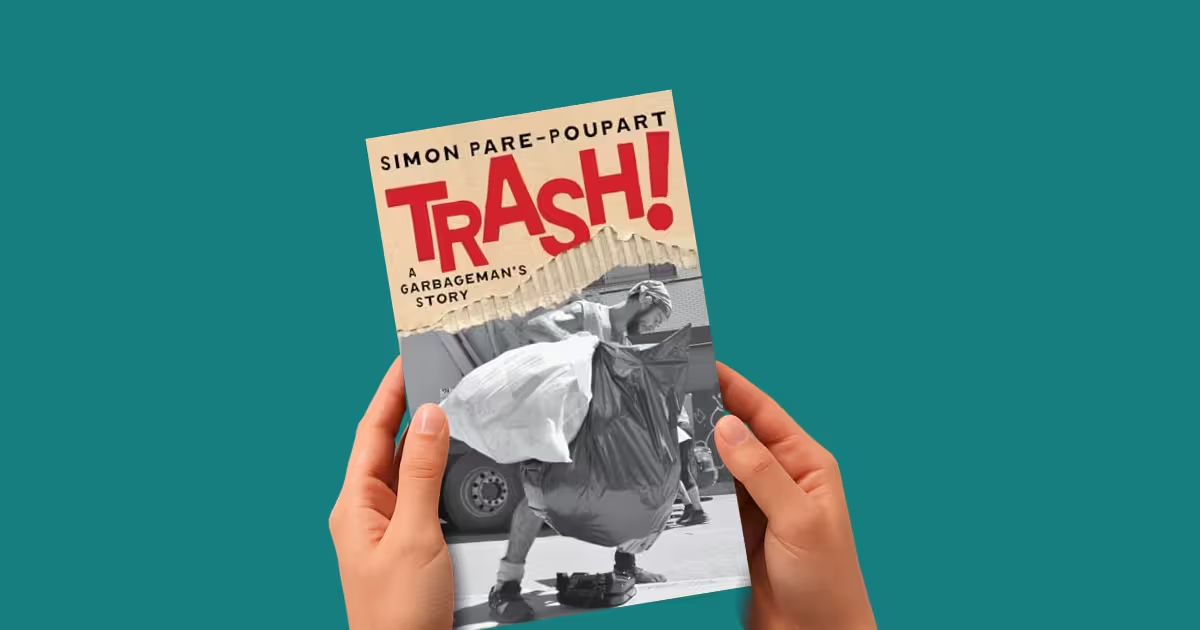
Did you ever wonder why a man with a master’s degree in sociology would spend twenty years running behind a garbage truck? I didn’t either, until I read Simon Paré-Poupart’s Trash! A Garbageman’s Story, and it rearranged something in how I think about work, status, and what it actually means to be free. If you’ve ever flinched away from your own garbage can, or wondered who that person is on the back of the truck before sunrise, this book will not let you look away again.
Table of Contents
Title and Author Information
Trash! A Garbageman’s Story is a memoir-essay collection by Simon Paré-Poupart, a Montreal garbageman of twenty years who also holds graduate degrees in sociology and international business.
Originally published in French by Lux Éditeur in 2024 under the title Ordure! Journal d’un vidangeur, the book became a bestseller in Quebec before being translated into English by Pablo Strauss, a three-time finalist for the Governor General’s Literary Award for translation.
Melville House published the English-language edition in March 2026, distributed through Penguin Random House.
The book runs under two hundred pages and includes eight black-and-white photographs of Paré-Poupart at work.
Context: What Is Trash! About?
At its core, this is a book of essays — part memoir, part sociological field report, part furious love letter — about what it’s actually like to throw trash for a living in Quebec.
Paré-Poupart began the job in 2003, at eighteen, after his stepfather suggested it as a way to “be a man.” He kept doing it. Not despite his education, but alongside it: he worked the truck through his bachelor’s degree, through his master’s, through stints as a journalist, a Red Cross coordinator, and a social worker.
He still works the truck today, part-time, by choice.
The book is organized into two parts — “Becoming a Garbageman” and “Throwing Trash” — interspersed with five short interludes called “Garbage Doesn’t Lie,” each built around a different angle on what waste reveals about the people who produce it.
Genre-wise, it sits somewhere between memoir, labor sociology, and cultural criticism, in the lineage of Émile Zola’s working-class novels and George Orwell’s reportage, though Paré-Poupart’s own touchstones — Victor Hugo, Zygmunt Bauman, David Graeber, Catherine de Silguy — surface constantly in his thinking.
Purpose: Trash!‘s Central Argument
Paré-Poupart states his argument plainly in the opening pages. He wants readers to “stop believing that your waste disappears ‘by magic.'”
That’s the surface argument. But underneath it sits something sharper: a class argument about who is permitted to find meaning, even joy, in supposedly degrading work, and who gets to decide that the work is degrading in the first place.
He isn’t asking for pity. He’s asking you to recognize that the man you’ve trained yourself not to see is, by his own account, one of the freest people you’ll ever meet.
Background
To understand why this book lands the way it does, it helps to know a little about Quebec’s waste industry, which Paré-Poupart treats almost as its own ecosystem.
Unlike France, where sanitation workers are heavily unionized and must pass exams at a dedicated École de la Propreté, Quebec’s garbage business has historically operated, in his words, by “the law of the jungle.”
Small Quebec-owned outfits like Services Sanitaires Gauthier, where Paré-Poupart got his start, were gradually squeezed out by multinational waste conglomerates, and today the City of Montreal directly handles less than 5 percent of its own waste collection, subcontracting the rest to private brokers.
That structural detail matters, because much of the book’s tension comes from what happens to workers when an essential public service gets run almost entirely by private companies competing on tonnage.
Trash! Summary
Part I: Becoming a Garbageman
The book opens with “A Life in Garbage,” where Paré-Poupart lays out the scale of what he’s done: in twenty years, he’s hauled nearly seventy thousand tons of trash.
He calls himself “the Sisyphus of our consumer society,” a phrase that recurs throughout the book and frames garbage collectors as the people condemned to repeat, forever, the labor that keeps consumer civilization from collapsing under its own waste.
“Baptism by Swearing” is the chapter that announces the book’s voice: profane, physical, unsentimental. Paré-Poupart describes the exact moment a new garbageman crosses over — not when he lifts his first bag, but when he finally curses, out loud, at the absurdity and unfairness of the work.
He frames swearing as a kind of secular sacrament. It’s also where he introduces a recurring villain archetype: the homeowner watching from behind their curtains, judging the man hauling their construction waste while contributing nothing themselves.
“Be a Man!” tells the origin story. Paré-Poupart grew up the son of an alcoholic father, raised mostly by a protective mother, and was teased for liking Dungeons & Dragons and reading Zola instead of lifting weights.
When his stepfather suggested running behind a garbage truck as a way to prove his manhood, eighteen-year-old Simon took him up on it — and discovered, almost by accident, that he loved it.
His first shift, in summer 2003 in Mirabel, ran nearly seventeen hours in extreme heat. He describes nearly losing consciousness, sleepwalking afterward, and still being unable to wait to go back the next morning.
“Nighttime” and “Kids Love Trucks” round out the early chapters with two contrasting moods.
Nighttime collection, he writes, brings out “the very worst in garbagemen” — fights, reckless driving, illegal dumping — but also a strange tenderness, like the moment a mother tells him her son dreams of growing up to be just like him.
Paré-Poupart’s deadpan response — “Don’t worry. He’ll get over it” — sets up one of the book’s most devastating through-lines: the sociological process by which children who idolize garbage trucks grow into adults who can’t look the garbageman in the eye.
He leans on sociologist Luc Boltanski’s research on occupational inheritance to make the point explicit: doctors’ children become doctors, and garbagemen’s children become garbagemen, and almost nobody crosses that line in either direction.
Part II: Throwing Trash
This is where the book widens out from memoir into something closer to investigative sociology, though it never loses its personal voice.
“Garbage Doesn’t Lie (II)” opens with the famous 1955 Life magazine photo spread titled “Throwaway Living,” which celebrated a family flinging disposable plates and cups into the air.
Paré-Poupart uses it to trace the history of planned obsolescence back to Bernard London’s 1932 paper, written the same year as Aldous Huxley’s Brave New World. He then drops in figures from the United Nations Environment Programme: global solid waste production currently tops 2 billion tons annually and is projected to reach 3.8 billion tons by 2050.
He adds, almost as an aside, that nearly 10,000 tons of human-made debris are currently orbiting the planet.
“Recycling” is one of the book’s angriest and funniest chapters.
Paré-Poupart walks through the internal hierarchy of garbage work — garbage collection for “real men,” recycling for amateurs, compost beneath contempt — and argues the hierarchy actually tracks autonomy, not toughness: the more control a worker has over the pace and shape of their own labor, the more dignity the job carries in their own eyes.
He cites a 2021 Montreal figure of roughly 1,020 pounds of waste discarded per person annually, projected to drop below 880 pounds by 2025 as composting and recycling expand.
This chapter also contains the book’s most quietly devastating exchange, when a resident tells him, “You chose your job. Quit whining,” and Paré-Poupart reveals, almost in passing, that he holds a master’s degree — information the man refuses to believe.
“Garbage Doesn’t Lie (III)” turns outward to the global recycling supply chain. Paré-Poupart cites the figure that only around 10 percent of plastic that’s collected for recycling is actually recycled; the rest is shipped to poorer countries or ends up in the ocean.
He references a CBC News investigation into Ricova, the Montreal recycling company he himself worked for, sending contaminated recyclable loads to India, and draws on anthropologist Mikaëla Le Meur’s fieldwork among Vietnamese women unpacking plastic bales by hand in Minh Khai.
The chapter closes on one of the book’s sharpest lines, paraphrasing a global divide between rich countries that get to discard waste and poor countries that inherit it, with the garbage collector caught in between.
“Abolish Winter!” and “Heat Wave” are the book’s most physically grueling chapters, detailing what it actually costs the body to throw trash through a Quebec winter or a summer heat wave — frozen, ice-crusted bins; heatstroke; a memory of vomiting on a stranger’s lawn and being driven home by his grandfather because his employer’s responsibility, in his telling, ended at the curb.
“See Lorraine and Die” is arguably the book’s emotional and intellectual center. Paré-Poupart works a shift in the wealthy Montreal suburb of Lorraine, covering for an injured Black coworker named Édouard, and uses the visit to pivot into one of the most striking pieces of labor history I’ve read outside a textbook: the 1968 Memphis sanitation workers’ strike.
He recounts how Echol Cole, 36, and Robert Walker, 30, were crushed to death in the hopper of their garbage truck on February 1, 1968, after being denied shelter from a storm under Jim Crow segregation rules — a tragedy that triggered a strike under the slogan “I am a man.”
Martin Luther King Jr. traveled to Memphis in support of the strikers and delivered his “I’ve Been to the Mountaintop” speech on April 3, 1968. He was assassinated the following day, shot on the balcony of the Lorraine Motel — the same word, Lorraine, that names the wealthy Quebec suburb where the chapter began.
Paré-Poupart also cites historian Rutger Bregman’s comparison between the 1968 New York garbage strike, which produced ten thousand tons of uncollected trash per day and a declared state of emergency within ten days, and a simultaneous six-month Irish bank workers’ strike that caused no comparable economic disruption — Bregman’s evidence, Paré-Poupart notes, that garbage collectors are arguably more economically essential than bankers.
“Garbagemen and Sanitation Workers” compares Quebec’s deregulated, non-unionized garbage culture to France’s heavily regulated éboueur tradition, tracing the etymology of “éboueur” back to medieval “mudmen” who cleared sludge from unpaved, sewerless streets, and to the 1883 laws of Eugène Poubelle, the Paris official whose name became the French word for trash can.
This chapter also leans on Harold Crooks’s Giants of Garbage and references Italian investigative reporting on the Camorra’s toxic waste trafficking, estimated by one mafia member at fourteen billion euros in Italian revenue.
“A Passion for Garbage” makes the book’s most audacious comparison: that elite professional athletes and elite garbagemen perform comparable feats of endurance, but only one group receives medical care, admiration, and money for it.
Paré-Poupart describes a Quebec reality TV segment in which former NHL player André Roy, a six-foot-four professional athlete, attempted a garbage route and reportedly couldn’t finish even a single hour.
“Freeganism” closes out the substantive chapters with Paré-Poupart’s own lifestyle of dumpster-diving, scrap-metal recovery, and deliberate non-consumption, including a reference to ReTuna, an actual recycling-themed shopping mall near Stockholm, Sweden.
The five “Garbage Doesn’t Lie” interludes scattered throughout the book function as character studies and philosophical detours — Spandex, who talks to the garbage he collects; the gutted trash bag that becomes a kind of secular relic, borrowing a prayer from poet Jacques Prévert; and a parade of coworkers, including a former Hells Angels member who calls the rush of running behind a truck the thing that “saved my life.”
Analysis: Is Trash! Actually Good?
Yes — and not in a qualified, “good for what it is” way. This is a genuinely important book, and I say that as someone who reads a lot of labor memoirs that promise grit and deliver platitudes.
What makes Trash! work is that Paré-Poupart never lets you settle into either of the two comfortable readings available to you. He won’t let you read this as poverty tourism, because he chose this life with a master’s degree in his back pocket.
And he won’t let you read it as simple romanticism of blue-collar labor either, because he’s brutally honest about the addiction, the racism, the loan-sharking brokers, and the men who don’t make it out — Jo, found mid-overdose at 6:55 a.m. and still somehow finishing the route; Ti-Chris, who goes from “strong as Samson” to scrap-metal collecting after cocaine takes everything else.
The author supports his arguments with an unusual range of evidence for a memoir: UN waste statistics, CBC investigative journalism, sociological theory from Boltanski and Bauman, anthropological fieldwork from Le Meur and Fourrier, and a genuinely rigorous historical excavation of the word “garbage” itself, tracing it through Old French and Latin vastare. This isn’t a guy venting.
It’s a guy who happens to also be trained as a sociologist, using that training to make sense of his own working life, in real time, on the page.
Does the book fulfill its stated purpose? Almost entirely. The thesis — stop imagining your waste disappears by magic — gets delivered with overwhelming force.
If there’s a gap, it’s that Paré-Poupart is more interested in diagnosing the problem than prescribing fixes; he gestures at solutions (better-designed bins, profit-sharing for scrap collectors who divert material from landfills, an “anarcho-garbageman” politics of self-managed waste collectives) without fully developing any of them into policy.
That’s a fair trade for a book this personal, but readers hoping for a blueprint will be a little disappointed.
Strengths and Weaknesses
What I found most compelling was the structural irony Paré-Poupart builds the whole book around: a man overqualified by every conventional metric, choosing repeatedly to do the work society considers least qualified to be done at all.
That irony does more persuasive work than any direct argument could. The prose itself is also a genuine pleasure — profane, fast, funny, never precious, and translator Pablo Strauss deserves real credit for preserving that voice across languages; Quebec slang and franglais don’t always survive translation, and here it does.
The weaknesses are minor but worth naming honestly.
The book occasionally repeats its central thesis more than it needs to — by the fourth or fifth iteration of “nobody sees us,” the point has long since landed. A few chapters, particularly some of the shorter character sketches in the “Garbage Doesn’t Lie” interludes, feel more like loosely connected anecdotes than fully developed essays.
And readers looking for a sustained policy argument about how waste management should be organized will find Paré-Poupart’s anarchist sympathies interesting but underdeveloped as an actual proposal.
Comparison with Similar Works
Trash! sits comfortably alongside Émile Zola’s Germinal and George Orwell’s Down and Out in Paris and London as a document of dignity inside degrading labor, though it’s far funnier and more profane than either.
Within contemporary nonfiction, it pairs naturally with Stephanie Land’s Maid and Class, which similarly trace the gap between formal credentials and the work society actually assigns to people, and with Barbara Ehrenreich’s Nickel and Dimed as an immersive account of low-wage labor — though, crucially, Paré-Poupart isn’t an outside journalist slumming it for a chapter.
He’s lived inside this world for two decades. That distinction matters more than it might first appear.
Conclusion and Recommendation
If you’ve ever wheeled a bin to the curb without a second thought, this book will make that thirty-second act feel different forever. Trash! is best suited for readers drawn to labor sociology, working-class memoir, environmental nonfiction, and anyone who appreciated Maid or Orwell’s reportage.
It’s not a light beach read despite its propulsive pace — the profanity and the unflinching detail about addiction and violence mean it’s not for readers seeking a gentle or sanitized account.
But for general readers curious about who actually keeps a city running, and for specialists in sociology, labor history, or waste management policy, this is essential reading. I’d put it without hesitation among the most original work-focused memoirs published in the past several years.
If you found Paré-Poupart’s lens on class, labor, and who gets permission to find dignity in their work compelling, you may also want to look at Rousseau’s The Social Contract, reviewed elsewhere on this site, for the deeper philosophical roots of the questions this book raises about legitimacy, freedom, and what society actually owes the people who keep it functioning.







