
What do you do when the life you built suddenly no longer fits you? Jim Collins’s What to Make of a Life is one of the rare books that does not flatter you with easy answers, but still leaves you feeling steadier, wiser, and more able to face your own cliffs.
Ever wonder why you feel completely lost after a major life change, even when you’ve done everything “right”?* What to Make of a Life* will show you how to stop leaping blindly in the fog and start discovering the unique encodings that were inside you all along.
What to Make of a Life is best for readers who feel stuck, ambitious people who have achieved something yet still feel foggy, midlife readers asking what comes next, and younger readers trying to find a path without blindly copying other people’s success stories.
It is not for readers who want a fast motivational manual, a simple ten-step self-help prescription, or a purely business-focused Jim Collins book in the style of Good to Great.
Table of Contents
1. Introduction
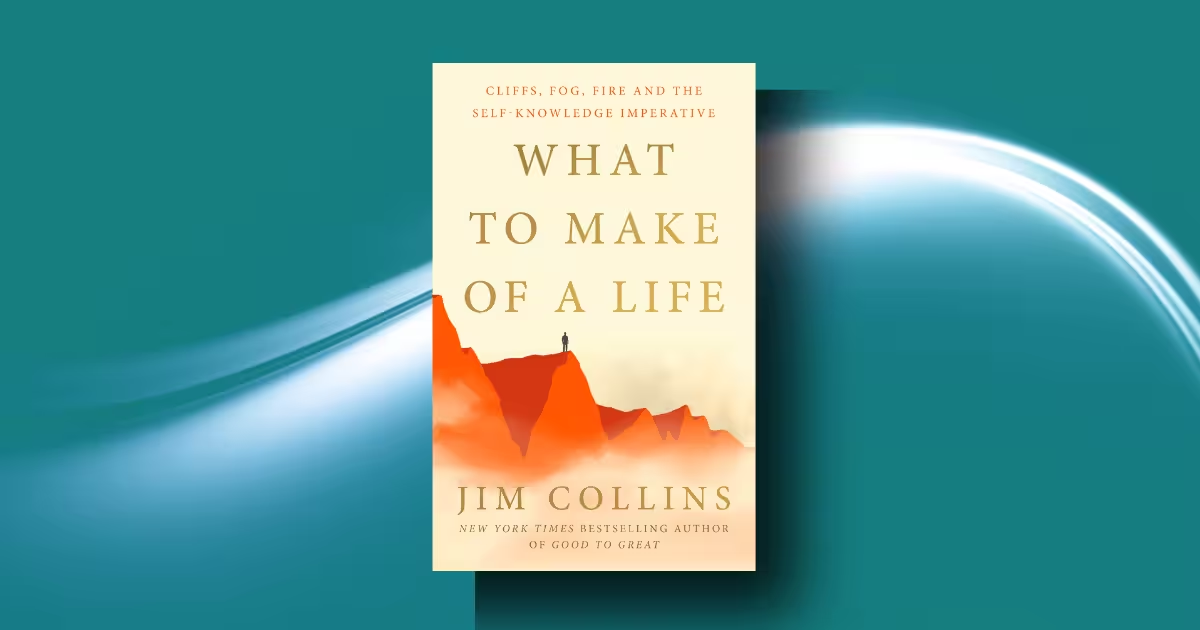
What to Make of a Life: Cliffs, Fog, Fire and the Self-Knowledge Imperative is the latest work from Jim Collins, the legendary business thinker and author of perennial bestsellers like Good to Great and Built to Last.
Published by Harper Edge in April 2026, What to Make of a Life represents a dramatic departure from Collins’s previous focus on corporate excellence, pivoting instead to the most intimate and universal question of all: how to construct a meaningful human life.
Context: If you know Jim Collins, you know he doesn’t do small projects. Known for his rigorous research methodology—spending years analyzing matched pairs of companies to understand what separates the great from the merely good—Collins applies this same exhaustive framework here to individual lives.
Over ten years of research and two years of writing, he and his team systematically studied 34 remarkable lives spanning more than 2,809 years of lived human experience.
The methodology is ingenious: he pairs people who faced remarkably similar “cliffs” (life-altering events) and then examines how their divergent responses shaped everything that followed.
The subjects range from rock stars (Robert Plant and Jimmy Page of Led Zeppelin) to astronauts (John Glenn, Gordon Cooper), Nobel Prize-winning scientists (Barbara McClintock), pioneering suffragists (Alice Paul, Lucy Burns), NFL legends (Alan Page, Carl Eller), and even Founding Fathers (Benjamin Franklin, Roger Sherman).
Purpose: The central thesis of What to Make of a Life is both simple and revolutionary: There is no single “right” path or purpose that you must discover. Instead, Collins argues, each of us carries a unique “constellation of encodings”—durable, intrinsic capacities built into our construction that await discovery through the experiences of life.
What to Make of a Life‘s purpose is to provide a conceptual scaffolding for understanding how lives unfold, fracture, and renew, organized around three core elements: encodings (what you’re intrinsically built for), economics (flipping the arrow of money), and inner fire (what you love doing so much you’d do it regardless of reward).
As Collins writes in the opening chapter, “It is decidedly not a self-help book. But it is a self-knowledge book.”
2. Background: The Personal Cliff That Started It All
What to Make of a Life‘s origin story is deeply personal—and it’s one of the most moving passages Collins has ever written. At age 13, Collins essentially lost his father while the man was still alive.
His parents had split, his mother moved the family to a freezing basement apartment with a hotplate for a stove, and his beatnik-artist father had retreated to an adobe hut with a dirt floor in New Mexico. Collins describes the precise “fracture point”:
“In early high school, I gave one last try with my father, hoping for a dad… Over that weekend, he asked almost nothing about me, but talked mainly about himself and how unfairly his mother had treated him… When I boarded the bus going back north, I knew once and for all, ‘There will never be a father there.'”
This moment planted the first seed of the research project that would consume a decade of Collins’s life. He left New Mexico not with a father, but with a cascade of existential questions: *How to get through the befuddling terrain of youth?
How to find a path? What to do with this one amazing gift of a single life to live?* As he admits in interviews, “I didn’t know, and I didn’t know how to know.”
That admission of profound uncertainty from someone who would go on to become one of the world’s most influential business thinkers is, in itself, a powerful opening salvo. It tells readers: even those who seem to have it all figured out started in the fog.
3. What to Make of a Life Summary
Collins structures the book into three interconnected parts, each building on the last. Here’s everything you need to know—organized so comprehensively that you may feel you’ve absorbed the book’s essential wisdom without turning a single page.
Part I: Coming Into Frame
This section addresses how people find and commit to a path that meets three essential tests: (1) they are deeply encoded for it, (2) they make the economics work to pursue it, and (3) it ignites their inner fire.
1. One Big Thing: Finding a Personal Hedgehog
Collins revives his famous “hedgehog concept” from Good to Great and applies it to individual lives.
The hedgehog represents the intersection of three circles: what you’re encoded for, what you can be paid for (with the arrow of money flipped), and what feeds your inner fire. Barbara McClintock serves as the archetype. A geneticist who won the Nobel Prize at age 81, McClintock was so absorbed in her work that she once forgot her own name during a college exam. She described herself as being “entranced with the joy of study and learning.”
Crucially, she never saw her work as a means to wealth—when told her Nobel Prize came with $190,000, she seemed almost befuddled: “Oh, it is? I didn’t know.”
Grace Hopper, the computer science pioneer who invented the first compiler and helped create COBOL, shows a more expansive hedgehog. She thrived in the Navy, in corporate settings, and on Late Night with David Letterman, pulling out color-coded nanosecond wires at age 79 to explain computing efficiency.
Both women found their “One Big Thing,” but they expressed it in radically different ways based on their unique encodings.
2. A Constellation of Encodings
This is perhaps What to Make of a Life‘s most transformative concept. Collins argues that encodings are fixed like stars in the sky—what changes as you move through life is the frame through which you’re viewing them.
When John Glenn was struggling in college chemistry and failing to make varsity sports teams, his encodings for spatial reasoning, calm under pressure, and precision were out of frame. The moment he got into a cockpit, the frame shifted, and those same capacities lit up brilliantly.
As Collins puts it, “The encodings are fixed, just as the stars in the sky are largely fixed. What changes as people move through life is the positioning and size of the frame.”
The research reveals that people languish terribly when operating contrary to their encodings. Glenn’s disastrous run for president in 1984?
Out of frame. Gordon Cooper’s post-NASA business ventures where he trusted the wrong people? Out of frame. Some encodings, like Glenn’s check-happy grunt-work mentality, stay in frame across multiple roles (astronaut, senator). Others appear only when life spins the frame sideways.
Collins even applies this insight to his own management style, admitting: “I used to spend a lot of emotional energy feeling frustrated with what people are not. And most egregiously, I would sometimes feel incredibly frustrated that they weren’t more like me.”
Now, he says, his dominant emotion is gratitude—he simply seeks the right frame for each person.
3. Flipping the Arrow of Money
The book’s economic insight is startlingly counter-cultural: the people in this study did not work to make money; they needed money to be able to do their work. Collins calls this “flipping the arrow.”
Robert Plant endured years of privation—stealing milk from doorsteps, siphoning petrol—to sustain his music before Led Zeppelin‘s success. Later, at age 59, he turned down a potential billion-dollar Led Zeppelin reunion tour because it wasn’t an adventure. “You know that Monty Python film where the king is with his son in a castle and he’s pointing out the window saying, ‘One day lad, all this will be yours’?
And the son says, ‘But I don’t want it, all I want to do is sing!’ I think that’s my deal,” Plant said.
Collins’s research team identified twelve distinct economic streams that people drew upon, including mastering scarcity, family wealth, spousal economics, salaried hedgehog, creative flywheel, and earned earlier. The key finding: only about half the study subjects earned a traditional paycheck as their primary economic mechanism.
Everyone found some combination that worked for their circumstances.
4. Focus the Inner Fire
Love of the doing—not love of the idea of the work, but of the daily grind—emerged as the most sustainable fuel. Tenley Albright, the first American woman to win Olympic figure skating gold, trained for years for a performance that lasted mere minutes (Collins calculates less than 0.001% of her total training time).
What fed the other 99.999%? She loved the process of falling, getting up, improving incrementally. As she put it, “You do it because you love what you are doing.” She later applied the same ethos to her surgical career, finding the operating room as absorbing as the ice rink.
Collins also introduces the Stress and Drudgery Tax—the unavoidable friction even in work you love. Architect I.M. Pei, even at the zenith of his career, was spat upon in Paris streets and saw his Louvre Pyramid design denounced as “soulless, cold, and absurd.”
He endured. Grace Hopper battled bureaucratic resistance to technological change for four decades. The crucial question: does the fire exceed the tax?
Part II: Navigating Cliffs and Fog
5. Cliffs
A cliff is “a significant event that alters the trajectory of a life and forces choices about what’s next.” Collins’s research team tried to find “cliffless” lives as a methodological control.
They couldn’t. After analyzing 141 candidates, they concluded: “the odds that you’re going to get to the end of a reasonably long life without at least one major cliff are astronomically close to zero.”
The book’s paired comparisons are devastatingly illuminating. Cardiss Collins lost her husband in a plane crash and inherited his Congressional seat—a role she’d never wanted.
She gradually discovered she was deeply encoded for legislative work and served 12 terms. Maryon Pittman Allen faced an identical cliff when her senator husband died suddenly.
She took his seat, hated every minute of it (“politics was for those whose stomachs are lined with lead”), and eventually found her true frame restoring vintage wedding gowns. Same cliff, entirely different outcomes—a function of different encodings.
6. Fog
Fog is the disorienting, uncertain period after a cliff. What to Make of a Life‘s most comforting revelation: everyone experiences fog, even the most accomplished people. Michael J. Fox took seven years between his Parkinson’s diagnosis and going public.
He spent that time wrestling privately—dealing with a drinking problem, making disappointing films, gradually reorienting his priorities toward family and, eventually, his foundation. As he told Barbara Walters, he initially expected a cure within a decade; instead, he found a community and a new purpose.
Collins’s crucial warning for high-achievers: the discomfort of fog triggers premature action. “What can happen is they find the fog very uncomfortable, because they’ve actually had a long period of life leading their companies where they were not in the fog.
The result: They leap. They take another CEO gig. They join 18 boards.” Leaping just to escape the fog can send you over another cliff.
7. Simplex Stepping
The way out of fog is not through grand plans but through “simplex stepping” —taking the best small step visible right in front of you, reassessing, and stepping again. Katharine Graham is the master class.
When her husband’s suicide left her in charge of The Washington Post Company, she didn’t sell (too big a decision), didn’t hire a replacement CEO (too risky), and simply began learning. “I thought, well, the only intelligent thing is to try to learn what things are about.”
Seven years of small steps later, she had the clarity and courage to publish the Pentagon Papers and weather Watergate. She won a Pulitzer for her memoir at age 80.
Part III: Feeding the Inner Fire Long and Late
This section is where Collins delivers his most hopeful and least expected finding: your best, most creative years are likely still ahead of you.
8. Extend Out/Circle Back
Meryl Streep is the exemplar here. Facing Hollywood’s “turning-40” cliff, when she received three separate offers to play a witch, she made an unexpected pivot: she did comedy (Death Becomes Her, Postcards from the Edge) and action (The River Wild).
She extended far out, then circled back to deeply dramatic roles (The Bridges of Madison County, Doubt), then extended again into musicals (Mamma Mia!). The result: she earned more Oscar nominations after age 40 than any actor in history (male or female) achieved in their entire careers.
Benjamin Franklin provides the ultimate data point Collins loves to cite: across major biographies, 53% of the pages remain when Franklin reaches age 60. More than half of what was worth writing about one of history’s most accomplished humans hadn’t happened yet.
At age 70, he served on the committee to draft the Declaration of Independence and made the crucial edit from “sacred and undeniable” to “self-evident.” At age 81, he helped rescue the Constitutional Convention.
9. Choosing Responsibilities
Collins quotes Toni Morrison: “Freedom doesn’t mean the absence of responsibilities. Freedom means you get to choose your responsibilities.” Charles Colson, Nixon’s “hatchet man” who went to prison for Watergate, could have tried to rehabilitate his reputation.
Instead, he chose the forward-facing responsibility of Prison Fellowship, dedicating 37 years to bringing faith and reform to prisons. He kept a letter from Siberian prisoners in his briefcase, not his Templeton Prize medal.
The book’s message is clear: those who kept the fire burning hottest asked not “What do I want my legacy to be?” but “What am I still responsible for?”
4. Critical Analysis
What to Make of a Life is an important, potentially life-altering work—and easily Jim Collins’s most personal and philosophically ambitious book to date.
The book’s central arguments are exhaustively supported by evidence. Collins’s methodology is transparent and, by the standards of this kind of qualitative life research, rigorous.
The matched-pair design yields genuine insights that a simple collection of inspirational biographies could not. Seeing Robert Plant and Jimmy Page confront the same cliff (the end of Led Zeppelin) in utterly different ways—Plant moving relentlessly outward into musical adventure, Page circling back again and again to Zeppelin’s magic—illuminates the “encodings” concept more powerfully than any definition could.
What to Make of a Life fulfills its stated purpose: it provides a conceptual scaffolding for self-reflection, not a prescription.
There are no “7 Steps to a Better Life” here, and that’s precisely the point. Collins’s core insight—that we each carry a unique constellation of encodings, and that no one else’s recipe will work for us—is both liberating and demanding.
It requires the hard work of self-knowledge, which is why he calls this “a self-knowledge book, not a self-help book.”
5. Strengths and Weaknesses
What I Found Compelling (The Strengths):
The “encodings” framework is genuinely transformative. The shift from “find your purpose” (which implies a single, elusive answer) to “discover your encodings” (which suggests a vast, internal constellation waiting to be revealed) is more than semantic—it’s emotionally freeing.
Collins’s own transformation from a frustrated manager trying to mold people into mini-mes to a grateful leader seeking the right frame for each person models what this looks like in practice.
The cliff-based methodology yields consistently surprising insights. The pair of John Glenn and Gordon Cooper is particularly haunting: two men of nearly identical backgrounds and extraordinary capabilities, yet one found a perfectly fitting second hedgehog in the U.S. Senate while the other drifted through a series of misadventures.
The difference, Collins suggests, lay in Glenn’s deeper self-awareness of what his encodings actually were (grunt work, checklists, minutiae) versus what they weren’t (presidential-level vision, fundraising).
The book’s unexpected discoveries—that cliffs are universal, that creativity accelerates after 60, that focusing on legacy is actually counterproductive—overturn multiple pieces of conventional wisdom in ways that feel both fresh and evidence-grounded.
The Roger Sherman case study, in which Collins rescued an obscure Founding Father whose committee-work encodings proved as consequential as Franklin’s showmanship, is a master class in why visible success is not the same as impact.
Where I Felt Some Friction (Potential Weaknesses):
The density of biography is both a feature and a bug. With 34 subjects, some readers may feel they’re being asked to track an overwhelming number of life stories. Certain figures appear briefly and then vanish; others recur, but not always in predictable ways.
A more streamlined narrative might have sacrificed research rigor but gained accessibility.
The economic analysis, while valuable, sometimes feels like a concession to Collins’s business-book roots rather than a fully integrated component. The “12 economic streams” are analytically useful, but the book’s most moving passages have little to do with financial mechanics.
That said, Collins’s honesty about family wealth (only six of 34 subjects drew on it significantly) and his emphasis on “mastering scarcity” offer necessary correctives to the bootstrap myth.
Finally, Collins’s own transformation narrative is so central to the book’s emotional arc that readers who don’t connect with his personal story may feel slightly held at arm’s length. I found it moving—particularly the closing reconciliation with his late father—but it’s a gamble to make the author’s journey so central to a book that claims to be about universal patterns.
6. Comparison with Similar Works
What to Make of a Life occupies interesting territory. It has more research rigor than Daniel Pink’s Drive or Angela Duckworth’s Grit, but less psychological science than something like Arthur Brooks’s From Strength to Strength.
It shares DNA with David Epstein’s Range in its appreciation for late blooming and diverse experience, but Collins’s matched-pair structure is entirely his own.
The closest comparison might actually be to a work of history like Robert Caro’s biographies—which also use contrast pairs (Lyndon Johnson vs. his contemporaries) to illuminate what made a particular life unfold as it did.
But Collins is more explicitly focused on extracting actionable frameworks.
For readers of Collins’s earlier work, there’s continuity (the hedgehog, the flywheel) but also dramatic evolution—this is a more emotionally vulnerable and philosophically searching book than Good to Great.
7. Conclusion
What to Make of a Life will resonate most deeply with readers who find themselves at a transition point—whether that’s the fog of youth, the disorientation of a midlife cliff, or the question of how to stay fully alive in one’s 60s, 70s, and beyond.
It’s for people who have grown skeptical of prescriptive self-help and are ready for something more rigorous, more patient, and ultimately more respectful of human complexity.
Best for:
- Anyone facing a major life transition (career change, empty nest, retirement, or unexpected loss)
- Leaders who want to better understand how to deploy people based on their encodings, not just their résumés
- Readers of Collins’s previous work who are curious about how his thinking has evolved
- People in their 50s and 60s who suspect their best work is behind them (it’s not)
- Parents trying to support young adults through the fog of youth without imposing their own encodings
Not for:
- Readers seeking quick-fix solutions or simple “ten steps to happiness” formulas
- Those who prefer single-biographical narratives to research-driven synthesis (try Walter Isaacson’s biographies instead)
- Anyone unwilling to engage in the uncomfortable work of genuine self-examination
The book’s closing image is of Collins’s final meeting with Jack Bogle, the Vanguard founder, then 88 years old. Bogle’s body was failing—it took 20 minutes to walk a five-minute courtyard—but his eyes “burned with fierce intensity undiminished by the ravages of age, a fire of the hottest blue.”
That’s the promise of What to Make of a Life: not that you’ll avoid cliffs or skip the fog, but that if you discover your encodings, choose your responsibilities, and keep stepping forward, the fire never needs to go out.