
Oil is more than a commodity. It is a strategic resource that sits at the intersection of national security, global finance, industrial development, and climate policy. “World oil politics” refers to the ways governments, state-owned energy companies, private firms, alliances, and international institutions compete and cooperate to control oil production, transportation, pricing, and access—while managing the profound social and environmental consequences of hydrocarbon dependence.
Although oil markets are often described as governed by “supply and demand,” the real world is messier: wars disrupt exports, sanctions rewire trade routes, cartels attempt to manage prices, and technological shifts—like the shale revolution or the rise of electric vehicles—reshape bargaining power.
To understand modern geopolitics, one must understand how oil created leverage for some states, vulnerability for others, and recurring cycles of boom, bust, and conflict.
This article explores the evolution of global oil politics, the major actors and tools of influence, the strategic geography of chokepoints and pipelines, the role of pricing and finance, and how the energy transition is transforming the political logic of oil.
Table of Contents
1. Introduction to World Oil Politics
Oil has been a cornerstone of global politics since the early 20th century, shaping alliances, conflicts, and economies. Often called “black gold,” it’s not just an energy source but a strategic asset that influences international relations.
Historical Roots
The modern oil era began with discoveries in the Middle East, where Western powers like Britain and the US secured concessions in places like Iran and Saudi Arabia. Post-World War II, oil fueled reconstruction and the Cold War, with superpowers vying for control over reserves. The 1973 Arab-Israeli War led to the OPEC oil embargo, causing price shocks and highlighting oil’s weaponization in geopolitics.
Key Players
OPEC (Organization of the Petroleum Exporting Countries): Founded in 1960, this cartel (including Saudi Arabia, Iraq, and Venezuela) coordinates production to stabilize prices. OPEC+ extends this to non-members like Russia.
Major Producers: Saudi Arabia leads in reserves and exports, followed by Russia (despite sanctions) and the US, which became the top producer via shale oil fracking in the 2010s.
Consumers: The US, China, and Europe are top importers, making them vulnerable to supply disruptions.
Geopolitical Dynamics
Oil politics often intertwine with conflicts: Wars in Iraq (1991, 2003) were partly about securing resources. Sanctions on Iran and Russia aim to curb their influence by limiting exports.
Pipelines, like Nord Stream or those crossing Central Asia, become flashpoints for control. Climate change adds tension, as oil-dependent nations resist transitions to renewables, while others push for green energy to reduce dependence.
Price volatility—driven by supply cuts, demand shifts, or events like the COVID-19 pandemic—affects global inflation and growth. The 2022 Russia-Ukraine war spiked prices, underscoring energy security’s role in national strategies.
In essence, oil politics is about power: Who controls it, who needs it, and how it’s used as leverage. As the world shifts toward sustainability, these dynamics are evolving, but oil remains a pivotal force in international affairs.
2. Why Oil Became a Political Resource
Oil’s political importance comes from three attributes:
1. Concentration of reserves and low-cost production.
A large share of easily produced, low-cost oil lies in a small number of countries, especially in the Middle East. This creates structural dependence for importers and gives exporters potential leverage.
2. “Fungibility,” but not frictionless trade.
Oil can be shipped globally and substituted across suppliers—but only if transportation routes remain open, insurance and payments are possible, and refineries can process the crude grades available.
Politics can add friction: embargoes, sanctions, piracy risks, or shipping lane threats can effectively segment the market.
3. Centrality to modern life and military power.
Oil fuels transportation (cars, trucks, ships, aviation), petrochemicals (plastics, fertilizers, industrial inputs), and military mobility. That makes supply disruptions politically explosive: fuel prices affect inflation, household costs, and electoral outcomes.
For much of the 20th and early 21st centuries, oil has been both an economic foundation and a strategic vulnerability—an ideal recipe for geopolitics.
3. A Brief History of World Oil Politics
The early era: private empires and “concessions”
In the early 1900s, major oil firms and imperial powers shaped access through concessions—long-term agreements granting foreign companies rights to explore and produce. This created resentment and set the stage for later resource nationalism.
By the mid-20th century, a small group of Western oil majors dominated production, refining, and distribution. They could manage prices and investment, often aligned with the strategic interests of their home governments.
Decolonization and nationalization
After World War II, producer countries increasingly pushed back. Many created national oil companies (NOCs) and nationalized assets, aiming to capture greater rents and sovereignty. This shift transformed oil from mostly corporate power into state power.
OPEC and the oil shocks
Founded in 1960, the Organization of the Petroleum Exporting Countries (OPEC) gained influence as producers asserted control. The 1973 Arab oil embargo and the 1979 Iranian Revolution underscored how political events could cause price shocks, reshaping global inflation, security planning, and foreign policy.
In the 1980s and 1990s, price collapses and conflicts (including the Iran–Iraq War and the Gulf War) reminded both producers and consumers that instability can destroy revenue or trigger intervention.
Meanwhile, oil markets globalized further through expanding spot markets and futures trading.
The 21st century: multipolar competition and new technology
The 2000s saw rising demand from Asia, resource wars and insurgencies, and intense debate about “peak oil.” Then the U.S. shale revolution upended assumptions by adding large, flexible supply.
In the 2020s, sanctions, great-power rivalry, and energy transition pressures intensified uncertainty.
History reveals a constant pattern: oil markets repeatedly swing between confidence and crisis, and politics is often the trigger.
4. The Core Actors in Oil Politics
1. Producer states and their national oil companies (NOCs)
Many of the world’s largest reserves are controlled by NOCs. These companies are often instruments of state policy, not purely profit-maximizing firms.
Governments rely on oil revenue to fund budgets, subsidies, public sector wages, and political coalitions. That dependence can push producers to favor higher prices—but it also creates fear of losing market share or provoking demand destruction.
Major importers—such as the United States (despite large production), the European Union, China, India, Japan, and South Korea—focus on reliability, price stability, and diversification.
Their tools include strategic petroleum reserves, diplomacy, naval presence, sanctions policy, and efficiency standards.
2. International oil companies (IOCs)
Private majors and large independents still matter, especially in technology-intensive areas (deepwater, complex geology, project management, trading). However, their control over reserves has declined relative to NOCs.
They remain politically significant due to investment decisions, lobbying, and their role in international supply chains.
OPEC is best seen as a coalition that attempts to manage production to influence prices.
Over time, coordination with non-OPEC producers—most notably Russia—has sometimes increased the group’s ability to shape market expectations. The success of coordination depends on internal discipline, shared incentives, and external competition (like U.S. shale).
3. International institutions and standard-setters
Organizations such as the International Energy Agency (IEA) coordinate consumer policies (especially emergency stock releases), publish data that shape expectations, and influence long-term transition narratives.
Financial regulators, shipping insurers, and benchmark providers also have quiet but powerful influence over how oil is traded.
5. The Producer’s Dilemma: Revenue vs. Market Share
Oil producers face a recurring strategic tradeoff:
- Restrict supply to raise prices (higher revenue per barrel)
vs. - Maintain or expand supply to protect market share (long-term relevance)
This is complicated by three realities:
1. Spare capacity as geopolitical power
Countries with spare production capacity—the ability to quickly raise output—hold outsized influence because they can calm markets during disruptions or, conversely, keep markets tight. Spare capacity is not just an economic tool; it is strategic leverage that can win diplomatic goodwill or extract concessions.
2. Fiscal break-evens and domestic politics
Many petrostates fund large portions of government budgets with oil revenue. When prices fall, leaders may face social unrest, cuts to subsidies, currency pressure, or elite infighting. That can motivate producers to support price-increasing coordination—until cheating becomes tempting.
3. The credibility problem
Cartel-like coordination is hard. Every member benefits if others cut, but each has an incentive to produce more than agreed. Compliance depends on monitoring, trust, and the fear of retaliation or price collapse.
6. The Consumer’s Dilemma: Cheap Oil vs. Secure Oil
Consumers also face a strategic tradeoff:
- Seek the lowest cost (cheaper energy, lower inflation)
vs. - Pay for security and resilience (diversified suppliers, stockpiles, domestic production, protected shipping)
Key consumer strategies include:
1. Strategic petroleum reserves (SPRs)
Stockpiles can dampen panic during supply disruptions and buy time for diplomacy or market adjustment. Their effectiveness depends on scale, release speed, and coordination among major consumers.
2. Diversification of supply and refining flexibility
Importers often seek multiple suppliers and invest in refineries able to process different crude types. However, infrastructure is sticky: pipelines, refineries, and long-term contracts create path dependence.
3. Domestic production and “energy independence”
Domestic output can reduce vulnerability, but it rarely eliminates exposure to global prices. Because oil is globally traded, a price shock hits domestic consumers even if the barrels come from local fields.
7. Geography as Destiny: Chokepoints, Sea Lanes, and Pipelines
Oil politics is inseparable from geography. Production is concentrated, but consumption is global—so transportation routes become strategic.
Maritime chokepoints
Several narrow passages carry a large share of seaborne oil trade. Disruption—through conflict, mining, piracy, drone attacks, or blockade threats—can spike insurance costs and prices.
- Strait of Hormuz: gateway from the Persian Gulf to global markets
- Bab el-Mandeb: connects the Red Sea to the Gulf of Aden (route toward Suez)
- Suez Canal and SUMED pipeline: key for Europe-Asia flows
- Strait of Malacca: critical for East Asia’s imports
- Turkish Straits (Bosporus/Dardanelles): important for Black Sea flows
Even the threat of disruption can raise prices because markets price risk.
Pipelines: fixed assets, fixed politics
Pipelines create durable relationships between transit states, producers, and consumers. They can also create vulnerability: sabotage, political disputes over transit fees, and dependency on a single corridor.
Pipeline politics often involves:
- bargaining over tariffs and access,
- disputes over ownership and control,
- the use of energy as leverage in broader diplomatic conflicts.
8. Sanctions, Export Controls, and “Oil as a Weapon”
One of the most consequential aspects of modern oil politics is the use of economic statecraft.
Historically, embargoes or supply reductions aimed to pressure consumer states. In practice, this tool is risky: it can accelerate diversification, encourage domestic production elsewhere, and reduce long-term demand.
1. Consumer leverage: sanctions and financial restrictions
Importers and coalitions sometimes restrict a target country’s ability to export oil, receive payments, obtain technology, or insure shipments. Modern sanctions frequently operate through:
- banking and payment systems,
- shipping insurance and classification services,
- technology controls (especially for complex extraction).
Sanctions reshape global trade patterns: oil may be rerouted through intermediaries, sold at discounts, or transported via “shadow” logistics. This creates a cat-and-mouse dynamic between enforcement and evasion, and it can fragment the market into partially separated price zones.
2. The moral and political complexity
Sanctions are rarely “clean.” They can reduce revenue to targeted governments, but they may also raise global prices, burden civilians, and incentivize alternative alliances.
As a result, sanctioning oil exporters often forces policymakers to balance strategic goals against inflation and supply risk.
9. How Oil Prices Are Actually Made: Markets, Benchmarks, and Narratives
Oil prices are shaped not only by physical barrels, but by expectations—about future supply, demand, risk, and policy.
Benchmarks and grades
Global pricing often references benchmarks like Brent and WTI, but most crude is sold at a differential to a benchmark based on quality (sulfur content, density) and location. Politics that affects shipping routes or refinery access can change differentials dramatically.
Futures markets allow hedging and speculation. They also transmit geopolitical news quickly into prices. A missile strike, a coup rumor, or an unexpected policy announcement can move prices before any physical disruption happens.
Credibility, messaging, and “jawboning”
Statements by key producers, consumer governments, or central banks can move prices by changing expectations about supply policy, demand growth, or interest rates. Oil politics includes information politics: signaling, ambiguity, and strategic messaging.
10. Domestic Politics Inside Petro-States: The Hidden Engine
International oil politics is deeply shaped by domestic constraints within producing states.
The “rentier state” problem
In many oil-dependent states, governments rely heavily on oil rents rather than broad taxation. This can reduce accountability and encourage patronage networks. Stability may depend on distributing oil revenue through public wages, subsidies, and elite bargains.
When prices fall:
- budgets tighten,
- currency pressure grows,
- social expectations collide with austerity,
- regime legitimacy can be tested.
When prices rise:
- governments may expand spending,
- but also risk corruption, overheating, and long-term dependency.
Succession, legitimacy, and conflict risk
Leadership transitions and factional politics can affect oil output decisions, investment, and relations with neighbors. In some contexts, oil wealth can finance internal repression; in others, it can fund social contracts that reduce unrest.
11. The U.S., China, Russia, and the New Multipolar Oil Order
Modern oil politics is often described as “multipolar,” with several major powers shaping outcomes.
The United States: producer, consumer, and security provider
The U.S. plays multiple roles at once:
- a major oil producer with highly responsive shale output,
- a large consumer sensitive to gasoline prices,
- a security actor with interests in sea-lane protection and regional stability.
This creates internal tension: policies that support producers (higher prices) may hurt consumers (inflation), and foreign policy goals (sanctions, pressure campaigns) can collide with domestic price politics.
China: demand gravity and strategic diversification
China’s scale gives it influence: its demand trends affect global balances, and its investment and diplomacy shape upstream projects and infrastructure.
China’s strategy often emphasizes diversification—multiple suppliers, long-term contracts, and expanded refining and storage—reducing vulnerability to any single chokepoint or producer.
Russia: energy as revenue and leverage
Russia has long been a major exporter whose oil revenues support the state. Its role in producer coordination and its exposure to sanctions demonstrate how oil is both a source of power and a vulnerability.
Political conflict can change where and how Russian barrels move, forcing global logistics to adapt.
Middle Eastern producers: core of low-cost supply
Many Gulf producers sit atop low-cost reserves and, in some cases, spare capacity—key levers in stabilizing markets. Their geopolitical relationships with the U.S., China, Europe, and regional rivals influence production decisions, investment, and security alignments.
12. The Energy Transition and the Changing Politics of Oil
Perhaps the biggest structural shift in oil politics today is the collision between petroleum dependence and climate policy.
Demand uncertainty becomes the new risk
For decades, producers worried most about supply disruptions and price collapses. Now, many also worry about long-term demand erosion from:
- electric vehicles,
- efficiency improvements,
- alternative fuels,
- climate regulation and carbon pricing,
- changes in investor sentiment.
This creates a paradox: if producers believe demand will peak sooner, they may accelerate production to monetize reserves—potentially increasing near-term supply and volatility.
“Stranded assets” and the race to be the last low-cost producer
In a world of declining demand, the lowest-cost barrels have the best chance of being produced profitably.
That could intensify competition among producers and encourage strategies to lock in customers through refining partnerships, petrochemical expansion, or price discounts.
The rise of “green geopolitics”
As oil politics gradually declines, geopolitics doesn’t disappear—it shifts:
- critical minerals (lithium, nickel, cobalt, rare earths),
- clean-tech supply chains (batteries, solar, wind),
- electricity grids and interconnectors,
- hydrogen and ammonia trade,
- carbon capture and storage infrastructure.
Oil remains important, but it increasingly competes with—and is shaped by—decarbonization strategies.
13. Where World Oil Politics May Be Headed
Predicting oil politics is notoriously difficult, but several durable dynamics are likely to persist:
1. Volatility will remain a feature, not a bug
Because investment cycles are long and geopolitical shocks are sudden, oil markets naturally swing. Underinvestment can create future shortages; oversupply can crash prices. Politics magnifies both.
2. Energy security will broaden beyond oil
Governments will increasingly treat energy security as a system problem: oil, gas, electricity, critical minerals, cyber resilience, and climate adaptation. This may reduce oil’s singular dominance in geopolitics, but it raises new vulnerabilities.
3. Producer states will face pressure to diversify
Petrostates that use today’s revenues to build non-oil economies may become more stable in a transition. Those that fail may face fiscal crises and political instability, which can feed back into supply risk.
4. Military and maritime security will stay relevant
Even with declining oil demand, shipping lanes and regional stability remain central to trade, food, and broader security—so chokepoint politics won’t vanish quickly.
5.Legitimacy politics will matter as much as barrels
International partnerships will increasingly be shaped by governance, sanctions alignment, technology access, and climate commitments—not just volumes.
14. World Oil Politics With Case Studies: How Crude Became Power
Oil politics is the struggle—sometimes quiet, sometimes violent—over who produces oil, who transports it, who buys it, and on what terms.
Because oil is central to transportation, petrochemicals, and military mobility, shifts in supply or price ripple into inflation, economic growth, and regime stability.
Oil is traded globally, but it is not insulated from politics: chokepoints can be threatened, production can be coordinated or disrupted, and finance and shipping services can be weaponized through sanctions.
A helpful way to understand world oil politics is to treat it as a set of recurring “games” played by states and firms:
- The cartel game: producers coordinate (or fail to) to influence price (OPEC, OPEC+).
- The chokepoint game: narrow waterways and pipelines become strategic pressure points (Suez, Hormuz, Bab el‑Mandeb).
- The security game: militaries protect—or threaten—energy infrastructure and shipping.
- The financial plumbing game: insurance, shipping services, and payment systems shape who can sell oil and at what discount (sanctions, price caps).
- The domestic survival game: oil revenue funds budgets and political coalitions; price swings can destabilize governments.
The case studies below show how these games repeatedly reshape the global order.
Case Study 1: The 1956 Suez Crisis and the Geopolitics of Chokepoints
What happened.
In 1956, war and crisis around the Suez Canal disrupted a key maritime artery linking the Mediterranean and Red Sea.
The canal’s strategic value wasn’t abstract: it handled an enormous share of Europe’s oil flows. A commonly cited contemporary measure is that it controlled about two‑thirds of the oil used by Europe—meaning that disruption translated quickly into economic and political pressure
Why it mattered.
The closure forced rerouting around Africa (the Cape route), which lengthened voyages and strained tanker capacity. Scholarship on the period notes that with the canal closed and pipeline capacity reduced, much Middle East oil had to travel to Europe via the Cape, greatly increasing distance and logistical friction.
What it changed.
Suez highlighted a core rule of oil politics that still holds: geography creates leverage.
If the world’s energy system depends on a few narrow passages, then political crises in those locations become global economic events.
Suez also encouraged longer-term investments and strategies—alternative routes, pipeline planning, and stockpiling—to reduce vulnerability.
Case Study 2: The 1973–74 Arab Oil Embargo and the Birth of Modern Energy Security
What happened.
During the 1973 Arab‑Israeli war, Arab producers used oil supply as political leverage. Production cuts and embargo measures transformed prices.
The U.S. Federal Reserve’s historical account describes how these actions nearly quadrupled oil prices—from about $2.90/barrel before the embargo to $11.65/barrel in January 1974—and notes the embargo was lifted in March 1974.
Why it mattered.
The shock wasn’t only higher prices—it was the demonstration that producers could coordinate policy to punish or pressure consumers. That altered diplomatic calculations, defense planning, and domestic politics across importing countries.
What it changed.
The crisis catalyzed institutional responses. The International Energy Agency (IEA) was created in the aftermath of the 1973–74 oil crisis, explicitly as a response to the vulnerability of industrialized countries dependent on imported oil.
This period effectively launched the modern “energy security state”: strategic stockpiles, coordinated emergency response, efficiency standards, and a permanent security focus on supply routes.
Case Study 3: The 1978–80 Iranian Revolution and the “Fear Premium”
What happened.
Revolution in Iran produced a major supply shock. The Federal Reserve’s history of the episode reports that Iranian output declined by about 4.8 million barrels per day by January 1979—around 7% of world production at the time.
Prices then surged: the same account notes oil prices more than doubled between April 1979 and April 1980.
Why it mattered.
This case shows that oil prices are driven not only by barrels lost, but by expectations. The Fed history emphasizes that the disruption helped trigger fear of further disruptions and speculative hoarding—an early example of what traders now call a geopolitical “risk premium.”
What it changed.
The revolution underscored a second durable rule: domestic political upheaval in a key producer can reorder global economics. It also intensified the strategic importance of spare capacity and emergency stocks, because markets react to uncertainty faster than production can adjust.
Case Study 4: The “Tanker War” (1980s) and Naval Power as Energy Policy
What happened.
During the Iran‑Iraq War, the conflict spilled into shipping in the Persian Gulf. Iraq targeted shipping to reduce Iran’s ability to export oil and finance the war.
A U.S. Naval Institute account describes the tanker war as an economic attrition campaign: Iraq attacked ships serving Iranian ports, while Iran’s exports went entirely by sea.
As risks rose, Kuwait sought protection for its tankers. The U.S. responded with Operation Earnest Will (1987–88)—a major naval convoy effort that escorted reflagged Kuwaiti tankers.
Why it mattered.
This is oil politics in its most literal form: freedom of navigation enforced by naval power. Oil supply security became inseparable from military presence and rules of maritime order.
What it changed.
The tanker war entrenched the idea that the Persian Gulf is not just a commercial region but a global security theater. It also showed how chokepoints (like the Strait of Hormuz) are “magnets” for escalation: even limited attacks can drive up insurance costs and influence global prices.
Case Study 5: 1990–91 Gulf Crisis—Invasion, Price Spike, and Stockpile Strategy
What happened.
Iraq’s invasion of Kuwait triggered immediate price volatility.
The 1991 Economic Report of the President notes that after the invasion on August 2, the spot price rose quickly, reaching about $28/barrel on August 6, peaking around $40/barrel in mid‑October, then declining; after the start of Operation Desert Storm in mid‑January 1991, the spot price fell to about $20/barrel.
Why it mattered.
This crisis tested the post‑1973 energy security system. A U.S. Government Accountability Office (GAO) review reports that on August 9, 1990, IEA members decided it was not necessary to draw down emergency stocks at that moment.
What it changed.
The episode illustrated a balancing act that still shapes consumer policy: use strategic reserves too early and you waste ammunition; use them too late and markets may panic.
It also showed how military outcomes can shift oil expectations rapidly—prices eased as confidence grew that major producers and infrastructure would be protected.
Case Study 6: The 2007–08 Oil Price Spike—When Demand, Not War, Drove Geopolitics
What happened.
In July 2008, oil prices hit historic highs—commonly cited around $147 per barrel—and then collapsed as demand fell sharply. A World Bank analysis notes crude reached $147 per barrel in July 2008, then declined by well over 60% over the next six months as demand weakened.
Why it mattered.
This period challenged the popular assumption that “oil shocks = Middle East wars.” Research by James D. Hamilton (Brookings) argues the 2007–08 run‑up was driven largely by strong demand confronting stagnating world production, unlike earlier shocks dominated by physical supply disruptions.
What it changed.
High prices intensified political interest in alternatives—efficiency, biofuels, and eventually electrification.
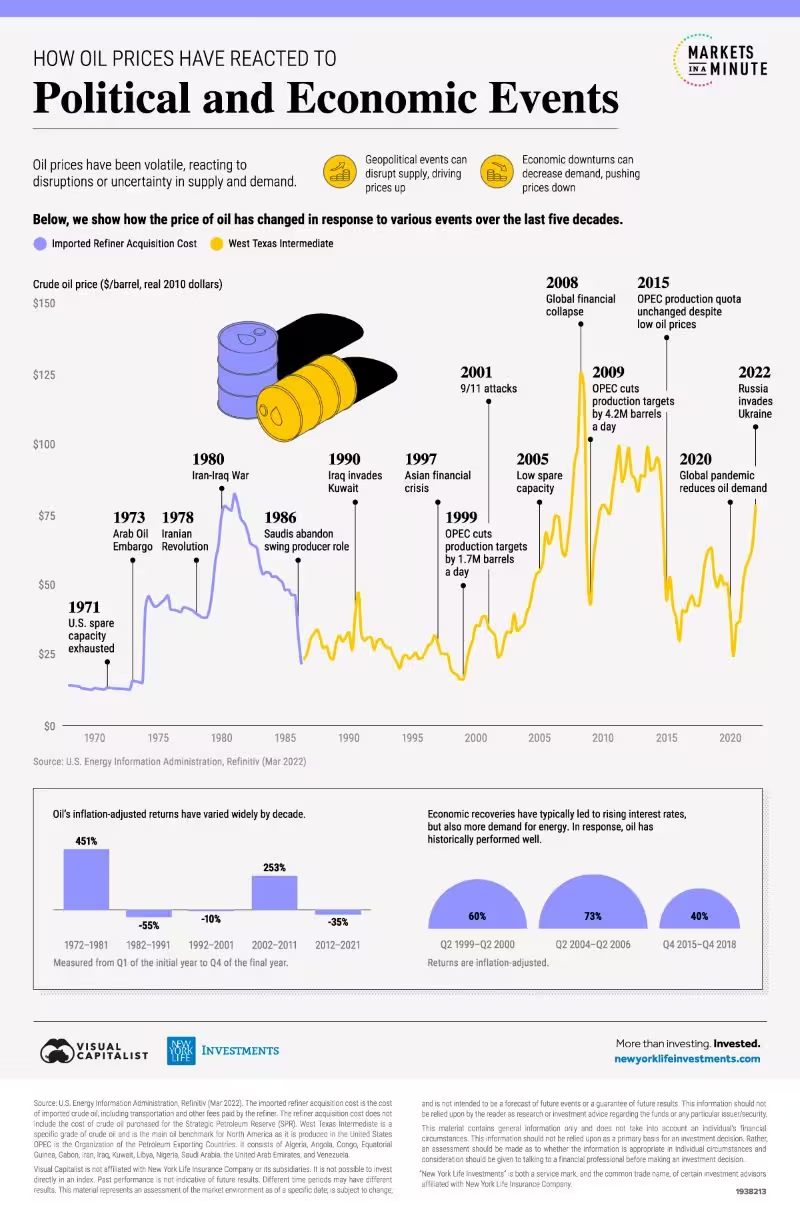
It also strengthened the role of financial expectations and market narratives in oil politics: when demand growth or macroeconomic policy shifts, geopolitics can follow—through inflation, protests, and changes in government priorities.
Case Study 7: Libya 2011 and the IEA’s Coordinated Emergency Release
What happened.
Libya’s civil conflict removed significant volumes of oil from the market, especially light sweet crude valued by many refineries.
In response, the IEA coordinated a major action: it announced that member countries agreed to release 60 million barrels of oil to offset the disruption.
Why it mattered.
This was an example of consumer coordination designed to prevent a supply disruption from morphing into a broader economic crisis. It also highlighted a practical reality: some supply disruptions are not easily replaced by “any oil,” because refinery configurations and crude quality matter.
What it changed.
The action reinforced the IEA’s role as a stabilizer and signaled that energy security had matured into a coordinated system—one in which governments could intervene directly in physical supply to manage geopolitical shocks.
It also set precedents that later informed other emergency releases and coordination efforts.
Case Study 8: 2014–16 Price Collapse—Shale, Market Share, and the Road to OPEC+
What happened.
By 2014, global supply overtook demand and prices began falling. The International Monetary Fund notes that in November 2014 OPEC decided not to reduce supply, accelerating the decline; analysts interpreted this as a choice to squeeze higher‑cost competitors, including U.S. shale.
A contemporaneous analysis from Japan’s Institute of Energy Economics (IEEJ) describes OPEC maintaining production quotas totaling 30 million barrels per day at the November 27, 2014 meeting.
The World Bank similarly describes OPEC’s decision to abandon price controls as amplifying the perception of a supply glut, alongside surging U.S. shale output.
Why it mattered.
This was a strategic gamble: accept lower prices to protect long‑term market share. But it hammered the budgets of petrostates and tested the resilience of shale producers.
What it changed.
The aftermath helped produce a new coordination architecture. OPEC’s own history notes that in December 2016, OPEC and 10 non‑OPEC producers adopted a “Declaration of Cooperation” to help rebalance markets.
The U.S. EIA describes how this 2016 agreement created what is now known as OPEC+.
Oil politics became more explicitly multipolar: coordination now depended not only on OPEC discipline but also on relationships with major non‑OPEC producers.
Case Study 9: 2019 Abqaiq–Khurais Attacks—Infrastructure Vulnerability Goes Global
What happened.
In September 2019, attacks hit Saudi Aramco facilities at Abqaiq and Khurais. A U.S. Congressional Research Service (CRS) brief reports the strikes (using missiles and drones) temporarily disrupted 5.7 million barrels per day—over half of Saudi production and about 5% of global supply.
Why it mattered.
Even though the disruption was temporary, it demonstrated that modern precision attacks could threaten critical nodes of the oil system. Markets quickly priced in the possibility that a similar strike could last longer.
What it changed.
Security thinking shifted from protecting oil fields broadly to protecting key processing plants, export terminals, and the “network” of infrastructure that turns reserves into deliverable barrels. It also reinforced why spare capacity, emergency stocks, and rapid repair capabilities function as geopolitical stabilizers.
Case Study 10: 2020—COVID Demand Collapse and the Day Oil Went Negative
What happened.
In April 2020, oil politics collided with physical constraints. The U.S. EIA reports that on April 20, 2020, WTI front‑month futures traded in negative territory for the first time since trading began in 1983, reaching about −$40.32 per barrel intraday.
The EIA explains the mechanics: collapsing demand plus limited storage and low market liquidity—an illustration that oil is not just a financial asset, but a physical commodity that must be stored.
Why it mattered.
This episode showed how “market fundamentals” can become political emergencies overnight, as governments face pressure over fuel prices, employment, and financial stability—while producers confront existential revenue shocks.
What it changed.
It strengthened the perception that oil markets are now shaped by both geopolitics and “system shocks” (pandemics, supply-chain breakdowns, sudden macroeconomic halts).
It also reinforced the importance of flexible supply, coordinated production management, and storage as strategic assets.
Case Study 11: 2022–26 Russia Sanctions and the G7/EU Oil Price Cap—Financial Chokepoints
What happened.
After Russia’s invasion of Ukraine, Western governments sought to reduce Russia’s oil revenue without removing all Russian barrels from the global market.
The European Commission explains that under the price cap coalition mechanism, EU operators may provide maritime transport and related services for Russian crude and petroleum products only if sold at or below the relevant price caps—designed to reduce revenues while supporting market stability.
Why it mattered.
This was a different kind of oil weapon: instead of blockading oil physically, policymakers targeted the services that make oil trade possible—shipping, insurance, and finance.
In oil politics terms, it turned market infrastructure into leverage.
What it changed (and what it revealed).
It accelerated trade rerouting and the growth of sanction‑evasion logistics. An Associated Press report describes a large “shadow fleet” of tankers helping Russia move oil outside typical G7 oversight and notes that enforcement has become an ongoing contest between regulators and workarounds.
This illustrates a modern reality: control over oil trade increasingly depends on control over the institutions that certify, insure, and finance it, not only on control over wells.
Case Study 12: 2023–24 Red Sea Crisis—Drones, Militias, and the Return of Chokepoint Politics
What happened.
Beginning in November 2023, Yemen‑based Houthi attacks on commercial vessels in and near the Red Sea pushed some shipping to avoid the Bab el‑Mandeb chokepoint and reroute around Africa.
The U.S. EIA notes this shift increased shipping times and costs because Europe–Asia voyages via Suez must pass Bab el‑Mandeb.
The impact was measurable in oil flows: EIA data (via Vortexa) indicates oil trade flows through Bab el‑Mandeb averaged 4.0 million b/d in 2024 through August, down from 8.7 million b/d in full‑year 2023.
The broader economic damage showed up in Egypt’s finances too: an AP report says Egypt’s Suez Canal revenue fell sharply in 2024—nearly two‑thirds versus 2023—amid the disruption and reduced transits.
Why it mattered.
This was a reminder that even in an age of diversified supply, chokepoints still matter—and non‑state actors can impose global costs.
What it changed.
Red Sea disruptions renewed attention to route redundancy, naval protection, and the hidden costs of insecurity (insurance premiums, longer voyages, fleet shortages). And it reinforced how oil politics now intersects with regional conflicts that may have motives only partly related to energy.
15. Patterns and Lessons From the Case Studies
Across seven decades, the same core lessons repeat:
- Oil is global, but its routes are fragile.
Suez (1956) and the Red Sea (2023–24) show that narrow waterways can transmit local conflict into global inflation and fiscal shock. - Perceptions can move prices as much as physical losses.
Iran 1979 demonstrates “fear premiums” and hoarding dynamics; markets price risk instantly, even when barrels are partly replaced. - Institutions matter.
The 1973–74 shock spurred the creation of the IEA and emergency coordination frameworks; Libya 2011 shows those tools being used in practice. - Producer coordination is powerful—but unstable.
The 2014–16 collapse and the later emergence of OPEC+ show how shifts in strategy (price defense vs market share) can reorder alliances and reshape bargaining power. - Modern oil conflict is increasingly “hybrid.”
2019’s Abqaiq attack highlights infrastructure vulnerability; Russia’s price cap highlights financial/insurance leverage; Red Sea attacks highlight the role of militias and drones.
16. Conclusion: Oil Politics Isn’t Ending—It’s Evolving
These case studies show that world oil politics is not simply a story about OPEC meetings or wars in producing regions.
It is a system where geography, domestic legitimacy, market expectations, naval power, and financial rules all shape who gets oil—and who gets paid.
Even as electrification and decarbonization grow, oil politics will remain consequential for decades because the world still runs on liquid fuels and petrochemicals.
The more immediate shift is how oil politics is practiced: less about formal embargoes, more about chokepoint risk, infrastructure defense, sanctions design, and the constant strategic dance between revenue, market share, and security.