
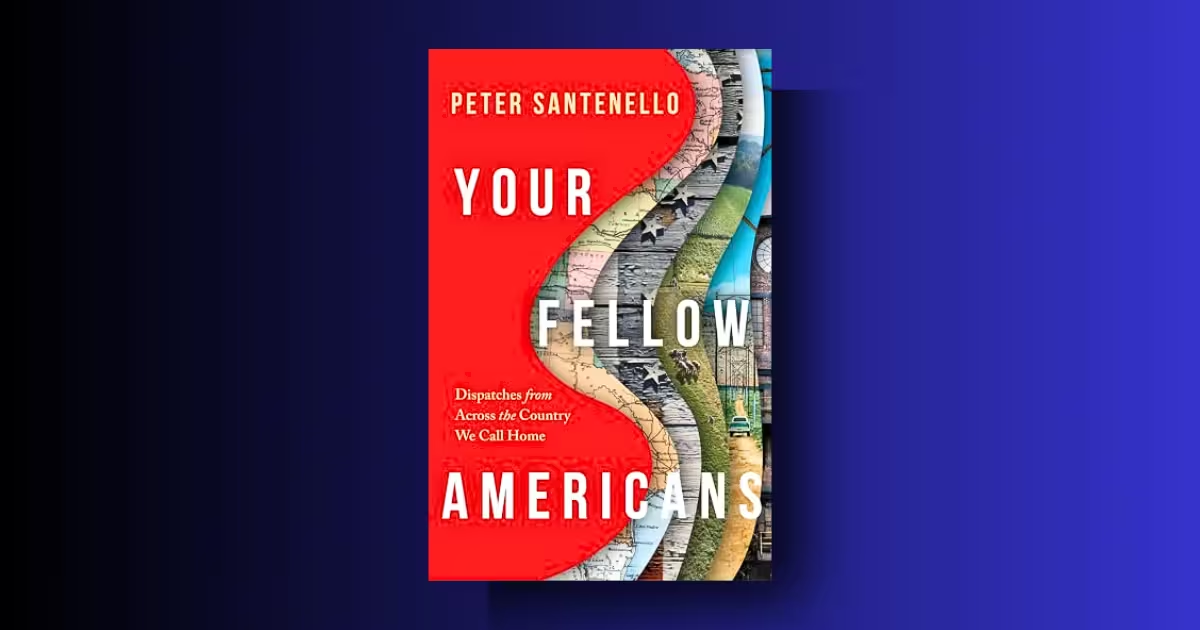
Did you ever wonder why we feel so disconnected from our own countrymen, even though we share the same flag and the same soil? Peter Santenello’s Your Fellow Americans doesn’t just answer that question—it drags you into the homes, hollers, and houseboats of people you’ve only ever seen through the distorted lens of cable news.
Overview
Peter Santenello is an independent journalist and filmmaker with over four million subscribers on YouTube. He’s traveled to eighty-five countries and lived in five, building a global audience by letting people tell their stories in their own words.
Your Fellow Americans, published by Simon & Schuster on August 4, 2026, represents his most personal work yet, turning his camera inward on his own country after years of documenting the rest of the world.
The book is organized into four distinct parts: “Neither Here Nor There” explores communities living alongside the modern world while staying rooted in their traditions, Amish farmers in Ohio, Chicano lowrider culture in East LA, and Siberian Yupik hunters on a remote Alaskan island.
“The Underdogs” takes us to Central Appalachia and the Mississippi Delta, regions written off by most of the country but full of grit and sincerity. “The Long Game” examines places that have endured and overcome—Northern California’s redwood country and an isolated island in the Chesapeake Bay where families have spoken an Elizabethan dialect for nearly four hundred years.
Finally, “Pioneering Spirit” celebrates Americans living true to their own tune, including a memorable journey into the Louisiana Bayou.
Table of Contents
Reader recommendation
Your Fellow Americans is best for:
- Americans feeling disconnected from their own country and wanting to understand what’s happening beyond the headlines
- Travel enthusiasts who appreciate immersive, people-first storytelling
- Readers who loved Anthony Bourdain’s travel narratives or the human-centric approach of “Humans of New York”
- Anyone curious about Amish culture, Appalachian life, Alaskan Native communities, or the Cajun bayou
- People seeking hope and perspective in a polarized era
Your Fellow Americans is not suggested for:
- Readers looking for political analysis or policy prescriptions—Santenello doesn’t offer solutions, just stories
- Those who prefer tightly structured narratives with clear conclusions—this is more of a meandering journey
- Anyone expecting polished, production-quality journalism—Your Fellow Americans retains the raw, unfiltered feel of his YouTube videos
- Readers uncomfortable with uncomfortable truths about poverty, addiction, and decline in American communities
Background
Santenello’s origin story is as American as it gets. Growing up in rural Vermont in the 1980s, he developed an early fascination with the world beyond his borders.
At just eight years old, he asked for a book about the Soviet Union for Christmas. “In rural Vermont anything on the other side of the Iron Curtain was supposed to be feared. So of course, in my rebellious little kid way, I couldn’t think of anything cooler”.
By age twenty-four, he’d saved enough money waiting tables and cleaning cars to leave North America for the first time. He spent two years traveling overland through fifty countries on a budget of $20,000. His approach was simple: “politics and people are two different things, and most people are open and welcoming”.
When the pandemic shut down the world in 2020, Santenello and his Ukrainian wife Natalia moved back to the US, settling in San Francisco.
That’s when he had his epiphany: “One of the places I understood least was the one I came from”. He decided to apply the same approach he’d used overseas—pointing the camera inward.
Your Fellow Americans Summary
Part I: Neither Here Nor There
Amish Country, Ohio
Santenello’s journey begins in Pinecraft, Florida, where Amish “snowbirds” winter. He describes stumbling upon a community that feels like “a dream, with different centuries overlapping”. The Amish aren’t what most people imagine—they use solar panels, motorized balers, and even talk to English people on the phone for business.
What struck me most was the complexity beneath the simplicity. There are over 140 Amish church districts in Holmes County alone, each with its own rules set by its bishop. Some allow rubber tires on buggies; others don’t. Some permit solar panels; others consider them too modern. As one farmer told Santenello, “Sometimes an Old Order Amish person will move to another district just because they’re allowed to bale hay a little easier”.
The Amish aren’t frozen in time, they’re constantly negotiating with modernity on their own terms. Ivan, a farmer Santenello spends the most time with, wakes up around 4:00 a.m. and wraps up around 10:00 p.m. during summer. He doesn’t have electricity, so he and his kids read by lamplight, mostly history, including World War II.
Who would have thought pacifists would love military history?
The Amish have figured out something many of us haven’t: community care. When Ivan’s neighbor William Miller had a serious accident while mowing hay, “five of us went in and cut all his hay.
The next day, there were fourteen of us raking”. They run their own healthcare networks and insurance pools. If a house burns down, there’s funding to rebuild and an army of neighbors ready to do the work.
East LA
Twenty-four hundred miles away, Santenello explores Chicano lowrider culture. “Just like the Amish, people out here can be a little hesitant to approach you,” he notes, “for different reasons”.
Your Fellow Americans traces how lowriders emerged after World War II, when Mexican American veterans returned from war with money, skills, and a taste for style. While other young men were jacking their vehicles up for speed, Chicano drivers dropped theirs to the pavement, gliding through the streets like kings.
It was a way of saying: “We’re here, and we’ll make you stop and look without us having to say a word”.
Police didn’t see it that way. In the late ’50s and early ’60s, California passed laws banning cars from being too low. So Chicanos installed hydraulics—repurposed aircraft landing gear—that let a car lift itself at the push of a button.
Ronin, one of the men Santenello rides with, explains how Chicano culture is all about respect: “In most neighborhoods—especially where people don’t have money or material things—respect is all they’ve got. Their name, their reputation, that’s the real currency”.
But there’s a darker side. Ronin admits he got “caught up in the drug business” when he was younger. Most of his childhood friends are either dead or in prison. At twenty-four, facing twenty years, he had to make a choice: “Is this what I wanna do, or do I wanna change?”.
He chose change, eventually working in the motion picture business on films like Hancock, “Black Panther,” and Divergent.
Saint Lawrence Island, Alaska
This chapter was the one that hit me hardest. Santenello flies to one of the most remote places in America—an island in the Bering Sea, closer to Moscow than to Washington, DC. The Siberian Yupik people who live there have been on this land for roughly two thousand years.
The community of Savoonga has about eight hundred people. There are no sidewalks, no traffic lights, no road signs. Almost every house looks the same, same shape, same color palette beaten pale by wind and salt. Exposed plumbing runs above ground because buried pipes don’t work in permafrost.
What makes this place extraordinary is how the people live. Every spring, they hunt bowhead whales. A single whale feeds the entire village. Nothing is wasted. When a whale is caught, “all of us gather and share a bite. Right out on the water, we take muktuk—the whale blubber—and eat it”.
Derek Jr., a teenage athlete who got a wrestling scholarship to Washington State, describes killing his first whale at sixteen: “Kinda feels spiritual… there’s a whole bunch of adrenaline rushing throughout your body. When I was striking, I was kinda shaking because of the excitement of it. When I killed it, it felt fun… and at the same time, kinda sad”.
The isolation is staggering. Santenello asks Sunny, his guide, if he’s ever touched a tree. “Not one,” Sunny replies. “Only the dead ones you see washed up from somewhere else”.
But perhaps the most haunting detail is the housing crisis. Audrey, a resident, tells Santenello they’ve been on a housing waitlist for eighteen years. “I was promised to get one, but they gave me a false hope”.
Part II: The Underdogs
Central Appalachia
Santenello drives through West Virginia’s McDowell County, the poorest county in the state with a median family income of $31,984. Empty houses outnumber people. Downtown Welch is a ghost town—boarded-up storefronts, some with CLOSED UNTIL FURTHER NOTICE signs slapped in the windows “five or six at a time, like just one wouldn’t do”.
But the people he meets are anything but defeated. A fifth-generation coal miner named Wes shows him around Harlan County, Kentucky. Wes’s grandfather was killed in the mines in 1957. Wes started in 1989. Back then, “just in this little community, Cawood, not all of Harlan County, just Cawood, there were probably over a hundred coal mines. Now there’s none”.
Wes has black lung. “What it does is scar your lungs,” he says. “The rock dust, it’s like breathing in tiny shards of glass. It just cuts and cuts”.
But the real tragedy is the opioid epidemic. Wes was one of the first people in his county put on OxyContin after getting hurt in the mines in 1994. “They started me on forty milligrams. Within a month, I was up to three eighty-milligram pills a day. Three Xanax a day”. When his doctor got cut off, Wes started selling pills and ended up doing nine and a half years in prison.
Young people are the ones dying now, from fentanyl. “The schoolhouse—you actually can’t see it through the trees, just across the street—they had four die in one house there”.
Yet despite everything, Wes’s pride in his community remains unshaken.
Standing on a ridge overlooking the valley, he says: “I could knock on any door out there, and I guarantee they’d feed you. You’re not even from around here. I guarantee you could go to any door around and say, ‘I’m thirsty. I need a bite to eat.’ Ninety-nine point nine percent of ’em would take you in”.
The Mississippi Delta
Santenello meets Booker T. Beckum, a sixty-four-year-old former welder who worked in plants from Abu Dhabi to Alaska. Booker T grew up picking cotton—he started at age six with a seven-foot sack. By twelve, he was using a twelve-foot sack.
His family were sharecroppers. The economics were brutal: “So, my cousin, Mr. Babe—by him lettin’ us farm on the land, we would get two bales of cotton, he would get one. Same thing is co’n—we’d get two loads, an’ we’d take him a load to his crib for his animals”.
Booker T didn’t even have a GED when he left Mississippi. But he went and took that first welding test and came out a welder. He later studied to become a maintenance supervisor.
For all the hardship, Booker T’s story is one of triumph. He married his wife Lodine forty-five years ago. They have three kids. He’s proud of what he’s built.
But the Delta is still struggling. Lodine notes that “there’s still a Black-and-White thing down here in the South… this particular town here is still kinda stuck in the ways it was years and years ago”. Whites have always had it easier “because that’s generational wealth”.
Part III: The Long Game
Humboldt County, California
The redwoods of Northern California have survived for over a thousand years. Eric at Blue Ox Millworks shows Santenello a cross-section of the Fieldbrook Giant, cut down in 1901. The tree was 1,450 years old. The Declaration of Independence was signed practically on the edge of the tree. “Whole lotta stuff happened back that way”.
But it’s not just the trees that have endured. Brett, a farmer and musician, spent five years in federal prison for growing cannabis. He didn’t snitch, even when they threatened him with ten years.
Prison changed him. “There’s a saying in prison: ‘You can either do your time, or it’s gonna do you'”. He learned about forgiveness. “I was bitter. I was angry. I was mad at the government. I was so mad at those snitches… But I had all this time to do, and I figured out pretty early on: If I stay here, I will die. I will become bitter, and I will wither away”.
While in prison, Brett attended a “mystery school” led by inmates. They talked about manifestation and limitless thinking. “I thought, ‘What are you talking about? We’re literally in prison'”.
But he stayed. They made drawings and mind maps, talking about future goals in the present tense. “When I came back, it wasn’t all that rosy… But the other day I pulled those drawings out of the box. Everything you saw today—our farm, my family, the music that led me to you—that was all drawn in a prison. I made those drawings in 2014”.
Smith Island, Chesapeake Bay
Jerry is a crabber whose family has been on Smith Island since 1650. The island is shrinking—it may slip under the Chesapeake for good by the end of this century.
When hurricanes hit, water floods Jerry’s house. “See the minnows swimming all around,” he tells Santenello. “You can take your life any way you want. You can blame every little thing happens on you and make it the worst possible life, or you can take what you have got and make it the best possible life”.
There are only about twenty watermen left on the island. Jerry’s son won’t be one of them. “He’s really smart, so I want him to do something with his mind”.
Part IV: Pioneering Spirit
The Louisiana Bayou
Keith and Tara live part-time in a one-room houseboat on a swamp. They’re surrounded by alligators, water moccasins, and snapping turtles. But they love it.
Keith doesn’t watch the news. “It would just upset me so much to see all the stuff going on. So I was like, ‘You know what? I’m a lot happier, honestly, not keeping up with it.’ ‘Cause how much positive stuff do you see in the news?”.
Tara’s father, Carlis, is eighty-two. He remembers when French was all they spoke. “In school, they made us quit talking French”. Now the language is fading, “maybe twenty-five to thirty percent” of kids speak it.
Your Fellow Americans Analysis
This is an important book. In an era when we’re constantly told we’re more divided than ever, Santenello shows us the opposite. Yes, there are problems. Serious ones. But there’s also resilience, kindness, and a stubborn refusal to give up.
What makes this book groundbreaking is its method. Santenello doesn’t parachute in with a camera crew and a preconceived narrative. He shows up alone, self-films, and listens. “I’ve always felt that once money enters the exchange, the dynamic shifts. It stops being an authentic interaction and becomes a transaction”.
Your Fellow Americans‘ structure—four parts, ten chapters—mirrors the journey of discovery Santenello himself went through.
He starts with communities that feel foreign (Amish, Chicano, Yupik), moves to places that have been written off (Appalachia, the Delta), then explores places that have endured (redwood country, Smith Island), and finally celebrates the pioneering spirit that still exists (the bayou, his own road trip).
The most powerful moments are the ones where Santenello simply lets people speak. Wes the coal miner. Booker T the welder. Jerry the crabber. Their voices are raw, unpolished, and unforgettable.
Strengths and Weaknesses
Strengths:
Authenticity: Your Fellow Americans feels real. These aren’t carefully curated interviews, they’re conversations with people who don’t normally get a microphone.
Diversity: From Alaskan tundra to Louisiana swamp, Santenello covers an extraordinary range of American experiences.
Hopefulness: Despite the problems he documents, the book leaves you feeling optimistic about America.
Personal connection: Santenello’s own journey—from Vermont kid to world traveler to documentarian—gives the book emotional weight.
Weaknesses:
Lack of analysis: Santenello mostly observes rather than analyzes. If you’re looking for policy solutions or deep historical context, you won’t find it here.
Incomplete picture: Your Fellow Americans focuses on communities that are struggling or traditional. There’s less about thriving urban areas or the American middle class.
Repetitive structure: Each chapter follows a similar pattern—arrive, meet people, have conversations, leave. It can feel formulaic.
Author’s presence: Sometimes Santenello inserts himself too much into the story, though he acknowledges this is part of his approach.
Comparison with Similar Works
Your Fellow Americans sits somewhere between Anthony Bourdain’s travel narratives, Humans of New York by Brandon Stanton, and J.D. Vance’s Hillbilly Elegy. Like Bourdain, Santenello is interested in food, culture, and the people who make them. Like Stanton, he lets his subjects speak for themselves.
Like Vance, he’s interested in communities that have been left behind.
But Santenello is more optimistic than Vance and less polished than Bourdain. His strength is his willingness to go anywhere and talk to anyone, without judgment.
Conclusion
If you’re feeling disconnected from your own country, read this book. If you’re tired of the headlines and want to understand what’s really happening in America, read this book. If you believe that there’s more that unites us than divides us, read Your Fellow Americans.
Santenello writes: “What’s surprised me the most in all these places isn’t the problems, although there are plenty. It’s the opposite: It’s how often I’ve walked away from a day of filming more hopeful about America than when I began”.
That hope is contagious. By the time you finish Your Fellow Americans, you’ll feel it too.







