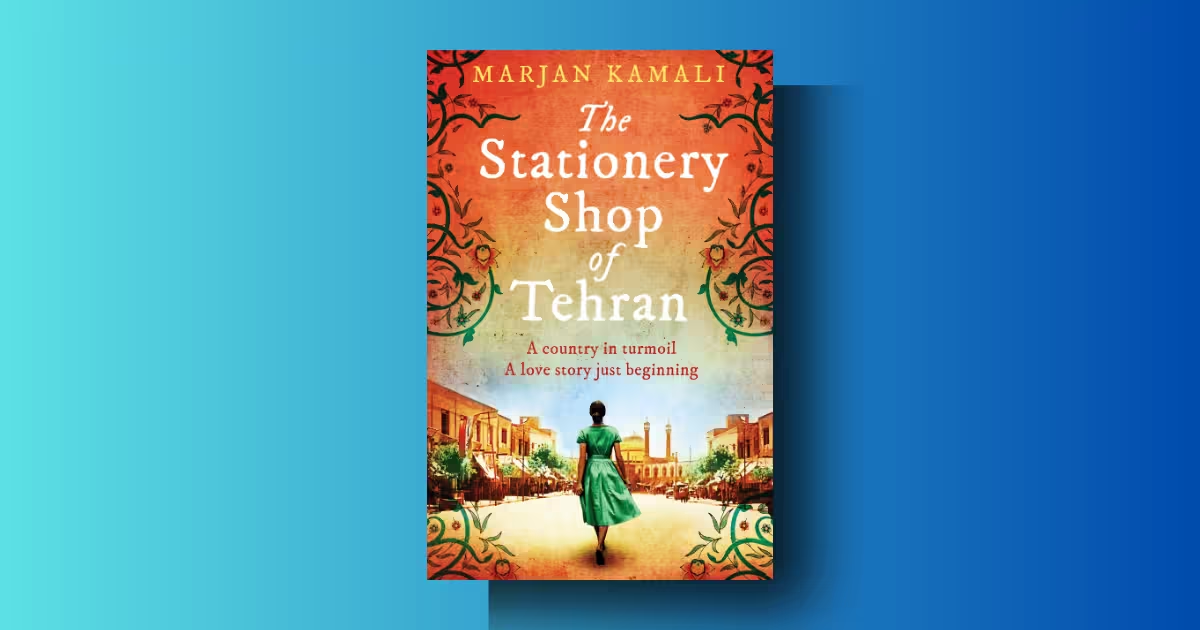

The Stationery Shop of Tehran reveals a moving story about love, political turmoil, separation, and the long shadow of choices made in youth. Marjan Kamali’s novel follows seventeen-year-old Roya as she meets Bahman Aslan in a quiet Tehran stationery shop in 1953, where their shared love of books and poetry sparks a romance against the turbulent backdrop of Iran’s political upheaval.
Decades later, Roya is still carrying questions about the love she lost, and the answers make this more than a conventional historical romance.
Marjan Kamali, an Iranian-American novelist born in Turkey to Iranian parents, published this book in 2019. It has since been translated into more than 25 languages and is being adapted into an HBO series. But before we get into all that, let me tell you why this book wrecked me, and why it might wreck you too.
Table of Contents
Overview
| Aspect | Details |
|---|---|
| Title | The Stationery Shop of Tehran |
| Author | Marjan Kamali |
| Published | 2019 |
| Publisher | Gallery Books (Simon & Schuster) |
| Pages | ~247 |
| Genre | Historical Fiction, Literary Fiction, Romance |
| Setting | Tehran, Iran (1953) & New England, USA (2013) |
| POV | Third-person omniscient |
| Content Warning | Graphic violence, death, chronic illness, mental illness, suicidal ideation, pregnancy loss, abortion |
Background: The 1953 Coup That Changed Everything
Before I dive into the story, you need to understand the historical backdrop. This isn’t just a fictional romance, it’s rooted in one of the most consequential events in modern Iranian history.
On August 19, 1953, a coup orchestrated by the CIA and Britain’s MI6 overthrew Iran’s democratically elected Prime Minister Mohammad Mossadegh. Mossadegh had nationalized Iran’s oil industry, infuriating the British Anglo-Iranian Oil Company (AIOC). The coup restored the Shah (king) to power and crushed Iran’s brief experiment with democracy.
Kamali captures this moment perfectly in the novel. One character reflects: “We want democracy but never seem to get it. What if what follows is worse?”. That question, asked in 1953, asked again in 1979, asked still today, haunts the entire book.
The novel shows us something that history textbooks often miss: how ordinary lives are bent and broken by those forces. This isn’t a story about politicians or power brokers. It’s about two teenagers whose futures were stolen by events they couldn’t control.
The Stationery Shop of Tehran Plot Summary
Warning: This section contains complete spoilers for the entire book.
Part One: 1953 Tehran
The story opens in 2013, with seventy-seven-year-old Roya Archer visiting an elderly man named Bahman Aslan at the Duxton Senior Center in Massachusetts. She’s come to ask him one question: Why didn’t you wait for me?
Then we’re thrown back to 1953.
Seventeen-year-old Roya Kayhani lives in Tehran with her progressive parents, Baba, a government clerk who dreams of his daughters becoming the next Madame Curies or Helen Kellers, and Maman, who supports her husband’s modern views even as traditional relatives whisper criticism. Roya has a younger sister, Zari, who’s more interested in boys and parties than politics.
Roya’s favorite place in all of Tehran is Mr. Fakhri’s Stationery Shop on the corner of Churchill Street and Hafez Avenue. It’s a sanctuary, a quiet haven filled with books, fountain pens, and bottles of jewel-colored ink. Mr. Fakhri, a gentle man in his fifties, knows Roya’s reading tastes intimately and always has a Rumi poetry book ready for her.
One windy January day, a boy bursts into the shop. His name is Bahman Aslan. He’s handsome, passionate, politically active, a supporter of Prime Minister Mossadegh. Mr. Fakhri warns Roya: “That is the boy who wants to change the world.”
Their romance blossoms slowly, through Tuesday afternoon meetings at the shop. They share poetry, discuss politics, fall in love. Bahman takes Roya to Café Ghanadi, where she tries her first espresso and pastries shaped like elephant ears. He introduces her to his sophisticated friends, including the wealthy playboy Jahangir, and teaches her to dance the tango at his parties.
But there are complications. Bahman’s mother, Mrs. Aslan, is volatile, prone to dark moods and rages. She’s already chosen a different girl for Bahman, Shahla, whose family works for the Shah. Bahman’s mother makes no secret of her disapproval of Roya.
During a political rally, Bahman is attacked by government thugs. He’s cut with a chain-wrapped baton but refuses to fight back. Roya sees firsthand the dangers of his activism.
Despite everything, they get engaged. The engagement party is tense, Mrs. Aslan is rude and dramatic, Mr. Fakhri looks uncomfortable, and Roya feels the weight of her future mother-in-law’s hostility.
Part Two: The Separation
Then Bahman disappears.
Roya searches for him, desperate and confused. Mr. Fakhri tells her Bahman is in hiding, involved in political activities, and that the only way to communicate is through letters passed between the pages of books in the shop.
Roya writes to Bahman. He writes back. Their letters are passionate, filled with longing and promises. “I think of you all the time, every single day, every night,” he writes. “In the hopes of seeing you again, the sooner the better. You are my love.”
Then comes the final letter: Bahman asks Roya to meet him at Sepah Square on August 19, 1953, so they can go together to the Office of Marriage and Divorce and get legally married.
On the appointed day, Roya goes to Sepah Square. But chaos erupts. Anti-Mossadegh protesters flood the streets. The police join them. Gunshots ring out. Mr. Fakhri finds Roya in the crowd, desperate to tell her something, but before he can, he’s shot. He dies in her arms.
Bahman never shows up. Roya waits for hours, but he never comes.
Part Three: The Aftermath
The coup succeeds. Mossadegh is overthrown. The Shah returns to power.
Roya finally receives a letter from Bahman, but it’s cruel, cold. He tells her he’s not ready for marriage, that he got swept up in teenage love, that she should move on. Then his mother calls to inform Roya that Bahman is marrying Shahla.
Heartbroken and humiliated, Roya’s father encourages her to leave Iran. He’s secured spots for both his daughters at a women’s college in California. Roya and Zari immigrate to America.
Part Four: America and a New Life
In California, Roya meets Walter Archer, a kind, stable American man. He’s everything Bahman wasn’t, safe, predictable, uncomplicated. She marries him and moves to New England.
They have a daughter, Marigold. But tragedy strikes, Marigold dies of croup at just twelve months old. Roya is shattered. The loss compounds all her previous grief, and she retreats into herself.
Years later, they have a son, Kyle. He becomes her new world.
Meanwhile, in Iran, Bahman lives his life. He marries Shahla, they have twins (Omid and Sanaz), and he eventually opens a stationery shop in Massachusetts, a replica of Mr. Fakhri’s shop.
Part Five: The Reunion
In 2013, seventy-seven-year-old Roya stumbles upon Bahman’s stationery shop in Newton, Massachusetts. She meets his son, Omid, and learns that Bahman is living at the Duxton Senior Center.
She makes an appointment to see him.
Their reunion is heartbreaking. Bahman tells Roya he waited for her at Baharestan Square, not Sepah Square. Someone changed their letters.
After their meeting, Bahman writes Roya a letter revealing the truth: his mother, Mrs. Aslan, had a dark history. She was the melon seller’s daughter from Mr. Fakhri’s past. Mr. Fakhri had gotten her pregnant as a teenager, then abandoned her. She aborted the baby herself, which damaged her body and caused her to lose four subsequent children before Bahman survived.
Mrs. Aslan manipulated Mr. Fakhri into altering the letters, sending Roya and Bahman to different squares. Mr. Fakhri, filled with guilt over his past, complied.
Roya visits Bahman one last time in the nursing home. They lie together in his bed, holding each other. He dies that evening.
At his memorial service, Roya receives a blue tin box containing all the letters she wrote to Bahman in 1953, and all the letters he wrote to her but never sent. She finally understands: their love was real, but it was stolen from them by forces they couldn’t control.
The epilogue reveals Mr. Fakhri’s perspective on that fateful day. He ran to the square to tell Roya the truth, but he was shot before he could. His final thought: “It is a love from which we never recover.”
The Stationery Shop of Tehran Analysis
Character Analysis
Roya Archer (née Kayhani)
Roya is the heart of this novel. We meet her as a dreamy, bookish teenager and follow her through decades of loss and resilience.
Teenage Roya: She’s idealistic, passionate, and deeply romantic. She loves poetry, especially Rumi, and finds escape in Mr. Fakhri’s shop. She’s also sheltered, she’s never been to a political rally before Bahman takes her. But she has a core of strength that becomes evident when she faces adversity.
Adult Roya: After Bahman’s betrayal and Mr. Fakhri’s death, Roya hardens. She marries Walter not out of passion but out of safety. She keeps a part of herself locked away. When Marigold dies, that locked-away part feels like it might kill her. But she survives, and she loves her son Kyle fiercely.
Elderly Roya: At seventy-seven, she’s still haunted by the past. She’s spent sixty years wondering why Bahman didn’t show up. Her decision to finally ask him is an act of courage. Her ability to forgive him, and herself, is the novel’s emotional climax.
What I love about Roya is how real she feels. She’s not perfect. She makes mistakes. She marries someone she doesn’t truly love because it’s safer than risking heartbreak again. She struggles to connect with her American in-laws. She carries her grief for decades. But she keeps going.
Bahman Aslan
Bahman is the boy who would change the world, but the world changes him instead.
Teenage Bahman: He’s charismatic, passionate, and idealistic. He supports Mossadegh and works as an activist. He falls deeply in love with Roya and defies his mother to be with her. But he’s also trapped, trapped by his mother’s mental illness, by his father’s weakness, by the class expectations of his society.
Adult Bahman: After the coup, after losing Roya, he marries Shahla and works in the oil industry, the very thing he once opposed. He’s disillusioned. He never stops loving Roya. He opens a stationery shop in Massachusetts as a tribute to Mr. Fakhri and to the love he lost.
Elderly Bahman: He’s in a nursing home, suffering from Parkinson’s, but his mind is sharp when it comes to Roya. He’s spent sixty years wondering why she didn’t show up at the square. When he finally learns the truth, he’s devastated.
Bahman’s tragedy is that he was always trying to do the right thing, for his mother, for his country, for Roya, but circumstances conspired against him. He’s not a villain. He’s a victim of forces beyond his control.
Mr. Fakhri (Ali Fakhri)
Mr. Fakhri is the most complex character in the novel. On the surface, he’s the kindly stationer who helps young lovers and political activists. But beneath that surface lies a deep well of guilt.
His Past: As a young man from a wealthy family, Ali Fakhri fell in love with Badri, the melon seller’s daughter. He got her pregnant, then abandoned her to marry the woman his family chose. Badri aborted the baby herself, which damaged her body and caused her to lose four subsequent children.
His Guilt: Mr. Fakhri opens the stationery shop as a kind of penance. He wants to help young people find the love and freedom he was denied. He passes love letters between the pages of books. He helps activists spread political material.
His Downfall: When Badri (now Mrs. Aslan) demands that he alter Roya and Bahman’s letters, he complies. He does it because he owes her, because he destroyed her life. He runs to the square to fix his mistake, but he’s shot before he can.
Mr. Fakhri is a tragic figure. He spent his whole life trying to make up for one terrible mistake, but that mistake ultimately destroyed the happiness of the two people he loved most.
Mrs. Aslan (Badri)
Mrs. Aslan is the novel’s antagonist, but she’s also a victim.
Her Story: She was the melon seller’s daughter, poor and uneducated. She fell in love with Ali Fakhri, got pregnant, and was abandoned. She aborted the baby herself, damaging her body and causing her to lose four subsequent children.
Her Illness: Mrs. Aslan suffers from severe depression and mood swings. She’s volatile, cruel, and manipulative. But her cruelty comes from a place of deep trauma. She’s spent her whole life trying to climb out of poverty, and she’s terrified that her son will fall back down.
Her Actions: She manipulates Mr. Fakhri into changing the letters because she believes Shahla is a better match for Bahman. She’s willing to destroy her son’s happiness to protect him from what she sees as a fate worse than death: poverty and social stagnation.
What makes Mrs. Aslan so compelling is that she’s not purely evil. She’s a broken woman doing terrible things out of love and fear. She’s a reminder that trauma doesn’t just hurt the person who experiences it, it ripples outward, poisoning everyone it touches.
Zari Kayhani
Zari is Roya’s younger sister, and she’s the voice of reason throughout the novel.
Her Personality: Zari is blunt, practical, and occasionally cruel. She warns Roya about Bahman from the beginning. She calls him a “political donkey” and says he can’t be trusted. But she also loves her sister fiercely.
Her Journey: Zari immigrates to America with Roya and builds a life there. She marries Jack, a beat poet turned advertising executive, and has children. She’s the one who helps Roya through the grief of losing Marigold.
Zari is the character who tells Roya what she needs to hear, even when Roya doesn’t want to hear it. She’s the grounding force in Roya’s life.
Walter Archer
Walter is Roya’s American husband. He’s kind, stable, and uncomplicated, everything Bahman wasn’t.
His Role: Walter represents the safe life Roya chose after Bahman betrayed her. He’s not passionate or exciting, but he’s reliable. He supports Roya through her grief and never questions her love for him, even when he knows part of her heart belongs to someone else.
His Significance: Walter is the embodiment of “moving on.” He’s proof that you can build a good life after heartbreak. But he’s also a reminder that “good” isn’t always “great.”
The Stationery Shop of Tehran Themes
The Stationery Shop as Sanctuary
The stationery shop is the novel’s central symbol. For Roya, it’s a refuge from the chaos of politics and family expectations. For Mr. Fakhri, it’s a temple to intellectual, political, and romantic freedom. The shop is where Roya and Bahman fall in love, where their letters are exchanged, where political resistance is nurtured.
When the shop burns down during the coup, it feels like the destruction of everything the characters believed in. But Mr. Fakhri reflects that the ideals the shop represents can never truly be destroyed. And indeed, Bahman rebuilds the shop in America, proof that love and hope can survive even the most devastating losses.
The Power of Letters
Letters are how Roya and Bahman communicate during their separation. They’re how their love survives. The letters are passed between the pages of The Stationery Shop of Tehran, making the shop itself a conduit for love.
But letters are also how their love is destroyed. Someone alters the final letter, changing the meeting place from Baharestan Square to Sepah Square. A single word change, the name of a square, shatters their future.
This is a powerful reminder of how fragile communication can be. One wrong word, one misunderstanding, and a lifetime can change.
Fate and Free Will
The novel constantly grapples with the question of fate. Roya’s mother believes that “our fate is written on our foreheads when we’re born”. But the novel suggests that fate is complicated, it’s shaped by politics, by trauma, by the choices we make and the choices others make for us.
Roya and Bahman were meant to be together. Their love was real and deep. But political forces, family trauma, and human weakness conspired to tear them apart. Was that fate? Or was it just bad luck?
The Persistence of Love
The most powerful theme in the novel is that love doesn’t die. Roya and Bahman spend sixty years apart. They marry other people. They have children. They build separate lives. But they never stop loving each other.
“I was never as happy as when I was with you,” Bahman writes in his final letter. “There have been years when you were the first thing I thought about when I woke up.”
This isn’t a fairy tale. It’s not romantic in a Hollywood way. It’s painful and real. Love doesn’t always conquer all. Sometimes it just… persists. It sits in the background of your life, a constant ache, a reminder of what could have been.
My Evaluation
Rating: 5/5 Stars
The Stationery Shop of Tehran is devastating. I don’t say that lightly. I finished it at 2 a.m., sobbing into my pillow, waking up my husband to tell him through tears that “they never got to be together!”
What Works
The Emotional Depth: Kamali writes with an elegance that makes every sentence feel like a sigh. The emotions in this book are raw and real. You feel Roya’s joy, her heartbreak, her grief, her quiet despair. You feel Bahman’s passion, his guilt, his longing.
The Historical Context: The novel does something remarkable, it makes history personal. The 1953 coup isn’t just a backdrop; it’s a character in the story. It shapes everything that happens. Kamali shows us how ordinary lives are bent and broken by forces beyond their control.
The Characters: These aren’t cardboard cutouts. They’re complicated, flawed, deeply human. Even Mrs. Aslan, who I wanted to hate, I ended up feeling sorry for. She was a victim of her own trauma.
The Ending: The ending is heartbreaking but also, somehow, peaceful. Roya finally gets closure. She understands what happened. She forgives Bahman, forgives herself, and moves forward.
What Could Have Been Better
The Epilogue: Some critics have said that the epilogue over-explains the mystery of the altered letters. I can see that point. Part of me wishes the mystery had remained slightly ambiguous. But I also appreciated knowing the truth.
The Pacing: The middle section of the book, Roya’s years in America, feels slightly rushed compared to the 1953 sections. I wanted more time with her and Marigold, more time with her grief.
The Sentimentality: The Stationery Shop of Tehran is sentimental. It wears its heart on its sleeve. For some readers, this might be too much. But for me, it worked. This is a book about love and loss; sentimentality is appropriate.
Comparison with Similar Works
If you loved The Kite Runner by Khaled Hosseini, you’ll love this. Both books are set against the backdrop of political upheaval in the Middle East; both are deeply emotional, both explore themes of love, loss, and redemption.
If you loved A Thousand Splendid Suns, also by Hosseini, you’ll find similar emotional depth here. Both novels center on women whose lives are shaped by forces beyond their control.
If you loved The Nightingale by Kristin Hannah, you’ll appreciate the way this novel shows how ordinary people survive extraordinary circumstances.
Five Lessons from The Stationery Shop of Tehran
1. Love Doesn’t Die, It Just Changes Form
Roya and Bahman never stop loving each other, even after sixty years apart. Their love doesn’t conquer all, it doesn’t reunite them; it doesn’t give them a happy ending, but it persists. It shapes their lives, their choices, their memories. Love doesn’t have to end in a fairy tale to matter.
2. Trauma Ripples Through Generations
Mrs. Aslan’s trauma- being abandoned, losing her baby, losing four more children- poisons everything she touches. She destroys her son’s happiness because she’s terrified of losing him too. The novel is a powerful reminder that untreated trauma doesn’t just hurt the person who experiences it; it hurts everyone around them.
3. Politics Is Personal
The 1953 coup isn’t just a historical footnote. It’s the reason Roya and Bahman can’t be together. It’s the reason Mr. Fakhri dies. It’s the reason Iran’s brief democracy is crushed. Politics isn’t abstract; it’s the force that shapes our most personal lives.
4. Forgiveness Is Possible, But It Takes Time
Roya spends sixty years angry at Bahman. She thinks he abandoned her. When she finally learns the truth, she forgives him. But that forgiveness takes time. It takes understanding. It takes confronting the past head-on.
5. Books Can Save Us
The stationery shop is a sanctuary for Roya. The books she reads, the poetry she loves, the letters she writes, they sustain her through the hardest moments of her life. “Did you know that books can save you?”. This novel is a love letter to the power of reading.
The Stationery Shop of Tehran Quotes
Here are some of the most powerful passages from the book:
“I was never as happy as when I was with you. There have been years when you were the first thing I thought about when I woke up. Just about everything reminded me of you.” , Bahman’s final letter
“Look at love how it tangles with the one fallen in love. Look at spirit how it fuses with earth giving it new life.” , Rumi, quoted in the novel
“We carry all the ages and stages of ourselves all the time. The timbre of a particular voice, a specific scent, a tiny piece of melody can trigger in us memories we thought we’d lost or buried forever.” , Marjan Kamali
“This world is without compassion.” , Mr. Fakhri
“I thought you could grow to love her too. Despite it all.” , Bahman’s letter about his mother
“It is a love from which we never recover.” , Mr. Fakhri’s final thought
Conclusion
The Stationery Shop of Tehran is a beautiful, heartbreaking novel about love, loss, and the forces that shape our lives. It’s not a romance in the traditional sense, it’s not about two people finding each other against all odds. It’s about two people who were meant to be together but were torn apart by forces beyond their control.
It’s about the persistence of love. It’s about how grief can last a lifetime. It’s about how forgiveness is possible, even after decades of pain.
Who Should Read This Book
You should read this book if:
- You love historical fiction
- You’re interested in Iranian history and culture
- You enjoy emotionally devastating stories
- You believe in the power of love
- You’re a fan of Khaled Hosseini or Kristin Hannah
You might want to skip this book if:
- You’re looking for a light, happy read
- You’re not interested in political history
- You prefer plots that are more action-driven than emotion-driven
For me, this book was a revelation. It reminded me that love doesn’t always look like a fairy tale. Sometimes it looks like two elderly people holding hands in a nursing home, finally understanding what happened to them sixty years ago.
I’ll never forget Roya and Bahman. I’ll never forget the stationery shop. And I’ll never forget the lesson this book taught me: that love persists, even when everything else falls apart.