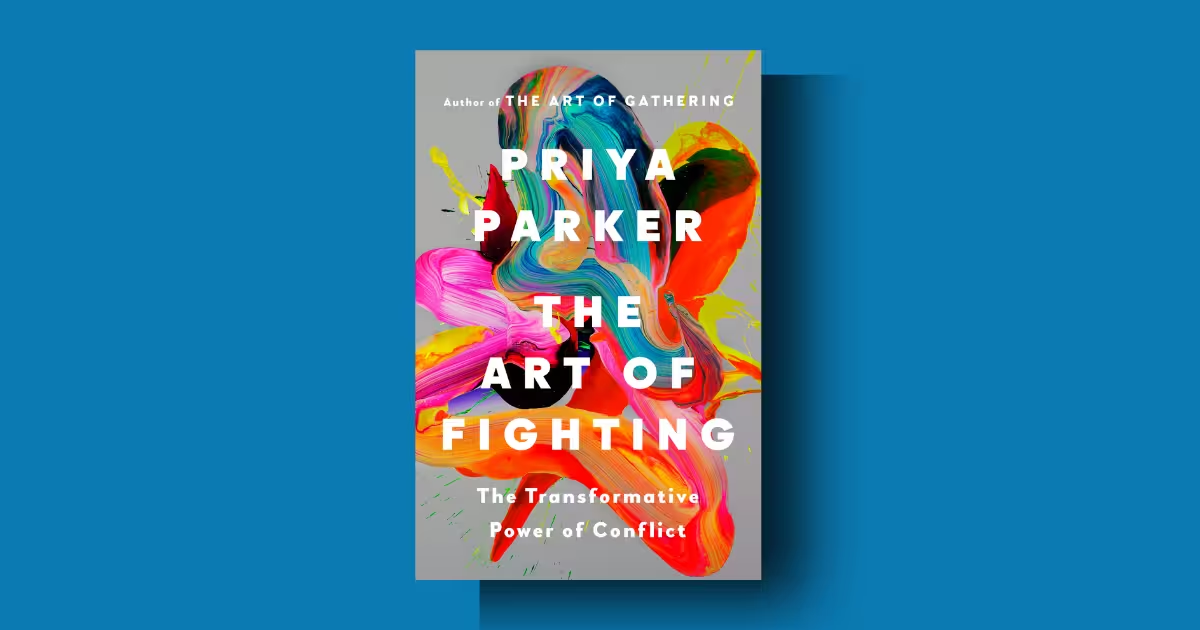

Priya Parker’s The Art of Fighting: The Transformative Power of Conflict makes a deceptively simple but radically uncomfortable argument: your fear of conflict is destroying your relationships.
Parker, a conflict facilitator and author of the bestselling The Art of Gathering, writes from a deeply personal place. She opens with a confession: “I became a conflict facilitator not because I am fearless, but because I hate conflict.”
This admission shapes everything that follows. She’s not some detached expert preaching from above. She’s someone who, like many of us, would rather bury her head in the sand, and who learned, the hard way, that avoidance comes with a cost.
The Art of Fighting walks readers through a three-part framework: TEAR (understanding why conflicts happen and what kind you’re in), GRAPPLE (the actual work of facing conflict with skill and intention), and CLEAVE (the aftermath, whether that means cutting ties or binding more closely together).
What makes this book different from the endless pile of “conflict resolution” guides? Parker doesn’t tell you to stop fighting. She tells you to fight more, and to learn how to do it well. “If you want to be more connected to the people in your life,” she writes, “fight more.”
Reader Recommendation: Who Will Actually Love The Art of Fighting
Read this if: You lead teams, facilitate groups, manage organizations, or find yourself constantly mediating between family members. You’re someone who has sensed that something is wrong in a group but couldn’t name it. You’re tired of surface-level harmony that masks real resentment.
Skip this if: You’re looking for a guide to one-on-one relationship conflict or late-night arguments with your partner. Parker’s expertise is group dynamics, and the book leans heavily into workplace, organizational, and community settings. The personal stuff is there, but it’s not the center of gravity.
The honest truth: This is a workbook disguised as a book. It took one reviewer two weeks to get through because it requires you to stop, reflect, and actually do the work. If you’re not willing to engage, you’ll bounce.
Table of Contents
1. Introduction
Title: The Art of Fighting: The Transformative Power of Conflict
Author: Priya Parker
Publisher: Riverhead Books (an imprint of Penguin Random House)
Publication Date: September 8, 2026
Context: What This Book Is About
Priya Parker is a conflict facilitator, strategic adviser, and the author of the acclaimed The Art of Gathering: How We Meet and Why It Matters. She has worked with colleges, corporations, museums, nonprofits, political movements, and multigenerational families. Her training is in group dialogue and conflict resolution, not therapy, not individual coaching.
The Art of Fighting is her second book, and it picks up exactly where The Art of Gathering left off. If the first book was about how to bring people together meaningfully, this one is about what to do when being together gets hard.
Publisher’s Weekly calls it “an astute and humane guide to navigating disagreements in workplaces, friend groups, communities, and families.” Kirkus Reviews describes it as “an exceptional guide for any group seeking ways to transform conflict into an occasion for positive growth.”
Purpose: The Central Argument
Parker’s thesis is this: Healthy community needs healthy conflict.
Groups can’t sustain without love, and they can’t sustain without conflict. When we treat conflict as harmful, immoral, or toxic, we squander the chance to build groups that nourish, sharpen, and bond us.
She rejects the idea that “good groups don’t fight.” In fact, she argues the opposite: groups need fights to figure out who they really are. “Fights aren’t a tragedy to be avoided,” she writes. “Fights form. Fights frame. Fights foster.”
The book’s central insight, that “fighting done right can help heal and reinvigorate relationships rather than end them”, is what makes it persuasive.
2. Background
I should admit something upfront. When I first picked up The Art of Fighting, I braced myself. I’m not someone who naturally leans into conflict. Like Parker herself, I’d rather avoid it. I’ve let friendships drift instead of having hard conversations. I’ve nodded along in meetings when I wanted to scream. I’ve told myself that keeping the peace was the mature thing to do.
Parker’s book forced me to reconsider that entire framework.
She draws on two decades of experience facilitating group conflicts, everything from corporate boardrooms to activist organizations to multigenerational family businesses. She’s not theorizing from a distance. She’s been in the room when things got ugly, and she’s learned what works and what doesn’t.
The book is structured around her observation that groups in conflict typically pass through three phases: an initial tear, a period of grappling, and eventually a cleaving, a contronym that means both cutting and binding.
3. The Art of Fighting Summary
Let me walk you through what Parker actually teaches. This is the meat of the book, and frankly, it’s enough that you might not need to read the original, though I’d still recommend it.
Part I: TEAR , Understanding What Kind of Fight You’re In
Parker starts by dismantling the mental models most of us carry about conflict.
The “make this go away” impulse is the first thing she addresses. When people in conflict call her, they typically say some version of: “Make this go away.” She understands the impulse, she shares it. But she also knows it’s the wrong question. “Trying to stave off a fight is not always what best serves a group.”
Feelings are not an inconvenience. When Rebekah, a woman struggling with her family’s Passover ritual, started crying on a Zoom call, Parker told her: “Feelings aren’t just OK here. They’re crucial. They’re not an inconvenience. They’re information. They’re a natural resource. They’re energy.”
This is a key insight. Many of us try to suppress our emotions during conflict, thinking they cloud our judgment. Parker argues the opposite: your feelings are telling you something important. “Where there are strong feelings, there is energy, and energy is easier to work with than apathy.”
Relational longing is one of The Art of Fighting‘s most important concepts. Parker learned this from Sethu Nair, a veteran group dialogue facilitator. Relational longing is “the residual desire within us to connect to someone or something, even when we’re hurt or mad.” Nair told Parker: “We wouldn’t even have conflict if we weren’t trying so hard to be in relationship.”
Triggering events are another crucial idea. These are precipitating moments that create or reveal cracks in a group. What looks like a freak accident, a thoughtless comment, a poorly timed Zoom call, is often just the surface of deeper fissures that have been papered over.
Forcing mechanisms are big moments that force conflicts to the surface. Weddings, renovations, milestone anniversaries, these aren’t inconveniences. They’re designed to surface questions groups have been avoiding. “In many ways, it is a core function and purpose of these life events to force conflicts we need to have but don’t want to.”
The heat map of relevance is Parker’s way of understanding what people actually care about. If you pay attention, conflicts tell you what matters to the group. Where’s the heat? That’s where the “us-ness” lives.
The conflict taxonomy is one of the book’s most practical frameworks. Parker categorizes group fights along two axes: intensity and existentialness (how much the conflict touches on the group’s sense of identity).
- Kerfuffles are low intensity, low existentialness. The TV in the break room. Minor annoyances that can be resolved through existing authority structures.
- Hairline fractures are low intensity but high existentialness. Small moments that hint at bigger questions about who the group is.
- Brawls are high intensity but low existentialness. People may not like each other, but the fight isn’t about the group’s identity.
- Rifts are high intensity and high existentialness. These are the fights that force a group to ask: What are we? Who decides?
The We’renota Clause is a tell. When you hear someone say “But we’re not a Y; we’re a Z!”, brace yourself. You’re drifting into existential territory.
Parker also addresses the question that haunts many of us: Should I face this or not? Her answer is nuanced. “Not everything should be faced.” There are legitimate reasons to step back: creative tension can be productive; some conversations aren’t appropriate for the setting; sometimes the group has simply reached its natural end.
The drum test is her way of helping you decide. When a group ruptures, do you care enough to build new drums? If yes, the relationship is worth fighting for.
Part II: GRAPPLE , The Craft of Holding Conflict
This is where Parker moves from diagnosis to action.
Excavation is the first step. Before you can have a productive fight, you need to understand what’s actually happening. Parker talks about the importance of dumb questions, the kind that seem naive but get people to spill the beans. “Ask dumb ones,” she advises. “You will be surprised by the answers you get.”
She cites the story of two New York Times reporters. Homer Bigart got better quotes than his replacement because he asked dumb questions. “That guy didn’t know anything,” a source said. “So I had to tell him everything.”
The workbook is one of Parker’s key tools. She designs digital workbooks with six to ten questions and sends them to participants before any formal confrontation. It’s a call-and-response mechanism that builds buy-in and trust. “Returned questionnaires signal that people have spent time engaging with the conflict.”
Capital-N Need is another cornerstone concept. Most groups rush past reflection straight to solutions. “We need a town hall!” “We need a Zoom!” But a meeting isn’t a solution; it’s an event. Parker pushes groups to ask: What is the actual Need of this group in this moment?
The Need must be felt, you know you’ve hit it when people exhale. It must be addressable, something you can sink your teeth into. It must be specific, not everything to everyone. And it must transcend individual needs, straddling factions rather than just reflecting one side.
Conflict rituals are a major theme. Parker draws on examples from around the world: the Cherokee Talking Circle, West African palavers, Hawaiian Ho’oponopono, Viking althings. These aren’t relics. They’re evidence that humans have always understood the need for infrastructure to hold conflict.
She even analyzes the Real Housewives reunions as a modern conflict ritual. The executive producers told her: “It is very ritualistic.” There’s a clear purpose, different roles, an accepted structure, a way to hold heat, and a beginning, middle, and end.
The fight plan is where Parker’s facilitation expertise shines. You need to design the confrontation with as much care as you’d plan a surgery. “It’s not a Band-Aid, to be ripped off. It’s a surgery, to be planned.”
Key elements of a fight plan:
The Worthy Grapple, the core question worth facing. Parker helped a tech leader move from “How do we improve our products?” to “Why do our customers hate our product?” The second question actually got somewhere.
Hypoallergenic interventions, designing the confrontation to avoid triggering people’s defenses. Find what’s endemic to the group. Use humor. Name the gathering carefully. “Names carry social contracts.”
Size matters, groups of six allow for equal exchange. Groups of twenty-plus become an audience without careful design.
Complicate the individual, instead of trying to unify the group, draw out the complexity within people. Connection becomes sturdier when you allow people to be many things at the same time.
Preparation matters more than you’d think. Parker quotes a mentor: “90 percent of success occurs before anyone enters the room.” She has her own pre-fight rituals: specific songs, deep breathing, reminding herself of her agency. “I’m choosing to do this. I can not engage. I can quit this job. I can exit this relationship.”
The room where it happens requires careful design. Parker’s examples are instructive:
- At Administration for Children’s Services, facilitator Sethu Nair started with an opening ceremony and guidelines. She asked people to bring personally meaningful objects. She had them cocreate agreements. “It all feels so unnecessary,” Nair said, “but you’ve already learned how to move through a small fight.”
- At Burning Man, Marian Goodell spoke a “dangerous truth”, that the founders shouldn’t all be paid equally. She risked being kicked out. Instead, her words expanded the group’s geography of thought.
- At Canlis restaurant, the Hot Seat exercise revealed the core conflict: whether excellence comes through harsh demands or human dignity. Mark Canlis said, “I’m holding you accountable because I want to work with you.”
- The shared garden conflict between neighbors was resolved when Isla spoke from relational longing: “I know we don’t know each other very well… but I was really excited to get to know you better.”
Speaking from the wound is Parker’s phrase for getting to the real emotion beneath the position. At ACS, a former police officer described how a coworker had barricaded her desk with plants. “There’s a plant on the spot where I would lean on her desk. I don’t understand,” he said. “How did we get here, not talking to each other, after all of these years of chatting?”
Part III: CLEAVE , The Aftermath
The final section is about what happens after the fight.
The vulnerability hangover is real. Even when a facing goes well, people crash. Parker normalizes this: “Know that the emotional hangover is normal. It will pass.”
The vacuum after a fight is when meaning is most malleable. “The facts may be settled, but the meaning is still up for grabs. Either you shape that story or someone else will.”
The debrief matters. Parker advises asking reflection questions rather than evaluation forms: “What did you learn? What was an aha moment? Who are you grateful for?”
Watering the garden is Parker’s phrase for helping people remember the good in the group after a fight. It could be a Taylor Swift concert with a daughter, or reviving an old kickball game. “Find backdoor ways to remind people that you actually like each other.”
The three gut checks help you decide whether to stay or go:
- The Mun Test, from the Hindi word for “mind” or “desire.” Deep down, do you still have the urge?
- The Alterability Test, is the group willing to be changed? Are you?
- The Posthumous Questions Test, are the group’s questions still your questions? “Shared questions often matter more than shared answers.”
Cleaving as cutting is about ending well. Parker shares examples: the 13P playwrights who planned their own dissolution; the Howlett family who held a “Housecooling” when their mother moved out; the Agora arts organization that chose an “intentional sunsetting.”
She emphasizes three acknowledgments for a good ending: acknowledge the end, take stock of what was, and acknowledge the loss.
Cleaving as binding is about staying and changing. Parker draws on the metaphor of an architectural renovation. “By staying, you choose to renovate rather than move. To renovate after a fight is to take what’s been revealed from airing hard truths and rebuild the torn-up house incorporating these new truths.”
Repair requires more than apology. It requires “doing sorry.” Parker cites Danielle Sered: “We misuse our power when we cause harm. By ‘doing’ and not merely saying sorry, the person who created the harm is actually changed by it.”
Visible mending is a Japanese technique called sashiko. Instead of hiding a tear, you reinforce it with visible stitching, adding strength and beauty. “A visible mend is up front and honest: This was hard. We got through it.”
4. The Art of Fighting Analysis
Here’s the thing about The Art of Fighting: it’s not an easy read. Not because it’s poorly written, Parker’s prose is clear and conversational, but because it forces you to confront your own patterns.
I found myself highlighted passages and then immediately feeling defensive. Is she talking about me? Yes. She was.
What works: The frameworks are genuinely useful. The taxonomy of conflicts (kerfuffles, hairline fractures, brawls, rifts) helped me categorize situations I’d previously lumped together as “drama.” The concept of relational longing gave me language for something I’d felt but couldn’t name. The emphasis on preparation, 90 percent of success before anyone enters the room, explains why so many of my past attempts at “having a conversation” went sideways.
What’s challenging: Parker is a facilitator, not a therapist. Her home territory is groups, organizations, teams, communities. The personal stuff, the late-night argument with a partner, the parent-child conversation that keeps going sideways, is gestured at but not fully explored.
This is a fair criticism. Parker herself acknowledges it. The Art of Fighting is about group conflict, not individual relationships. But for readers hoping for a guide to their personal conflicts, it may feel incomplete.
What’s missing: The Art of Fighting could benefit from more attention to power dynamics. Parker touches on them, she warns leaders not to dump their feelings on subordinates, and she discusses the dangers of “unanchored care”, but it’s not a central theme. Given how much conflict is driven by power imbalances, this feels like a gap.
5. Strengths and Weaknesses
Strengths
Practical frameworks. This isn’t vague advice. Parker gives you tools you can actually use: workbooks, timelines, conversation exercises. One reviewer noted they found themselves using Parker’s techniques three weeks later in a meeting.
Real examples. Parker draws on her own facilitation work: family holiday squabbles, pandemic-era friend-group fissures, labor union negotiations, corporate crises. These aren’t hypotheticals. They’re messy, real situations with real people.
Permission to fight. The book’s core message is liberating. Conflict isn’t a sign of failure. It’s proof that you care. “The person who never picks a fight, never brings up tension, never challenges the direction things are going; that is not someone laid-back,” Parker writes. “That is someone who has decided the relationship isn’t worth the discomfort.”
The writing. Parker is a skilled communicator. Her sentences are clear. Her examples are vivid. She doesn’t talk down to you.
Weaknesses
Group focus. If you’re looking for help with one-on-one conflict, this isn’t the book. Parker’s expertise is collective settings, and the book reflects that.
Dense. This is a workbook, not a quick read. One reviewer took two weeks to get through it. If you’re not ready to engage actively, you’ll bounce.
Limited attention to power. Parker addresses power dynamics but doesn’t center them. For a book about conflict, this feels like a notable omission.
6. Comparison with Similar Works
The Art of Fighting sits in a crowded field of conflict resolution books, but it stands out in several ways.
Compared to Crucial Conversations (Patterson, Grenny, McMillan, Switzler): Crucial Conversations is more focused on individual communication skills, how to speak persuasively, how to listen actively. Parker is more concerned with group dynamics and collective processes. She’s less interested in teaching you how to win an argument and more interested in helping a group find its way through a rupture.
Compared to High Conflict (Amanda Ripley): Ripley focuses on why conflicts become intractable and how to de-escalate them. Parker shares that concern but adds a layer: sometimes conflict is good and necessary. She’s not just about de-escalation; she’s about productive engagement.
Compared to The Culture Map (Erin Meyer): Meyer looks at how different cultures approach conflict. Parker doesn’t dive as deeply into cultural differences, but she acknowledges them, particularly in her discussion of banter as a way to help conflict-averse groups practice disagreement.
Compared to Parker’s own The Art of Gathering: The first book was about how to bring people together. This one is about what to do when being together gets hard. They complement each other perfectly.
7. Conclusion
The Art of Fighting is a necessary book for anyone who leads groups, facilitates teams, or cares about community. It reframes conflict from something to be avoided to something to be mastered.
Who should read this: Team leaders, HR professionals, organizational consultants, activists, educators, anyone who finds themselves constantly mediating between others.
Who should skip it: People looking for a guide to personal relationships. People who aren’t ready to do the work, this book demands engagement.
The bottom line: Parker is right. We’ve been treating conflict all wrong. We avoid it, suppress it, and then wonder why our relationships feel hollow. The answer isn’t less fighting. It’s better fighting.
“If you want to be more connected to the people in your life,” she writes, “fight more. And learn the art of doing it well.”
I’m still learning. But this book gave me a map.