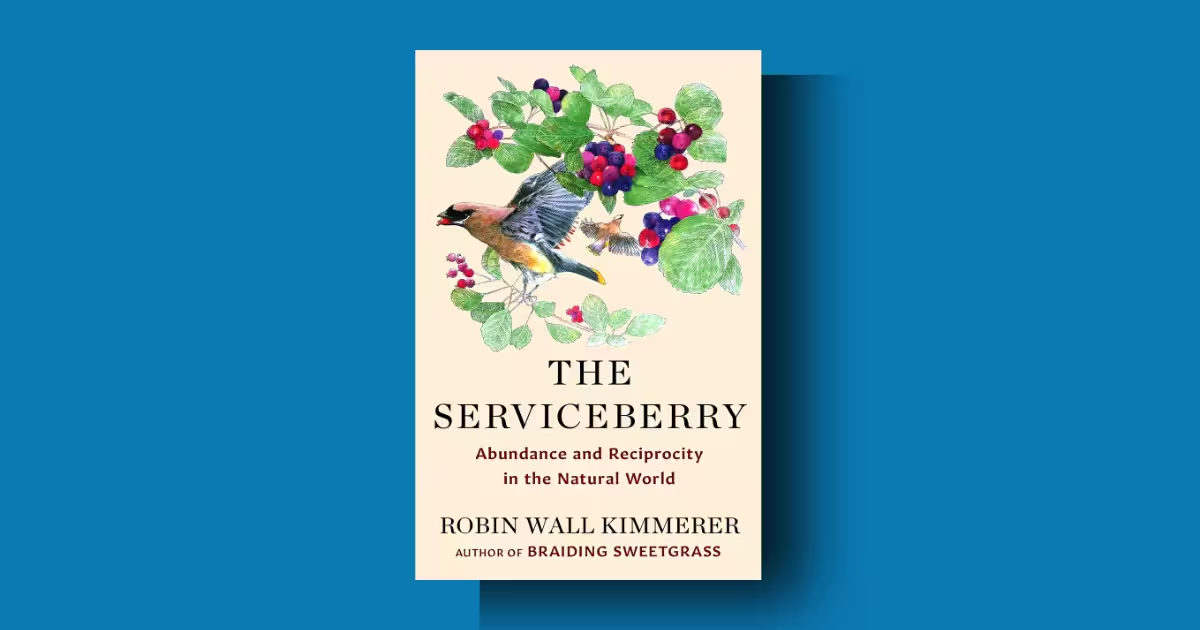

Robin Wall Kimmerer’s The Serviceberry argues that nature’s gift economies offer a powerful alternative to market capitalism. Read this deep dive into abundance, reciprocity, and the Honorable Harvest. This slim but potent book invites you to see the world differently, not as a collection of resources to be extracted, but as a network of relationships to be honored.
Overview
If you have ever stood in a grocery store aisle and felt vaguely unsettled by the sheer volume of choices, or if you have scrolled through social media and felt a creeping sense that you are never quite enough, Robin Wall Kimmerer’s The Serviceberry offers a different way of seeing. This is a short book, 128 pages, expanded from an essay originally published in Emergence Magazine in October 2022, but it carries an enormous argument.
Kimmerer, a botanist and enrolled member of the Citizen Potawatomi Nation, uses the serviceberry tree (Amelanchier) as a living metaphor for an economic system based on abundance, gratitude, and reciprocity rather than scarcity, competition, and hoarding.
The book’s central question is disarmingly simple: what if we treated the Earth’s gifts as gifts rather than commodities? What if wealth meant having enough to share, and status came not from how much you accumulated but from how much you gave away? Kimmerer does not offer a policy blueprint or a step‑by‑step guide to dismantling capitalism. Instead, she plants a seed, a provocation to reimagine what we value and how we organize ourselves to sustain life.
This is not a book for anyone looking for quick fixes or technical economic models. It is a book for anyone who has ever felt that the way we live is broken and that nature might have something to teach us about fixing it.
Reader Recommendation for The Serviceberry
Who will actually love it: Readers of Kimmerer’s previous work, especially Braiding Sweetgrass (which has sold more than 2 million copies worldwide), will find familiar territory here.
The book will resonate deeply with anyone interested in Indigenous knowledge, ecological economics, environmental justice, and the philosophy of gift economies. It is also a wonderful introduction to Kimmerer’s thought for readers who may not have the time or inclination for a longer book.
If you have ever participated in a Little Free Library, a community garden, or a Buy Nothing group, you will recognize yourself in these pages.
Who will bounce: Readers looking for concrete economic policy proposals or a detailed critique of capitalism will be disappointed. The Serviceberry is philosophical and evocative, not prescriptive. Some Indigenous scholars have criticized Kimmerer’s work for being insufficiently radical, warning that it risks reducing Indigenous culture to something picturesque and palatable.
If you prefer your economics heavy on data and light on poetry, this may not be your book.
Table of Contents
1. Introduction
The Serviceberry: Abundance and Reciprocity in the Natural World is a 2024 nonfiction book by Robin Wall Kimmerer, with illustrations by John Burgoyne. It was published by Scribner in November 2024 and became an instant New York Times bestseller.
Kimmerer is a mother, scientist, SUNY Distinguished Teaching Professor of Environmental Biology, and an enrolled member of the Citizen Potawatomi Nation. She is the author of the #1 New York Times bestseller Braiding Sweetgrass: Indigenous Wisdom, Scientific Knowledge, and the Teachings of Plants (2013) as well as Gathering Moss: A Natural and Cultural History of Mosses (2003). In 2022, she was named a MacArthur Fellow, receiving an $800,000 “genius grant”. She also received the National Humanities Medal in 2023.
She is the founder of the Center for Native Peoples and the Environment at the SUNY College of Environmental Science and Forestry.
Context
The Serviceberry sits at the intersection of memoir, ecological science, Indigenous philosophy, and economic critique. It builds on themes Kimmerer explored in Braiding Sweetgrass, the gift economy, gratitude, and the ethical relationship between humans and the more‑than‑human world, but distills them into a concentrated, urgent argument.
The book grew out of an essay commissioned by Emergence Magazine. Kimmerer initially resisted the assignment, telling the editors, “I don’t know anything about economics. I’m a botanist”. But in conversation, she realized she knew a great deal about “the economies of nature”, the ways the natural world delivers goods and services for the flourishing of all things. That realization became the seed of this book.
Purpose
The central thesis of The Serviceberry is that our dominant economic system, rooted in scarcity, competition, and the hoarding of resources, actively harms what we love. In contrast, the serviceberry tree embodies a different model: one based on reciprocity, interconnectedness, and gratitude.
As Kimmerer writes, “Serviceberries show us another model, one based upon reciprocity rather than accumulation, where wealth and security come from the quality of your relationships, not from the illusion of self‑sufficiency”.
The book argues that we can learn from Indigenous wisdom and ecological systems to reimagine what we value most, and that doing so is not merely desirable but essential for our survival.
2. Background
To understand The Serviceberry, it helps to know a little about the plant itself. The serviceberry (Amelanchier) goes by many names: Saskatoon, Juneberry, Shadbush, Shadblow, Sugarplum, and Sarvis. As Kimmerer notes, ethnobotanists know that the more names a plant has, the greater its cultural importance.
The tree is a calendar plant, its early spring flowers signaling that the ground has thawed. In Potawatomi, it is called Bozakmin, a superlative meaning “the best of the berries”. The root min means both “berry” and “gift”.
The serviceberry is also a community organizer. It provides early pollen for insects, browse for deer and moose, and berries for birds and humans. Its abundance is not hoarded but shared, and in sharing, it ensures its own survival.
3. The Serviceberry book Summary
The Gift Economy
Kimmerer opens with a scene of harvesting serviceberries alongside cedar waxwings and robins. She writes: “This abundance of berries feels like a pure gift from the land. I have not earned, paid for, nor labored for them. There is no mathematics of worthiness that reckons I deserve them in any way”.
This is the heart of the gift economy: receiving without earning, and responding with gratitude and reciprocity. Kimmerer contrasts this with the market economy, where “if I were to buy a basket of berries in a market economy, the relationship ends with the exchange of money”.
In a gift economy, the currency is relationship. Kimmerer writes: “Gratitude and reciprocity are the currency of a gift economy, and they have the remarkable property of multiplying with every exchange, their energy concentrating as they pass from hand to hand, a truly renewable resource”.
Scarcity vs. Abundance
One of the book’s most powerful arguments is that scarcity is not a natural fact but a cultural construct, and a profitable one. Kimmerer writes: “In order for capitalist market economies to function, there must be scarcity, and the system is designed to create scarcity where it does not actually exist”.
She illustrates this with the example of water: “Sweet water, a free gift of the Earth, is pirated by faceless corporations who encase it in plastic containers to sell. And now many can’t afford what was previously free”.
In contrast, Indigenous societies view water as sacred and have a moral responsibility to care for it. Kimmerer quotes Lewis Hyde: “To assign a market value to a gift, destroys the gift”.
The Honorable Harvest
Kimmerer outlines the guidelines of the Honorable Harvest, a set of protocols for taking from the land with respect and restraint:
- Know the ways of the ones who take care of you, so that you can take care of them.
- Introduce yourself. Be accountable as the one who comes asking for a life.
- Ask permission before taking. Abide by the answer.
- Never take the first one. Never take the last.
- Take only what you need.
- Take only that which is given.
- Never take more than half. Leave some for others.
- Harvest in a way that minimizes harm.
- Use it respectfully. Never waste what you have taken.
- Share.
- Give thanks for what you have been given.
- Give a gift in reciprocity for what you have taken.
- Sustain the ones who sustain you and the Earth will last forever.
These are not abstract ideals. They are, Kimmerer writes, “reinforced in small acts of daily life”. They are also the result of “timeless treaties between the Human people and the Deer people, the Bear people, the Fish people, and the Plant people”.
The Windigo and the Darrens
Kimmerer introduces the Potawatomi figure of Windigo, a cannibal monster whose hunger is never sated. She writes: “Windigo thinking jeopardizes the survival of the community by incentivizing individual accumulation far beyond the satisfaction of ‘enoughness’”.
She then gives contemporary Windigos a name: Darren, after the CEO of ExxonMobil. She writes: “They sit in boardrooms deciding to exploit fossil fuels for short‑term gain while the world burns. They know the science, they know the consequences, but they proceed with ecocidal business as usual and do it anyway”.
The Serviceberry Economy
The serviceberry tree, Kimmerer argues, operates on a gift economy. It does not hoard its energy but invites birds to a feast. She writes: “Are they not storing their meat in the bellies of their brothers and sisters, the Jays, the Thrashers, and the Robins?”
This is not altruism; it is survival. The birds disperse the seeds, ensuring the tree’s future. Kimmerer writes: “Without gift relationships with bees and birds, the Serviceberries would disappear from the planet”.
Ecological Succession as a Model for Change
Kimmerer draws on the ecological concept of succession to imagine how economic systems might change. She writes: “Plant communities are changing and replacing one another all of the time, in a dynamic mosaic we know as ecological succession”.
Pioneer species, fast‑growing, resource‑consuming, and short‑lived, are eventually replaced by more mature, cooperative communities. Kimmerer sees a parallel: “The extractive practices of the colonists must be replaced with reciprocity and replenishment if anyone is to survive”.
She argues that both incremental change and creative disruption are tools available to us. She writes: “I want to see emerging gift economies nurtured in the gaps carved out of the overbearing market economy”.
Real‑World Examples
Throughout the book, Kimmerer offers concrete examples of gift economies in action: Little Free Libraries, front‑yard giveaways, free farm stands, and the Buy Nothing movement. She also cites the work of economists like Elinor Ostrom, who showed that common resources can be sustained without state intervention or privatization , and Kate Raworth, whose “Doughnut Economics” model incorporates ecological limits and social justice.
Kimmerer also tells the story of her neighbors, Paulie and Ed Drexler, who run Springside Farm. When their serviceberry trees produced an abundant first harvest, they invited neighbors to pick for free. Kimmerer asked why, especially in pandemic days when every small business was struggling. Paulie replied: “They’re so abundant. There’s more than enough to share, and people could use a little goodness in their lives right now”.
4. The Serviceberry Critical Analysis
The Serviceberry is a remarkable book, but not because it is groundbreaking in a scholarly sense. The ideas Kimmerer explores, gift economies, reciprocity, Indigenous ecological knowledge, have been written about extensively by anthropologists, economists, and Indigenous scholars. What makes this book special is its tone.
Kimmerer writes as a botanist, a mother, a neighbor, and a storyteller. She does not lecture; she invites. She does not preach; she shares. The book is “relaxed yet passionate,” as one reviewer put it, “bringing the reader on a guided walk”.
Another reviewer called it “emotionally resonant” and noted that Kimmerer’s blend of “scientific observation, memoir, and philosophical reflection makes The Serviceberry a compelling read that transcends mere ecological treatise”.
The book’s strength is its accessibility. Kimmerer writes in plain language, using stories rather than jargon to make her argument. She does not assume her readers know anything about economics or ecology. She meets them where they are.
However, this accessibility comes with trade‑offs. The book is short, 128 pages, and some readers may find it underdeveloped. One reviewer noted that it “takes more of a philosophical path than a practical one” and that “if you’re looking for concrete economic models or policy suggestions, you won’t find them here”. Another reviewer criticized the book for “somewhat lacking urgency by suggesting the new gift economy relies on ‘the slow, steady replacement of that which does not serve ecological flourishing’”.
There is also the question of political efficacy.
Some Indigenous scholars have expressed concern that Kimmerer’s work, for all its beauty, risks reducing Indigenous culture to something “picturesque and palatable”. The argument is that a focus on gratitude and reciprocity, while valuable, may not be enough to confront the structural violence of colonialism and capitalism.
I understand that criticism. But I also think it misses the point. The Serviceberry is not a policy paper; it is a provocation. It is meant to plant a seed, not to build a house. And in that, it succeeds brilliantly.
5. Strengths and Weaknesses
Strengths
1. Accessibility. Kimmerer writes with clarity and warmth. She does not assume specialized knowledge, and she uses stories, picking berries, visiting a neighbor’s farm, walking through a forest, to illustrate complex ideas.
2. Interdisciplinary synthesis. Kimmerer weaves together Indigenous knowledge, ecological science, and economic critique in a way that feels seamless and natural. She shows that these are not separate domains but different ways of understanding the same world.
3. Hopefulness. In an era of climate despair, The Serviceberry offers a vision of possibility. Kimmerer does not deny the severity of our situation, but she refuses to give in to nihilism. She writes: “We live in the tension between what is and what is possible”.
4. Practical examples. The book is full of small, tangible examples of gift economies in action: Little Free Libraries, front‑yard giveaways, community gardens, Buy Nothing groups. These are not utopian fantasies; they are things people are already doing.
Weaknesses
1. Lack of depth. At 128 pages, The Serviceberry is more of an extended essay than a comprehensive treatment of its subject. Some readers may find it too brief, wishing Kimmerer had explored certain ideas more fully.
2. Limited practical guidance. The book does not offer a roadmap for systemic change. It shifts your thinking, but it does not tell you what to do next.
3. Potential for idealization. Some critics have noted that Kimmerer’s portrayal of Indigenous gift economies can feel romanticized, glossing over the complexities and challenges of traditional lifeways.
4. Repetitiveness. For readers already familiar with Kimmerer’s work, some of the themes and examples will feel familiar. The Serviceberry does not break much new ground; it distills and refines ideas Kimmerer has been developing for decades.
6. Comparison with Similar Works
The Serviceberry invites comparison with several other books:
Lewis Hyde’s The Gift (1983) is the foundational text on gift economies. Kimmerer cites Hyde directly, and her argument builds on his. But where Hyde is scholarly and wide‑ranging, Kimmerer is personal and focused.
Kate Raworth’s Doughnut Economics (2017) offers a structural framework for reimagining economics within ecological and social boundaries. Kimmerer draws on Raworth’s work, but her approach is more philosophical than policy‑oriented.
Braiding Sweetgrass (2013) is Kimmerer’s own earlier work. The Serviceberry covers similar ground but in a more concentrated form. It is, in some ways, a companion piece, a shorter, more urgent follow‑up.
Charles Eisenstein’s Sacred Economics (2011) explores many of the same themes: gift economies, the failure of capitalism, and the possibility of a more relational economic system. Eisenstein is more systematic and comprehensive; Kimmerer is more poetic and personal.
7. Conclusion
The Serviceberry is a small book with a big heart. It asks a simple question, what if we treated the Earth’s gifts as gifts?, and follows it to its radical conclusions. It is not a policy blueprint, and it is not a comprehensive critique of capitalism. It is an invitation: to see the world differently, to recognize the abundance that already surrounds us, and to respond with gratitude and reciprocity.
Kimmerer writes: “All flourishing is mutual”. That is the book’s central insight, and it is one that feels more urgent with every passing day. The serviceberry tree does not hoard its abundance; it shares it, and in sharing, it ensures its own survival. We could learn from that.
If you are looking for a book that will make you feel hopeful without being naive, that will challenge your assumptions without making you feel stupid, that will invite you into a different way of seeing the world, this is that book.
8. Related Information / Books / Films / Articles
- Books: Braiding Sweetgrass by Robin Wall Kimmerer; The Gift by Lewis Hyde; Doughnut Economics by Kate Raworth; Sacred Economics by Charles Eisenstein; Indigenous Economics by Ronald Trospen
- Articles: The original essay appeared in Emergence Magazine in October 2022
- Interviews: Kimmerer has discussed the book on Living on Earth, Emergence Magazine, and with Ari Shapiro