

Do you know why the American Civil War still dictates our social debates today?
The Glory 1989 film tells the historical story of the 54th Massachusetts Infantry Regiment. This unit stood as the Union Army’s second African American regiment. The narrative follows their fierce combat against Confederate forces and the harsh prejudice they endured from their own allies.
I find it remains a striking piece of cinema because it refuses to hide the ugly realities of war. The story strips away the typical Hollywood gloss to show real human struggle.
Recommended Audiences
You will benefit from this film if you study American history or appreciate character-driven military dramas. General audiences looking for a grounded, emotional story will enjoy it. Specialists in historical media will appreciate the accurate costume design and practical battle sequences.
I highly recommend it to anyone who prefers raw, practical filmmaking over computer-generated imagery. Glory 1989 is number 1 of the best 15 films of Denzel Washington.
Table of Contents
Introduction
The Glory 1989 film demands your attention from the first frame. Directed by Edward Zwick and released on December 15, 1989, this historical war drama operates on a massive scale. It stars Matthew Broderick, Denzel Washington, Cary Elwes, and Morgan Freeman.
My overall impression of this film is highly favorable, though it requires patience. Running at exactly two hours and two minutes, the film takes its time building the characters before rushing into the violence of the American Civil War.
Curating essays and reading lists for online publications taught me that audiences crave truth over comfort. We see this when debating the true costs of our modern food systems or examining climate fiction. Real history hits harder. Glory 1989 film does exactly that. It forces you to confront the past without any sugarcoating.
Background
Edward Zwick built the Glory 1989 film around the personal letters of Colonel Robert Gould Shaw, along with the novels Lay This Laurel by Lincoln Kirstein and One Gallant Rush by Peter Burchard. The production cost around $18 million. It went on to gross roughly $26.8 million at the domestic box office. While not a massive financial blockbuster at the time, it found immense respect among critics and home video viewers.
According to BBC reviews and retrospectives over the years, historical dramas of this era often struggled to balance accuracy with entertainment, yet this movie largely succeeded by focusing on the soldiers rather than just the politics.
Glory 1989 Plot
The Glory 1989 film begins with Robert Gould Shaw (Matthew Broderick), a young white officer, surviving the bloody Battle of Antietam in 1862. Following his recovery, the Massachusetts governor offers him a promotion to Colonel.
His task is to command the 54th Massachusetts Infantry Regiment, an all-Black unit. Shaw accepts the duty. He recruits his friend Cabot Forbes (Cary Elwes) as his second-in-command.
The volunteer soldiers come from diverse backgrounds. We meet Thomas Searles (Andre Braugher), a free, educated man and childhood friend of Shaw. We also meet John Rawlins (Morgan Freeman), a wise former gravedigger, and Trip (Denzel Washington), an escaped enslaved man carrying deep anger.
Training is brutal. The army quartermaster denies the men proper shoes and uniforms. Furthermore, the Confederacy issues an order stating they will execute any captured Black soldier and their white officers. Despite this threat, the men choose to stay and fight. Shaw struggles to discipline the troops while managing his own doubts. In one difficult scene, Shaw orders Trip to be whipped for leaving camp, only to discover Trip left to find shoes. The scars on Trip’s back from his time in slavery are revealed, bringing Shaw to a realization of the man’s trauma.
When the federal government announces Black soldiers will receive less pay than white soldiers, Trip incites the men to tear up their pay vouchers. Shaw joins them in solidarity. Finally, the men receive their blue uniforms.
The regiment heads south but initially sees no combat. A corrupt Union general uses them for manual labor and pillaging. Shaw blackmails the general to get his men into real combat. In their first skirmish at James Island, South Carolina, the 54th successfully fights off Confederate forces.
The climax of the Glory 1989 film centers on the assault on Fort Wagner. The fort is heavily fortified and seemingly impossible to breach. Shaw volunteers the 54th to lead the charge. On the night before the battle, the men gather to sing and pray. Trip, who previously rejected the unit’s camaraderie, admits that the regiment is the only family he has.

The next day, July 18, 1863, the men charge the beach toward Fort Wagner. Artillery and rifle fire decimate their ranks. Shaw charges forward, carrying the American flag, but is shot and killed. Trip picks up the flag, rallying the remaining men before he too is gunned down. Forbes and Rawlins lead the survivors into the fort, where they are overwhelmed by cannons.
The morning after, Confederate soldiers throw the bodies of Shaw, Trip, and the other men into a mass grave. The closing text explains that Fort Wagner was never taken, but the bravery of the 54th Massachusetts encouraged President Lincoln to authorize further recruitment of Black soldiers, turning the tide of the American Civil War.
Glory 1989 Analysis
1. Direction and Cinematography
Edward Zwick brings a grand, sweeping vision to the Glory 1989 film. He focuses on the dirt, the blood, and the confusion of 19th-century combat. Cinematographer Freddie Francis captures the battles with a chaotic yet beautiful lens.
The final charge at Fort Wagner utilizes low angles and smoke to create a claustrophobic, terrifying environment. You feel the physical toll of the march. Francis won an Academy Award for this work, and it shows in every frame.
2. Acting Performances
The cast anchors the Glory 1989 film. Matthew Broderick captures Shaw’s initial naivety and his gradual hardening into a leader. However, Denzel Washington steals the picture as Trip. His performance is raw, physical, and deeply emotional.
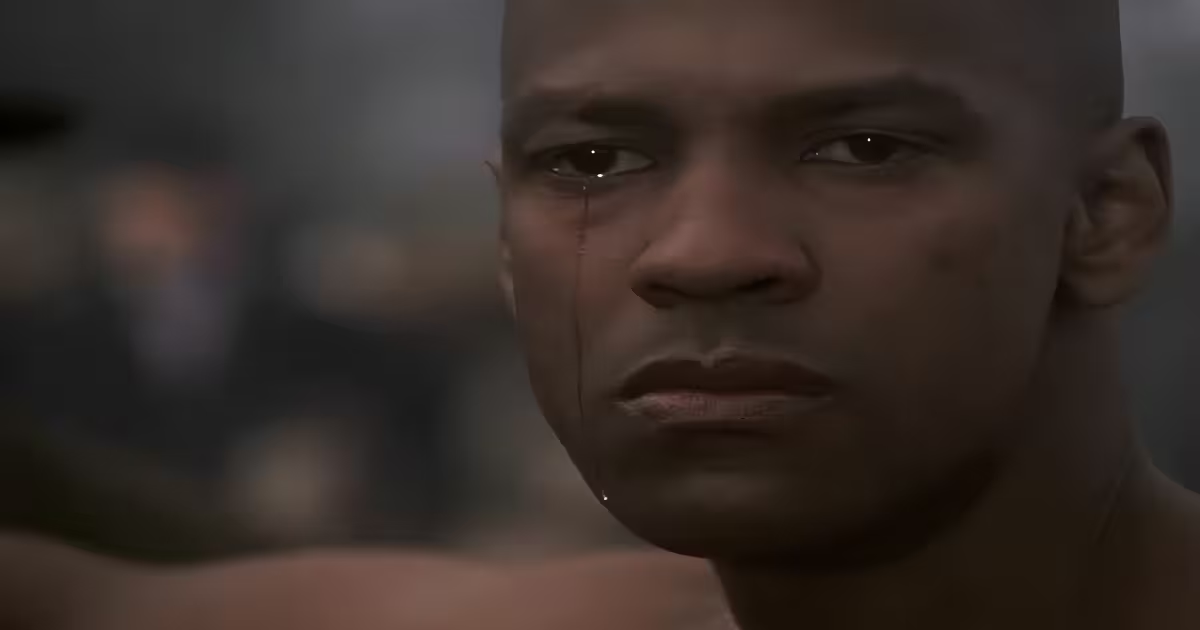
The single tear that falls down his cheek during the whipping scene remains one of cinema’s most powerful images. Washington rightly won the Academy Award for Best Supporting Actor.
Morgan Freeman provides a steady, grounding presence as Rawlins, balancing Trip’s explosive anger with quiet wisdom. The chemistry among the men in the regiment feels entirely authentic.
3. Script and Dialogue
Kevin Jarre’s screenplay relies heavily on Shaw’s actual letters. This provides a formal, slightly rigid tone to Shaw’s dialogue, contrasting sharply with the natural, conversational speech of the enlisted men. The script builds tension slowly.
One weakness is the pacing during the middle act, which drags slightly as the political maneuvering takes center stage. However, the dialogue hits hard when it matters, especially during the quiet campfire scene before the final battle.
4. Music and Sound Design
James Horner composed the score for the Glory 1989 film. His use of the Boys Choir of Harlem adds a haunting, spiritual quality to the violence. The music swells during moments of triumph but becomes mournful and quiet during the aftermath of battles.
The sound design is equally striking. The sound of musket fire, the thud of cannonballs hitting the sand, and the screams of the wounded create an immersive, terrifying soundscape. The film won an Oscar for Best Sound, a well-deserved recognition.
5. Glory 1989 Themes and Messages
The primary theme of the Glory 1989 film is the fight for dignity. The men of the 54th are not just fighting the Confederacy; they are fighting the racist assumptions of their own army.
The film comments on the idea that freedom is never given; it must be claimed, often at a terrible cost. It reminds audiences that history is built on the sacrifices of marginalized groups who believed in a country that did not yet fully believe in them.
Comparison
When you compare the Glory 1989 film to other war movies of its era, like Platoon or Full Metal Jacket, it feels more classical and romantic in its tragedy. Compared to Zwick’s later work, such as The Last Samurai, you can see the director’s ongoing interest in isolated military cultures and doomed charges.
What sets Glory apart is its specific focus on racial dynamics within the military. It falls short only in its over-reliance on the “white savior” trope, as the story is framed entirely through Shaw’s perspective rather than centering the Black soldiers completely.
Audience Appeal/Reception
The film targets history buffs, military enthusiasts, and fans of intense character dramas. It is entirely suitable for cinephiles who want to study pacing, practical effects, and acting. Casual viewers might find the middle section slow, but the emotional payoff at the end works universally.
Awards
The Glory 1989 film earned significant recognition. It won three Academy Awards: Best Supporting Actor for Denzel Washington, Best Cinematography for Freddie Francis, and Best Sound. It received a total of five Oscar nominations. Denzel Washington also won a Golden Globe for his performance.
Personal Insight
When you evaluate the Glory 1989 film today, the lessons it offers feel sharply relevant to our current social climate. We live in an era where discussions about race, equality, and national identity dominate our daily news feeds. Often, these conversations become abstract, reduced to statistics or loud arguments on social media. I find that going back to a film like this grounds those arguments in brutal reality. The men of the 54th Massachusetts were fighting for the basic right to be recognized as human beings and citizens. They wore the uniform of a country that still debated their worth.
This tension mirrors many modern struggles.
Whether we look at current debates over voting rights, economic disparities, or systemic biases in justice, the core issue remains the same: the demand for equal dignity.
The Glory 1989 film shows us that progress is rarely a straight line. It is messy, violent, and requires immense personal sacrifice. The film does not end with a neat, happy victory. It ends in death and a mass grave. Yet, that sacrifice moved the needle of history. It forced the federal government to recognize the value and courage of Black soldiers.
In my own reading and writing, I often gravitate toward subjects that explain why our systems work the way they do, like the economics of poverty or the psychology behind crime. Watching Trip refuse to carry the flag because he does not fully believe the country will love him back, only to pick it up when Shaw falls, is a profound psychological study. It is a man choosing to fight for the idea of America, even when the reality of America has abused him.
You cannot watch this film and remain passive. It asks you what you are willing to sacrifice for your beliefs. It demands you look at the foundations of modern society and recognize the blood mixed into the mortar. For young people today, who often feel cynical about political systems, the Glory 1989 film serves as a harsh reminder that cynicism is a luxury.
The men on that beach did not have the luxury of giving up. They fought anyway. That is the lesson we must carry forward. We must continue to push for a better system, honoring those who paid the ultimate price to give us the ground we stand on today.
Glory 1989 Quotations
“I ain’t much about no prayin’, now. I ain’t never had no family, and… killed off my mama. Well, I just… Y’all’s the onliest family I got. I love the 54th.” – Trip
“There’s more to fighting than just rest, sir. There’s character. There’s strength of heart. You should have seen us in action two days ago. We were a sight to see!” – Thomas Searles
“A good man, Colonel. A good man.” – John Rawlins
Pros and Cons
Pros:
- Gripping performances, especially from Denzel Washington and Morgan Freeman.
- Stunning visuals and realistic, terrifying battle sequences.
- Incredible, emotive musical score by James Horner.
- Historically accurate costume and set design.
Cons:
- Slow pacing in parts, particularly during the second act’s political maneuvering.
- The narrative heavily relies on the perspective of the white commanding officer, which dilutes the focus on the Black soldiers.
- Some historical inaccuracies regarding the backgrounds of the specific soldiers.
Conclusion
My final opinion of the Glory 1989 film is that it remains a necessary watch. It tackles the painful history of the American Civil War with honesty and incredible artistic skill. While it suffers from some slow pacing in its middle sections and frames its story through a conventional lens, the sheer power of the performances overcomes these flaws.
I give a clear recommendation: A must-watch for history enthusiasts and anyone who appreciates masterful acting.
Rating
4.5/5 stars
Recommendation for potential readers: This article will benefit students of history, film critics, and general readers looking for profound media recommendations. It is perfectly suitable for general audiences who want to understand the cultural footprint of the American Civil War.





