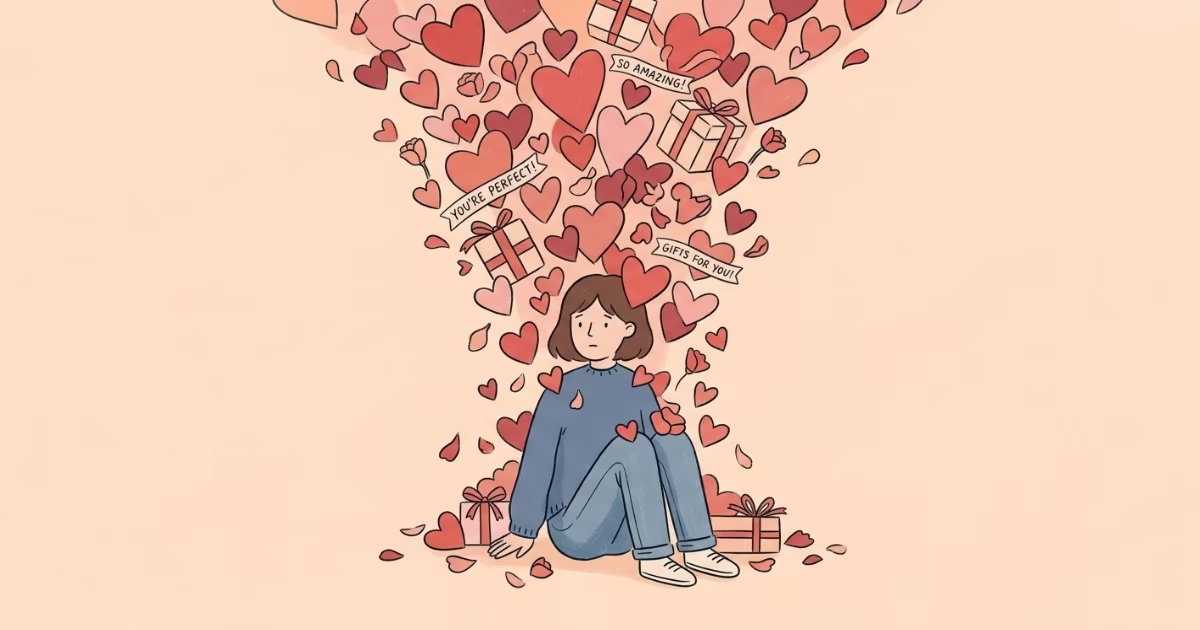

Love bombing is the most dangerous kind of flattery because it arrives dressed as the relationship you always hoped for. The gifts come early, the texts never stop, and within weeks you hear the word “soulmate.” It feels wonderful.
That is the whole point. And in my reading of the research, the clearest way to tell love bombing from honest, excited love is not how much affection you receive. It is what happens the first time you say no.
Table of Contents
What is love bombing?
Love bombing is a manipulation pattern where someone floods you with excessive attention, praise, and affection early on so that you feel dependent on them and obligated to them. That is close to how licensed therapist Sasha Jackson, LCSW, defined it in a Cosmopolitan feature republished by Cosmo.ph on September 18, 2022, written by Taylor Andrews, Rachel Varina, and Lauren L’Amie. The article was the starting point for this piece, and I read it twice before I went looking for the studies behind it.
What struck me first was a quiet detail in Jackson’s explanation. She points out that the early phase actually feels good, because the flood of attention makes you feel needed, loved, and worthy. Those are the exact ingredients of healthy self-esteem. So love bombing does not attack your self-worth at the start. It borrows it. Then, later, it takes it back with interest.
Also, the term is older than dating apps. According to the Wikipedia entry on love bombing, which cites historical sources on new religious movements, the phrase was coined by members of the Unification Church of the United States (often called the Moonies) during the 1970s.
Psychologist Margaret Singer later described the tactic in her book Cults in Our Midst as a coordinated effort by long-standing members to shower recruits with flattery, attention, and affectionate touch. The Cosmopolitan piece adds that cult leaders such as Jim Jones and David Koresh used similar excessive positive reinforcement to manufacture unity and loyalty.
That history matters to me. It tells you love bombing was never about romance in the first place. It is a recruitment method. Romance is just one place where it works very well.
Quick summary
Love bombing is intense, fast, over-the-top affection used to gain control, not to build closeness.
The term dates to the 1970s Unification Church, not modern dating culture.
The first empirical study, by Strutzenberg and colleagues at the University of Arkansas in 2017, surveyed 484 people aged 18 to 30 and linked love bombing to higher narcissism, lower self-esteem, and heavier texting.
The usual cycle runs idealize, devalue, discard, and sometimes repeat.
Romance scams use the same script at scale. The FTC counted about $1.16 billion in reported romance scam losses in the first nine months of 2025, based on data reported by Global Dating Insights.
The simplest test: set a small boundary. Real love adjusts. A love bomber punishes, sulks, or pushes harder.
If you feel unsafe, reach out to a trusted person or a domestic abuse helpline.
Why does love bombing feel so good if it is harmful?
Love bombing feels good because it targets real human needs, and your brain rewards you for getting them met. The Cosmopolitan article credits the early high partly to dopamine and endorphins. I would add a note of caution here. I could not find a peer-reviewed study that measured brain chemistry in people being love bombed specifically, so treat the “chemical rush” explanation as a reasonable description rather than a proven mechanism.
What is well supported is the psychology of reciprocity. Jackson ties love bombing to the law of reciprocity: when someone gives you something, you feel you owe them something equal or greater back.
Robert Cialdini made reciprocity famous in his book Influence, and it is one of the most studied persuasion principles in social psychology. Now apply it to a relationship. If someone gives you a designer bag in week two, a weekend trip in week three, and constant praise every day, you start to feel you owe them loyalty. Even when the red flags show up. Especially then.
Here is the uncomfortable part. The better you are at gratitude and fairness, the more exposed you are. Love bombing does not exploit weak people. It exploits decent ones.
What are the signs of love bombing?
The main signs of love bombing are extravagant gifts, obsessive flattery, nonstop complimentary texting, and an expectation that you reply right away. Those four come directly from the Cosmopolitan piece, and they match what I found in clinical and research writing.
The article also lists five phrases worth noticing. I have paraphrased them and added what each one often hides:
- “I want to spoil you.” Heavy gifts in a short time. The gift is not the problem. The speed and the sense of debt are.
- “I just want to be with you all the time.” If you feel guilty for wanting space, that guilt is the warning.
- “I check on you because I worry.” An occasional check-in is sweet. Tracking your location, reading your social media, or asking for passwords is control.
- “We are meant for each other.” Soulmate talk within weeks skips the part where two people actually learn each other.
- “It’s you and me forever, right?” A demand for a future before there is a present.
Lori Nixon Bethea, PhD, owner of Intentional Hearts Counseling Services, adds three behaviors in the same article. A love bomber tends to demand your time and attention and may isolate you from family and friends. They compliment you excessively. And they push you toward commitment very early in the courtship.
Notice the pattern. None of these signs is evil on its own. Plenty of kind people buy gifts and send “good morning” texts. The problem is the combination, the speed, and the pressure.
For instance, a partner who sends flowers and then asks, “Did you like them?” is being sweet. A partner who sends flowers and then sulks because you had dinner with your sister that night is keeping score.
A quick self-check
Take this scenario into consideration. You are three weeks into dating someone. Answer these honestly:
- Do you feel you owe this person, even though you never asked for anything?
- Have you cancelled plans with friends more than twice because they seemed hurt?
- Do you feel anxious if you do not reply within a few minutes?
- Has anyone close to you said, “This is moving really fast”?
- Did they say “I love you” or “soulmate” before you met their friends or knew their daily life?
If you answered yes to three or more, I would not panic. I would slow down and watch closely. That is all. Slowing down costs a real partner nothing.
Is it love bombing or just a new relationship?
The difference between love bombing and genuine early romance is whether the affection respects your pace and your “no.” That is my own reading of the expert advice, and it is the angle I think most love bombing guides miss. They list signs, but the signs overlap with normal infatuation. Almost everyone texts a lot in the first month.
So I use what I call the boundary test. The Cosmopolitan article hints at it: if you think it might just be a hard-core crush, say something like “This is moving pretty fast, and I need to set some boundaries.” Then watch.
| Situation | Genuine early love | Love bombing |
|---|---|---|
| You say you need a quiet weekend alone | “Of course. Enjoy it. Talk Monday?” | Guilt, sulking, a flood of texts, or a surprise visit |
| You decline an expensive gift | Mild disappointment, then acceptance | Hurt feelings framed as your fault |
| You want to meet their friends | Happy to arrange it | Vague excuses; they prefer “just us” |
| You slow the talk of moving in | They wait | They escalate the pressure or offer bigger promises |
| Time passes (three to six months) | Affection settles into steady care | Affection drops sharply, often into criticism |
In other words, real love bends. Love bombing breaks, or it pushes harder. Your “no” is the cheapest, safest diagnostic tool you have.
A word of honesty here. I cannot give you a verified number of weeks after which love bombing “always” flips. I did not find research that sets a reliable timeline, and I would be suspicious of any article that claims one. What I can tell you is that the Cosmopolitan experts describe the switch happening after the person feels they have secured you.
What does the research actually say about love bombing?
The research on love bombing is small but real, and it points toward narcissism and insecurity. Initially, it may seem like a pop-psychology buzz term with no data behind it. Surprisingly, there is at least one solid academic starting point.
In 2017, Claire Strutzenberg, Jacquelyn Wiersma-Mosley, Kristen Jozkowski, and Jennifer Becnel published “Love-bombing: A Narcissistic Approach to Relationship Formation” through the University of Arkansas.
They surveyed 484 college students aged 18 to 30 at a southern US university. According to the published abstract, their findings were:
- Love bombing was positively linked with narcissism.
- Love bombing was negatively linked with self-esteem.
- Love bombing was linked with more text and media use within romantic relationships.
- It was also tied to insecure attachment, though, oddly, secure attachment also predicted some of these behaviors.
The authors described this as the first empirical look at love bombing. What I found most human about the study is the second finding. People who love bomb may not feel powerful inside. They often feel the opposite. For someone with high narcissism and low self-worth, the researchers suggested, love bombing can seem like a logical, even necessary, strategy.
That does not excuse it. Still, it changes how I think about it. Many love bombers are not cold masterminds. Some are frightened people running a script that once worked.
Newer work exists, but it is thin. For example, a 2024 study by Raashi Beri in the International Journal of Interdisciplinary Approaches in Psychology looked at 45 young adults aged 18 to 25, comparing people in relationships with people in “situationships.” The directions of the correlations were interesting, but the abstract states that all relationships were statistically insignificant. So I would not draw conclusions from it. I mention it because you will see it cited online, and you deserve to know how small it is.
To put it another way, the evidence base for love bombing is still young. Due to insufficient evidence, nobody can tell you how common it is in the general population. I searched for a reliable prevalence figure and could not verify one. If you see a statistic like “X% of people have been love bombed,” check where it came from.
Is love bombing always a sign of a narcissist?
No, love bombing is not always a sign of a narcissist, but it is strongly associated with narcissistic traits. Psychotherapist Ami Kaplan, LCSW, told Cosmopolitan that anyone is capable of love bombing, though it is most often a symptom of narcissistic personality disorder. She also described it as a largely unconscious behavior.
That word “unconscious” is important. It means some love bombers do not sit down and plan the con. They chase the feeling of “getting” someone, and once they feel they have you, Kaplan says, they tend to switch and become difficult, abusive, or manipulative.
I would add two cautions of my own:
- Love bombing is not a clinical diagnosis. It is a description of behavior. Only a qualified clinician can diagnose narcissistic personality disorder, and they do it in person, not from a list of texts.
- Anxious people can over-give too. Someone with an anxious attachment style may shower a new partner with affection because they fear being left. That is different from love bombing when there is no pressure, no isolation, and no punishment when you set a limit. The Strutzenberg study itself found links with insecure attachment, which tells me the line is blurry.
So the label matters less than the behavior. You do not need to prove someone is a narcissist to leave a relationship that makes you feel controlled.
What is the love bombing cycle?
The love bombing cycle usually moves through three stages: idealization, devaluation, and discard, sometimes followed by a return. Psychiatrist Dale Archer described this pattern in Psychology Today in 2017 using the shorthand “IDD”: intense idealization, devaluation, discard, and repeat.
Here is how it tends to unfold:
1. Idealization. You are perfect. They have never met anyone like you. The attention is constant and intense.
2. Devaluation. The warmth drops. Criticism shows up. Bethea describes how, once the love bomber begins to withdraw, they may gaslight their partner and leave them feeling invalidated and devalued. You start working harder to get back the person from the first month.
3. Discard. They pull away or leave. According to Bethea, the love bomber may walk away believing they can return at any time to continue the cycle.
4. Hoovering (the return). This is a widely used informal term, not a research term, for the phase where the person comes back with apologies and affection. The love bombing starts again, and the loop resets.
This leads to the cruelest part. The memory of the idealization phase keeps you hooked. You are not staying for who they are now. You are staying for who they were in week two, hoping that person will return. As a result, many people in these relationships blame themselves for “ruining” something that was never real in the first place.
Why is love bombing considered emotional abuse?
Love bombing is considered emotional abuse because it uses affection as a tool for control rather than connection. The Cosmopolitan article calls it a dangerous form of emotional abuse, and Bethea describes it as a possible cycle of abuse in which the love bomber gains control over their partner’s mind and heart while boosting their own ego.
Some places now treat the wider pattern as a legal matter. In England and Wales, for example, section 76 of the Serious Crime Act 2015 created the offence of “controlling or coercive behaviour” in an intimate or family relationship.
It came into force on 29 December 2015 and carries a maximum sentence of five years, according to a legal analysis published by Inforrm. To be clear, love bombing by itself is not a crime. But the isolation, monitoring, and control that often follow it can fall under coercive control laws in some jurisdictions. If you are outside the UK, the rules will differ, and a local legal adviser is the right person to ask.
How do romance scammers use love bombing?
Romance scammers use love bombing to build intense trust fast, then turn that trust into money. The Cosmopolitan writers point to Netflix’s The Tinder Swindler as a perfect example, and the numbers behind that film are staggering.
The Tinder Swindler, directed by Felicity Morris, was released on Netflix on February 2, 2022. It follows Shimon Hayut, who called himself “Simon Leviev,” and is estimated to have taken around $10 million from victims. According to Wikipedia’s entry on the film, it logged 45.8 million hours viewed globally in its first week and reached the top 10 in 92 countries. What made it so watchable, at least for me, was not the money. It was how normal and smart the women were. The script, not the victim, did the work: private jets, grand gestures, “I’ve never felt this way,” and then an emergency.
The scale today is much larger than one man. Here are figures I could verify:
- Romance scams hit a then-record $547 million in reported losses in 2021, according to a Federal Trade Commission press release from February 2022.
- For the first nine months of 2025, the FTC’s Consumer Sentinel data showed about $1.16 billion in reported romance scam losses across 55,604 reports, a 22% rise over the same period in 2024, with a median loss of $2,218 in the third quarter. These figures come from Global Dating Insights’ report on FTC data, published February 26, 2026.
- In an April 27, 2026 press release, the FTC said nearly 60% of people who reported losing money to a romance scam in 2025 said it started on social media.
Please note that these are reported losses only. The real totals are almost certainly higher, since many people never report out of shame. I cannot put an exact figure on that gap, though.
The lesson for everyday dating is simple. A stranger online who is madly in love within days, cannot meet in person, and then has a money problem is running the love bombing script with a price tag attached.
What should you do if you think you are being love bombed?
If you think you are being love bombed, slow things down, test a boundary, and talk to someone outside the relationship. Here is a practical plan based on the advice in the Cosmopolitan piece, plus a few steps I would add.
Step 1: Name what you feel. Write down three moments that made you uneasy. Dates help. Memory gets foggy when someone is charming you.
Step 2: Set one small boundary. Keep it low stakes: “I’m going to spend Saturday with my friends,” or “Let’s not talk about moving in yet.” Watch the reaction over the next 48 hours.
Step 3: Tell someone you trust. Kaplan recommends turning to a close friend or family member who can keep your confidence, or a therapist or support group. Love bombing works best in isolation. A second opinion breaks the spell.
Step 4: Do not try to fix them. The Cosmopolitan writers are blunt about it: it is almost certainly not within your power to change a manipulative person, and that work belongs to professionals. You are not their therapist.
Step 5: Step back safely. If the pattern is clear, the article’s advice is to end it, unfollow, and lean on your support system. If you fear how the person may react, plan your exit with help. In the US, the National Domestic Violence Hotline is 1-800-799-7233. In the UK, the National Domestic Abuse Helpline is 0808 2000 247. If you are elsewhere, search for your local domestic abuse service.
Step 6: Expect to miss them. The Cosmopolitan piece notes that it is normal to feel a strong attachment to a love bomber and even defend them. Missing someone does not mean you made a mistake by leaving. It means the idealization phase worked, which is exactly why it was a problem.
How do you heal after being love bombed?
Healing after love bombing starts with understanding that the high you felt was real, even if the person was not. Your feelings were not stupid. They were a normal response to an abnormal amount of attention.
A few things I have found helpful to keep in mind while reading survivors’ accounts and therapists’ advice:
- Grieve the fantasy, not just the person. You are often mourning the week-two version who never existed.
- Rebuild your own sources of worth. Since love bombing borrows your self-esteem, give it back to yourself through friends, work, and hobbies that do not depend on a partner.
- Go slower next time. Not colder, just slower. Let trust be earned in months, not days.
- Learn the shape of manipulation. Books help. If you want to understand why some people treat relationships as a power game, I would start with Robert Greene’s The Laws of Human Nature, which I discussed in our review of The Laws of Human Nature. Bill Eddy’s high-conflict personality framework, summarized in 5 Types of People Who Can Ruin Your Life, is also useful for spotting narcissistic patterns early.
- Relearn what love looks like. bell hooks argued that love is a practice made of care, respect, and responsibility, not just a feeling. After a love bomber, that definition can feel like fresh air. I wrote about it in All About Love by bell hooks.
If you keep replaying the relationship and cannot stop thinking about the person, Sopranu’s piece on romantic obsession psychology is worth reading, and its essay on the philosophy of love from Plato to Erich Fromm offers a calmer, longer view of what love is supposed to be. For the confusing withdrawal phase, their article on why men pull away emotionally covers some of the same ground, though it is not specifically about love bombing.
My honest take on love bombing
Love bombing is not a story about too much love. It is a story about love used as a weapon against another person’s gratitude. That is my one-line verdict after reading the Cosmopolitan feature, the 2017 Arkansas study, the scam data, and the legal material.
Where I part ways slightly with a lot of online content is in tone. Much of it treats every enthusiastic partner as a potential narcissist. That is not fair, and it is not supported by evidence. The research base is small. One widely cited early study had 484 students. A newer one had 45 people and found nothing statistically significant.
Nevertheless, the pattern that clinicians describe is consistent: fast intensity, early pressure, isolation, and a sharp drop in warmth once you are committed.
So here is what I would tell a friend. Enjoy being adored. You deserve it. But keep your friends close, keep your own plans, and say no to something small in the first month. The right person will barely notice. The wrong one will show you who they are.
Frequently asked questions about love bombing
What is love bombing in simple words?
Love bombing is when someone showers you with too much attention, praise, and gifts too quickly so you feel attached and indebted to them, which they later use to control you.
How long does love bombing last?
There is no verified standard length. Experts quoted by Cosmopolitan say the switch usually comes after the love bomber feels secure in the relationship. I could not find research that sets a reliable timeline.
Can love bombing happen in friendships or at work?
Yes. The term started in a religious recruitment setting in the 1970s, not in dating. The same pattern of flattery, fast closeness, and pressure can appear in friendships, groups, and workplaces.
What is the difference between love bombing and being in love?
Real love respects your pace and your boundaries. Love bombing pushes past them and punishes you, often with guilt or sulking, when you slow things down.
Do love bombers know they are doing it?
Sometimes not. Psychotherapist Ami Kaplan described it to Cosmopolitan as a largely unconscious behavior, though scammers clearly use it on purpose.
Is love bombing a red flag for abuse?
It can be. Experts in the Cosmopolitan feature describe it as a form of emotional abuse that often leads to devaluation, gaslighting, and a repeating cycle.
What should I say to someone who is love bombing me?
Try something calm and direct, such as, “I like you, but this is moving too fast for me, and I need to slow down.” Then watch how they respond.
References
- Andrews, T., Varina, R., and L’Amie, L. “Everything You Need To Know About Love Bombing And Why It’s So Dangerous.” Cosmopolitan, republished by Cosmo.ph, September 18, 2022. (Source PDF supplied.)
- Strutzenberg, C. C., Wiersma-Mosley, J. D., Jozkowski, K. N., and Becnel, J. N. (2017). “Love-bombing: A Narcissistic Approach to Relationship Formation.” Discovery, University of Arkansas. scholarworks.uark.edu
- Beri, R. (2024). “A Study on Love Bombing, Narcissism and Emotional Abuse among Young Adults in Relationship and Situationship.” International Journal of Interdisciplinary Approaches in Psychology. psychopediajournals.com
- “Love bombing.” Wikipedia (origin in the Unification Church, Margaret Singer’s Cults in Our Midst, Dale Archer’s IDD model). en.wikipedia.org
- “The Tinder Swindler.” Wikipedia (release date, director, viewing figures). en.wikipedia.org
- Federal Trade Commission. “FTC Data Show Romance Scams Hit Record High; $547 Million Reported Lost in 2021.” February 2022. ftc.gov
- Global Dating Insights. “Romance Scams Outpace Other Fraud Types at $1.16 Billion.” February 26, 2026 (reporting FTC Consumer Sentinel data). globaldatinginsights.com
- Federal Trade Commission. “New FTC Data Show People Have Lost Billions to Social Media Scams.” April 27, 2026. ftc.gov
- Robertson, R. “Controlling or Coercive Behaviour: section 76 of the Serious Crime Act 2015.” Inforrm, January 13, 2016. inforrm.org