
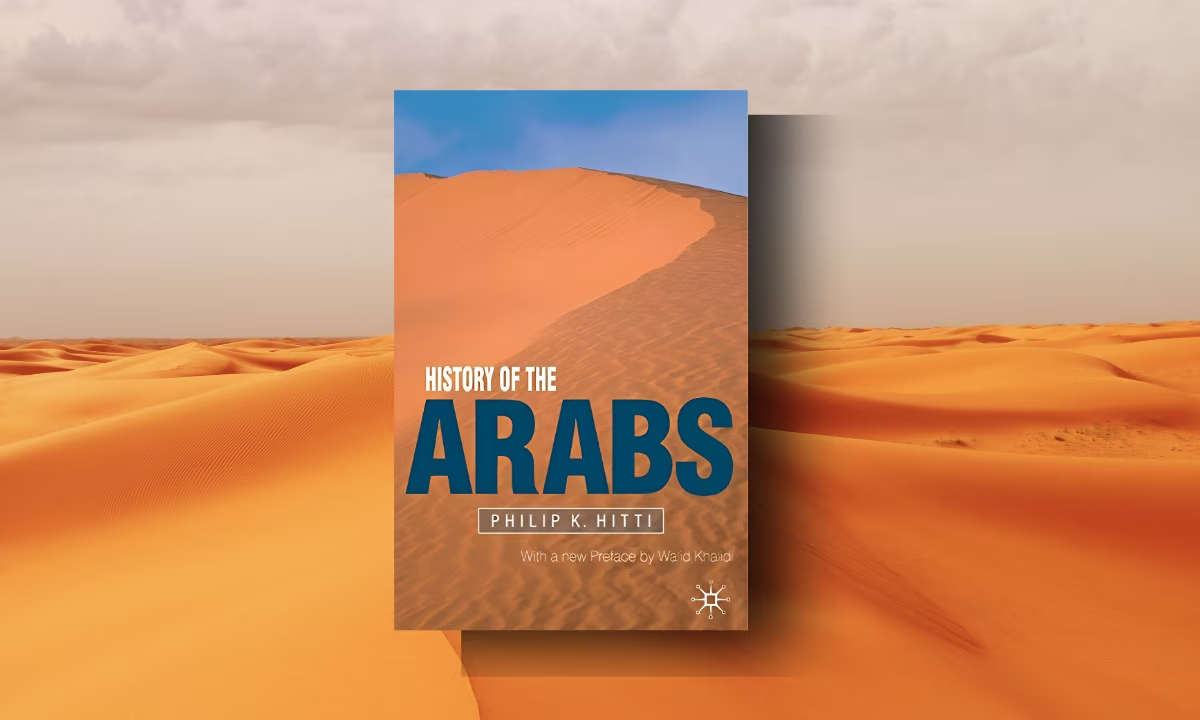

History of the Arabs by Philip K. Hitti is the 1937 Princeton classic that taught the English-speaking world who the Arabs were, and almost ninety years later it is still the single book most people are told to read first. It is also a book that will, every forty pages or so, say something no historian would print today.
That tension is the whole story of this review. I read the 1970 tenth edition cover to cover (757 pages of text before the index), and in this History of the Arabs summary I give you everything I took from it: the Bedouin world, Muhammad and the Koran, the Umayyad and Abbasid empires, Muslim Spain, the Crusades, the Mamluks, the Ottoman centuries, and the modern Arab states.
Table of Contents
I also flag, with page numbers, the places where Hitti’s 1930s lens shows. If you only have time for one article on this book, I wrote this one so you will not need to go back to the 800-odd pages yourself.
History of the Arabs at a Glance
What is History of the Arabs about? It is a one-volume history of the Arabians and the Arabic-speaking peoples from the earliest Semitic migrations to the 1960s, written by Lebanese-American historian Philip Khuri Hitti (1886 to 1978).
Hitti’s core claim sits on page 4: “No people in the Middle Ages contributed to human progress so much as did the Arabians and the Arabic-speaking peoples.”
The most important takeaways:
The desert made the people. Hitti argues Arabia’s isolation preserved Semitic language and social traits, and that Bedouin values (raiding, hospitality, clan loyalty called ‘asabiyah) shaped Arab politics long after Islam.
Islam replaced blood with faith. Muhammad’s community at Medina was “the first attempt in the history of Arabia at a social organization with religion, rather than blood, as its basis” (p. 120).
The conquests were driven by hunger as much as heaven. Hitti writes, “Not fanaticism but economic necessity drove the Bedouin hordes” (p. 144). His sharpest line: “It was Arabianism and not Muhammadanism that triumphed first” (p. 145).
Within a century, the empire beat Rome’s size. By 732 it stretched “from the Bay of Biscay to the Indus” (p. 215).
The Battle of Tours was overrated. “In reality it decided nothing” (p. 501).
Baghdad was the engine of a translation boom. Greek science reached Arabic mostly through Syriac, translated largely by Nestorian Christians such as Hunayn ibn-Ishaq (p. 310 to 313).
Arabic science fed Europe. Al-Khwarizmi gave Europe algebra and the word “algorism” (p. 379); Ibn Sina’s Canon was, in William Osler’s words, “a medical bible for a longer period than any other work” (p. 368).
Muslim Spain was Europe’s brightest medieval light. Cordova had 113,000 homes and 70 libraries (p. 526).
The decline came from within before the Turks. “The Islamic creative spark had faded away centuries before the advent of the Turks” (p. 742).
Read it with a filter. Some passages on race, “Semitic character” and women reflect 1930s assumptions, and a few statistics (like the Morisco death and exile toll) are far above modern estimates.
Reader Recommendation for History of the Arabs
You will probably love it if you are:
A student of Islamic or Middle Eastern history who wants the classic reference that later books argue with.
A reader of history of science curious about algebra, the zero, the hospital, paper and the Canon of Ibn Sina.
Someone who enjoys old-school narrative history with dry humour. Hitti can be funny. He notes that the trench at Medina “struck the Bedouin miscellany as the most unsportsmanlike thing they had ever seen” (p. 117).
A Muslim reader who wants to see how a careful, Christian-born Arab scholar presented Islamic civilization to a Western audience in the 1930s.
You may bounce if you:
Want current scholarship. The text was last revised in 1970, and later reprints (including Palgrave’s 2002 “revised tenth edition”) did not update the content, as reviewer Letizia Osti pointed out on H-Net in 2003.
Want the twentieth century in depth. Ottoman rule and modern independence get roughly 50 of the 757 pages.
Dislike transliterated Arabic. Names like “al-Mas’udi”, “Hulagu” and “abu-al-‘Abbas” arrive in dense waves, often with Latin and Greek variants.
Have no patience for dated phrasing. Hitti writes “Moslem”, “Koran” and “Makkah”, and he generalizes about “the Semite” in ways that make modern readers wince.
Introduction to History of the Arabs by Philip K. Hitti
History of the Arabs: From the Earliest Times to the Present is a narrative history by Philip K. Hitti, Professor Emeritus of Semitic Literature at Princeton University.
Macmillan first published it in London in 1937. It went through ten editions in Hitti’s lifetime (1937, 1940, 1943, 1949, 1951, 1956, 1960, 1963, 1967 and 1970), according to the copyright page of the tenth edition. Palgrave Macmillan reissued the tenth edition in 2002 with a new preface by historian Walid Khalidi; Goodreads lists that paperback at 822 pages.
History of the Arabs is divided into six parts and 52 chapters:
- The Pre-Islamic Age
- The Rise of Islam and the Caliphal State
- The Umayyad and ‘Abbasid Empires
- The Arabs in Europe: Spain and Sicily
- The Last of the Medieval Moslem States
- Ottoman Rule and Independence
Context: What Kind of Book Is History of the Arabs?
History of the Arabs is a work of narrative and cultural history. It covers politics and war, but more than half of it deals with religion, law, poetry, science, medicine, architecture, trade and daily life. Hitti built it, as he says in the first preface, from “many years of study and teaching at Columbia University, the American University of Beirut and Princeton University.”
His credentials matter here.
Born on 22 June 1886 in Shemlan, Mount Lebanon, Hitti studied at the Syrian Protestant College (now the American University of Beirut), earned his PhD at Columbia in 1915, and chaired Princeton’s Semitic and Near Eastern work from 1926 until he retired in 1954, according to his Wikipedia biography and the American University of Beirut archive of his papers.
Arab America‘s “Pathbreakers” series credits him with founding Princeton’s Program in Near Eastern Studies in the mid-1940s. He died in Princeton on 24 December 1978.
He was also a public voice: in 1944 he testified before Congress against a Jewish state in Palestine, which led to a published exchange with Albert Einstein and Erich Kahler in the Princeton Herald. That background helps you read his final chapter, where Zionism appears as something “viewed by Arabs everywhere as an intrusive movement” (p. 756).
Purpose: What Is the Main Argument of History of the Arabs?
Hitti’s main argument is that the Arabs were not a footnote to Western history but one of its hinges. He states it on page 4: the Arabs “absorbed and assimilated the main features of the Greco-Roman culture,” then passed that learning to medieval Europe, setting the West “on the road towards its modern renaissance.”
He closes History of the Arabs on the same note, calling the Arabic-speaking peoples “holders aloft of the torch of enlightenment throughout medieval times” (p. 757).
A second, quieter argument runs underneath: that Arab history is best explained by environment and economics rather than by divine plan or fanatic zeal. That is why his chapters on conquest read more like economic history than like a chronicle of holy war.
Background
The story behind History of the Arabs is funny and a little sad. In the 1970 preface, Hitti recalls that Daniel Macmillan wrote to him in 1927 asking for a book to replace Ameer Ali’s A Short History of the Saracens (1900). Hitti signed a contract “in my youthful enthusiasm” to deliver the manuscript in three years.
It took ten.
When it finally came out in 1937, he suggested the New York office import a hundred copies, and the publisher “shot back, ‘Who is going to buy that many?'”
Hitti’s explanation is blunt: the American public, “even at its educated level, was then almost illiterate so far as the Arabs and Moslems were concerned.” Courses on Arab history barely existed outside a few graduate schools.
World War II changed that, and the book changed with it.
The first four editions ended with the Ottoman conquest of 1517. The fifth (1951) added Part VI on Ottoman rule and independence, and each later edition updated the modern material. By 1966 it had been translated into languages “beginning with Spanish and ending with Urdu and Indonesian,” and the 1970 preface adds Italian, Serbo-Croat and Polish versions.
History of the Arabs Summary
Part I. The Pre-Islamic Age: Why Does Hitti Start With the Desert?
Hitti starts with the desert because, in his view, the desert explains almost everything that follows. He opens with a complaint that still lands: of all peoples of comparable importance, “no country and no nationality have perhaps received so little consideration and study in modern times as have Arabia and the Arabs” (p. 3).
Arabia as the cradle of the Semites. Hitti accepts the theory, popular in his day, that the Arabian Peninsula was the original home of the Semitic peoples (Babylonians, Assyrians, Phoenicians, Hebrews, Aramaeans, Arabs). His reasoning is demographic. Arabia is mostly desert ringed by a thin habitable edge and the sea.
When the edge fills up, people must move north into the Fertile Crescent. Around 3500 BC, he writes, one such wave reached the Nile valley and helped produce “the Egyptians of history” (p. 10). The Arabs call their land Jazirat al-‘Arab, “the Island of the Arabs” (p. 8), and Hitti takes the label seriously: water on three sides, sand on the fourth.
The land in numbers. In the 1970 edition, Arabia covers 1,027,000 square miles with an estimated population of only fourteen million (p. 14). Oil, “first discovered in 1932” (p. 6), was already the biggest source of income, replacing pearls, salt and camels.
Bedouin life. This is the most quoted, and most criticized, chapter in History of the Arabs.
Hitti insists the Bedouin is no aimless wanderer: “Nomadism is as much a scientific mode of living in the Nufud as industrialism is in Detroit or Manchester” (p. 23). The nomad is “land-pirate or broker, or both at once.” The camel is everything; Hitti borrows Sprenger’s phrase that the Bedouin is “the parasite of the camel” (p. 22) and notes that Arabic is said to have about a thousand names for the camel. A camel can go about twenty-five days in winter and five in summer without water.
Three institutions define desert society in his account:
The raid (ghazw). Raiding is “raised by the economic and social conditions of desert life to the rank of a national institution” (p. 25). The poet al-Qutami put it plainly: raid the enemy, the neighbour, and your own brother if no one else is left.
Hospitality (diyafah). The counterweight to raiding. Harming a guest offends “not only against the established mores and honour but against God Himself” (p. 26).
Clan loyalty (‘asabiyah). “Boundless and unconditional loyalty to fellow clansmen” (p. 27), which Hitti later blames for the “disintegration and ultimate downfall of the various Islamic states” (p. 28). Blood feuds could last forty years, as in the Basus War.
He also argues that the Bedouin “is a born democrat” who meets his sheikh on equal terms (p. 28), and that “no people, other than the Arabians, have ever raised genealogy to the dignity of a science.”
The southern kingdoms. Before Mecca mattered, South Arabia was rich. “The Sabaeans were the Phoenicians of the southern sea” (p. 49), controlling incense and the India route.
Their great work was the Ma’rib dam, whose older parts date to the mid-seventh century BC (p. 54). Its final collapse, remembered in the Koran (34:15), happened sometime between 542 and 570 AD (p. 64). The year 570 or 571 is also “the year of the elephant,” when the Abyssinian Abraha marched on Mecca; Hitti identifies the “small pebbles” that destroyed his army with smallpox.
The northern trading states. Petra (the Nabataeans) and Palmyra (Queen Zenobia) were caravan cities. Palmyra peaked between AD 130 and 270, and its chief Odaynath was named dux Orientis by Rome in 262 (p. 75).
The Ghassanids and Lakhmids served as Arab buffer states for Byzantium and Persia.
The Jahiliyah and poetry. Hitti corrects a common mistranslation. Jahiliyah does not mean “barbarism”; it means the time when Arabia “had no dispensation, no inspired prophet, no revealed book” (p. 87). Then comes one of his best sentences: “But ideas are hard to kill, and no one person’s veto is strong enough to cancel the past.”
Pre-Islamic Arabs poured their art into speech, which they called “lawful magic” (p. 90). The fair of ‘Ukaz worked like “a kind of Académie française of Arabia” (p. 94), and the Seven Golden Odes (Mu’allaqat) were later compiled by Hammad al-Rawiyah. The warrior-poet ‘Antarah, born a slave, is “the Achilles of the Arabian heroic age” (p. 90).
Religion before Islam. The pagan Bedouin, Hitti argues, “had little if any religion” (p. 96). Mecca’s Ka’bah housed Hubal and other idols, plus the Black Stone; it was rebuilt in 608 (p. 100). Allah was already “the principal, though not the only, deity of Makkah,” and the name appears in older South Arabian inscriptions.
Part II. The Rise of Islam: How Does Hitti Explain Muhammad?
Hitti presents Muhammad as both a true prophet in the Hebrew mould and a gifted statesman, and he tracks the moment one role overtakes the other.
Early life. Muhammad was born “in or about A.D. 571” (p. 111), orphaned young and raised by his grandfather and then his uncle Abu Talib. Hitti calls him “the only one of the world prophets to be born within the full light of history,” while admitting that reliable reports on his youth are few.
At 25 he married Khadijah, a wealthy widow fifteen years his senior (p. 112).
The call. In a cave on Mount Hira, around 610, he heard the command “Recite thou in the name of thy Lord.” Hitti’s verdict: “In his call and message the Arabian Muhammad was as truly prophetic as any of the Hebrew prophets of the Old Testament” (p. 113). The early message was simple: one God, a judgment day, paradise and hell. Mecca’s Quraysh resisted, partly because the new faith threatened the pilgrimage trade around the Ka’bah.
The Hijrah. Muhammad reached Medina on 24 September 622 (p. 116). Hitti stresses that it was “not entirely a ‘flight'” but a migration planned for about two years. From here, “The prophet is gradually overshadowed by the statesman.”
Battles and the new state. At Badr in 624, about three hundred Muslims defeated a thousand Meccans (p. 116 to 117). Uhud (625) went the other way, and the Trench (627) saw the besiegers withdraw after a month. Hitti does not soften the treatment of Medina’s Jewish tribes: after the siege, six hundred men of the Banu Qurayzah were killed and the rest expelled (p. 117). His summary of the shift is famous: after Badr, Islam “itself became the state,” a “militant polity.”
The Ummah. The real revolution was social. The Medina community was “the first attempt in the history of Arabia at a social organization with religion, rather than blood, as its basis” (p. 120).
Muhammad lived simply, mended his own clothes, and left little.
Hitti quotes D. G. Hogarth: “No one regarded by any section of the human race as Perfect Man has been imitated so minutely” (p. 120). His closing judgment on the Prophet: “Within a brief span of mortal life Muhammad called forth out of unpromising material a nation never united before” (p. 121).
The Koran. Hitti gives both the traditional account (Zayd ibn Thabit’s collection under Abu Bakr, then ‘Uthman’s standard text in 651) and the critical one, noting that the text was finally fixed in 933 with seven readings accepted as canonical (p. 123).
Abraham appears about seventy times in twenty-five surahs and Moses in thirty-four (p. 125). The stories, he says, are told “to preach a moral,” and he finds “no verbal dependence” on the Bible despite many parallels.
The faith. Islam rests on belief (iman), worship (‘ibadat) and right-doing (ihsan). “Over ninety per cent. of Moslem theology has to do with Allah” (p. 128). Hitti walks through the five pillars and adds jihad, observing that the Ottoman sultan’s 1914 call for universal jihad “proved an utter failure” (p. 138). He also reminds Western readers that medieval Christians, including Dante, treated Islam as a Christian heresy.
The conquests. This chapter holds Hitti’s most important argument.
First, “Arabia had to conquer itself before it could conquer the world” (p. 142), meaning the Riddah wars under Abu Bakr and Khalid ibn al-Walid. Then came campaigns he ranks with those of “Napoleon, Hannibal or Alexander.” Why did they work?
Byzantium and Persia were exhausted by war, taxes were crushing, Christian sects resented Constantinople, and local Semites saw the Arabs “as nearer of kin” than their Greek overlords (p. 143). He dismisses the “Koran with the one hand and the sword with the other” picture as “equally discredited,” because Jews and Christians had a third option: tribute.
Then the key move: “Not fanaticism but economic necessity drove the Bedouin hordes” (p. 144).
He backs this with al-Baladhuri, with the Persian general Rustam’s taunt about Arab poverty, and with a verse from the Hamasah: “No, not for Paradise didst thou the nomad life forsake; / Rather, I believe, it was thy yearning after bread and dates.”
The conquest was “the last great Semitic migration” (p. 145), and the empire grew “less to early design than to the logic of immediate circumstances.” Conversion lagged far behind conquest; most people of Syria, Iraq and Persia became Muslim only in the second and third Islamic centuries.
Did the Arabs burn the Library of Alexandria? No, says Hitti. The tale is “one of those tales that make good fiction but bad history” (p. 166). No contemporary writer accused ‘Amr or ‘Umar; the story first appears with ‘Abd al-Latif al-Baghdadi, who died in 1231.
Administration under ‘Umar. Subject peoples (dhimmis) kept their own religious law and paid tribute; the poll tax ran roughly four dinars for the rich, two for the middle class and one for the poor, with women, children, monks, the old and the poor exempt (p. 171).
Hitti adds that the neat legal split between jizyah (poll tax) and kharaj (land tax) came later, under the late Umayyads. ‘Umar himself owned one patched shirt and one mantle and was assassinated on 3 November 644 (p. 176).
‘Ali, Karbala and the great schism. ‘Ali was brave, eloquent and generous but lacked “alertness, foresight, resolution, expediency” (p. 183).
His failure in life became victory in death: Hitti writes that the pilgrim crowds at Najaf and Karbala show “that death may avail a Messiah more than life.” On 10 October 680, about 4,000 Umayyad troops surrounded al-Husayn and roughly two hundred companions at Karbala (p. 190).
Hitti’s line: “Shi’ism was born on the tenth of Muharram” (p. 191). And then his best historian’s aside: “how a people actually do view an event is usually more important as a moving force in history than how they should view it.”
Part III. The Umayyad and Abbasid Empires: What Made the Golden Age Golden?
This is the longest and richest part of History of the Arabs, about 300 pages. If you read only one section of History of the Arabs, read this one.
Mu’awiyah builds a real state. Hitti calls Mu’awiyah “the model Arab sovereign” in his chapter heading.
He turned raw tribal levies into “the first ordered and disciplined force known in Islamic warfare” (p. 194), kept the Byzantine administrative framework, leaned on Syrian Christians, and started a postal service. He also made the caliphate hereditary by naming his son Yazid, a principle “never thereafter to be entirely abandoned” (p. 183 to 184).
The Umayyad peak. Under ‘Abd al-Malik (685 to 705) and al-Walid, the empire went truly global. Muhammad ibn al-Qasim reduced Sind in 711 to 712 (p. 210). Tariq crossed into Spain in 711 (p. 214). Maslamah besieged Constantinople from August 716 to September 717 and failed (p. 212).
By 732, a hundred years after the Prophet’s death, the caliph ruled “an empire greater than that of Rome at its zenith, an empire extending from the Bay of Biscay to the Indus and the confines of China” (p. 215).
Making the state Arab. ‘Abd al-Malik changed the public registers from Greek and Pahlavi into Arabic and struck “the first gold dinars and silver dirhams which were purely Arabic” at Damascus in 695 (p. 217).
Hitti, characteristically, rejects al-Baladhuri’s story that the switch happened because a Greek clerk urinated in an inkwell; it was “a well-planned policy.” In 691 ‘Abd al-Malik built the Dome of the Rock in Jerusalem, “wrongly called the ‘Mosque of ‘Umar'” (p. 264), and al-Walid rebuilt the Umayyad Mosque of Damascus.
Why the Umayyads fell. Tribal feuds between northern (Qays) and southern (Yaman) Arabs, succession fights, Shi’ite grievance after Karbala, and the anger of non-Arab converts (mawali), who were taxed and treated as second class, brought the house down.
The end was brutal.
After the Battle of the Zab in January 750, the Abbasid general ‘Abdullah invited eighty Umayyads to a banquet near Jaffa on 25 June 750 and had them all killed, then kept eating over their bodies (p. 285 to 286). Only one prince, ‘Abd al-Rahman, escaped to Spain.
Hitti’s verdict on the change is one of the most quoted lines in History of the Arabs: “Arabianism fell, but Islam continued, and under the guise of international Islam Iranianism marched triumphantly on” (p. 287). Persians, not Arab tribesmen, now ran the empire.
Baghdad. Al-Mansur laid the foundation of Baghdad in 762, spending some 4,883,000 dirhams and employing about a hundred thousand workers over four years (p. 292). It was a perfect circle, the “Round City,” officially named Madinat al-Salam, the City of Peace. He picked the site because the Tigris linked it “with lands as far as China.”
Harun al-Rashid and Charlemagne. “Of the two Harun was undoubtedly the more powerful and represented the higher culture” (p. 298).
Hitti enjoys debunking here, too. The famous pipe organ Harun supposedly sent Charlemagne is “fictitious,” a mistranslation of clepsydra, a water clock. He also notes the strange silence of Arabic sources about these embassies. Court luxury was staggering: Queen Zubaydah reportedly spent three million dinars on one pilgrimage, including water for Mecca brought from a spring twenty-five miles away (p. 302).
The translation movement. This is the heart of Hitti’s case. The Abbasid age saw “the most momentous intellectual awakening in the history of Islam and one of the most significant in the whole history of thought and culture” (p. 306).
Greek works came in through raids, gifts and purchases.
But “the Arabians knew no Greek” at first, so Nestorian Christian scholars translated Greek into Syriac and then Syriac into Arabic: “Before Hellenism could find access to the Arab mind it had to pass through a Syriac version” (p. 310). Al-Ma’mun founded his Bayt al-Hikmah (House of Wisdom) in 830, which Hitti calls a “library, academy and translation bureau.”
The star is Hunayn ibn-Ishaq (809 to 873), “the sheikh of the translators” (p. 312).
He translated almost all of Galen, and seven books of Galen’s anatomy survive only in Arabic thanks to him. Al-Ma’mun reportedly paid him “in gold the weight of the books he translated” (p. 313). When al-Mutawakkil ordered him to make a poison for an enemy, he refused, citing “my religion and my profession,” and spent a year in jail for it.
Hitti then lands his jab at the West: while Harun and al-Ma’mun studied Greek and Persian philosophy, “Charlemagne and his lords were reportedly dabbling in the art of writing their names” (p. 315). By the tenth century Arabic had become “a pliant medium for expressing scientific thought” (p. 316).
Medicine. Harun founded the first hospital in Islam on a Persian model, and thirty-four more followed throughout the Muslim world (p. 365).
Al-Razi (865 to 925) chose the site of a Baghdad hospital by hanging meat in different spots and picking the one where it rotted slowest (p. 366). His treatise on smallpox and measles holds “the first clinical account of smallpox.” Ibn Sina (980 to 1037) wrote al-Qanun fi al-Tibb, which went through fifteen Latin editions in the last thirty years of the fifteenth century and covered some 760 drugs (p. 368).
Mathematics and astronomy. Indian numerals and the zero entered Arabic via a Hindu scholar at al-Mansur’s court (p. 378).
Al-Khwarizmi (780 to about 850) wrote the oldest work on algebra, “presented through over eight hundred examples,” which stayed “the principal mathematical text-book of European universities” until the sixteenth century and gave Europe both “the science of algebra, and with it the name” (p. 379). ‘Umar al-Khayyam, better known to us as a poet, helped build the Jalali calendar, which by Hitti’s figures errs by one day in about 5,000 years, against one day in 3,330 for the Gregorian (p. 377).
Books, paper and the Nights. Chinese prisoners taught papermaking at Samarqand in 751, and the first paper mill in Baghdad followed around 794 (p. 414). By 891 the capital had “over a hundred book-dealers congregated in one street.”
The first draft of The Thousand and One Nights was made in Iraq before the mid-tenth century by al-Jahshiyari (died 942), based on a Persian collection called Hazar Afsana; it took its final form only in Mamluk Egypt (p. 404).
Theology and the turn inward. Hitti traces the fight between rationalist Mu’tazilites and the orthodox. Al-Ash’ari built scholastic theology, and his formula bila kayf (“without modality”) “served as a damper on free-thought and research” (p. 431).
Then came al-Ghazzali (1058 to 1111), “unquestionably the greatest theologian of Islam,” whose autobiography Hitti quotes: “Ever since I was under twenty (now I am over fifty) … I have not ceased to investigate every dogma or belief.” Al-Ghazzali’s thought touched Aquinas and, indirectly, Pascal.
Hitti’s conclusion is bleak: Christendom broke out of its scholasticism, Islam did not, and “Since then the West and the East have parted company, the former progressing while the latter stood still” (p. 432).
Break-up and the Mongols. From the ninth century on, provinces broke away: Tahirids, Saffarids, Samanids, Buwayhids who controlled the caliph in Baghdad, and Saljuq Turks.
Hitti lists the internal rot (heavy taxes, depopulation, floods, famine) and notes “no less than forty major epidemics” in the first four Islamic centuries (p. 486).
In January 1258 Hulagu’s catapults hit Baghdad’s walls.
By 10 February his troops were in the city. The last Abbasid caliph, al-Musta’sim, surrendered with three hundred officials and qadis, and ten days later they were all put to death (p. 487). “For the first time in its history the Moslem world was left without a caliph whose name could be cited in the Friday prayers.”
Two years later, at ‘Ayn Jalut in 1260, the Mamluk general Baybars stopped the Mongol advance.
Part IV. The Arabs in Europe: What Did Muslim Spain and Sicily Give the West?
The conquest and the “decisive” battle that decided nothing. After Tariq crossed in 711, Arab and Berber armies swept through the Visigothic kingdom and over the Pyrenees.
In October 732, between Tours and Poitiers, ‘Abd al-Rahman al-Ghafiqi met Charles Martel. The Franks stood “shoulder to shoulder, firm as a wall, inflexible as a block of ice,” in the words of a Western chronicler Hitti quotes (p. 500), and by morning the Arab camp was empty.
Gibbon imagined the Koran taught at Oxford had the Arabs won. Hitti will have none of it: “In reality it decided nothing” (p. 501). The wave was almost a thousand miles from Gibraltar and had “reached a natural standstill.” Raids went on; Narbonne was held until 759.
The Umayyads of Cordova. The young Umayyad survivor ‘Abd al-Rahman I founded an independent emirate in 756. His descendant ‘Abd al-Rahman III (912 to 961) inherited a state shrunk to Cordova and its suburbs, rebuilt it province by province, declared himself caliph, and built a fleet “second to none in the world of that age” (p. 520 to 521).
Under him and al-Hakam II, Cordova became, with Constantinople and Baghdad, one of “the three cultural centres of the world” (p. 526).
The numbers are the kind you remember: 113,000 homes, twenty-one suburbs, seventy libraries, miles of paved and lit streets (p. 526). Hitti quotes the American historian John W. Draper that “seven hundred years after this time there was not so much as one public lamp in London.”
A Saxon nun called Cordova “the jewel of the world” (p. 527). Al-Hakam II’s library was said to hold 400,000 volumes, with a catalogue of forty-four volumes (p. 531). Kings in Leon, Navarre and Barcelona sent to Cordova when they needed a surgeon, an architect or a dressmaker.
Petty kings, Berber empires and Granada. After 1031 Spain split into rival “party kings” (muluk al-tawa’if). Two Berber movements from Morocco, the Almoravids (Murabits) and Almohads (Muwahhids), propped up Muslim Spain for a while.
The last state, the Nasrid kingdom of Granada, built the Alhambra. Granada fell on 2 January 1492 (p. 555). As the last sultan, Abu ‘Abdullah (Boabdil), looked back and wept, his mother allegedly said, “Thou dost well to weep like a woman for what thou couldst not defend like a man.”
The hill is still called “the last sigh of the Moor.”
What followed is grim. Ferdinand and Isabella broke the surrender terms. Cardinal Ximenez began forced conversions in 1499 and burned Arabic manuscripts in Granada. The Inquisition followed, then a series of decrees, and finally Philip III’s expulsion order (p. 556).
Hitti writes that some half a million Moriscos were deported and that, from 1492 to the early seventeenth century, “about three million Moslems were banished or executed.” (Modern historians give much lower figures; see my critique below.)
The intellectual harvest. “Moslem Spain wrote one of the brightest chapters in the intellectual history of medieval Europe” (p. 557). Hebrew grammar was born there on the Arabic model.
Ibn Tufayl wrote Hayy ibn Yaqzan, a philosophical novel about a man raised alone on an island who reasons his way to God; “Some have sought in it an original of Robinson Crusoe” (p. 582). Then came Ibn Rushd (Averroes, 1126 to 1198), qadi, physician and the great commentator on Aristotle.
Hitti’s description of how Europe read him is a small masterpiece of comic exactness: Christian scholars used “a Latin translation of a Hebrew rendition of an Arabic commentary upon an Arabic translation of a Syriac translation of a Greek original” (p. 583). His sad conclusion: Ibn Rushd “belonged more to Christian Europe than to Moslem Asia or Africa.”
Toledo, retaken by Castile in 1085, became the great translation centre that moved this learning into Latin.
Sicily. Arabs ruled Sicily for over two centuries before the Normans took it in the eleventh century. Under Roger II and Frederick II, an Arab-Norman culture flourished. The geographer al-Idrisi worked at Roger’s court, and Sicily joined Spain as a bridge carrying Arabic learning into Italy.
Part V. The Last Medieval Muslim States: Fatimids, Crusades and Mamluks
The Fatimids. “The Fatimid caliphate, the only major Shi’ite one in Islam” (p. 617) began in Tunisia in 909, built on Isma’ili missionary work among the Berbers. It conquered Egypt, founded Cairo, and for a time challenged Baghdad for leadership of the Muslim world.
Hitti covers its court life, its Hall of Science, the astronomer and optics pioneer Ibn al-Haytham, and its art. A small delight: the cloth Chaucer’s England called fustian came from al-Fustat, Old Cairo (p. 631).
The Crusades. Hitti treats the Crusades as an episode the West has inflated: “their historical importance has been somewhat exaggerated. For the Occident they meant much more than for the Orient” (p. 659).
He walks through the First Crusade and the capture of Jerusalem in 1099, the Muslim counterattack under Zangi and Nur al-Din, and the rise of Saladin (Salah al-Din). At Hittin on 3 to 4 July 1187, a Frankish army of about twenty thousand, “all but dying of thirst and heat,” was destroyed (p. 647).
Saladin personally executed Reginald of Chatillon, who had raided pilgrim caravans in breach of truce. Jerusalem surrendered on 2 October 1187 (p. 648). The Third Crusade, with Richard the Lionheart, followed.
The cultural chapter is full of things you use daily. Sugar was “the first luxury introduced into the West” through crusader contact (p. 667). The Genoese took more than sixteen thousand pounds of pepper as loot from Caesarea in 1101.
Muslim sailors made “practical use” of the magnetic needle for navigation; the first consuls in history were Genoese posted to Acre in 1180; and the English word “check” came from Arabic sakk (p. 669). Hitti’s harsher note: the Crusades “bequeathed a legacy of ill will between Moslems and Christians that has not yet been forgotten” (p. 659).
The Mamluks. “In other than Moslem annals the rise and prosperity of such a dynasty as the Mamluk is hardly conceivable” (p. 671).
They were literally slaves, Turkish and later Circassian soldiers, who ruled Egypt and Syria from 1250 to 1517. They finished off the crusader states, stopped the Mongols, and gave Cairo its finest buildings.
Hitti calls them “on the whole uncultured and bloodthirsty,” yet with a taste in art and architecture “that would have been a credit to any civilized dynasty.” The Mamluk centuries also produced Ibn Khallikan’s biographical dictionary of 865 lives (p. 687), the historian al-Maqrizi, the very prolific al-Suyuti, and Ibn Khaldun, whom Hitti mentions only briefly.
The end came from Portuguese ships that stole the Indian spice trade, from plague, and from a stubborn refusal to use guns. At Marj Dabiq, north of Aleppo, on 24 August 1516, the Ottoman sultan Selim’s artillery and muskets beat Mamluk cavalry that “clung to the antiquated theory that personal valour is the decisive factor in combat” (p. 704).
Cairo fell in January 1517, and the last Mamluk sultan, Tuman-bay, was hanged at one of Cairo’s gates on 14 April.
Part VI. Ottoman Rule and Independence: How Does the Story End?
For four centuries the Arab lands were Ottoman provinces. Hitti credits the early Ottomans with real grandeur but sees decline setting in after Suleiman the Magnificent.
The failed siege of Vienna in 1683 “may be considered as marking the beginning of the end” (p. 717). North Africa slipped away first: France took Algeria in 1830 and Tunisia in 1881; Algeria won independence in 1962 after an eight-year war.
His diagnosis of Arab cultural stagnation is not mainly about the Turks: “The Islamic creative spark had faded away centuries before the advent of the Turks” (p. 742).
The causes he lists are the triumph of scholastic theology, the dominance of mystics, “uncritical reverence for the past,” and a literary culture of “commentators, compilers and abridgers.”
The modern awakening begins with Napoleon in Egypt in 1798, who brought an Arabic printing press “plundered from the Vatican” (p. 745). Hitti’s phrase for the shock is “the first knock that helped to awaken them from their medieval slumber.”
Muhammad ‘Ali, “founder of modern Egypt,” sent student missions abroad; between 1813 and 1849, 311 Egyptian students went to Italy, France, England and Austria (p. 724).
Missionary colleges in Beirut, the Suez Canal (1869), British occupation of Egypt, the post-1918 French and British mandates, Arab nationalism and the reformer Muhammad ‘Abduh fill the last chapter.
History of the Arabs closes in the turbulence of the 1960s. The Arab League was signed in Cairo in March 1945 (p. 756). Syria and Egypt’s United Arab Republic broke up in 1961. Syria, Hitti notes dryly, holds the record, with “no less than thirteen coups” in twenty years ending February 1966 (p. 757).
Then the last, hopeful line: with their heritage and “unmatched natural resource of oil,” the Arabic-speaking peoples “should be able to make a significant contribution to the material and spiritual progress of mankind.”
History of the Arabs Review: My Critical Analysis
History of the Arabs is a magnificent, generous and occasionally maddening book, the work of a scholar who loved his subject enough to argue with its legends and was still a man of 1937 in how he described its people. I came away with more respect for Hitti than for most of the books that replaced him, and with a pencil full of question marks in the margins.
Does Hitti Support His Arguments With Evidence?
Mostly, yes, and better than his reputation suggests. Nearly every page carries footnotes to the Arabic chroniclers (al-Tabari, al-Baladhuri, al-Mas’udi, Ibn Khallikan, al-Maqqari), to papyri, coins and inscriptions, and to European scholarship.
The New York Times blurb on the old jacket singled out exactly this, “the abundance and facility of its references to original and primary sources.” He also argues with his sources openly.
He rejects the inkwell story about Arabic coinage, the pipe organ for Charlemagne, the burning of the Alexandrian library, and the idea that Tours saved Christendom.
On Tours, modern historians such as Alessandro Barbero and Franco Cardini have reached roughly where Hitti stood decades earlier, as Wikipedia’s summary of the battle’s historiography shows.
Where the evidence thins, it is usually because the scholarship of his time was thin. His economic reading of the conquests leans on Caetani and Becker, which was cutting-edge then and is still useful now.
Still, he sometimes states as settled what was only a strong hypothesis, as with the Arabian “cradle” of the Semites, which he calls “most plausible” (p. 10) and then builds on as if it were settled; the chapter title itself calls Arabia “the Cradle of the Semitic Race.”
Does History of the Arabs Fulfil Its Purpose?
It does. Hitti set out to write a book “designed to meet the needs of the student as well as the cultivated layman,” and to prove that Arab civilization belongs at the centre of world history.
On both counts he succeeded. The fact that History of the Arabs stayed in print through ten editions, was translated from Spanish to Urdu and Indonesian, and was reissued in 2002 says enough.
Reviewer Letizia Osti, writing for H-Net in 2003, praised its “completeness, objectivity and erudition,” while warning that it now reads best as a record of how Arabic studies developed.
Maryanne Rhett, in World History Connected (2005), called it “ideal as a reference work.”
Strengths: What I Loved About History of the Arabs
The cultural chapters. Most political histories give culture one chapter at the end. Hitti gives it hundreds of pages, and they are the best part: hospitals, paper, algebra, optics, poetry, bookshops, baths and food.
Myth-busting with a straight face. The Library of Alexandria, Charlemagne’s organ, the inkwell, Tours. Hitti enjoys correcting legends, and so did I.
Memorable sentences. “Shi’ism was born on the tenth of Muharram.” “Arabianism fell, but Islam continued.” “In reality it decided nothing.” These are lines you can carry around.
Fairness to the losers. He writes with sympathy about the Umayyads, the Moriscos, the Mamluk soldiers who refused guns, and the Christians and Jews who did much of the translating.
Range. Few single volumes run from Sabaean incense to the 1966 Syrian coups.
Weaknesses: Where History of the Arabs Has Aged Badly
This is where the “blind spots” in my title come from.
Race and “the Semitic character.” Hitti writes about Semites as a biological type with a fixed temperament: “deep religious instinct, vivid imagination, pronounced individuality and marked ferocity” (p. 10).
He describes the Bedouin as anatomically “a bundle of nerves, bones and sinews” (p. 24), claims that “Typical Semites, the Arabians created or developed no great art of their own” (p. 90), and that the Arab artist had “no particular capacity for harmonizing and unifying the various parts into a great and united whole” (p. 416). Modern scholarship treats “Semitic” as a language family, not a race.
These passages are the kind Edward Said’s Orientalism (1978) taught a generation to question.
Loaded asides. Al-Hasan, the Prophet’s grandson, was “more at home in the harem than on the throne” (p. 190). The Black Stone is “a black meteorite which was venerated as a fetish” (p. 100). Hitti sources these views, but the tone would not pass an editor today.
The decline story is too neat. Hitti says Arab science stood still after the tenth century and that, after al-Ghazzali, “the West and the East have parted company, the former progressing while the latter stood still” (p. 432).
Yet his own book records al-Biruni, Ibn al-Haytham, al-Khayyam, Nasir al-Din al-Tusi’s Maragha observatory in 1259, Ibn Rushd, Ibn Khaldun and Mamluk medicine, all after that supposed freeze.
In fact, historians of science such as George Saliba, in Islamic Science and the Making of the European Renaissance (2007), have since challenged this decline story directly.
Numbers that need updating. “Every eighth person in our world today is a follower of Muhammad” (p. 3) was a 1930s figure. Pew Research counts about 2.0 billion Muslims in 2020, roughly 26 percent of humanity, closer to one in four.
Hitti’s claim that “about three million Moslems were banished or executed” in Spain after 1492 (p. 556) is far above modern estimates; Henri Lapeyre’s classic count of those expelled in 1609 to 1614 is 275,000 to 300,000, and Trevor Dadson argues that many avoided expulsion or came back.
The Library of Alexandria, half right. Hitti is right that the caliph ‘Umar story is a late legend. But he says the great library “was burnt as early as 48 B.C. by Julius Caesar” (p. 166).
Current scholarship, as summarized in Wikipedia’s entry on the library, holds that Caesar’s fire probably destroyed warehouses near the docks and that the library declined gradually over centuries.
The House of Wisdom. Hitti presents al-Ma’mun’s Bayt al-Hikmah as a combined library, academy and translation bureau.
Yale’s Dimitri Gutas has argued it was mainly a palace library and that the surviving translations do not name it as their workplace. The translation movement was real; the single grand institution is doubtful.
Thin modern coverage and no bibliography. Part VI is a fast survey. Ibn Khaldun, arguably the greatest Arab historian, gets only passing mentions. And because the planned chapter bibliographies were cut from the first edition (Hitti says so in his first preface), you hunt for sources in the footnotes.
My honest feeling at the end: I enjoyed this book more than I expected, and I argued with it more than I expected. Both reactions are part of its value.
Books Like History of the Arabs: How Hitti Compares
If you liked History of the Arabs, or if you want a more current view, here is how it sits beside the other main histories:
Albert Hourani, A History of the Arab Peoples (1991). The natural modern successor. Hourani, also of Lebanese background, puts far more weight on social history and on the Ottoman and modern periods that Hitti hurries through. If you read only one modern book, read this one.
Bernard Lewis, The Arabs in History (1950). A short, sharp overview that is still useful, although Lewis’s later political writing has made him a contested figure.
Hugh Kennedy, The Great Arab Conquests (2007). A detailed modern account of the seventh-century campaigns that tests Hitti’s economic thesis against newer evidence.
Eugene Rogan, The Arabs: A History (2009). Starts in 1516, almost exactly where Hitti’s medieval story ends, and covers the Ottoman and modern centuries Hitti rushes.
Tim Mackintosh-Smith, Arabs: A 3,000-Year History of Peoples, Tribes and Empires (2019). A lively, language-centred history that, like Hitti, starts deep in pre-Islamic Arabia.
Philip K. Hitti, The Arabs: A Short History (1943). Hitti’s own condensed version, useful if 800 pages scares you.
For a wider reading list, our 100 best history books puts these titles in context. If the Mamluk “slave soldiers” chapter grabs you, Francis Fukuyama’s analysis of them in The Origins of Political Order is a good follow-up.
For the modern Middle East that Hitti’s last chapter only sketches, try From Beirut to Jerusalem, and for how Islamic ideas of world order fit beside Western ones, see our review of Henry Kissinger’s World Order.
And if Hitti’s pages on the Moriscos move you, reread Don Quixote: Cervantes pretends his novel is translated from an Arabic manuscript by “Cide Hamete Benengeli,” and Part II includes the exiled Morisco Ricote.
FAQs About History of the Arabs
Who wrote History of the Arabs?
Philip Khuri Hitti (1886 to 1978), a Lebanese-born historian who taught at the American University of Beirut, Columbia and Princeton, where he founded the Program in Near Eastern Studies.
When was History of the Arabs first published?
In 1937, by Macmillan. The tenth and final revised edition appeared in 1970, and Palgrave Macmillan reprinted it in 2002 with a preface by Walid Khalidi.
What is the main idea of History of the Arabs?
That the Arabs and Arabic-speaking peoples were central to world history: they built an empire larger than Rome’s within a century and carried Greek, Persian and Indian learning, plus their own additions, into medieval Europe.
Is History of the Arabs still accurate?
Mostly, for political events and dates. It is dated on race, on the “decline” of Islamic science, and on some statistics, such as the number of Moriscos expelled from Spain. Read it with a modern book such as Hourani’s beside it.
How long is History of the Arabs?
The 1970 edition has 757 pages of text plus an index; the 2002 Palgrave paperback is listed at 822 pages.
Is History of the Arabs good for beginners?
It works for a patient beginner, but reviewers including Maryanne Rhett note that it assumes some background knowledge. If you are new to the subject, start with Hitti’s The Arabs: A Short History or Hourani, then come back.
Conclusion:
Should you read History of the Arabs?
History of the Arabs is still the book that built the field, and it reads like it. You get a complete, confident, often witty story of the Arabs from the incense kingdoms of Sheba to the Arab League, with more about science, medicine, books and daily life than almost any rival.
You also get a 1930s professor’s habits: talk of “the Semite,” some dismissive asides, and a few numbers that have not survived newer research.
Who should read it: history students, readers of Islamic and Middle Eastern history, anyone curious about how algebra, hospitals, paper and Aristotle reached Europe, and general readers who enjoy long narrative history. It is suitable for general audiences with patience, and essential for specialists who want to understand how Arab history was first framed in English.
Who should skip it, or read it second: anyone who wants the twentieth century in depth, or who is looking for the latest scholarship. For them, Hourani or Rogan first, and Hitti as the classic in the background.
My own verdict: read it, argue with it, and keep it on the shelf. Few history books from 1937 are still worth arguing with.
History of the Arabs
History of the Arabs by Philip K. Hitti is the 1937 Princeton classic that taught the English-speaking world who the Arabs were, and almost ninety years later it is still the single book most people are told to read first. It is also a book that will, every forty pages or so, say something no historian would print today.
URL: https://www.sopranu.com/history-of-the-arabs-philip-hitti-summary-review/
Author: Philip K. Hitti
4
Pros
- Comprehensive and authoritative study of Arab history
- Well-laid-out and ideal as a reference work for students and laymen
- Full of material, with abundant references to original and primary sources
Cons
- The bulk of the work was written in 1937, which may make some citations hard to use for modern readers
- Some critics note a tendency toward emphatic assertions on debatable matters and a potential Western or Arab nationalist bias.





