
Last updated on October 15th, 2026 at 10:57 pm
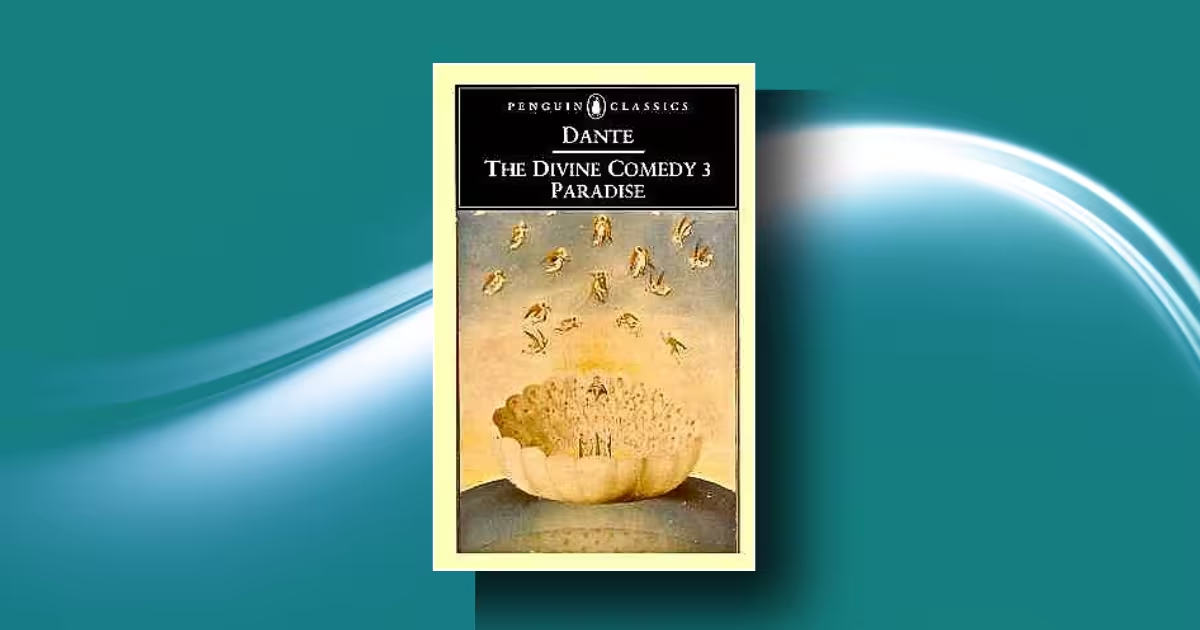
Paradise by Dante is where The Divine Comedy reaches its summit. It is the third and final canticle, in which the pilgrim who has walked through Hell and climbed Purgatory finally rises into the heavens. Dante journeys first with Beatrice, then alone, toward the Trinity, and the poem turns from punishment and penance to light, love, and the limits of human language.
I read it in Mark Musa’s translation, which comes with his interpretive commentary, a glossary, and a bibliography that clarify its theological themes. Musa was Distinguished Professor Emeritus at Indiana University and received the “Fiorino d’oro” from the city of Florence for his work on Dante, and that scholarship shows in the edition’s care. In this review, I look at what Paradise asks of its readers and how well Musa carries Dante’s heaven into English.
I read Purgatory almost as quickly because the mountain has a shape you can hold in your head, one terrace, one sin, one lesson at a time. Then I opened Paradise (Paradiso), and for the first ten cantos I kept asking myself why I was reading a lecture on Ptolemaic astronomy dressed up as poetry.
I kept going anyway, and by the final canto I understood something I did not expect to understand: Dante saved his hardest writing for last on purpose. He was not stalling. He was building toward a vision that no easier writing could have earned.
This is a complete review and reading guide to Paradise (Paradiso), based on the Mark Musa translation published by Penguin Classics.
If you want to know what actually happens across all 33 cantos, whether the book holds up against Inferno’s shock value, and whether you personally should push through to the end of the trilogy, I am answering all of that here, in enough detail that you will not need to go back to the poem to remember what happened.
Overview
✅ The book: Paradise (Paradiso), the third and final canticle of The Divine Comedy, written by Dante Alighieri in the last years of his life and completed shortly before his death in Ravenna in 1321.
✅ This edition: Translated with an introduction, notes, and commentary by Mark Musa, a Distinguished Professor of French and Italian at Indiana University. His Paradise (Paradiso) translation was first published by Indiana University Press in 1984 and reissued in Penguin Classics in 1986, completing his three-volume Divine Comedy alongside Inferno and Purgatory.
✅ What happens: Dante the Pilgrim, guided first by Beatrice and later by St. Bernard, rises through nine heavenly spheres, from the Moon to the Primum Mobile, before entering the Empyrean and glimpsing the vision of God that closes the poem.
✅ The verdict: Paradise (Paradiso) is the hardest of the three canticles to love on a first pass and the one that rewards a second and third reading the most. It fuses theology, medieval astronomy, and Dante’s own political exile into 33 cantos of interlocking rhyme, and the closing lines alone justify the climb.
✅ Reading time: Around four to six hours for the poem itself, longer if you actually read Musa’s notes, which I would not skip.
Paradise is best for readers who already finished Inferno and Purgatory and want the ending Dante actually built toward; students of medieval theology, Scholastic philosophy, or the history of astronomy; anyone who enjoyed Confessions by Augustine of Hippo and wants another work of first-person spiritual autobiography with real intellectual weight behind it; poets and translators curious about what terza rima can do across a hundred cantos.
Not for readers who want Paradise (Paradiso) to feel like Inferno with better weather. There is no torture here, no gossip about people the poet personally hated, and very little conflict in the conventional sense. If you need friction to stay engaged with a book, Paradise (Paradiso) will test your patience before it gives you anything back.
Table of Contents
Introduction
Paradise (Paradiso) is the third of the three canticles that make up The Divine Comedy, following Inferno and Purgatory. Dante Alighieri wrote it in Italian, in the final years of his exile, most likely between roughly 1316 and 1321, and it was still fresh when he died in Ravenna that same year at around age fifty-six.
He never called the whole work “divine.”
That word was added by a Venetian printer in 1555, more than two centuries after Dante’s death, in what amounted to one of publishing’s earliest marketing decisions.
Dante himself simply called it his Comedy, using the term in its old sense: a story that begins in difficulty and ends in joy, as opposed to a tragedy, which does the reverse.
This particular edition matters because translation choices shape how readable Paradise (Paradiso) feels. Mark Musa earned his B.A. from Rutgers in 1956, studied in Florence on a Fulbright, and completed his Ph.D. at Johns Hopkins before becoming Distinguished Professor of French and Italian and Director of the Center for Italian Studies at Indiana University. He is also known for translating Petrarch, Boccaccio, and Machiavelli.
His Paradise (Paradiso) translation prioritizes clarity over strict meter, rendering Dante’s hendecasyllabic terza rima into readable modern English verse, with a prose “argument” summary before each canto and extensive notes after it.
If you are choosing between Musa, Dorothy Sayers, John Ciardi, Robert Hollander, or Robin Kirkpatrick, Musa is consistently recommended as one of the more approachable options for a first read, largely because of how much context he front-loads before the poetry begins.
Paradise (Paradiso) is about the last stage of the Pilgrim’s journey through the Christian afterlife. Having climbed Mount Purgatory and been reunited with Beatrice, the woman he loved and lost, Dante rises with her through the heavens themselves.
The book’s stated purpose, laid out in Dante’s own letter to his patron Cangrande della Scala and echoed throughout the poem, is to move humanity, while still living, out of a state of misery and into a state of happiness, by showing exactly what perfect happiness looks like and how a soul earns it.
Where Inferno shows what happens when love is twisted and Purgatory shows love being corrected, Paradise (Paradiso) shows love working exactly as it should. That is a much harder thing to dramatize than sin, and Dante knew it.
Background
To understand what you are reading, it helps to know two things about Dante’s world: his cosmology and his politics.
Dante builds Paradise (Paradiso) on the Ptolemaic model of the universe, which was the accepted scientific framework of his time. Earth sits at the center, motionless, surrounded by nine concentric, transparent spheres that carry the Moon, Mercury, Venus, the Sun, Mars, Jupiter, Saturn, and the fixed stars, in that order outward from Earth.
Beyond all of them sits the Primum Mobile, the ninth and outermost moving sphere, which receives its motion directly from God and passes that motion down to everything below it.
Enclosing all nine is a tenth, motionless realm called the Empyrean, pure light and pure spirit, where God and the souls of the blessed actually dwell. The nine spheres you travel through are not, strictly speaking, where souls live.
Dante makes this explicit through Piccarda in Canto III: every soul is already with God in the Empyrean, and the spheres are a courtesy, a staging ground so that a living, breathing Pilgrim can understand rank and reward in terms his mind can process. This is worth remembering, because it resolves what looks at first like a contradiction between Christian equality and heavenly hierarchy.
The second key to Paradise (Paradiso) is Dante’s exile.
In 1301, while Dante was away in Rome on a diplomatic mission, the rival Black Guelph faction seized control of Florence with the backing of Charles of Valois. Dante, a prominent White Guelph, was condemned in absentia, fined, and eventually sentenced to death by burning if he ever returned to his city.
He never did return. For roughly twenty years he moved between the courts of northern Italy, dependent on the hospitality of nobles, until he settled in Ravenna, where he finished the Comedy and died.
That biography surfaces directly inside Paradise (Paradiso), most memorably in Canto XVII, where Dante’s ancestor Cacciaguida predicts the exile in language so exact it reads like memoir wearing prophecy’s clothes.
Politics runs through nearly every sphere of the poem: Justinian’s history of the Roman Eagle in Canto VI, the corruption of religious orders denounced by Aquinas and Bonaventure in Cantos XI and XII, St. Peter’s furious attack on his papal successors in Canto XXVII. Paradise (Paradiso) is not only about heaven.
It is also Dante settling scores from exile, using the mouths of saints to say what a living man could not say and survive.
Structurally, the whole Comedy runs to one hundred cantos: thirty-four in Inferno (one introductory canto plus thirty-three), thirty-three in Purgatory, and thirty-three in Paradise (Paradiso).
Every canticle ends on the word “stars,” a small architectural signature that ties the three books together. The entire poem is written in terza rima, a rhyme scheme Dante is credited with inventing for this work: interlocking three-line stanzas rhyming aba, bcb, cdc, and so on, a chain that keeps pulling the reader forward line by line, the same way the Pilgrim keeps being pulled upward sphere by sphere.
Paradise Summary (Paradiso)
The Moon: Broken Vows (Cantos I to V)
The poem opens with one of the most quoted lines in the entire Comedy: “The glory of the One Who moves all things” fills the universe unevenly, more in some places than others.
At noon on the spring equinox, Dante watches Beatrice stare directly into the sun, imitates her, and feels himself “transhumanized,” his own coinage for a transformation beyond ordinary human experience. He and Beatrice rise into the sphere of the Moon, where he meets Piccarda Donati, a nun forced out of her convent by her family to marry against her will.
Piccarda explains why she does not resent her comparatively low place in Paradise (Paradiso)‘s hierarchy, delivering the line that anchors the entire canticle’s theology: “In His will is our peace.”
Beatrice then distinguishes between the Absolute Will, which never wavers from God, and the Conditioned Will, which can be forced to bend, a distinction that resolves the question of moral responsibility under coercion.
Mercury: Ambition and Empire (Cantos V to VII)
The sphere of Mercury holds souls who did good but were partly motivated by love of earthly fame.
The Emperor Justinian, the sixth-century ruler behind the Justinian Code of Roman law, identifies himself with the memorable line “Caesar I was, Justinian I remain,” then delivers a long history of the Roman Eagle standard, from the founding of Rome through the Empire, closing with a condemnation of both the Guelph and Ghibelline factions for misusing that symbol in his own century.
Beatrice follows this with a dense theological digression on why Christ’s crucifixion was simultaneously just and unjust, and why God chose the Incarnation, rather than any other method, to redeem humanity.
Venus: Love, Rightly Ordered (Cantos VIII to IX)
In Venus, Dante meets souls whose earthly love, though real, was not perfectly directed toward God.
Charles Martel of Anjou, a prince Dante had actually known in life, discusses how good character is shaped by celestial influence rather than bloodline, explaining why virtuous fathers sometimes produce corrupt sons.
Cunizza da Romano and the troubadour-turned-bishop Folco of Marseilles appear next; Folco points out the presence of Rahab, the Old Testament prostitute of Jericho, honored here for her faith, and closes the canto with a bitter attack on the corruption of the Church in Florence.
The Sun: Two Circles of Wisdom (Cantos X to XIV)
The sphere of the Sun holds theologians and philosophers, arranged in a dancing circle of twelve lights led by Thomas Aquinas, the great Dominican.
Aquinas surprises the Pilgrim by telling the story not of a fellow Dominican but of Francis of Assisi, the founder of the rival Franciscan order, describing Francis’s devotion to Lady Poverty in language borrowed from courtly romance.
A second circle of twelve then forms around the first, led by the Franciscan Bonaventure, who returns the favor by praising Dominic, the Dominican founder. Both saints go on to criticize the decline of their own orders, a structural mirroring that is one of the more elegant pieces of architecture in the whole poem.
Solomon then clarifies an earlier remark, that “there never arose a second with such vision,” explaining he meant Solomon possessed unmatched wisdom specifically as a king asking for prudence to govern, not as the wisest human being who ever lived, a distinction Aquinas uses to warn against rushing to theological judgment.
Mars: Ancestry and Exile (Cantos XIV to XVIII)
Ascending to Mars, Dante sees souls of holy warriors arranged in the shape of a giant cross, with a flashing image of Christ across it.
Here he meets Cacciaguida, his great-great-grandfather, who describes the simpler, more virtuous Florence of his own twelfth-century lifetime in contrast to the corrupt city Dante grew up in. Cacciaguida then delivers the canticle’s emotional core: a direct prophecy of Dante’s coming exile. “You shall be forced to leave behind those things you love most dearly,” he says, and warns that Dante will learn “how salty is the taste of others’ bread,” and how hard it is to climb “the stairs of others’ homes.”
He urges Dante not to soften his poem out of fear, because naming the corrupt by name, even powerful men, will ultimately serve and outlast him.
Jupiter: The Eagle of Justice (Cantos XVIII to XX)
In Jupiter, the souls of just rulers arrange themselves letter by letter into the opening line of the Book of Wisdom, DILIGITE IUSTITIAM QUI IUDICATIS TERRAM, “love justice, you who judge the earth,” before reshaping themselves into the form of a speaking eagle.
The eagle discusses the mystery of divine justice and, to the Pilgrim’s surprise, points out two pagan souls, the Roman emperor Trajan and the Trojan Ripheus, saved through what the eagle admits is a form of predestination beyond any soul’s full understanding, even within Paradise (Paradiso) itself.
Saturn: Silence and Contemplation (Cantos XXI to XXII)
Beatrice stops smiling in Saturn; her beauty has grown too intense for the Pilgrim’s mortal eyes to survive it if she did.
There is no singing here either, for the same reason. Peter Damian, an eleventh-century contemplative, appears on a golden ladder stretching upward out of sight and delivers a sharp critique of the self-indulgence of contemporary Church leaders, provoking a thunderous shout from the surrounding souls that leaves Dante badly shaken.
St. Benedict, founder of Western monasticism, follows with his own lament that his order has abandoned its original discipline.
The Fixed Stars: An Examination (Cantos XXII to XXVII)
Dante and Beatrice rise to the sphere of the fixed stars, where Dante first looks back down through all seven spheres he has climbed and sees the Earth for what it actually is: small.
He then witnesses the Church Triumphant and the ascension of Christ and the Virgin Mary.
In one of the poem’s more unusual structural choices, three apostles put the Pilgrim through a formal oral examination: St. Peter questions him on Faith, St. James on Hope, and St. John on Love, and Dante passes all three, temporarily losing his sight while staring at John before it is restored. Adam himself then appears and answers Dante’s questions about Eden, the length of his life there, and the nature of the first human language.
The canto closes with St. Peter turning blood red with rage and denouncing the corruption of his own papal successors, a passage sharp enough that some translators soften it and others do not.
The Primum Mobile and the Angels (Cantos XXVII to XXIX)
In the ninth and final moving sphere, Beatrice explains the mechanics of celestial motion and delivers a stinging critique of human greed and the absence of good governance on Earth.
The Pilgrim then sees a single blinding point of light surrounded by nine rings of angels, spinning fastest closest to the point, which Beatrice explains represents the true, spiritual order of creation, the exact inverse of how the physical universe appears from Earth.
She goes on to correct a historical dispute about the ranking of angelic orders and explains that angels, unlike humans, have no need of memory, because they perceive everything through God directly and continuously.
The Empyrean: The White Rose and the Final Vision (Cantos XXX to XXXIII)
Beatrice and Dante finally arrive in the Empyrean itself, where the Pilgrim’s sight, after being blinded by a river of light, adjusts and reveals the true form of what he has been seeing: a vast white rose made of the souls of the blessed, tiered like petals, with angels moving between the rose and God like bees between flowers and a hive.
Beatrice returns to her seat within the rose, and an old man takes her place at Dante’s side. He is St. Bernard of Clairvaux, and he guides the Pilgrim through the rose’s structure before praying directly to the Virgin Mary on Dante’s behalf, asking her to grant him the strength to look directly at God.
What follows is the most famous passage in the poem. Dante’s sight is cleared, and he sees three interlocking circles of three different colors, sharing a single circumference: an image of the Trinity.
Staring into the second circle, he perceives, impossibly, a human face within the divine light, the mystery of Christ’s dual nature, a paradox his mind cannot fully resolve until a sudden flash of understanding arrives, not through reasoning but through grace.
The poem ends with the Pilgrim’s will and desire turning in perfect harmony with the force that governs everything, closing on one of the most quoted final lines in Western literature: he is moved “by the Love that moves the sun and the other stars.”
Paradise (Paradiso) Analysis
Here is where I have to be direct with you: Paradise (Paradiso) is not an easy recommendation, and I think reviews that pretend otherwise are not being honest about the experience of actually reading it.
Does Dante support his arguments with evidence and logical reasoning? Within his own theological framework, yes, remarkably so.
Every major doctrinal digression in this book, free will versus predestination, the justice of Christ’s death, the nature of angelic memory, the hierarchy of the angelic orders, is worked through with the rigor of a Scholastic disputation, not asserted as mood or vibe.
Dante studied Aquinas’s Summa Theologica closely, and it shows on nearly every page. If you approach Paradise (Paradiso) as a philosophy student rather than a novel reader, the argumentation holds together with an internal consistency that few works of imaginative literature even attempt.
Does the book fulfill its stated purpose? Mostly, and where it fails, it fails instructively. Dante set out to make happiness itself dramatic, and for long stretches he does not fully succeed, because contentment resists narrative tension by its nature.
The middle third of the book, roughly Mercury through Saturn, can feel like a sequence of theological interviews rather than a story, and I will not pretend those cantos moved me the way Inferno’s Ugolino or Purgatory’s Statius did. But Dante clearly understood this risk himself.
He builds drama not from conflict between souls, since there is none, but from the sheer difficulty of describing an experience that exceeds human language, and that struggle becomes the plot. Watch how often the poem interrupts itself to say some version of “words fail me here.” That is not a weakness in the writing. It is the writing’s actual subject.
What genuinely surprised me, reading this after Inferno, is how personal and how angry Paradise (Paradiso) still is. I expected serenity from cover to cover. Instead I got St. Peter turning the color of blood while denouncing his papal successors, and Cacciaguida forecasting Dante’s exile in language precise enough to draw blood on the page.
Heaven, in Dante’s hands, is not neutral about earthly injustice. It is furious about it, and that fury gives the book a pulse that pure contemplation would not have provided.
Strengths and Weaknesses
What works:
The final vision in Canto XXXIII is, in my opinion, the single greatest closing passage in medieval literature, and it earns every difficult canto that comes before it.
The Cacciaguida sequence in Cantos XV through XVII is the emotional high point of the book, turning cosmic theology into intimate family history and personal grief over exile.
The parallel stories of Francis and Dominic in Cantos XI and XII show a formal elegance, two circles, two saints, two structurally identical praise-and-critique speeches, that rewards close reading.
Musa’s prose “argument” before each canto and his endnotes make an otherwise forbidding text genuinely navigable for a first-time reader.
What does not work as well:
The middle cantos, particularly Mercury through Jupiter, lean heavily on Scholastic argument with comparatively little sensory or narrative texture, and readers who loved Inferno’s vividness may find this section a slog.
Dante’s hierarchy of souls, however carefully explained through Piccarda’s “In His will is our peace,” still reads to modern eyes as an uncomfortable ranking system, and Dante’s confidence about who is saved and who is damned, including unbaptized infants, has aged badly and drew sharp criticism even from sympathetic modern readers.
Beatrice functions more as a lecturer than a character for large stretches of the book, and readers hoping for the romantic intensity of Dante’s earlier Vita Nuova will not find much of it here.
How Paradise (Paradiso) Compares to Similar Works
If you finished Paradise (Paradiso) and want somewhere else to go, a few comparisons are worth knowing.
John Milton’s Paradise (Paradiso) Lost takes on a related theological project, humanity’s fall and the justice of God, but from the opposite direction: Milton dramatizes rebellion and temptation with a Satan so charismatic that readers have argued for centuries about whether Milton secretly admired him. Dante never gives his damned or his blessed that kind of ambiguity; his Paradise (Paradiso) is confident where Milton’s God is often defensive.
C.S. Lewis’s The Great Divorce is a much shorter, gentler descendant of this same tradition, a bus ride from Hell to the outskirts of Heaven that borrows Dante’s basic method, meeting symbolic souls who explain themselves, without attempting anything close to Dante’s theological or structural scale.
Other English translations are worth knowing about if Musa’s clarity-first approach is not your preference. Dorothy Sayers’s version leans into strict terza rima and archaic diction; John Ciardi’s is punchier and more colloquial; Robert and Jean Hollander’s edition is prized by scholars for its notes; Robin Kirkpatrick’s is a more contemporary, widely praised modern rendering.
If you want to compare closely, reading a canto in two translations side by side is one of the fastest ways to understand what a translator’s choices actually cost and gain.
If your interest in Paradise (Paradiso) runs more toward its theology and first-person spiritual seriousness than its plot, our full breakdown of Confessions by Augustine of Hippo covers a text Dante had almost certainly absorbed before he ever wrote a line of the Comedy.
Readers curious about how later writers borrowed Dante’s medieval cosmology should also see our piece on The Name of the Rose, which draws the same theological architecture into a very different genre.
And if Paradise (Paradiso) leaves you hungry for more of the philosophical canon that shaped it, our lists of the Top 20 Philosophy Books of All Time and the 100 Books Everyone Should Read in a Lifetime both include several works that sit in direct conversation with Dante’s project.
Conclusion
Paradise (Paradiso) is not the canticle I would hand to someone who has never read Dante before. Start with Inferno, let Purgatory earn your patience, and arrive at Paradise (Paradiso) only once you actually want the ending rather than needing to be convinced to keep reading.
For readers who make it that far, though, this is not a lesser sequel to a better book. It is the destination the first two-thirds of the Comedy were quietly built to reach, and Musa’s translation, with its clear prose and generous notes, is one of the more forgiving ways to make that final climb.
I went in expecting a theology lecture and came out understanding why Dante thought a poem, not a treatise, was the only form large enough to hold what he was trying to say. If you have already read Inferno and Purgatory and stalled out before Paradise (Paradiso), as most readers apparently do, go finish it. The ending earns the difficulty.
Frequently Asked Questions
What is Dante’s Paradise (Paradiso) about?
Paradise (Paradiso) is the third and final part of Dante Alighieri’s The Divine Comedy. It follows the Pilgrim Dante, guided by Beatrice and later by St. Bernard, as he ascends through nine heavenly spheres and into the Empyrean to receive a vision of God.
Is Paradiso harder to read than Inferno or Purgatory?
Most readers and critics find Paradise (Paradiso) the most demanding of the three canticles because it relies heavily on medieval theology, Scholastic argument, and Ptolemaic astronomy rather than the vivid, concrete imagery of Inferno’s punishments or Purgatory’s clearly staged terraces.
What is the most famous line in Dante’s Paradise (Paradiso)?
The poem’s closing line, describing the Pilgrim’s will turning in harmony with “the Love that moves the sun and the other stars,” is generally considered the most famous passage in the entire Divine Comedy.
Who was Beatrice in Dante’s Paradise (Paradiso)?
Beatrice, based on the historical Florentine woman Bice di Folco Portinari, whom Dante loved from a distance and who died in 1290, serves as the Pilgrim’s guide through most of Paradise (Paradiso), functioning allegorically as divine revelation and theology.
How many cantos does Paradise (Paradiso) have?
Paradise (Paradiso) contains 33 cantos, matching Purgatory. Inferno has 34, including one introductory canto, bringing the full Divine Comedy to 100 cantos total.
Is the Mark Musa translation of Paradise (Paradiso) good for first-time readers?
Yes. Musa’s translation is widely recommended for first-time readers because each canto opens with a prose summary of the plot and closes with extensive explanatory notes, making the theological and historical references far more accessible than in stricter, more literal translations.
Paradise

Paradise by Dante is where The Divine Comedy reaches its summit. It is the third and final canticle, in which the pilgrim who has walked through Hell and climbed Purgatory finally rises into the heavens. Dante journeys first with Beatrice, then alone, toward the Trinity, and the poem turns from punishment and penance to light, love, and the limits of human language.
URL: https://www.sopranu.com/dantes-paradise-paradiso-review-mark-musa/
Author: Dante
4.5







