Emotional exhaustion signs are easy to misread as laziness, both by the people around you and, more painfully, by yourself. You stare at an email for twenty minutes without replying. You cancel plans you actually wanted to keep. You sleep eight hours and wake up tired.
You know exactly what you should be doing, and you simply can’t make yourself do it. Then the guilt arrives, and the guilt makes everything heavier.
I’ve been through a stretch like this, and the most useful thing anyone told me was that laziness and exhaustion look similar from the outside but feel completely different from the inside.
Laziness is not wanting to. Exhaustion is wanting to and having nothing left. This guide covers seven signs that point to emotional exhaustion rather than a lack of willpower, what the research says about it, and the practical steps that help you recover.
Table of Contents
At a Glance
Emotional exhaustion is a state of feeling drained, used up and unable to cope, usually after long periods of stress, caregiving or emotionally demanding work. It is the core feature of burnout.
The World Health Organization describes burnout, in ICD-11 (2019), as having three dimensions: exhaustion, mental distance or cynicism toward work, and reduced effectiveness.
It’s common. A Gallup survey of nearly 7,500 full-time employees found 23% felt burned out very often or always, and another 44% felt it sometimes.
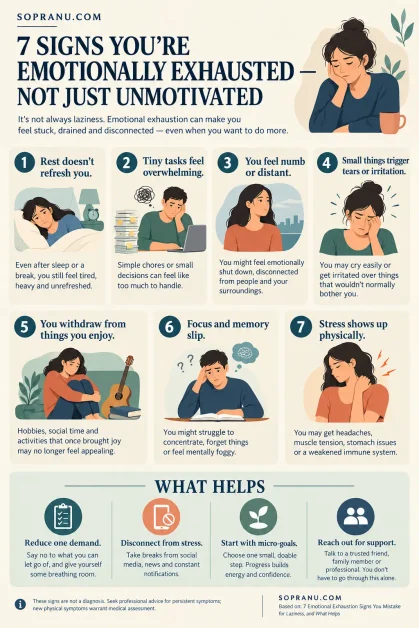
The 7 emotional exhaustion signs: rest doesn’t restore you, small tasks feel enormous, you feel numb, you’re irritable or tearful, you avoid things you used to enjoy, your focus and memory slip, and your body keeps complaining.
The key difference: a lazy person doesn’t care; an exhausted person cares a lot but can’t act. Recovery needs real detachment from stress, better sleep, smaller goals and, sometimes, professional help.
What Is Emotional Exhaustion?
Emotional exhaustion is a deep tiredness of the mind and feelings that rest alone doesn’t fix, caused by prolonged stress, emotional demands or a sense of having to give more than you have.
The term comes largely from burnout research. In 1981, social psychologist Christina Maslach and colleague Susan Jackson published the Maslach Burnout Inventory, which measures burnout across three areas: emotional exhaustion, depersonalisation (feeling detached or cynical toward people), and a reduced sense of personal accomplishment. Emotional exhaustion is often treated as the central piece, the first domino.
In May 2019, the World Health Organization updated its definition of burnout for the ICD-11, its international classification of diseases.
WHO describes burnout as a syndrome resulting from chronic workplace stress that hasn’t been successfully managed, with three dimensions: feelings of energy depletion or exhaustion, increased mental distance or cynicism toward one’s job, and reduced professional efficacy.
WHO is careful to say burnout is an occupational phenomenon, not a medical condition, and that the term applies specifically to work.
That last point matters. You can be emotionally exhausted without a job at all. Caregivers, new parents, students, people going through divorce or grief, and people supporting a sick family member often feel exactly the same drained state. The word “burnout” may technically belong to work, but emotional exhaustion belongs to anyone who has given too much for too long.
How Is Emotional Exhaustion Different From Laziness?
Emotional exhaustion is different from laziness because an exhausted person wants to act and can’t, while a lazy person, in the usual sense of the word, could act but doesn’t want to.
Devon Price makes a stronger argument in the 2021 book Laziness Does Not Exist, published by Atria Books. Price argues that what we call laziness is usually burnout, overwhelm or unmet needs, and that the “laziness lie” is the belief that a person’s worth depends on their productivity.
You don’t have to agree with every point to find the core idea useful: before you call yourself lazy, ask what you’re actually lacking.
Here’s a simple self-test I use:
| Question | Points to exhaustion | Points to low motivation or boredom |
|---|---|---|
| Do you feel guilty about not doing it? | Yes, a lot | Not really |
| Did you used to do this easily? | Yes | Never enjoyed it |
| Does a good night’s sleep fix it? | No | Often yes |
| Is it affecting many areas of life at once? | Yes | Mostly one task |
| Have you been under heavy stress for months? | Yes | No |
If most of your answers land in the middle column, you’re probably not lazy. You’re running on empty.
7 Emotional Exhaustion Signs People Mistake for Laziness
1. Rest Doesn’t Restore You
The first and clearest of the emotional exhaustion signs is waking up tired after a full night’s sleep, or finishing a weekend off feeling no better than when it began.
Ordinary tiredness responds to rest. Emotional exhaustion doesn’t, or not much. That’s because the problem isn’t only physical fatigue. Your mind may still be running stress in the background: replaying conversations, anticipating demands, scanning for the next problem.
Research on recovery helps explain this. In a 2010 study published in the Journal of Applied Psychology, Sabine Sonnentag, Carmen Binnewies and Eva Mojza followed 309 human service employees over 12 months and examined “psychological detachment,” the ability to mentally switch off from work during free time.
Detachment was linked to emotional exhaustion, and it also buffered the effect of high job demands on later health complaints and on declines in work engagement. In plain terms, being physically off work isn’t the same as being mentally off work.
What to try: Notice whether your “rest” is actually rest. Scrolling work emails on the sofa or mentally rehearsing Monday’s meeting isn’t recovery. Even 30 minutes of genuine detachment, such as a walk without your phone or a hobby that absorbs your attention, can do more than three hours of half-rest.
2. Small Tasks Feel Enormous
Small tasks feeling enormous is one of the most misunderstood emotional exhaustion signs. Replying to a two-line message, booking a dentist appointment, or putting away laundry suddenly feels like climbing a hill.
From the outside, it looks like procrastination. From the inside, it feels like every task carries a hidden weight. When your emotional reserves are low, even simple decisions cost more than usual, and your brain starts avoiding anything that requires effort, however small.
What to try: Shrink the task until it feels almost silly. Not “clean the kitchen,” but “put three cups in the sink.” Not “answer emails,” but “reply to one person with one sentence.” Momentum often returns once you start, but the starting line has to be very low.
3. You Feel Numb, Distant or Cynical
Feeling numb or cynical is the second dimension of burnout in both Maslach’s model and the WHO definition. You stop caring about things you used to care about. Colleagues’ problems annoy you. Your partner’s news barely registers. You catch yourself thinking “What’s the point?” more often than you’d like to admit.
This numbness is easy to mistake for laziness or even coldness. In truth, it’s often a protective response. When you’ve been giving emotionally for too long, your mind starts conserving what little it has left by turning the volume down on everything.
Arlie Russell Hochschild described a related idea in her 1983 book The Managed Heart, where she introduced the concept of “emotional labour,” the work of managing your own feelings to meet the expectations of a job. Her original research focused on flight attendants, but nurses, teachers, customer service staff, social workers and many others know the feeling of smiling on the outside while emptying on the inside.
What to try: Notice the cynicism without judging yourself for it. Then ask what you’ve been giving that hasn’t been replenished. Numbness is often a signal that your emotional output has far outrun your input.
4. You’re Irritable or Tearful Over Small Things
Irritability and unexpected tearfulness are emotional exhaustion signs that people often blame on personality. You snap at a family member for asking a simple question. You cry at an advertisement. You feel rage at a slow driver.
Part of this is sleep. A 2007 UC Berkeley study led by Matthew Walker found that the brain’s emotional centres were more than 60% more reactive after sleep deprivation. Emotional exhaustion and poor sleep often travel together, and the result is a nervous system with very little buffer.
What to try: Treat irritability as a fuel gauge, not a character flaw. When you notice it rising, it’s usually a sign to stop, eat, rest or step away, not to push harder. Apologise when you snap, and then look at what’s draining you.
5. You Avoid Things You Used to Enjoy
Avoiding things you used to enjoy is one of the emotional exhaustion signs that worries people most, because it feels like you’re losing yourself. You stop reading. You skip the gym. You leave friends’ messages unanswered for days. Even fun feels like effort.
This is where exhaustion can overlap with depression, and it’s worth being careful. Loss of interest or pleasure in activities is one of the classic symptoms of depression listed by the US National Institute of Mental Health. Exhaustion and depression can feed each other, and I’m not able to tell you from an article which one you’re experiencing.
What to try: If the loss of interest has lasted two weeks or more, comes with persistent low mood, hopelessness, changes in sleep or appetite, or thoughts that life isn’t worth living, please speak to a doctor or mental health professional. If it’s milder, try reintroducing one enjoyable thing in a tiny dose.
Ten pages, not a chapter. One song, not an album. A short walk, not a workout.
6. Your Focus and Memory Keep Slipping
Brain fog is one of the more frustrating emotional exhaustion signs. You read the same paragraph three times. You walk into a room and forget why. You lose track of conversations. At work, simple decisions take far longer than they should.
This often gets labelled as carelessness or not trying hard enough. Yet sustained stress and poor sleep both affect attention and memory, and emotional exhaustion usually brings both. The third WHO burnout dimension, reduced professional efficacy, captures exactly this feeling of not being able to perform the way you know you can.
What to try: Lower the cognitive load. Write everything down. Use one simple list for the day with no more than three priorities. Batch similar tasks together. Protect at least one hour a day from interruptions, if your job allows it.
7. Your Body Keeps Complaining
The last of the emotional exhaustion signs is physical. Headaches, stomach problems, muscle tension, frequent colds, chest tightness, or a general feeling of being unwell can all accompany long-term emotional strain.
The data on this is striking. In a 2018 Gallup analysis of nearly 7,500 full-time employees, those who felt burned out very often or always were 63% more likely to take a sick day and 23% more likely to visit an emergency room than those who didn’t. They were also 2.6 times as likely to be actively looking for a different job.
Of course, physical symptoms always deserve a proper medical check, because they can have many causes. Don’t assume everything is stress. But don’t dismiss the possibility either.
What to try: See a doctor for any persistent or new symptoms. While you wait, pay attention to the basics that exhaustion often erodes first: regular meals, water, daylight, and some form of movement, even a 10-minute walk.
Who Is Most at Risk of Emotional Exhaustion?
People most at risk of emotional exhaustion are those who give care or emotional support for long stretches with little relief, whether at work or at home.
Family caregivers are a clear example. In July 2025, AARP and the National Alliance for Caregiving reported that 63 million Americans are family caregivers, and that nearly one in four provides 40 or more hours of care a week.
Nearly one in four caregivers also said caregiving made it hard to look after their own health, and a similar share reported feeling socially isolated. Those are almost a checklist of the conditions that drain people emotionally: long hours, little time for yourself, and few people to share the load.
Other high-risk groups include healthcare and social care workers, teachers, customer-facing staff who must stay pleasant under pressure, parents of young children or children with complex needs, and anyone who has become the family’s default problem-solver.
If you belong to one of these groups, the signs in this article deserve extra attention, because the demands around you are unlikely to ease on their own. Planning recovery deliberately, rather than waiting for a quiet period that never comes, is often the only way to stay well.
What Causes Emotional Exhaustion?
Emotional exhaustion is usually caused by long-term stress without enough recovery, especially when you feel you have little control, little support, or too much responsibility for other people’s needs.
Gallup’s 2018 research identified five main causes of workplace burnout: unfair treatment at work, an unmanageable workload, lack of role clarity, lack of communication and support from a manager, and unreasonable time pressure. Employees who felt unfairly treated were 2.3 times more likely to experience high burnout.
Outside work, common causes include:
- Caring for a sick child, partner or parent
- Grief, divorce or a long relationship conflict
- Financial pressure that never lets up
- Being the person everyone relies on in a family or friend group
- Living with chronic illness or pain
- Long periods of uncertainty, such as job hunting or immigration processes
Notice that very few of these are about “not trying.” Most are about trying too hard, for too long, with too little support.
How Do You Recover From Emotional Exhaustion?
You recover from emotional exhaustion by reducing the load, increasing real recovery, and rebuilding energy slowly, which usually takes weeks or months rather than a single weekend.
Here’s a realistic plan:
- Name it honestly. Saying “I’m emotionally exhausted” instead of “I’m lazy” changes what you do next. You stop punishing yourself and start looking for causes.
- Cut one demand. Say no to one commitment this week. Hand off one task. Lower one standard. Recovery begins with subtraction.
- Protect sleep. Keep a regular bedtime and wake time, and keep screens out of the last 30 minutes before bed where you can.
- Practise detachment. Create a clear end to the workday or caregiving shift. Change clothes, take a walk, put the phone in another room. Sonnentag’s research suggests mental switching off matters, not just physical rest.
- Set micro-goals. Pick tasks small enough that you can’t fail. Success rebuilds momentum.
- Reconnect with one person. Exhaustion isolates. Even one honest conversation can lighten the load.
- Get professional support when needed. If you notice signs of depression, persistent anxiety, or thoughts of self-harm, contact a doctor or mental health professional promptly. You don’t need to reach a crisis point to deserve help.
If you want to rethink your relationship with productivity at a deeper level, our review of Four Thousand Weeks by Oliver Burkeman is one of the kindest books on the subject, and Bertrand Russell’s essay In Praise of Idleness, summarised here on Sopranu, argued as early as 1932 that modern society overvalues work.
Our piece on dolce far niente and how to actually enjoy doing nothing is a practical follow-up.
What I Wish Someone Had Told Me Sooner
During my own exhausted stretch, I kept making the same mistake. I treated every sign of exhaustion as a discipline problem. If I couldn’t concentrate, I drank more coffee.
If I couldn’t get started, I made bigger to-do lists.
If I felt numb, I told myself to be more grateful. None of it worked, because I was trying to solve a depletion problem with more effort.
What finally helped was the opposite of effort. Fewer commitments. Earlier nights. Saying no without a long explanation. Walks without headphones. Allowing a few unproductive evenings without guilt. It felt wrong at first, almost irresponsible.
Within a few weeks, though, I noticed small things coming back: reading for pleasure, laughing at a friend’s joke, wanting to cook.
If you see yourself in these seven signs, please be gentler with yourself than I was. You are not lazy. You may simply be someone who has been strong for too long. For a wider reflection on why so many of us feel this way right now, our essay on why we feel empty in modern life is worth reading.
FAQs About Emotional Exhaustion Signs
What are the first signs of emotional exhaustion?
Early emotional exhaustion signs often include waking up tired despite sleeping, feeling irritable, struggling with small tasks, and dreading things you once handled easily. These usually build gradually over weeks or months of stress.
How do I know if I’m lazy or emotionally exhausted?
Ask whether you want to act but can’t, and whether you feel guilty about it. Exhaustion usually comes with guilt, a history of handling the task easily, and long-term stress. Laziness, in the usual sense, involves not caring much either way.
Is emotional exhaustion the same as burnout?
Emotional exhaustion is a core part of burnout but not the whole of it. The World Health Organization’s ICD-11 definition of burnout includes exhaustion, mental distance or cynicism toward work, and reduced professional effectiveness. You can feel emotionally exhausted outside work too, for example from caregiving or grief.
How long does it take to recover from emotional exhaustion?
There’s no fixed timeline, and I couldn’t find a single reliable figure. Mild exhaustion may ease within a few weeks of reduced stress and better rest, while severe burnout can take months, especially if the cause continues.
Can emotional exhaustion cause physical symptoms?
Yes. Many people report headaches, stomach problems, muscle tension and frequent illness. Gallup found that employees who frequently felt burned out were 63% more likely to take a sick day and 23% more likely to visit the emergency room. Any persistent physical symptom should still be checked by a doctor.
When should I see a doctor for emotional exhaustion?
See a doctor or mental health professional if exhaustion lasts more than a few weeks, comes with low mood, hopelessness, anxiety, sleep or appetite changes, or thoughts of self-harm. These can be signs of depression or another condition that responds well to treatment.
Final Thoughts
The seven emotional exhaustion signs are easy to mistake for laziness: rest that doesn’t restore you, small tasks that feel enormous, numbness, irritability, avoiding what you love, a foggy mind, and a body that keeps complaining.
Yet none of them mean you don’t care. Usually, they mean you’ve cared hard for a long time without enough support or recovery.
The way out isn’t more self-criticism. It’s honest naming, smaller demands, real rest, and help when you need it. Start with one subtraction this week. That’s not giving up.
That’s how recovery begins.