
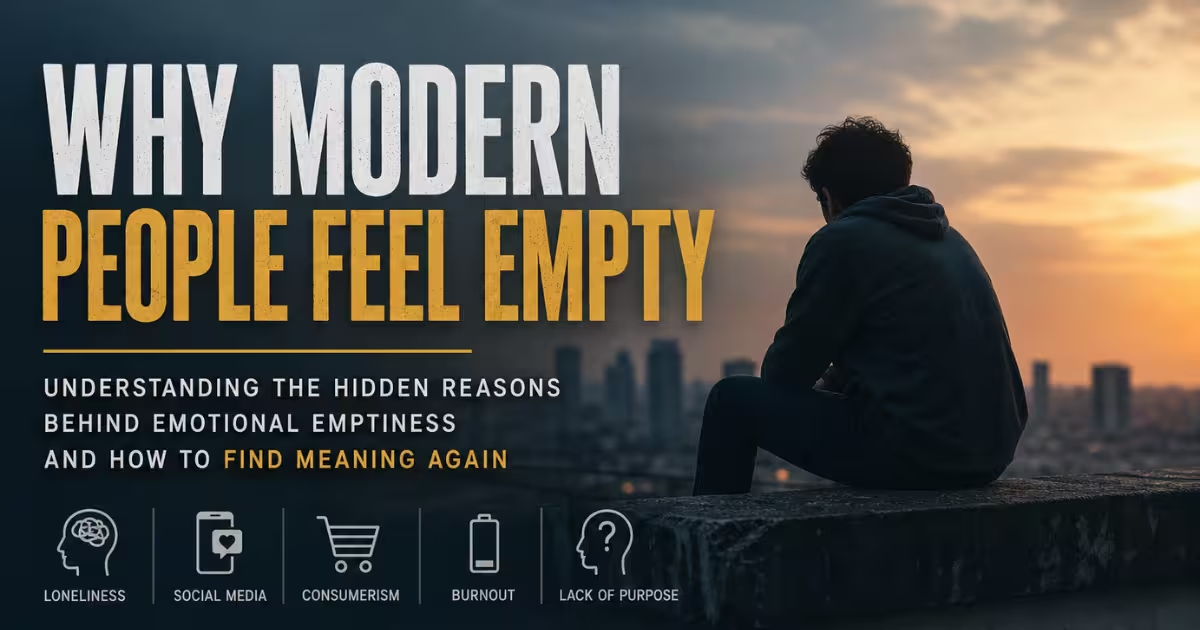
You wake up, check your phone, answer messages, go to work, meet deadlines, scroll through other people’s lives, buy things you do not really need, and somehow end the day with the same quiet question: why do I feel empty?
It is one of the most modern questions a person can ask.
Not because emptiness is new, but because our age has become very good at hiding it. We are surrounded by noise, options, entertainment, advice, productivity tools, dating apps, food delivery, online communities, and endless self-improvement content.
Yet many people still feel hollow, disconnected, or strangely untouched by their own lives.
This empty feeling is not always sadness.
Sometimes it feels like emotional numbness. Sometimes it feels like boredom, loneliness, or the sense that life is happening around you rather than through you. You may have friends, a job, a family, a social media presence, and future plans—and still feel as if something essential is missing.
That does not make you weak. It makes you human in a time that often feeds the surface of the self while starving the deeper parts.
Table of Contents
What Does It Mean to Feel Empty?
Feeling empty usually means there is a gap between the life you are living and the life your inner self needs. That gap may be emotional, relational, spiritual, creative, physical, or psychological.
For some people, emptiness appears after loss: a breakup, death, career failure, illness, or major life transition. For others, it appears after success.
They finally get the job, the relationship, the degree, the apartment, the followers, or the money—and then feel disturbed because the promised satisfaction does not arrive.
Clinical sources also recognize “empty” mood as something that can appear in depression.
The National Institute of Mental Health lists a persistent sad, anxious, or “empty” mood among common signs of depression, alongside hopelessness, loss of interest, fatigue, sleep changes, appetite changes, and thoughts of death or suicide.
NIMH also notes that symptoms lasting most of the day, nearly every day, for at least two weeks may require professional attention.
But emptiness is not always clinical depression. It can also be a signal. It may be your mind’s way of saying: “The way I am living is not feeding me.” Modern life often tells us to treat that signal as an inconvenience. Scroll more. Work harder. Buy something.
Stay busy.
But the emptiness usually returns because it is not asking for more stimulation. It is asking for more truth.
Why Do I Feel Empty in Modern Life?
The first reason many modern people feel empty is that life has become overstimulating but undernourishing.
We are constantly occupied, but not always meaningfully engaged. We are frequently connected, but not always deeply known. We consume information, but often lack wisdom. We chase progress, but struggle to define what progress is for.
My review of How to Live a Meaningful Life captures this modern tension well. The article highlights the idea that meaning is not simply something people “find” once and keep forever; it is something they design through impact, fulfillment, and particular moments of lived attention.
It also warns against treating meaning as a distant destination rather than something available in the “granular now.”
That insight matters because many people are waiting for life to become meaningful later. After they earn more. After they move. After they heal. After they become confident.
After they meet the right person. After they finally become the ideal version of themselves.
But a life postponed becomes emotionally thin. When your days are only preparation for some future identity, the present starts to feel like a waiting room.
The Loneliness Behind the Empty Feeling
One of the biggest reasons people ask “why do I feel empty?” is loneliness.
Not always obvious loneliness, but hidden loneliness: the kind you can feel while sitting in a group chat, lying beside a partner, working in a busy office, or posting a photo that gets likes but no real conversation.
The U.S. Surgeon General’s 2023 advisory described loneliness and isolation as a major public health concern and emphasized that belonging is a fundamental human need. The advisory defines belonging as the feeling of deep connection with social groups, places, and shared experiences.
It also notes that social connection is a significant predictor of health and well-being.
Recent polling from the American Psychiatric Association found that in early 2024, 30% of U.S. adults said they felt lonely at least once a week during the past year, while 10% said they felt lonely every day.
Modern loneliness is painful because it is often invisible. In older communities, loneliness might have looked like physical isolation. Today, loneliness often looks like being reachable by everyone but truly held by no one.
You can have hundreds of contacts and still no one who knows what you are afraid of. You can be liked online and still feel unknown offline. You can be surrounded by opinions and still lack a safe place for your own.
That is why the empty feeling often softens when people experience real connection: a sincere conversation, shared work, a meal without phones, a walk with someone who listens, or a community where they are useful and seen.
Social Media Gives Us Mirrors, Not Roots
Social media is not evil, but it is emotionally complicated.
It gives us visibility without necessarily giving us intimacy. It gives us comparison without context. It gives us constant updates about other people’s lives while making our own ordinary moments feel inadequate.
The American Psychiatric Association reported in 2025 that Americans’ relationship with technology is complicated: 62% of adults said they feel anxious without access to their phone, while half reported actively limiting social media use in 2025.
This matters because emptiness often grows when your attention is always outside your own life. You begin measuring your inner reality against other people’s edited surfaces. Their vacation looks like freedom. Their relationship looks like love.
Their body looks like discipline. Their career looks like destiny.
Meanwhile, your real life contains laundry, uncertainty, awkwardness, bills, bad moods, aging parents, unanswered messages, and mornings when nothing feels inspiring.
The problem is not that your life is empty. The problem is that you are comparing a lived life to displayed lives. A displayed life is designed to be consumed. A lived life must be inhabited.
Consumerism Keeps Promising to Fill the Void
Another reason modern people feel empty is that consumer culture turns every ache into a shopping problem.
If you feel unattractive, buy beauty. If you feel behind, buy productivity. If you feel lonely, buy lifestyle. If you feel ordinary, buy status. If you feel anxious, buy comfort.
For a moment, buying works.
The package arrives. The new thing shines. The body gets a little hit of anticipation. But the feeling fades because the original hunger was not for the object. It was for meaning, rest, dignity, connection, identity, or control.
My article on the psychology of consumption explains how buying behavior is shaped by psychological levers such as scarcity, social proof, anchoring, choice overload, present bias, and digital design.
In other words, modern markets do not merely respond to desire; they help manufacture and intensify it.
That is why consumption can deepen emptiness. It teaches you to treat your inner life as a series of gaps to be filled from the outside. But the self is not a cart. You cannot checkout your way into wholeness.
Burnout Makes the Soul Go Quiet
Sometimes the answer to “why do I feel empty?” is simple: you are exhausted.
Not tired in the ordinary sense, but depleted. You have been performing, adapting, producing, caring, worrying, and pushing for so long that your emotional system has lowered the volume to protect you.
You do not feel much because feeling fully would reveal how much you have been carrying.
The World Health Organization emphasizes that mental health at work requires organizational interventions, manager training, worker training, individual interventions, return-to-work support, and support for employment.
This matters because burnout is not only an individual failure to “manage stress.” It is often produced by environments where people are overloaded, under-supported, underpaid, or treated as endlessly replaceable.
Modern culture often praises busyness as proof of importance.
But constant busyness can become a socially acceptable form of self-abandonment. You keep saying yes until your life no longer has room for the things that make you feel alive.
This is where the book Essentialism becomes relevant. The article frames “less but better” as a way of replacing noise, distraction, and burnout with clarity, purpose, and focus.
It also describes essentialism as a challenge to the modern obsession with “more”—more work, more goals, more achievements—and a return to doing what truly matters.
Emptiness sometimes begins when your schedule is full but your values are absent.
The Crisis of Meaning
Modern people are freer than many previous generations in some ways, but freedom can be frightening when it comes without direction.
Traditional sources of identity—religion, extended family, local community, lifelong career, shared moral codes—have weakened for many people. That can be liberating.
It can also leave people unsure how to answer basic questions: Who am I? What is a good life? What is worth suffering for? What should I give myself to?
Nietzsche’s “God is dead” describes the phrase not as a simple rejection of religion, but as a diagnosis of cultural upheaval: modern science, skepticism, and secularization weakened older metaphysical foundations, leaving many people without an absolute source of morality, meaning, or cosmic purpose.
Whether a person is religious or not, the deeper point remains: human beings need meaning. If we do not inherit it, we must build it. If we do not build it, we often drift into distraction, cynicism, or numbness.
Viktor Frankl’s idea of the “existential vacuum” is also useful here. His of Man’s Search for Meaning explains Frankl’s logotherapy as a meaning-centered approach and describes the existential vacuum as a state connected with boredom and not knowing what to do with one’s time or existence.
That vacuum is everywhere today. It appears in the person who has entertainment but no purpose. F
reedom but no direction. Options but no devotion. Opinions but no convictions. A calendar full of tasks but no answer to the question: “Why am I doing all this?”
Why Success Can Still Feel Empty
One of the most confusing forms of emptiness appears after achievement.
You worked hard for something. You got it. People congratulated you. Then, quietly, you felt nothing—or worse, you felt disappointed.
This happens when success is borrowed from someone else’s definition of life. Maybe you wanted the career because it impressed your family. Maybe you wanted the relationship because being single felt shameful.
Maybe you wanted money because you thought it would cure insecurity. Maybe you wanted followers because attention felt like love.
But when a goal is not connected to your real values, achieving it can feel like arriving at the wrong address.
Modern success often teaches people to optimize the visible self: body, brand, career, lifestyle, productivity, popularity.
But the inner self asks different questions. Am I loved? Am I useful? Am I honest? Am I becoming kinder? Do I belong anywhere? Can I rest? Is there beauty in my day? Do I respect the person I am becoming?
When those questions are ignored, success can become a beautiful room with no oxygen.
Emotional Disconnection
Another hidden cause of emptiness is emotional disconnection. Some people do not feel empty because life lacks meaning; they feel empty because they have learned to disconnect from their own emotions.
This can happen after childhood emotional neglect, trauma, chronic stress, shame, rejection, or years of being punished for having needs.
If your feelings were ignored, mocked, minimized, or used against you, numbness may have become a survival strategy.
At first, emotional numbness protects you. Later, it imprisons you. You stop feeling pain sharply, but you also stop feeling joy deeply. You become functional but not fully alive.
This is why healing emptiness often requires gentleness.
You cannot bully yourself into feeling again. You rebuild emotional life slowly by noticing small signals: irritation, longing, relief, tension, envy, tenderness, grief, curiosity.
These are not inconveniences. They are messages from the self trying to return.
How to Stop Feeling Empty
The empty feeling rarely disappears through one dramatic breakthrough. It usually changes through repeated acts of reconnection.
Start with the body.
Sleep enough. Eat real food. Move daily. Get sunlight. Reduce alcohol or other numbing habits if they are becoming substitutes for feeling.
The body is not separate from meaning; it is the ground where meaning is experienced.
Then rebuild attention. Spend time without input. Walk without headphones. Eat without scrolling. Let boredom speak. Under boredom, you may find grief. Under grief, you may find desire. Under desire, you may find direction.
Rebuild relationships through depth, not quantity. Message someone honestly. Ask better questions. Join something local. Volunteer. Cook with people. Study with people. Pray with people, if that is part of your life. Make things with people. The Surgeon General’s advisory notes that social connection can influence health through psychological processes such as meaning and purpose, and that adults globally rate close relationships as one of the most important sources of meaning, purpose, and motivation.
Rebuild purpose through contribution.
You do not need a grand mission to begin. Help one person. Repair one relationship. Learn one skill. Create one useful thing. Clean one corner of your life. Meaning often returns through contact with reality, not endless self-analysis.
Finally, reduce false noise. Stop saying yes to everything.
Stop treating urgency as importance. Stop consuming content that leaves you ashamed, restless, or inferior. Ask: “What actually matters here?” Then let your life become smaller, deeper, and more honest.
When to Seek Help
If emptiness lasts for weeks, interferes with work or relationships, comes with hopelessness, self-harm thoughts, suicidal thoughts, heavy substance use, panic, severe numbness, or inability to function, it is time to seek professional support.
NIMH recommends talking to a health care provider when depression signs persist, and in the U.S., people in suicidal crisis can call or text 988; in life-threatening situations, call emergency services.
Getting help does not mean you have failed to understand life. It means you are taking your life seriously enough to support it.
Final Say: Why Do I Feel Empty?
You may feel empty because you are lonely, burned out, emotionally disconnected, overstimulated, undernourished, trapped in comparison, chasing goals that are not yours, or living without enough meaning.
But emptiness is not always the end of something. Sometimes it is the beginning of honesty.
It tells you that distraction is no longer enough.
Achievement is no longer enough. Approval is no longer enough. Consumption is no longer enough. Your deeper self is asking for a life with more connection, more presence, more courage, more truth, and more love.
So when the question returns—why do I feel empty?—do not rush to silence it. Sit with it carefully. It may be pointing toward the life you have been avoiding, but also toward the life you still have time to build.
“







