
Empty nest syndrome is the sadness, loss and disorientation many parents feel when their last child leaves home, and while it isn’t a medical diagnosis, anyone who has walked past an empty bedroom at 7 a.m. knows the feeling is very real. What surprised me, reading the research and the stories mothers share, is that the feelings underneath are far more mixed than “I miss my child.” There is relief, and guilt about the relief. There is envy. There is a strange invisibility.
There is the uncomfortable discovery that you have to get to know your own spouse again.
Table of Contents
This article walks through seven of those feelings mothers rarely say out loud, explains what the evidence actually shows about life after children leave, and offers practical ways to move through it.
At a Glance
Empty nest syndrome is not a clinical diagnosis. Mayo Clinic describes it as a phenomenon of sadness and loss when the last child leaves home.
The hidden feelings: relief followed by guilt, loss of identity, grief for small daily rituals, envy of your child’s freedom, a spotlight on your marriage, social invisibility, and fear of becoming unnecessary.
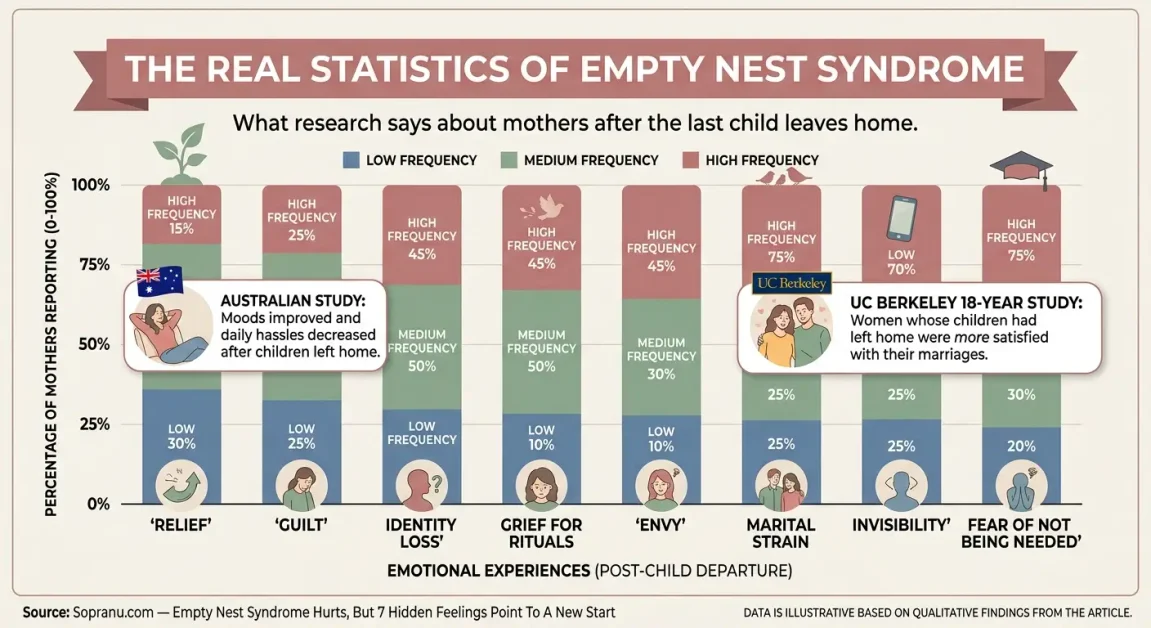
The research is more hopeful than the stereotype. An 18-year UC Berkeley study (Gorchoff, John and Helson, 2008) found women whose children had left home were more satisfied with their marriages than those whose children were still at home.
Mothers who stayed home, worked part-time, or come from cultures where children usually stay home longer may find the transition harder.
If sadness lasts for weeks and affects sleep, appetite or daily functioning, it may be depression, and it is worth seeing a doctor.
What Is Empty Nest Syndrome?
Empty nest syndrome is a name for the grief, loneliness and loss of purpose some parents feel when their children grow up and move out, whether for university, work, marriage or a move abroad.
Mayo Clinic is clear that it is not a clinical diagnosis. In a piece published through its news network, Dr. Jessica Sosso describes it as a phenomenon of sadness and loss when the last child leaves, and notes that parents of only one child, and parents who strongly identify with the parenting role, may find it harder to adjust.
I want to be honest about one thing up front. I tried to trace where the phrase “empty nest syndrome” first came from, and I could not find a source I would trust enough to put in front of you. You’ll see various origin stories online. I am leaving that question open rather than repeating something I can’t verify.
What I can say is that the phrase has stuck because it names something real. A mother who has organised her days around school runs, exam timetables and dinner for four for twenty years doesn’t simply switch to a new life the day the car pulls away.
Is Empty Nest Syndrome Worse for Mothers?
Empty nest syndrome is often described as harder for mothers, especially those who stayed at home or worked part-time, though fathers feel it too and are less likely to talk about it.
A University of Florida family science resource on adjusting to the empty nest summarises research suggesting that sadness and loss may be more intense for women who stayed home or worked part-time, and that parents from cultures where adult children traditionally live at home longer reported more difficulty.
That last point matters a lot where I come from. In Bangladesh and across much of South Asia, children often live with their parents until marriage, and sometimes after.
When a child leaves for study abroad or a job in another country, the break is sharper, because nobody really prepared for it as a normal stage of life.
Fathers, on the other hand, often show it differently.
Some throw themselves into work. Some become unusually quiet. Some suddenly start calling their children far more than they ever did when the kids were at home. The feeling is the same; the language is different.
The 7 Feelings Mothers Rarely Talk About
These seven feelings come from memoirs, research and the stories mothers tell when someone finally asks. Not every mother feels all seven. Most feel more than one.
1. Relief, Followed Quickly by Guilt
Relief is the feeling almost no mother admits to first. The house is quiet. There is no laundry mountain. Nobody is slamming doors or arguing about curfew. For the first time in two decades, you can eat dinner at 9 p.m. or skip it entirely.
Then the guilt arrives. “What kind of mother feels relieved that her child is gone?”
The answer is a normal one. Relief doesn’t mean you love your child less. It means you spent years in a demanding role and your body knows it has been allowed to rest.
In fact, research supports the idea that life can feel lighter. An Australian study by Lorraine Dennerstein, Emma Dudley and Janet Guthrie, published in 2002, found that women’s moods improved and their sense of daily hassle decreased after their children left home, according to the University of Florida summary.
What helps: Name both feelings at once. “I’m relieved, and I miss her.” Both can be true on the same morning.
2. “Who Am I If Not Their Mother?”
Loss of identity is the feeling that runs deepest for many women. For years, your answer to “What do you do?” may have been some version of “I take care of my children.” Your calendar, your friendships and your sense of competence were built around them.
When they leave, the role doesn’t disappear, but it shrinks overnight. You are still a mother, but you are no longer a daily mother. And many women realise, sometimes painfully, that they haven’t asked themselves what they want in a very long time.
The Jungian analyst James Hollis argues in Finding Meaning in the Second Half of Life that midlife often forces this kind of question, because the roles that carried us through the first half stop carrying us. If that idea speaks to you, our review of Finding Meaning in the Second Half of Life goes through his argument in detail.
What helps: Start small and concrete. Write down three things you enjoyed before you had children, or three things you always said you’d do “when the kids are older.” Pick one and put a date on it.
3. Grief for the Small Rituals
Grief for small rituals is often what catches mothers off guard. It isn’t the big goodbye at the airport or the university gate. It’s packing one lunch instead of two. It’s buying the brand of cereal only your son ate, then realising nobody will eat it. It’s the moment you instinctively set out an extra plate.
One UAE-based mother told Gulf News that she didn’t cook her daughter’s favourite meal for months after she left, because it simply hurt too much. Many mothers will recognise that story. The dish becomes a kind of memorial.
These rituals carried love that was never spoken. When they stop, the love has nowhere to go for a while.
What helps: Keep one ritual on purpose. A Sunday video call over tea. Sending a photo of the dish when you cook it. Rituals can travel; they just need a new shape.
4. Envy of Your Child’s Freedom
Envy is perhaps the hardest of the seven to admit. You watch your daughter post photos from her new city, her new friends, her new apartment, and somewhere beneath your pride is a small, sharp voice: “I never got to do that.”
Many women of my mother’s generation, and plenty of my own, married young, had children early, or gave up study and career plans to raise a family. Seeing a child step freely into the life you once imagined for yourself can stir up old regrets you thought you’d buried.
This is not a moral failing. It is information. The envy points directly at what you still want.
What helps: Ask yourself what, specifically, you envy. The travel? The study? The independence? The friendships? Then ask whether a smaller version of it is still available to you. Often it is. A short course, a solo trip, a part-time job, a new circle.
If you’d like a reading companion for this stage, our list of books for midlife women is a good starting point.
5. Your Marriage Under a Spotlight
The marriage spotlight is the feeling that comes when it’s just the two of you at the dinner table, and you realise you’ve spent twenty years talking about the children. Without them, the silence can be awkward, or even frightening.
Some couples discover they have drifted into living as co-managers of a household rather than partners. That realisation can be painful.
However, the research here is more encouraging than the fear. In 2008, Sara Gorchoff, Oliver John and Ravenna Helson at UC Berkeley published a study in Psychological Science that followed a group of women for 18 years, from their 40s into their early 60s.
Marital satisfaction rose as the women aged, and women whose children had left home were more satisfied with their marriages than those whose children still lived with them.
Interestingly, the improvement wasn’t because couples had more time together. According to the researchers, it was because they enjoyed the time they had more. Older research by Lynn White and John Edwards, published in 1990, also found that marriages tended to improve after children left.
Gorchoff herself cautioned against reading this as “send the kids away to save your marriage.” Her suggestion was that couples shouldn’t wait until their children leave to make time for enjoyable moments together. That is sound advice for parents at any stage.
What helps: Plan something new together, not just something familiar. A class, a walk at a new time of day, a short trip. New experiences give you something fresh to talk about besides the children.
6. Feeling Invisible Among Other Adults
Social invisibility is the feeling that arrives when you notice how many of your friendships were really “parent friendships.” The mothers you chatted with at the school gate, the parents you sat beside at sports days, the WhatsApp group for exam updates. When your child leaves, many of those connections quietly dissolve.
Suddenly your social life feels thin. Conversations with friends whose children are still young centre on things you’ve already moved past. And friends without children may not understand why you’re struggling at all.
This loneliness is rarely discussed, but it’s common. Friendships built around a shared context tend to fade when the context ends, which is something research on adult friendship has shown repeatedly. (Our piece on signs a friendship is ending covers why this happens.
What helps: Look for contexts that don’t revolve around children. A reading circle, a volunteering group, an evening course, a walking club. You need new places to keep bumping into the same faces.
7. Fear of No Longer Being Needed
The fear of no longer being needed sits quietly underneath many of the other six feelings. For years, your child came to you first: for food, for money, for comfort after a bad day. Now they handle a fever by searching online, sort out a bank problem alone, and call a friend after a breakup.
That is exactly what you raised them to do. Yet it can feel like a demotion.
This fear often shows up as over-contacting. Ten messages a day. Asking about every meal. Offering advice that wasn’t requested. Mayo Clinic’s advice is to keep in touch through calls, messages, video chats and visits, which is good, but the hard part is finding the balance between connection and checking up.
What helps: Agree on a rhythm together. For example, one long call on the weekend and casual messages in between. Let your child set some of the terms. A relationship built on choice tends to stay closer than one built on obligation.
When Does Empty Nest Syndrome Become Depression?
Empty nest syndrome may be turning into depression when sadness lasts for weeks rather than days, and starts to affect your sleep, appetite, energy, work or sense of hope.
Mayo Clinic’s guidance is simple and sensible: if you feel depressed, talk to your health care provider. That’s not a sign of weakness. Midlife is also a time when other pressures pile up, such as menopause, ageing parents, health concerns and career changes, and these can combine with the empty nest to make things heavier than any one change alone would be.
Watch for these warning signs:
- Persistent low mood most days for two weeks or more
- Loss of interest in things you used to enjoy
- Major changes in sleep or appetite
- Withdrawing from friends and family
- Feeling worthless or hopeless
- Increased use of alcohol, sleeping pills or other substances to cope
If any of these sound familiar, please don’t wait it out alone.
Why Do Some Children Come Back Home?
Some children come back home because of the cost of living, job changes, study gaps or crises, and in recent years this has become far more common in many countries.
Pew Research Center reported that in July 2020, at the height of the early pandemic, 52% of Americans aged 18 to 29 lived with one or both parents. That was about 26.6 million young adults, and it was higher than the previous peak of 48% recorded in the 1940 census at the end of the Great Depression.
I mention this because the “empty nest” is not always a one-way door. Many mothers go through the grief of a child leaving, start building a new routine, and then find their adult child moving back in for a few months or a few years.
That can bring its own confusion: joy, yes, but also the loss of the new freedom you had just started to enjoy. If this happens to you, set clear expectations early about chores, money and privacy.
Adult children living at home is a different arrangement from raising children, and it works best when it’s treated that way.
How Can a Mother Cope With Empty Nest Syndrome?
A mother can cope with empty nest syndrome by allowing the grief, rebuilding a daily structure, reconnecting with her partner and friends, and slowly reinvesting in her own interests. There is no single trick. These steps, though, are practical and realistic.
- Give the feelings a few weeks. Don’t force yourself to be “fine” by the first weekend. Grief has its own pace.
- Rebuild a morning routine. The school-day structure is gone. Replace it with something deliberate: a walk at 7 a.m., a prayer or meditation, tea with a neighbour.
- Turn the empty room into something, slowly. Don’t rush to clear it, but in a few months, consider making part of it a reading corner, a sewing space or a study.
- Set a “first year” goal that is about you. Learn to drive, finish a degree, start a small business, get fit, write the family history.
- Agree on a communication rhythm with your child rather than guessing.
- Find one new group that has nothing to do with children.
- Talk to someone. A friend who has been through it, a counsellor, a support group. You’re not the first, and you won’t be the last.
Arthur C. Brooks writes in From Strength to Strength about how the second half of adult life can bring different kinds of strength than the first. Our summary of From Strength to Strength is worth reading if you want a practical, research-based view of how to reshape your purpose after a major life change.
What Mothers in This Stage Need Most
What strikes me most about the empty nest is the silence around it. Imagine this situation: a neighbour says, “Your son must be doing so well in Canada,” and the mother smiles and agrees. Then she goes home to a quiet house. Nobody asks how she is.
What seems to help most isn’t advice. It’s permission. Permission to say “I’m proud of him and I’m devastated.” Permission to admit she is a little relieved. Permission to want something for herself again without apologising for it.
If you are a mother in this stage, I hope this article gives you some of that permission. Your feelings are mixed because your love is complicated, your life has been full, and a big chapter has just closed. That’s not a syndrome to be ashamed of. It’s a transition worth taking seriously.
And if you’re the adult child reading this, call your mother. Not to check in out of duty. Call to tell her something real about your life. It may be the best gift you can give her this month.
For quieter reading on ageing and family life, Elizabeth Strout’s Olive Kitteridge is one of the most honest novels about a mother whose son grows up and away.
Our Olive Kitteridge review explains why the book hits so hard.
FAQs About Empty Nest Syndrome
How long does empty nest syndrome last?
There’s no fixed timeline. For many parents, the sharpest feelings ease within a few weeks to a few months as new routines form. If sadness lasts longer and affects daily life, it may be depression, and speaking to a doctor is a good idea.
Is empty nest syndrome a real medical condition?
No, it is not a clinical diagnosis. Mayo Clinic describes it as a phenomenon of sadness and loss when the last child leaves home. The feelings are real, but they are generally considered a normal response to a major life change.
Does empty nest syndrome affect fathers?
Yes. Fathers can feel the loss too, though they may express it differently, through work, withdrawal or more frequent contact with their children. Research has tended to focus on mothers, so fathers’ experiences are less documented.
Can the empty nest improve a marriage?
It can. An 18-year UC Berkeley study published in Psychological Science in 2008 found that women whose children had left home were more satisfied with their marriages, largely because they enjoyed their time with their partner more.
Why do I feel guilty for feeling relieved my child left?
Feeling relieved is normal after years of intense caregiving. It doesn’t mean you love your child less. Research from Australia (Dennerstein and colleagues, 2002) found women’s moods often improved and daily hassles decreased after children left home.
What are the first signs of empty nest syndrome?
Common early signs include sadness when passing your child’s room, loss of routine, feeling purposeless, frequent urges to contact your child, loneliness, and tension or awkwardness with your partner.
Final Thoughts
Empty nest syndrome is a soft name for a hard season. Under the obvious sadness, mothers often carry quieter feelings: relief and guilt, a shaken identity, grief for small rituals, envy, a spotlight on the marriage, social invisibility and the fear of no longer being needed.
None of these feelings mean you did something wrong. They mean you did something big for a very long time. The research suggests that, for many women, what comes after can be surprisingly good, with better marriages, lighter moods and room to rediscover yourself.
Getting there just takes honesty about what you feel, and a little courage to want something for yourself again.