
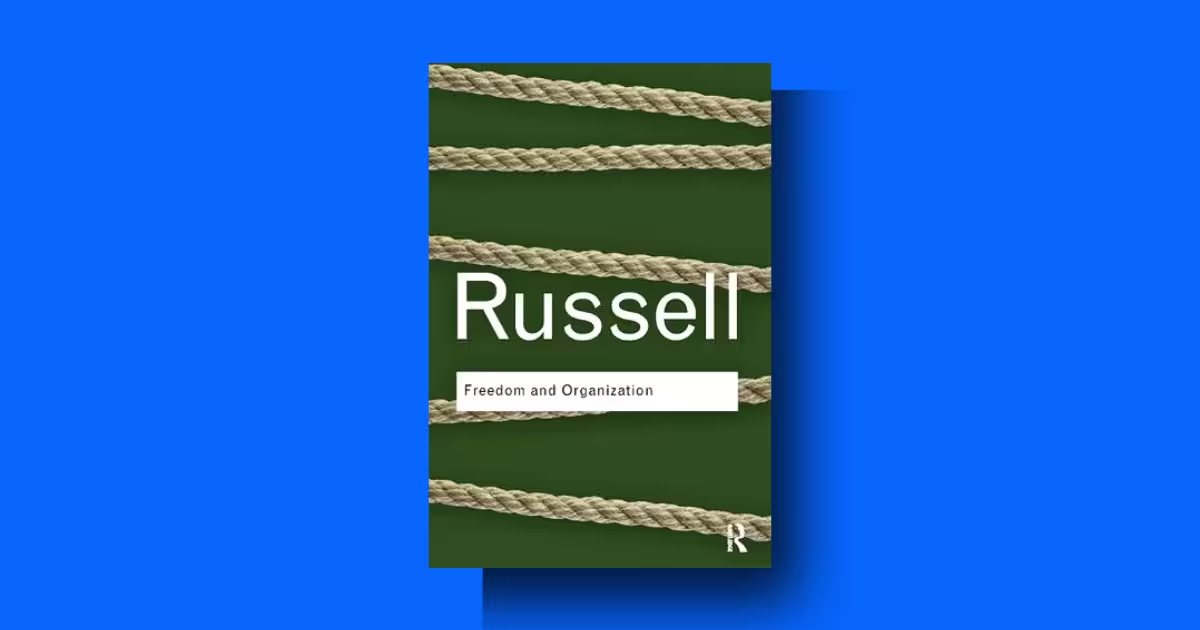
Why did the nineteenth century, the age that promised freedom, democracy, science and progress, also create the nationalism, imperialism and organized power that helped lead Europe toward the First World War? Bertrand Russell’s Freedom and Organization answers that question by showing how the modern world became more free in some ways and more tightly controlled in others.
Overview
Freedom and Organization is Bertrand Russell’s large-scale history of the political, economic and intellectual forces that transformed the century between the fall of Napoleon and the outbreak of the First World War.
Russell’s central argument is that nineteenth-century history cannot be explained by one cause alone. Instead, it emerged from the conflict between the ideal of freedom and the growing necessity for organization created by industrialism, science, capitalism, nationalism and the modern state.
Freedom and Organization begins with the conservative settlement after Napoleon and the Congress of Vienna. It then moves through British liberalism, Benthamite utilitarianism, free trade, the rise of socialism and Marxism, American democracy, slavery and the Civil War, the growth of monopoly capitalism, German nationalism, imperialism and the political pressures that eventually made the Great War possible.
What makes Freedom and Organization particularly interesting is that Russell does not simply ask whether freedom or organization is good. He asks what happens when both become powerful at the same time.
Industrial society requires large-scale coordination, but large organizations also concentrate power. Democracy expands political participation, yet nationalism can turn ordinary citizens into supporters of imperial competition and war.
My view is that Freedom and Organization is one of Russell’s most politically ambitious books. It is not his easiest work, and parts of it are undeniably dated. Nevertheless, its central question remains remarkably important: how can human beings organize society on a large scale without allowing organization itself to destroy freedom?
Reader recommendation
Freedom and Organization is best for:
- Readers interested in Bertrand Russell’s political philosophy
- Students of nineteenth-century European and American history
- Readers studying liberalism, socialism, Marxism and nationalism
- Anyone interested in the origins of modern capitalism and imperialism
- Readers who want to understand how industrialization changed politics
- People who enjoy historical books that connect ideas with political events
Freedom and Organization is not suggested for:
- Readers looking for a short introduction to Bertrand Russell
- Anyone wanting a conventional chronological history of every event between 1814 and 1914
- Readers who dislike political theory, economic history or long discussions of political thinkers
- Anyone expecting Russell to write as a completely neutral historian
Russell is not simply listing events. He is trying to explain why the nineteenth century developed as it did. That makes the book more intellectually ambitious, but it also makes it more demanding.
Table of Contents
1. Introduction: What Is Freedom and Organization About?
Freedom and Organization is a historical and political analysis by the British philosopher, mathematician and social critic Bertrand Russell.
Freedom and Organization was first published in 1934 by George Allen & Unwin, while the edition used for this review was published by Routledge in 2001. The book is identified as a work tracing political change across the hundred years from 1814 to 1914.
Bertrand Russell is best known for his contributions to logic, mathematics and philosophy. He co-authored Principia Mathematica with Alfred North Whitehead and later became one of the most influential public intellectuals of the twentieth century. The Nobel Foundation records that he received the 1950 Nobel Prize in Literature for writings that championed humanitarian ideals and freedom of thought.
However, Russell was never only a philosopher sitting inside an academic world. He repeatedly intervened in questions of war, politics, education, religion, nuclear weapons and social organization. His political writing was therefore not a side interest. It was central to his life.
The subject of Freedom and Organization is the transformation of the modern world between 1814 and 1914. The starting point is the defeat of Napoleon and the restoration of European order. The ending point is the First World War, when the political tensions created during the nineteenth century finally exploded into catastrophe.
Freedom and Organization was published in 1934, sixteen years after the end of the First World War and only a few years before the Second World War. This historical position matters. Russell was not writing from the innocent optimism of the nineteenth century.
He was looking backward at the century that had created the industrial and political forces of modern civilization and asking how those forces had produced such destructive results.
The central argument is clearly stated in the preface. Russell identifies three major kinds of historical causes: economic technique, political theory and important individuals. He refuses to reduce history to a single explanation. Industrial technology matters, but it does not explain everything. Political ideas matter, but they cannot explain everything either. Individuals matter, but individuals operate within wider structures.
The central conflict of the book is between the belief in freedom, associated especially with Liberals and Radicals, and the growing necessity for organization, created by industrial and scientific development.
That conflict is the key to understanding the entire book.
2. Background: Why 1814 and 1914?
The dates in the title are not accidental.
In 1814, Napoleon had been defeated and Europe was preparing to rebuild its political order. The French Revolution and the Napoleonic Wars had shaken the old European system. Monarchies had been overthrown, borders had been redrawn and ideas of citizenship, nationality and popular sovereignty had become impossible to ignore.
The Congress of Vienna attempted to restore stability. The European powers wanted peace, but they also wanted to prevent revolutionary movements from destroying established political authority.
By 1914, the situation was completely different.
Europe had experienced industrialization, mass politics, modern nationalism, huge armies, international finance, imperial competition and the rapid growth of science and technology. The nineteenth century had created a world that was far more interconnected than the world of 1814.
Yet it had also created new dangers.
The same organization that allowed modern industry to produce goods on an unprecedented scale could organize armies. The same nationalism that helped people demand political independence could become imperial nationalism. The same economic competition that encouraged innovation could produce monopolies and international rivalry.
In other words, progress did not simply produce freedom.
It produced power.
And the central question of Russell’s Freedom and Organization is what happens when power becomes increasingly organized while human beings continue to believe that they are becoming freer.
3. The Complete Argument of Freedom and Organization
The Principle of Legitimacy: Europe After Napoleon
Russell begins with the political settlement that followed Napoleon’s defeat.
The victorious powers had to decide what Europe should look like after more than two decades of revolution and war. The dominant political instinct was conservative. Monarchies wanted to restore authority, prevent revolution and maintain a balance of power.
The Congress of Vienna became the great symbol of this settlement.
The principle of legitimacy, promoted especially by Talleyrand, argued broadly that territories should belong to their hereditary rulers. In theory, this principle appeared to offer a moral basis for reconstructing Europe. In practice, however, it could be applied selectively.
This is one of Russell’s recurring themes: political principles often appear universal until they collide with political interests.
The Congress could invoke legitimacy when legitimacy was useful. But the rights of populations were not treated equally. The idea that people should choose their own government was still considered dangerously revolutionary.
The people who lived in a territory were often treated as if they were politically secondary to the rulers who claimed ownership of it.
Russell’s discussion of the Congress of Vienna therefore introduces an important contrast. On one side stood the old European order, based on monarchy, dynastic legitimacy and political authority. On the other side were emerging ideas of nationalism, democracy and popular sovereignty.
These forces would increasingly collide during the nineteenth century.
Metternich and the Fear of Change
The political personality who best represents the conservative reaction is Klemens von Metternich.
For Russell, Metternich was the great defender of political stability and the enemy of revolutionary change. His political outlook treated existing authority as something that should be preserved rather than questioned.
The problem, however, was that the world was changing too quickly for the old order to remain permanently stable.
Industrialization was transforming society. Nationalism was creating new political identities. Liberalism was challenging arbitrary authority. Democracy was becoming increasingly difficult to suppress.
Metternich’s system could delay these forces, but it could not eliminate them.
The revolutions of 1848 eventually demonstrated the limits of conservative restoration.
The March of Mind: Ideas Become Political Forces
The second major movement of the book is intellectual.
Russell examines the development of nineteenth-century political and economic thought through figures such as Malthus, Bentham, James Mill, Ricardo, Owen, Marx and Engels.
The importance of this section is that Russell does not treat ideas as abstract theories floating above society. Ideas influence political institutions, economic policies and social movements.
Malthus and the Problem of Population
Thomas Malthus became famous for his argument that population tends to grow faster than the food supply.
Russell examines Malthus not simply as a historical economist but as a thinker whose ideas influenced the way people understood poverty and social policy.
The Malthusian argument could be used in different ways. It could suggest that poverty was a natural result of population growth. It could also raise serious questions about whether economic progress alone could solve human suffering.
The darker side of Malthusian thinking was that it could make poverty appear inevitable.
If poverty was simply the result of population pressure, then political reform could seem less important.
Russell is particularly interested in how theories can shape political attitudes. A theory about population can become an argument against helping the poor. An economic theory can become a political justification.
This leads to one of the larger themes of Freedom and Organization: ideas do not remain safely inside books.
They eventually influence institutions.
Bentham and Utilitarianism
Jeremy Bentham represents another major intellectual force.
Benthamite utilitarianism judged policies according to their consequences for happiness and suffering. The central idea was that legislation should aim at the greatest happiness of the greatest number.
Russell recognizes the power of this approach. Utilitarianism attacked inherited privilege and traditional authority. It demanded that institutions justify themselves.
Why should monarchy exist?
Why should aristocracy exist?
Why should religious discrimination exist?
Why should economic rules benefit a small class?
The Benthamite method asked these questions in a direct and often uncomfortable way.
At the same time, Russell sees weaknesses in the purely utilitarian approach. Human beings are not simply calculating machines. They possess loyalties, emotions, traditions and collective identities.
The problem is that economic self-interest does not explain everything people do.
This limitation becomes especially important when Russell later discusses nationalism and war.
Free Competition and the Birth of Modern Capitalism
The nineteenth century also saw the expansion of free competition.
The idea was simple: if individuals and businesses were allowed to compete, economic activity would become more productive. Government interference should be limited.
This approach became particularly influential in Britain. Yet Russell shows the contradiction inside the system.
Competition tends to produce winners and losers. Successful businesses grow. Growing businesses gain more power. Over time, competition itself can lead to concentration.
A system that begins with many competitors can eventually produce a small number of powerful organizations.
This is one of the points where Russell’s discussion of nineteenth-century capitalism becomes particularly relevant to modern readers.
The problem is not simply that one business becomes successful.
The problem arises when economic power becomes so concentrated that individuals, smaller businesses and governments become dependent upon it.
Russell makes this argument especially clearly when discussing monopoly. He writes that “the real enemy is the monopolist.”
The point is important.
The employer may be the immediate opponent of a worker. But the deeper issue is the concentration of economic power.
This is one reason Russell’s discussion of capitalism is more sophisticated than a simple division between capitalism and socialism. He is interested in power.
Who controls land?
Who controls credit?
Who controls industry?
Who controls transportation?
Who can decide whether businesses survive or fail?
The answer to those questions determines the real structure of society.
Socialism and the Rise of Marx
Russell then turns to socialism.
Early British socialism, particularly the work of Robert Owen, attempted to create better social arrangements through cooperation and planned communities.
Marx and Engels rejected this approach as utopian.
Their argument was that capitalism could not be transformed simply by creating a few good communities. The economic system itself had to change.
Marx’s historical theory attempted to explain social development through economic structures and class conflict.
According to Russell’s account, Marx believed that industrial competition would lead to the concentration of capital. Businesses would become larger, smaller capitalists would be defeated and economic power would increasingly be concentrated.
Russell acknowledges the strength of this prediction. Marx recognized the tendency toward concentration and monopoly at a remarkably early stage.
However, Russell also identifies an important weakness in Marx’s analysis.
Marx underestimated non-economic motives.
People do not live by economic class alone.
They possess national loyalties, religious identities, cultural traditions and emotional attachments.
Marx expected the proletariat to recognize its common economic interest across national boundaries. But nationalism proved stronger than this expectation.
Workers could be persuaded to support their own nations even when those nations were controlled by elites.
This became one of the great tragedies of 1914.
The workers of different countries had more in common economically than the ruling classes that sent them to war. Yet national identity proved powerful enough to overcome international class solidarity.
The Most Important Failure of Marxism
This is one of the most interesting arguments in Freedom and Organization.
Marx understood economic power. He understood class. He understood that capitalism could produce concentration.
But he underestimated patriotism. Russell argues that modern nationalism combined economic self-interest with emotional loyalty.
This created a dangerous political formula.
Competition between nations. Cooperation within nations. Economic sacrifice by ordinary people.
Economic advantage for powerful groups. National glory as a justification for wealth and power.
Russell describes this combination as a political synthesis in which national competition and internal cooperation could coexist with economic inequality.
This is perhaps the most important idea in the entire book. Nationalism does not necessarily destroy economic interests.
It can unite them.
A worker and a millionaire may have almost nothing in common economically. But both can be persuaded that they share a national interest.
That is why nationalism can become so politically powerful.
Democracy in America
The third major part of Freedom and Organization moves across the Atlantic.
Russell examines Jeffersonian democracy, the settlement of the American West, Jacksonian democracy, slavery, the Civil War and Lincoln’s role in preserving national unity.
The American story presents a different version of the conflict between freedom and organization.
The United States was founded on powerful language about liberty and political equality. Yet it also developed slavery, racial domination, economic inequality and eventually enormous concentrations of industrial wealth.
Russell is especially interested in the conflict between Thomas Jefferson and Alexander Hamilton.
Jefferson represented a more democratic and agrarian ideal. Hamilton represented centralized government, financial power and the development of national economic institutions.
Russell’s summary of their conflict is memorable: Jefferson helped make America a home of democracy, while Hamilton helped make it a home of the millionaire.
The tension between these two visions never completely disappeared.
America could be democratic politically while becoming increasingly concentrated economically.
That contradiction is central to Russell’s understanding of modern society.
Political equality does not automatically produce economic equality.
A person may have the right to vote while possessing almost no economic power.
Meanwhile, a small number of wealthy individuals may have enormous influence over industry, finance and politics.
Slavery and the Civil War
Russell’s discussion of slavery reveals another contradiction.
The United States spoke the language of liberty while maintaining a system based on the denial of liberty.
The conflict between free and slave states eventually became impossible to contain.
The Civil War preserved the Union and abolished slavery, but Russell does not treat this as the end of the problem of power.
The organization necessary to preserve the Union also demonstrated the enormous destructive capacity of the modern state.
The American Civil War showed what industrial organization could do when applied to warfare.
This would become increasingly important in the decades that followed.
Competition Becomes Monopoly
The American economic story then returns to the problem of capitalism.
The nineteenth century began with the ideal of competition.
It ended with increasingly large corporations, financial institutions and industrial combinations.
This is another of the central paradoxes of Freedom and Organization.
The ideology of free competition can produce organizations powerful enough to reduce competition.
Economic freedom can therefore produce economic concentration. This does not mean that Russell believes every successful business is harmful.
His argument is more specific.
Economic power becomes dangerous when it depends upon control over essential resources such as land, minerals, credit and infrastructure.
In that situation, individual freedom becomes increasingly formal. A person may be legally free but economically dependent.
A small business may technically be independent but financially controlled by institutions that determine access to credit.
A government may be politically sovereign but economically dependent upon powerful financial interests.
The question is therefore not simply whether people are legally free.
The question is whether they possess enough real power to make their freedom meaningful.
Nationalism: From Liberation to Danger
The fourth part of Freedom and Organization examines nationalism and imperialism.
Nationalism begins as a force for unity.
People who share language, culture, history or common political interests may begin to see themselves as belonging to one nation.
In many cases, nationalism helped people resist foreign domination. It could therefore be connected with freedom. But nationalism also contained a danger.
A nation could begin to see its own interests as superior to the interests of other nations.
Nationalism could move from self-government to competition. Competition could become militarism.
Militarism could become imperialism. Imperialism could eventually produce war.
Russell explains that national feeling may arise from language, culture, common descent, common interests or common dangers. But he warns that nationalism often begins to imagine nations as biological races, producing ideas of superiority and inferiority.
This is a major transition in the history of modern political thought.
Nationalism promises belonging.
But belonging can become exclusion.
National pride can become national superiority.
National unity can become hostility to outsiders.
The political energy that once helped people fight for freedom can be redirected toward imperial expansion.
Germany and Bismarck
Russell gives particular attention to German nationalism and German unification.
The rise of Germany transformed the balance of power in Europe.
German nationalism began partly as a response to Napoleon. The German states had experienced French domination, and the idea of German unity became connected with resistance to foreign power.
But once German unity was achieved, nationalism changed.
A movement that had once been directed against domination could become a source of national power.
Bismarck was central to this transformation.
Russell emphasizes the importance of individuals in history. He rejects the idea that historical events would have unfolded in exactly the same way regardless of who was involved.
The existence of large historical forces does not make individual choices irrelevant.
Bismarck was not simply a product of German nationalism.
He also shaped it.
This is one of Russell’s most important methodological points.
History is neither entirely determined by structures nor entirely created by great individuals.
Both matter.
And sometimes chance matters too.
Russell argues that the First World War was made probable by large historical forces, but not absolutely inevitable. Small events could have changed the timing and possibly the outcome.
This is an important warning against historical hindsight.
After an event occurs, it often appears inevitable.
Before it happens, the future is usually much less certain.
Imperialism and Industrial Power
Industrialization changed imperialism.
Earlier imperialism had often been driven by conquest, trade, exploration and dynastic ambition.
Modern industrial imperialism added new economic pressures.
Industrial countries needed markets, raw materials, investment opportunities and strategic routes.
Imperial competition therefore became connected with the expansion of industrial economies.
Russell writes that modern economic technique gave imperialism a new character, while imperialism in turn changed the politics of industrialism.
This relationship is crucial.
Industry produced economic power.
Economic power encouraged overseas expansion. Overseas expansion increased national prestige. National prestige encouraged further competition. The process could become self-reinforcing. Britain, France, Germany and other powers increasingly competed for global influence. Imperialism was often presented in moral language.
It could be described as civilization, Christianity, education or good government.
But beneath these arguments were also questions of power, resources and strategic advantage.
Russell does not deny that imperial rule could sometimes produce improvements in administration or infrastructure. His analysis is more uncomfortable than a simple moral condemnation.
An imperial power might build roads, schools or administrative institutions while simultaneously denying political freedom.
The question therefore becomes: Can a system be beneficial in some practical respects and still be fundamentally unjust? Russell’s historical analysis forces the reader to confront that contradiction.
The British Empire and Imperial Nationalism
Russell is particularly critical of the growth of British imperial enthusiasm in the late nineteenth century.
The earlier British commitment to free trade had often been associated with opposition to acquiring new colonies.
But this changed.
The growth of industrial competitors, particularly Germany and the United States, challenged Britain’s sense of economic superiority.
Imperial pride became increasingly important. Empire could compensate psychologically for the loss of economic dominance. The result was the growth of a political culture in which imperial power became a source of national identity.
Russell describes this transformation with characteristic sharpness. The empire became a way for Britain to imagine itself as powerful even as industrial competition intensified abroad.
This argument is especially interesting because it connects nationalism with insecurity.
A powerful country may become more nationalist not because it is completely confident, but because it fears losing its position.
Nationalism can therefore be strongest when national status feels threatened.
Germany, Industry and Organization
The German Empire offers Russell one of the clearest examples of the power of organization.
Germany developed a highly educated population, advanced technical expertise and strong systems of coordination.
Its industrial growth was extraordinary.
But the same organizational strength that produced economic success also created political dangers. Industry became increasingly concentrated. Large banks, industrial firms and cartels gained enormous influence.
Russell cites a contemporary report describing economic decision-making as concentrated in the hands of a very small number of powerful figures controlling production, sales, prices, credit, capital and wages.
This is the central problem of organization.
Organization makes large achievements possible.
But organization also creates hierarchy. Hierarchy creates concentrated power. Concentrated power can become difficult to control.
The larger the organization, the further ordinary individuals may be removed from decision-making.
This problem exists in governments, corporations, armies and political parties. The modern world requires organization. But organization can reduce personal freedom. That is the dilemma at the centre of Freedom and Organization.
4. The Central Theme: Freedom Needs Organization, but Organization Threatens Freedom
The title of the book can be misunderstood.
Russell is not simply arguing that freedom is good and organization is bad. That would be far too simple.
Modern civilization could not exist without organization. Science requires institutions.
Industry requires coordination. Transportation requires systems. Public health requires administration. Modern education requires organization. The problem is that organization creates power. The more efficiently a system is organized, the more powerful it can become.
This power may be used for productive purposes.
It may also be used for oppression or war.
The modern state is therefore more powerful than the political systems of the past. The modern corporation is more powerful than the small business of the past. The modern army is more powerful than the armies of earlier centuries. The modern economy connects people across continents.
Consequently, modern society creates both unprecedented possibilities and unprecedented dangers.
Russell’s question is not whether organization should disappear.
It cannot.
The question is how organization can be controlled. How can individuals maintain freedom inside large systems? How can economic power be prevented from becoming political domination? How can national organization avoid becoming international warfare? These questions remain the real subject of the book.
5. Freedom and Organization Analysis
I think Freedom and Organization is one of Bertrand Russell’s most ambitious books because it attempts to explain an entire century without pretending that history has a single cause.
Russell’s strongest achievement is his refusal to reduce everything to economics.
Economic change matters enormously. Industrialization transforms society. Capitalism creates wealth and inequality. Technology changes political possibilities.
Yet Russell also recognizes that human beings are not economic machines.
People fight for nations.
They sacrifice for religions.
They follow leaders.
They defend traditions. They become emotionally attached to symbols. They sometimes act against their economic interests. This is where Russell’s criticism of Marx becomes particularly strong. Marx saw the enormous power of economic organization. But he did not fully appreciate the power of nationalism.
The First World War demonstrated the importance of this weakness.
International working-class solidarity was not strong enough to prevent national populations from supporting their own governments.
The workers of Europe did not unite to prevent war.
They were mobilized by their nations.
This is perhaps the most disturbing lesson of the book.
Human beings may have more in common than they realize, yet political organizations can persuade them to identify with groups that place them in conflict with one another. The second major strength of the book is Russell’s treatment of historical causation.
He does not believe that one can explain history simply by saying that capitalism caused everything, or that great leaders caused everything.
Economic structures matter.
Political ideas matter. Individuals matter. Chance matters. Russell’s method is therefore more cautious than many grand theories of history.
His warning that history can only appear completely scientific through “falsifications and omissions” is one of the book’s most memorable methodological points.
I find this particularly persuasive.
When historians explain the past after the fact, they often make events appear inevitable.
But history is full of accidents.
A decision that was not made.
A leader who died at the wrong moment.
A treaty that was signed.
A war that was delayed.
A political compromise that failed.
The world that emerges from these events may later appear inevitable, but it was not necessarily so. Russell’s view of history therefore contains an important element of humility. We should be careful when explaining the past. We should be even more careful when predicting the future.
6. Strengths and Weaknesses
Strengths
1. It connects politics, economics and ideas
The greatest strength of Freedom and Organization is its breadth.
Russell moves from the Congress of Vienna to Bentham, from Marx to Jefferson, from slavery to capitalism, from Bismarck to imperialism.
Yet Freedom and Organization does not feel like a random collection of subjects.
The central question holds everything together.
How did freedom and organization interact?
2. Russell understands the power of nationalism
His analysis of nationalism is particularly strong.
He understands that nationalism can be both liberating and dangerous.
It can help people resist foreign domination.
It can also produce imperialism and war.
This dual character makes nationalism difficult to understand.
Russell does not reduce it to simple patriotism or simple evil.
3. His criticism of economic concentration remains powerful
Russell’s discussion of monopoly and concentrated economic power is one of the sections that feels most relevant to modern readers.
His central concern is not merely wealth inequality.
It is the conversion of wealth into power.
When economic control becomes concentrated, formal political freedom may not be enough.
4. Russell avoids simplistic historical determinism
The book gives proper importance to chance and individuals without ignoring wider structures.
This makes his history more realistic.
Weaknesses
1. It is heavily shaped by Russell’s own political judgments
Russell is not a neutral historian.
He has clear opinions about monarchies, imperialism, capitalism, socialism, nationalism and political leaders. Sometimes this makes the book engaging. Sometimes it makes his judgments feel too sharp.
2. Some arguments are dated
Freedom and Organization was written in 1934.
Its language, political assumptions and historical interpretations belong to that period. A modern reader should therefore distinguish between Russell’s historical evidence and his interpretation of that evidence.
3. The scope sometimes becomes overwhelming
Russell covers an enormous amount of material. The advantage is breadth. The disadvantage is that some subjects receive less attention than they deserve.
A reader unfamiliar with nineteenth-century history may occasionally feel lost.
4. Russell’s analysis sometimes gives too much weight to intellectual elites
Freedom and Organization focuses heavily on major thinkers, political leaders and institutions.
Ordinary people are present, particularly in discussions of workers, peasants and democratic movements, but they are not always at the centre of the narrative.
7. Comparison with Similar Works
The Age of Revolution by Eric Hobsbawm
Hobsbawm’s The Age of Revolution is a more modern historical interpretation of the period from 1789 to 1848.
Hobsbawm gives greater attention to social classes, industrialization and the transformation of ordinary life.
Russell is more interested in political ideas and the intellectual forces behind historical change. Both books are useful, but they approach history differently.
The Open Society and Its Enemies by Karl Popper
Popper’s work is more explicitly philosophical and focused on the dangers of historicism and political authoritarianism.
Russell’s book is more historical and narrative.
Both writers share a concern about systems that claim to possess an absolute understanding of history.
The Origins of Totalitarianism by Hannah Arendt
Arendt’s book belongs to a later period and focuses especially on imperialism, antisemitism and totalitarianism.
However, the connection is clear. Russell examines how nationalism, imperialism and organized power developed before 1914.
Arendt later examined how some of these forces contributed to the political catastrophes of the twentieth century.
The Great Transformation by Karl Polanyi
Polanyi focuses on the social consequences of the rise of the market economy.
Russell’s work is broader, but both writers are interested in the relationship between economic organization and political freedom.
8. Why This Book Still Matters
The world of 1814 to 1914 has disappeared. The political map has changed. The British Empire is gone. The German Empire is gone. The old European aristocracy has largely disappeared. Technology has transformed daily life.
Yet the central problem of the book remains. We still depend on enormous organizations.
We still live inside governments, corporations, financial systems, political parties and international institutions.
We still debate the balance between individual liberty and collective coordination.
We still see nationalism used both as a force for liberation and as a source of hostility.
We still see economic power concentrated in large institutions. We still see technology increasing both freedom and control.
The modern world has not escaped Russell’s problem. It has made the problem larger.
The question is no longer whether we need organization.
We clearly do.
The question is whether organization can remain accountable to the individuals it is supposed to serve.
9. Conclusion
Freedom and Organization is not the first Bertrand Russell book I would recommend to a reader who has never encountered him.
For that, What I Believe, The Problems of Philosophy or A History of Western Philosophy may be more accessible starting points. I have also written about Russell’s broader intellectual work elsewhere on Probinism, including his historical and philosophical writing.
However, for readers interested in political history, the origins of modern capitalism, Marxism, nationalism, imperialism and the political causes of the First World War, this book deserves serious attention.
What I admire most about it is that Russell does not offer a comfortable explanation.
He does not say that history is controlled entirely by economic forces.
He does not say that great men create everything.
He does not say that political ideas alone determine events.
Instead, he shows a world in which different forces interact.
Freedom creates political movements.
Organization creates industrial power. Industrial power creates wealth. Wealth creates inequality. Nationalism creates unity.
Unity creates competition. Competition creates imperialism. Imperialism increases international tension.
And eventually, the organized power of modern civilization becomes capable of destroying civilization on an unprecedented scale.
That is the tragedy Russell finds in the century before 1914. The nineteenth century made humanity more powerful. It did not necessarily make humanity wiser.
For me, that is the lasting lesson of Freedom and Organization.
The problem of modern society is not simply that people lack freedom. Nor is it simply that societies lack organization. The real problem is that the systems required to create prosperity and security can become so powerful that they begin to control the people they were created to serve.
Russell’s book is therefore not only a history of the nineteenth century.
It is also a warning about modern civilization.
And that warning remains difficult to ignore.
Recommendation: Highly recommended for readers interested in political philosophy, modern history, capitalism, Marxism, nationalism, imperialism and Bertrand Russell’s political thought. It is best read slowly, with a historical timeline nearby, but its central argument is important enough to justify the effort.







