
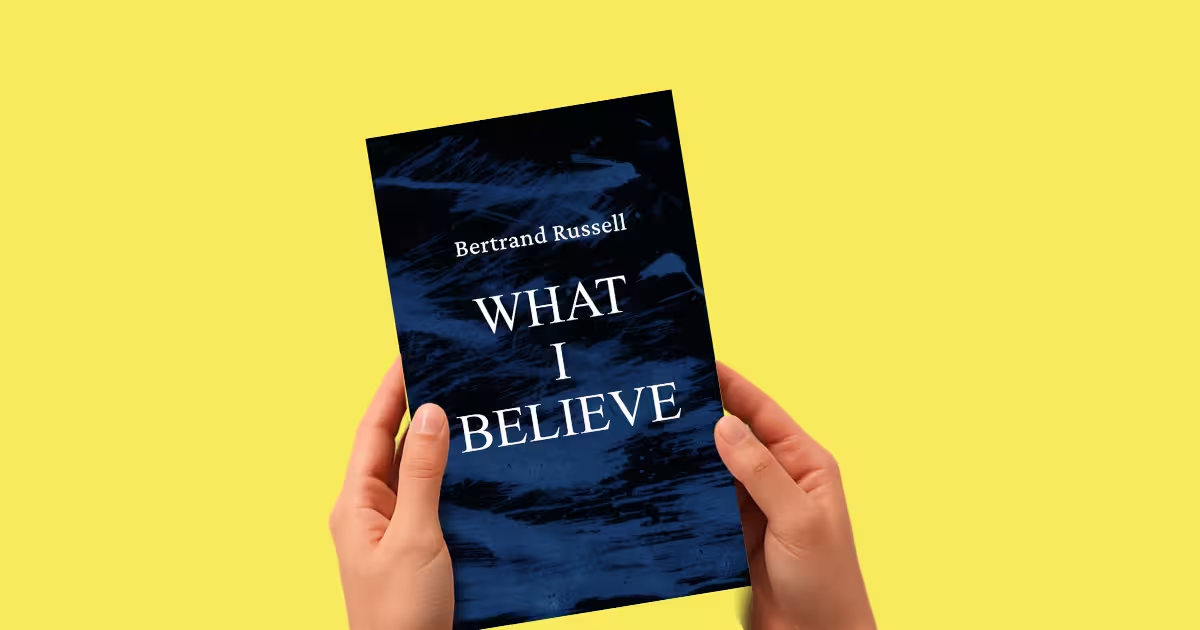
Did a slim, sixty-page pamphlet really get Bertrand Russell branded unfit to teach at a New York college? I read What I Believe cover to cover to find out, and it left me questioning how much of my own morality is just borrowed fear.
What I Believe is Bertrand Russell’s 1925 pamphlet on where humans stand in the universe and how they might still live well without God, fixed rules, or guaranteed happy endings. It is short, plain-spoken, and unusually personal for a philosopher this famous, and in 1940 it was one of the texts used to strip him of a teaching post in New York.
A decade later, in 1950, he won the Nobel Prize in Literature. This review covers all five chapters in full, weighs what still holds up and what has aged badly, and tells you honestly whether you need to read the original at all.
What I Believe is a great read for readers who want Russell’s whole outlook in one sitting instead of wading through History of Western Philosophy, skeptics building a secular framework for ethics, anyone who liked The Conquest of Happiness and wants the shorter, sharper version that came first, and students who need a clear, quotable summary of his views on religion, morality, and science.
Not for: religious readers hoping for a fair hearing of faith (Russell does not attempt one), anyone wanting rigorous academic argument with footnotes and counterarguments, or readers who need a book to hand them a step-by-step life plan rather than a personal creed.
Table of Contents
1. Introduction
What I Believe is a short philosophical essay by Bertrand Russell, first published in 1925 by Kegan Paul, Trench, Trubner & Co in London, as part of a pamphlet series called “To-day and To-morrow.”
Russell needs little introduction, but his credentials are worth stating plainly because they explain why a sixty-page pamphlet still gets cited a century later. He was a mathematician and logician who, together with G. E. Moore, is generally credited as a founder of analytic philosophy.
He co-wrote Principia Mathematica with Alfred North Whitehead, was imprisoned during the First World War for his pacifism, lost his lectureship at Trinity College, Cambridge over that same pacifism, and later became one of the founders of the Campaign for Nuclear Disarmament. In 1950, the Nobel committee awarded him the Prize in Literature “in recognition of his varied and significant writings in which he champions humanitarian ideals and freedom of thought.”
The purpose Russell sets for What I Believe is stated in his own preface, dated the first of January, 1925: to say what he thinks about “man’s place in the universe” and about “his possibilities of achieving the good life.” That is the whole of it. There is no thesis to defend across four hundred pages, no system to construct.
He simply tells you, chapter by chapter, what he has concluded after a lifetime of thinking about it, and asks you to test it against your own reasoning rather than take it on his authority.
2. Background
What I Believe did not appear in a vacuum. The “To-day and To-morrow” series that published it also carried J. B. S. Haldane’s optimistic Daedalus, about what science could do for the human future, and Russell had already answered it the previous year with his own pamphlet Icarus, a much darker look at how science could be turned to destruction.
What I Believe was written as the hopeful counterpart to Icarus: where the earlier book worried, this one tries, in Russell’s words, to state his “hopes.”
By 1925, Russell had already lived through the two experiences that shaped every argument in this book: the trench warfare and mass propaganda of the First World War, which convinced him that fear and nationalism were far more dangerous to happiness than any single dogma, and years of direct clashes with religious and legal authority over his views on marriage, sex, and pacifism, which had already cost him a Cambridge post and would, in 1940, cost him a New York one too.
He was also, at the time of writing, running Beacon Hill, an experimental school he founded with his second wife, Dora, which gives the chapters on education and superstition a personal, not just theoretical, edge.
3. What I Believe Chapter-by-Chapter Summary
What I Believe is organized into five short chapters. Here is what each one actually argues, in enough detail that you should not need to go back to the source text afterward.
3.1 Nature and Man
Russell opens by placing the human body and mind squarely inside physics rather than outside it. We are made of the same electrons and protons as stars and rocks, and our thoughts depend on the structure of the brain the way a journey depends on roads and railways: real, but not magical or separate from matter.
From this he draws his first big conclusion: there is no scientific reason to expect personal survival after death, since a mind this dependent on organized brain tissue should not be expected to outlast that tissue’s destruction.
He is careful here, and this is a section skeptics of Russell often misrepresent. He does not claim certainty that God does not exist; he calls himself agnostic on strict logical grounds, since he can no more disprove the Christian God than the gods of ancient Egypt or Babylon, and treats all three as equally unsupported rather than equally likely.
What he does claim, more confidently, is that survival of death is a testable, evidence-based question rather than a metaphysical one, and that on the evidence available in 1925, the case against personal immortality is far stronger than the case for it, though he leaves room for that balance to shift if better evidence turns up.
The chapter’s emotional core is his account of religion’s origin: “Fear is the basis of religious dogma,” he writes, and he means fear of death, fear of an indifferent universe, and the very human wish for what he calls, elsewhere, a kindly older presence to lean on.
His answer to that fear is not denial that death is real, but a redirection of value. Nature itself, he argues, is neither good nor bad; it just is. Meaning does not come from the universe being loving toward us. It comes from us: “It is we who create value and our desires which confer value.”
That single sentence is doing most of the philosophical work in this chapter, and arguably in the whole book.
3.2 The Good Life
This is the chapter everyone quotes, and for good reason. Russell states his central claim directly: “The good life is one inspired by love and guided by knowledge.”
He builds the case for it through a single, sharp example. During a plague outbreak, one community responds by packing into churches to pray, an act of love without knowledge, and the crowding actually speeds the disease’s spread.
A different community relies purely on medical knowledge with no compassion for the sick, and gets efficient but cold results. Neither alone is enough. Love without knowledge is well-meaning but often makes things worse; knowledge without love is competent but has no direction worth following.
Russell then splits love itself into two ingredients: delight, the simple pleasure of admiring something (a child’s charm, a beautiful painting), and benevolence, active goodwill toward someone’s welfare regardless of whether they are pleasant to be around. He is honest that most real love needs some mix of both, and equally honest that no one can extend full delight to every person or creature they meet; some people are, in his blunt phrasing, “disgusting,” and pretending otherwise only dulls a person’s genuine reactions. Benevolence can and should stretch much further than delight, but even it has limits once real rivalry or competition enters the picture.
The most quietly radical move in this chapter is Russell’s account of ethics itself. He denies that there is a special category of “ethical knowledge” distinct from ordinary facts about what satisfies or frustrates human desire.
When someone tells you that you “ought” to do something, Russell argues, what is actually happening is that they want you to do it, generally backed by the threat of disapproval.
Morality, on his account, is not a set of commands handed down from outside human wanting; it is what people would agree on if they honestly tracked which actions let the largest number of desires get satisfied without wrecking someone else’s.
3.3 Moral Rules
Here Russell turns from theory to practice, and gets considerably angrier.
He distinguishes between the uncontroversial part of morality (basic self-control, delaying one desire to protect another, the kind of thing you teach a toddler) and the far more contested part built on inherited religious taboo, particularly around sex.
His argument is that most Western sexual morality descends from the idea of “sin,” an act displeasing to God regardless of whether it actually harms anyone, and he traces this directly back to superstition rather than reasoned ethics. To make the comparison impossible to dodge, he lists real historical examples: tribes who believed they had a “painful duty” to practice cannibalism to keep the sun bright, and others who kept girls locked away from sunlight from puberty until age seventeen for fear the sun would make them pregnant.
His point is not that modern Western morality is that extreme; it is that the mechanism, an inherited taboo defended with no reference to actual consequences, is the same mechanism, and he thinks readers underestimate how much of that mechanism survives in supposedly rational modern codes.
He is at his most pointed discussing birth control and clergy hypocrisy.
He describes, with real contempt, a real “fashionable clergyman” whose wife had nine children in nine years, was told by doctors that another pregnancy could kill her, had one anyway, died, and whose husband kept his position and remarried, while men exactly like him continued publicly condemning couples who used contraception to avoid that fate.
Whatever you make of Russell’s broader anti-religious streak, this specific example is a genuine, documented moral inconsistency, and it is the strongest single passage in the chapter.
On crime, Russell makes an argument that reads as strikingly modern: he wants criminals treated the way a hospital treats a contagious patient, not the way a church treats a sinner.
“Moral indignation,” in his view, is just self-righteousness wearing a respectable coat, and if kindness combined with education can cut crime as effectively as punishment, kindness should win, purely on the practical grounds that it is achieving the community’s actual goal (fewer future crimes) with less needless suffering.
3.4 Salvation: Individual and Social
The fourth chapter tackles a question the earlier ones set up but never answered: is the good life something a person can achieve alone, or does it need a decent society around them?
Russell argues firmly for the second option, and blames Christianity for popularizing the first.
He traces the individualist idea of personal salvation, one soul, one God, saved regardless of the state of the world, to the early Christian communities’ complete lack of political power; when you cannot change your society, it is natural to relocate the whole moral drama inside a single soul instead.
He contrasts this with Plato’s Athens, where a citizen with real civic power thought about justice as a property of the whole community first, and the individual second.
Russell then applies this directly against the aristocratic version of the good life, the idea that a small, cultured, privileged class can live well regardless of how the majority lives.
He argues this always requires the privileged person to convince themselves that the people beneath them do not fully matter, and gives an unflinching contemporary example: English colonial officials who flog Africans “so severely that they die of unspeakable anguish” while remaining, by every private standard, cultured and pleasant company. No degree of personal refinement, in his view, redeems a life built on that kind of selective sympathy.
He closes the chapter by rejecting sudden, dramatic conversion, whether religious or revolutionary, as a shortcut to salvation for a person or a society. “There is no short cut to Utopia,” in his framing; building intelligence, self-control, and character is necessarily gradual, a matter of education across generations rather than a single transformative moment.
He also makes an economic point that has aged well: modern life depends on cooperation across an entire community (his example is Britain’s food supply depending on foreign trade), so anyone who thinks they are living a self-sufficient good life independent of society is, in his own words, “a conscious or unconscious parasite” on everyone else’s work.
3.5 Science and Happiness
The final chapter is the most forward-looking, and the reason Alan Ryan’s 2004 preface calls it the deliberately hopeful twin of the darker Icarus. Russell separates harm caused by simple ignorance, which more research and education can fix, from harm caused by genuine “active malevolence,” which he treats as the harder problem.
He is unusually candid that ordinary people, not just villains, take real pleasure in gossip about others’ misfortune, in punishing criminals beyond what actually prevents crime, and in cruelty toward outsiders, and he traces much of this to two sources: fear (economic insecurity, fear of political rivals) and envy (the old envying the young, the unlucky envying the fortunate).
His prescription is twofold: increase real security, since frightened people are crueler people, and deliberately cultivate courage, which he argues had been treated for centuries as an “aristocratic monopoly” reserved for soldiers and nobles. He points to the suffragettes and to ordinary conscripted soldiers of the First World War as proof that courage is not a rare, elite trait; it appears wherever people are actually asked to show it.
He ends with a direct response to Rousseau-style objections that science is “unnatural.” Russell picks the objection apart by noting that people who call birth control unnatural rarely object to celibacy, even though both are equally a deliberate override of raw instinct, showing that “natural” is usually just a label for “whatever we are already used to.”
What I Believe‘s final promise is that once humanity gains the same deliberate control over its own psychology that it has already gained over the physical world, people will be able to choose cooperation over conflict on purpose rather than by accident, and only then, in Russell’s closing words, will humanity have “won our freedom.”
4. What I Believe Analysis
Judged against its own stated goal, a personal, readable statement of one man’s considered beliefs about humanity’s place in the universe, What I Believe succeeds completely.
Russell writes with the kind of clarity that most philosophers spend a career trying and failing to reach: no jargon, no throat-clearing, and a genuine argument on almost every page rather than mood or assertion.
The plague example in Chapter 2, the clergyman story in Chapter 3, and the colonial-flogging example in Chapter 4 are not decoration; they are doing real argumentative work, forcing an abstract claim into a concrete case you cannot easily wave away.
Where What I Believe is weaker is exactly where Alan Ryan’s own 2004 preface admits it is weaker: in what Ryan calls Russell’s “frequent unfairness” toward religion.
Russell is far more interested in showing religious institutions at their worst (hypocritical clergy, superstition-driven cruelty) than in engaging the strongest intellectual defenses of religious belief or ethics. He also states, rather than defends at length, his central meta-ethical claim that there is no such thing as ethical knowledge separate from ordinary fact and desire; readers who want that claim actually argued against serious objections will need to look at his more technical philosophical writing, not this pamphlet.
As a personal creed, though, rather than a systematic treatise, it does exactly what it sets out to do, and does it in under sixty pages.
5. Strengths and Weaknesses
What works: the prose has barely aged in a hundred years, which is rare for 1920s nonfiction. His warnings about fear-driven nationalism and the psychological rewards of cruelty toward outsiders read, unfortunately, as current in 2026 as in 1925.
The definition of the good life at the center of Chapter 2 remains one of the most quoted lines in secular philosophy for a reason: it is short, testable against your own life, and genuinely useful as a personal standard.
What does not work as well: several of his illustrative examples about “savage” tribes and their taboos are dated, ethnocentric by today’s standards, and would not survive an editor’s pass in a book written now.
His treatment of religion, as noted above, focuses on institutional failure rather than the strongest philosophical case for faith, which makes the book more of a bracing personal statement than a fair debate. And because it is a pamphlet, not a treatise, several claims (particularly the flat rejection of ethical knowledge as a category) are asserted with more confidence than the sixty pages available can actually support.
6. Comparison With Similar Works
Readers who finish What I Believe usually want to know where to go next inside Russell’s own catalog. If the chapter on religion is what grabbed you, his later, far blunter essay Why I Am Not a Christian (1927) takes that single argument and pushes it much further with almost none of this book’s softer, hopeful chapters on love and courage.
If Chapter 2’s account of the good life is what stuck with you, Russell expanded it five years later into the far more practical The Conquest of Happiness (1930); that later book is more useful as an actual guide to daily contentment, though What I Believe states the underlying philosophy more sharply in far fewer pages.
For the science-and-religion argument specifically, Russell revisited the same ground two decades later in Religion and Science, and readers wanting his more technical epistemology behind the confident claims in Chapter 1 of this book should look at Human Knowledge: Its Scope and Limits, covered in our full review. The political argument buried in Chapter 4 about aristocracy and social power gets its own dedicated treatment in Russell’s Power: A New Social Analysis.
Outside Russell’s own catalog, the closest modern equivalent in tone, a short, personal, secular statement of belief, is the New Atheist wave of the 2000s, though those books tend to be angrier and less interested in the positive half of Russell’s argument (love, courage, the good life) than in the negative half (why religion fails).
Readers curious about the opposite side of the same debate, a serious contemporary case for faith rather than against it, might find our review of Ross Douthat’s 2025 book Believe a useful counterweight.
And because so much of Russell’s argument in Chapters 3 and 4 rests on his liberal, individual-freedom-first politics, our plain explainer on what liberalism actually means is a useful companion piece for readers who want the political theory underneath his ethics spelled out separately, alongside our wider look at how science and religion actually relate in the modern world.
7. What I Believe quotes
1. The Definition of the Good Life
The good life is one inspired by love and guided by knowledge. (Page 10)
This is arguably the most famous and frequently quoted line from the entire What I Believe. It appears early in Chapter 2 and serves as Russell’s central thesis. The passage that follows elaborates:
Knowledge and love are both indefinitely extensible; therefore, however good a life may be, a better life can be imagined. Neither love without knowledge, nor knowledge without love can produce a good life. (Page 10)
2. On Fear and Religion
Fear is the basis of religious dogma, as of so much else in human life. (Page 5)
This is Russell’s most cited statement about religion’s origins. It’s part of a larger passage:
Religion, since it has its source in terror, has dignified certain kinds of fear, and made people think them not disgraceful. In this it has done mankind a great disservice: all fear is bad. (Page 6)
3. On Death and Immortality
I believe that when I die I shall rot, and nothing of my ego will survive. I am not young, and I love life. But I should scorn to shiver with terror at the thought of annihilation. Happiness is none the less true happiness because it must come to an end, nor do thought and love lose their value because they are not everlasting. (Page 7)
This passage is widely quoted for its eloquent, courageous atheism combined with a life-affirming attitude.
4. On Knowledge and the Scientific Attitude
All moral rules must be tested by examining whether they tend to realise ends that we desire. (Page 14)
And the related passage:
What we ‘ought’ to desire is merely what someone else wishes us to desire. Usually it is what the authorities wish us to desire—parents, school-masters, policemen, and judges. (Page 14)
5. On Moral Rules and Superstition
Current morality is a curious blend of utilitarianism and superstition, but the superstitious part has the stronger hold, as is natural, since superstition is the origin of moral rules. (Page 19)
6. On the Soul and Body
Metaphysicians have advanced innumerable arguments to prove that the soul must be immortal. There is one simple test by which all these arguments can be demolished. They all prove equally that the soul must pervade all space. But as we are not so anxious to be fat as to live long, none of the metaphysicians in question have ever noticed this application of their reasonings. This is an instance of the amazing power of desire in blinding even very able men to fallacies which would otherwise be obvious at once. (Page 5)
7. On Science and Human Nature
To respect physical nature is foolish; physical nature should be studied with a view to making it serve human ends as far as possible, but it remains ethically neither good nor bad. (Page 41)
8. On Individual vs. Social Salvation
The good life must be lived in a good society, and is not fully possible otherwise. (Page 30)
9. On the Nature of Ethics
Outside human desires there is no moral standard. (Page 15)
10. On Courage and Fear
Everything that increases the general security is likely to diminish cruelty. (Page 35)
And:
Only justice can give security; and by ‘justice’ I mean the recognition of the equal claims of all human beings. (Page 35)
11. On Love and Hatred
A single desire is no better and no worse, considered in isolation, than any other; but a group of desires is better than another group if all of the first group can be satisfied simultaneously, while in the second group some are inconsistent with others. That is why love is better than hatred. (Page 41)
12. On the Philosophy of Nature vs. Value
The philosophy of nature is one thing, the philosophy of value is quite another. Nothing but harm can come of confusing them. (Page 7)
And:
We are ourselves the ultimate and irrefutable arbiters of value, and in the world of value Nature is only a part. Thus in this world we are greater than Nature. (Page 8)
13. On Moral Education
The question for the legislative moralist is, therefore: How shall this system of rewards and punishments be arranged so as to secure the maximum of what is desired by the legislative authority? (Page 15)
14. On War and Conflict
There is no short cut to the good life, whether individual or social. To build up the good life, we must build up intelligence, self-control and sympathy. This is a quantitative matter, a matter of gradual improvement, of early training, of educational experiment. Only impatience prompts the belief in the possibility of sudden improvement. (Page 31)
15. On Science’s Promise and Peril
Science can, if it chooses, enable our grandchildren to live the good life, by giving them knowledge, self-control, and characters productive of harmony rather than strife. At present it is teaching our children to kill each other, because many men of science are willing to sacrifice the future of mankind to their own momentary prosperity. But this phase will pass when men have acquired the same domination over their own passions that they already have over the physical forces of the external world. Then at last we shall have won our freedom. (Page 42)
16. On Crime and Punishment
The view that criminals are ‘wicked’ and ‘deserve’ punishment is not one which a rational morality can support. (Page 25)
And:
The vindictive feeling called ‘moral indignation’ is merely a form of cruelty. (Page 25)
17. On Nature and Human Desires
Human nature we should respect, because our impulses and desires are the stuff out of which our happiness is to be made. (Page 41)
18. On Courage and Democracy
Courage must be democratised before it can make men humane. (Page 36)
19. On the Limits of Science
Physical science is thus approaching the stage when it will be complete, and therefore uninteresting. (Page 2)
This appears early in What I Believe and is often quoted for its provocative, paradoxical claim.
20. On Hypocrisy and Morality
The Church does not mind hypocrisy, which is a flattering tribute to its power; but elsewhere it has come to be recognised as an evil which we ought not lightly to inflict. (Page 24)
8. Conclusion
What I Believe earns its reputation as the clearest single-volume entry point into Bertrand Russell’s entire outlook. It is short enough to finish in one sitting, direct enough that you never have to guess what he actually thinks, and, on the evidence of the 1940 court case that used it against him, sharp enough to have made powerful people genuinely uncomfortable.
Ten years after that case, the Nobel committee gave him literature’s highest honor for the same body of writing this pamphlet distills; the controversy did not sink What I Believe.
If anything, it proved the book’s point about fear and institutional power better than Russell could have argued it himself.
I would recommend it without hesitation to any general reader curious about secular ethics, and to anyone who wants Russell’s ideas without committing to the roughly nine hundred pages of A History of Western Philosophy.
I would not recommend it as a first stop for religious readers looking for a genuinely two-sided conversation, since this is a creed, not a debate; nor would I recommend it to anyone wanting rigorous, footnoted academic philosophy, since its whole appeal is that it deliberately avoids that register.
For everyone else, it remains, a full century on, one of the shortest routes to a complete, honest secular philosophy of life currently in print.







