
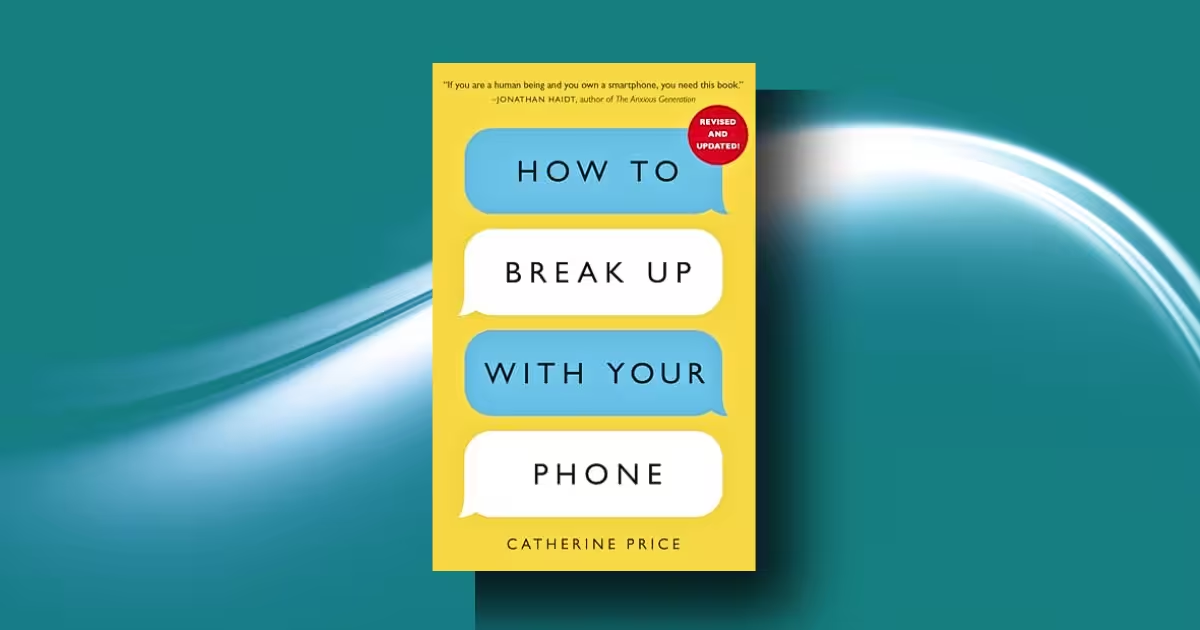

Is your phone the first thing you touch when you wake up and the last thing you let go of before sleep? Does the buzz of a notification ever tighten your stomach before you’ve even looked at the screen? I picked up Catherine Price’s How to Break Up with Your Phone already knowing the answer to both questions was yes, and by the end of it, I finally understood why.
How to Break Up with Your Phone: The 30-Day Plan to Take Back Your Life is a 2018 nonfiction book by science journalist Catherine Price that splits neatly into two halves: “The Wake-Up,” which explains, with real research, why smartphones are built to be nearly impossible to put down, and “The Breakup,” a day-by-day, four-week plan for changing your habits without swearing off your phone entirely.
It’s practical rather than preachy, it was tested on roughly 150 real volunteers before publication, and it’s since been released in a fully revised 2025 edition with new material on social media, algorithms, and kids.
If you’ve ever picked up your phone “just to check” and looked up 45 minutes later feeling worse than when you started, How to Break Up with Your Phone was written for exactly that moment.
How to Break Up with Your Phone is best for anyone who already suspects they’re checking their phone too much but has never had a concrete, day-by-day plan to change it; parents, teachers, and managers who want plain-English vocabulary (FOMO, phubbing, phantom vibration) for behaviors they see every day; readers who like their self-help with a personal, slightly self-deprecating narrator instead of a lecture, and people who want to try this with a friend, partner, or book club, since the plan is explicitly built to be shared
How to Break Up with Your Phone is not for readers who want a dense, footnote-heavy neuroscience text rather than a personal, journalistic one; parents specifically hunting for advice on kids and teenagers (Price’s newer, revised edition and Jonathan Haidt’s The Anxious Generation go further on that front), and anyone allergic to workbook-style prompts, journaling questions, and daily “assignments.
Table of Contents
Introduction: What This Book Actually Is
How to Break Up with Your Phone: The 30-Day Plan to Take Back Your Life is a nonfiction book by Catherine Price, published in 2018 by Ten Speed Press, an imprint of the Crown Publishing Group at Penguin Random House.
Price is an award-winning health and science journalist whose work has run in the New York Times, the Washington Post Magazine, Popular Science, O: The Oprah Magazine, and Outside, among other outlets, and her earlier book, Vitamania, took the same deeply-researched-but-readable approach to the history of vitamins.
That background matters here: this isn’t a motivational speaker’s opinion piece, it’s a journalist’s investigation into her own habit, backed by interviews, published studies, and a personal experiment involving nearly 150 volunteer test subjects.
How to Break Up with Your Phone‘s central argument is simple to state and harder to sit with: smartphones aren’t just convenient, they’re engineered, by teams of designers who understand human psychology in detail, to capture as much of your attention as possible, because attention is the product being sold to advertisers.
Price’s purpose isn’t to get you to throw your phone away. She’s explicit about this early on: swapping your smartphone for an old-fashioned rotary phone was never the goal.
It means noticing what you actually want your relationship with your device to look like, and then rebuilding it on your own terms over 30 days.
Background
Price has said in interviews that the real spark for How to Break Up with Your Phone was personal: after her daughter was born in 2015, she noticed one night that the baby was looking up at her while she was looking down at her phone, and it unsettled her enough to go looking for a solution. She couldn’t find one, so she spent roughly two years researching and testing a plan before writing it herself.
That timing matters.
How to Break Up with Your Phone landed in 2018, right in the middle of what tech reporters were already calling a “techlash.” Tristan Harris, a former Google design ethicist quoted throughout the book, had just launched the Center for Humane Technology and the Time Well Spent movement.
Sean Parker, Facebook’s first president, had recently admitted publicly that the platform was built to exploit “a vulnerability in human psychology.”
And the American Psychological Association’s 2017 Stress in America survey, which Price cites directly, found that nearly two-thirds of American adults agreed a “digital detox” would probably be good for their mental health, while barely a quarter of them had actually tried one. Price built her book to close that exact gap between knowing and doing.
Almost eight years later, the conversation hasn’t cooled off. Jonathan Haidt’s 2024 bestseller The Anxious Generation reignited the debate around phones and mental health, and in a full-circle moment, Haidt personally blurbed the 2025 revised edition of Price’s book, calling it “the best” adult and teen companion to his own work.
Price fully revised and updated How to Break Up with Your Phone that year, adding new material on algorithms, social media design, and children’s phone use, which tells you something on its own: the underlying problem she diagnosed in 2018 didn’t shrink, it grew.
How to Break Up with Your Phone Summary
How to Break Up with Your Phone has two distinct halves, and Price is upfront about the job each one does. Part One, “The Wake-Up,” is designed, in her own words, to freak you out. Part Two, “The Breakup,” is the 30-day plan that tells you what to actually do about it. Here’s what’s in both, in enough detail that you shouldn’t need to flip back to the original text to get the full picture.
Part One: The Wake-Up
Why your phone is built to addict you. Price opens with a quiz, the Smartphone Compulsion Test developed by Dr. David Greenfield of the Center for Internet and Technology Addiction.
Fifteen yes/no questions (Do you sleep with your phone under your pillow? Do you feel uneasy when you leave it in the car?) produce a score: 1 to 2 is normal, 3 to 4 leans compulsive, 5 or higher suggests a real problem, and 8 or higher is Greenfield’s cutoff for recommending professional help.
Price’s point isn’t to diagnose you, it’s to show that almost everyone scores high enough to feel a little rattled, and that this is itself the finding worth paying attention to.
From there she walks through the 2017 data that shaped the book: Americans checking their phones an average of 47 times a day (82 times for 18-to-24-year-olds), more than 9 billion collective checks daily, over 4 hours of average daily phone use (28 hours a week, 56 full days a year), and close to 80 percent of people checking their phone within 30 minutes of waking up.
These aren’t scare-tactic numbers she invented; they come from published industry and academic surveys, and she’s careful to cite where each one originates.
Dopamine and the tricks of the trade. The neuroscience chapter explains dopamine in plain terms: it’s not the “pleasure chemical” so much as the “anticipation chemical,” the thing that makes your brain crave a repeat of anything that once felt rewarding, including a notification.
Price then runs through the specific design tricks apps use to trigger it: intermittent, unpredictable rewards (the same mechanism that makes slot machines so hard to walk away from), infinite scroll and autoplay that remove any natural stopping point, and social features engineered to exploit our need for approval, the same “likes” psychology Facebook itself has openly built its engagement metrics around.
One especially striking piece of evidence: a 2014 University of Virginia and Harvard study found that 18 of 42 participants, left alone with their thoughts for 15 minutes, chose to give themselves a mild electric shock rather than sit with nothing to do. One person shocked himself 190 times.
Price uses that study to make a simple point: we will go to strange lengths to avoid being alone with our own minds, and phones are the easiest escape hatch we’ve ever built.
Why social media is worse than the rest. Price’s argument here is an economic one as much as a psychological one. Social platforms are free because you aren’t the customer, advertisers are, and your attention is the product.
She cites a New York Times analysis estimating that Facebook users collectively spent nearly 40,000 years’ worth of attention on the platform in a single day back in 2014, and notes that global ad spending on social media roughly doubled between 2014 and 2016. Every minute you spend scrolling is, by design, a minute of revenue for somebody else.
Multitasking is a myth. Citing a well-known 2009 Stanford study led by Clifford Nass, Price explains that so-called heavy multitaskers actually perform worse on every measured task than people who focus on one thing at a time.
What we call multitasking is really rapid task-switching, and each switch costs your brain time (Price cites estimates as high as 25 minutes to fully refocus) and mental energy, which is part of why a “quick check” of your phone during work rarely stays quick.
Your phone is reshaping your brain, your attention span, and your memory. Drawing on the classic study of London cab drivers (whose posterior hippocampus, the brain region tied to spatial memory, was measurably larger the longer they’d driven), Price argues that whatever we practice for hours a day physically changes our brains, for better or worse.
She then explains why phone use in particular erodes focus: every link, notification, and swipe forces your prefrontal cortex to make a tiny decision, and each of those tiny decisions drains the same limited resource you need for deep thought, a phenomenon researchers call decision fatigue.
The memory chapter covers working memory limits (most people can hold roughly two to four items in mind at once, not the “magic number seven” of older research) and explains why constant interruption prevents short-term memories from ever consolidating into long-term ones.
Stress, sleep, and satisfaction. The blue light emitted by screens suppresses melatonin, so late-night scrolling genuinely delays and degrades sleep, not just anecdotally but measurably; Price cites Harvard Medical School’s Division of Sleep Medicine, which found that a week and a half of six-hour nights can leave you as impaired as staying awake for a full 24 hours, or as impaired as driving at the legal alcohol limit.
She closes Part One with a chapter on “flow,” the state of deep absorption first named by psychologist Mihaly Csikszentmihalyi, arguing that constant phone-checking makes flow, and the boredom that often precedes real creativity, almost impossible to reach.
Part Two: The Breakup, Week by Week
Part Two is where How to Break Up with Your Phone earns its subtitle. It’s structured as a literal calendar, and Price recommends starting on a Monday so the rhythm lines up with a normal week.
Week 1, Technology Triage, is about gathering honest data before changing anything. Day 1 has you download a phone-tracking app (Price recommends Moment or OFFTIME) to compare your guess about your usage to the real number, which for most people is a genuinely uncomfortable gap.
The week builds through assessing your current relationship with your phone, noticing your specific triggers, and by Day 5, deleting social media apps from your phone entirely (not deactivating the accounts, just removing the app so using them requires a deliberate browser visit). Day 7 asks you to reconnect with a physical, offline activity.
Week 2, Changing Your Habits, moves into environmental design rather than willpower.
You turn off non-essential notifications (Day 8), declutter your home screen so only useful “tool” apps remain visible in a day playfully titled after Marie Kondo’s own decluttering philosophy (Day 9), move your phone’s charging spot outside your bedroom (Day 10), download an app-blocker like Freedom (Day 12), and set concrete no-phone zones and boundaries, like a fixed wake-up time before you’re allowed to check it (Day 13).
Day 14 tackles “phubbing” (phone-snubbing), a term coined outside the book, in 2012, that Price borrows to name the habit of glancing at your screen mid-conversation with a real person.
Week 3, Reclaiming Your Brain, shifts to rebuilding attention span directly, through short mindfulness exercises (Day 15’s “Stop, Breathe, and Be”), deliberately practicing pauses before reacting to urges (Day 16), stretching your attention span with sustained single-tasking (Day 17), and a full introduction to meditation (Day 18), grounded in a 2011 randomized trial by researcher Judson Brewer showing mindfulness training helped smokers quit at twice the rate of a standard program.
The week builds toward its centerpiece: a 24-hour “Trial Separation” from all internet-enabled devices, typically over a weekend (Days 19 through 21), which Price frames not as punishment but as proof that you can do it.
Week 4 and Beyond, Your New Relationship, is about making the changes durable. You debrief the Trial Separation (Day 22), learn to schedule regular short “phasts,” Price’s coined term for brief phone fasts modeled on intermittent fasting (Day 23), practice noticing and consciously declining your brain’s “invitations” to check your phone (Day 24), clean up digital subscriptions and email (Day 25).
Audit your remaining checking habits (Day 26), and by Day 28, write out your own personalized version of what Price calls “The Seven Phone Habits of Highly Effective People,” covering routines, manners, boundaries with other people’s phones, and what to do when you slip. Day 30 is simply titled “Congratulations.”
Along the way, Price coins or borrows a small glossary of terms that are genuinely useful shorthand: FOMO (fear of missing out) and its underused opposite, JOMO (joy of missing out); nomophobia (fear of being without your phone); phantom vibration (feeling a buzz that never happened); notifauxcation (the notification version of a phantom vibration); and WMD, researchers’ half-joking term for “wireless mobile device.” Naming these behaviors turns out to be one of the book’s quiet strengths, because it’s hard to change a habit you don’t have a word for.
How to Break Up with Your Phone closes with an epilogue that returns to its central refrain, a line Price wants you to keep asking yourself long after the 30 days end: what do you want to pay attention to?
As she writes directly, “Our attention is the most valuable thing we have.” It’s the closest thing the book has to a thesis statement, and everything else, the science, the daily exercises, the glossary, exists to help you answer it honestly.
My Take: Does How to Break Up with Your Phone Deliver on Its Promise?
What struck me most, reading this cover to cover, is how carefully Price avoids the trap most digital-detox books fall into: moralizing. She says explicitly, more than once, that there’s no failing at this, that mindless phone use isn’t inherently shameful, and that the goal is “consciousness,” not abstinence.
That tone shift, from guilt to curiosity, is doing real work. It’s the difference between a book that makes you feel bad about your phone and one that actually gets you to change your relationship with it.
On the evidence side, Price mostly earns her claims. The original paperback runs a lean 184 pages (the 2025 revised edition expands to 240), but it’s backed by a full notes section citing peer-reviewed studies (Nass on multitasking, Maguire on London cab drivers’ brains, Brewer on mindfulness and smoking cessation) alongside journalism from 60 Minutes, the New York Times, and industry reports.
That’s a stronger foundation than most pop-psychology self-help titles bother building. Where the evidence gets softer is in the plan itself: the 30-day structure was refined using feedback from roughly 150 volunteer testers, which is a genuinely useful real-world pilot, but it’s testimonial evidence, not a controlled study of the plan’s own effectiveness.
Price doesn’t claim otherwise, to her credit, but it’s worth knowing the difference between “this is backed by neuroscience” (true, for the diagnosis) and “this specific 30-day sequence is clinically proven” (not really tested that way).
Does How to Break Up with Your Phone fulfill its stated purpose? Largely, yes.
It set out to explain why phones are so hard to put down and to hand readers a workable plan, and it does both without pretending the problem is simple or the fix is instant.
The reception backs this up: readers have given it tens of thousands of ratings on Goodreads with an average hovering just under 4 out of 5, it became a national bestseller, and New York Times tech columnist Kevin Roose, after Price personally coached him through the plan, wrote a viral piece describing her as “the Marie Kondo of brains” and said the experience left him feeling more like himself than he had in years.
That’s not a manufactured blurb; it’s a working journalist describing a real change in his own habits.
Strengths and Weaknesses
What works:
✅ The day-by-day structure removes the single biggest failure point in most digital-detox advice: vagueness. “Use your phone less” is not a plan. “Delete social media apps on Day 5” is.
✅ The tone is warm and specific rather than punitive. Price treats a phone habit the way a good couples therapist treats a relationship, with curiosity about what need it’s actually meeting, not a demand to just stop.
✅ The mix of borrowed and invented vocabulary (phubbing, phasts, invitations) gives readers language they keep using long after finishing the book, which is a real sign of a self-help book landing.
✅ It’s built for real life. Price explicitly designs the plan to be done with a partner, friend, or group, and doesn’t ask you to give up your phone permanently, just to renegotiate the terms.
What’s weaker:
Some of the disability-adjacent language drew fair criticism. Price occasionally compares phone use to conditions like ADHD or OCD, or to “shooting up,” in ways that a number of readers, including some reviewers on Goodreads, flagged as careless toward people who actually live with those conditions or with substance addiction.
Because the book was written in 2016 and 2017, some of the specific app recommendations (Moment, OFFTIME) have aged unevenly, and TikTok, generative AI features, and today’s short-form video feeds simply didn’t exist yet to be addressed directly in the original edition.
The 2025 revised edition closes much of this gap, but if you’re holding the original 2018 printing, keep that timeline in mind.
The 24-hour Trial Separation asks for something close to full abstinence for one day, which sits a little uneasily next to more recent research.
A 2024 review in the journal Pediatrics, led by researchers at the Harvard T.H. Chan School of Public Health, pooled findings across 139 studies on digital detox interventions and concluded that reducing screen time tends to produce more consistent well-being benefits than short bursts of total abstinence, while other trials have found usage often rebounds within two weeks of a detox ending.
Price’s broader 30-day approach, built around gradual, sustainable change rather than one dramatic stop, is actually well aligned with that finding, but the one 24-hour cold-turkey stretch is the part of her own plan that fits it least neatly.
How It Compares to Similar Books
If you’ve read Cal Newport’s Digital Minimalism (2019), you’ll notice a real difference in temperature. Newport argues from philosophy first and asks for a 30-day full technology declutter before slowly reintroducing only what earns its place; Price starts from behavioral science and asks for smaller, sequential changes instead of an initial cold stop.
Adam Alter’s Irresistible (2017), which Price cites directly in her own book, spends more time diagnosing how tech companies engineer addictive products and less time on a personal action plan, so the two books actually pair well: Alter for the “why,” Price for the “now what.”
Johann Hari’s Stolen Focus (2022) makes a bigger, more wide-ranging argument, tying attention loss to diet, pollution, and surveillance capitalism as much as to phones specifically, which makes it a richer read if you want the widest possible lens, but a less immediately actionable one.
Jonathan Haidt’s The Anxious Generation (2024) narrows in on children and teenagers rather than adults, and is the book to reach for if your real concern is a kid’s phone use rather than your own; notably, Haidt considers Price’s book its natural adult-and-teen companion, and personally blurbed her 2025 revised edition.
And if you finish How to Break Up with Your Phone wanting to know what to actually do with the hours you get back, Price’s own 2021 follow-up, The Power of Fun, picks up exactly where this one leaves off.
Readers who enjoyed Neil Postman’s older, more academic Amusing Ourselves to Death, on how television reshaped public discourse, will find Price making a strikingly similar argument about smartphones two generations later: the medium itself, not just the content on it, is quietly reshaping how we think.
Frequently Asked Questions
Is How to Break Up with Your Phone worth reading in 2026?
Yes, especially the 2025 revised edition, which updates the original’s app-design chapters and adds new material on social media algorithms and children’s phone use.
The core psychology, dopamine, intermittent reinforcement, attention-as-product, hasn’t changed, and if anything, 2026’s screen-time numbers (multiple industry trackers now put average daily screen time for US adults somewhere between five and seven hours, depending on methodology) make the argument more relevant, not less.
What’s the difference between the original and revised editions?
The original 2018 edition (ISBN 978-0-399-58112-0) is the version most used copies in circulation are.
The revised edition, released in 2025 (ISBN 978-0-593-83716-0), expands the sections on social media and algorithmic design and adds new content specifically about protecting children, alongside a new foreword-style endorsement from Jonathan Haidt.
Do I have to delete all my apps to do the 30-day plan?
No. The plan only asks you to remove social media apps from your phone (Week 1), not delete your accounts, and it explicitly keeps useful tool apps like maps, calendars, and messaging in place throughout.
What is a “phast”?
It’s Price’s term for a short, scheduled phone fast, anywhere from 30 minutes to a full day, modeled loosely on intermittent fasting. Unlike the book’s single 24-hour Trial Separation, phasts are meant to become a regular, ongoing habit.
Conclusion
I’d recommend How to Break Up with Your Phone to almost anyone who has ever put their phone down and immediately picked it back up without meaning to.
It’s most useful for general adult readers who want a structured, non-judgmental plan rather than a scientific deep dive, and it’s genuinely well suited to doing alongside a partner, roommate, or friend, since Price built the whole thing with that in mind. If you’re specifically parenting a teenager, pair it with The Anxious Generation or Price’s own revised edition for the newer material on kids.
If you want the hardest, most academic version of the argument, start with Irresistible or Stolen Focus instead and come back to this one for the plan.
But if what you actually need is 30 days of small, specific, doable steps between “I know I have a problem” and “I did something about it,” this remains one of the clearest guides available for that exact gap, and that’s precisely the gap most of us are stuck in.