
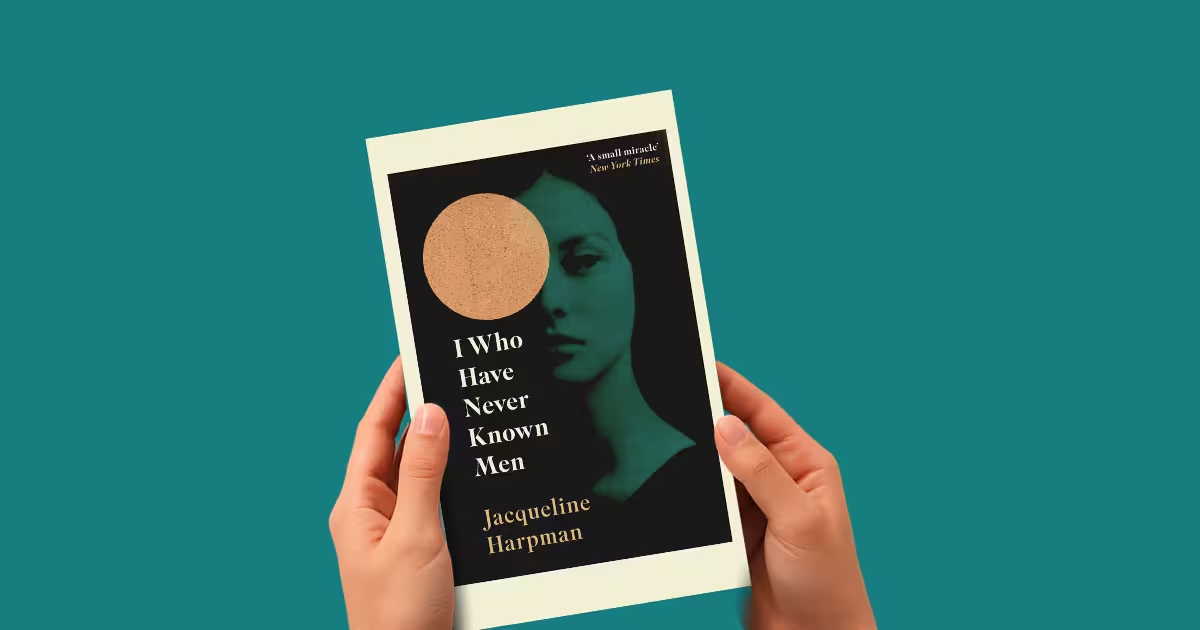

Did you ever wonder what it would feel like to become fully human only in the very last month of your life — after everyone who could have loved you back was already dead? That is the question I carried with me long after I closed Jacqueline Harpman’s I Who Have Never Known Men, and it is the question I want to put to you before you read another word.
Best idea in a sentence: A nameless woman, raised in an underground cage with no memory of a “before,” writes the story of her own life in the final weeks before her death, and in doing so becomes the only fully realised human being in a world that has otherwise gone completely silent.
I Who Have Never Known Men is best for readers who loved the quiet devastation of Never Let Me Go, anyone drawn to slow, philosophical post-apocalyptic fiction, fans of unreliable or “blank slate” narrators, and readers who want a book that will not leave them after the last page.
Not for readers who need a tidy, fully explained ending, anyone looking for action-driven dystopia in the vein of The Hunger Games, or readers currently in a fragile emotional state, since this is, by design, one of the bleakest reading experiences in contemporary fiction.
Table of Contents
Introduction
I Who Have Never Known Men is a 1995 novel by the Belgian writer Jacqueline Harpman, originally published in French as Moi qui n’ai pas connu les hommes.
The English translation by Ros Schwartz first appeared in 1997 under the title The Mistress of Silence, before being reissued by Vintage in 2019 under its now-famous title, with an introduction by Sophie Mackintosh. It is a slim novel, barely 190 pages, yet it carries the weight of a much longer book.
According to The New Yorker, after the rights moved to the small American publisher Transit Books, the novel found an enormous new readership on TikTok, and a single reissue sold 100,000 copies in the United States in 2024 alone.
Background
Harpman was born in Etterbeek, Belgium, in 1929, and as a child she fled with her Jewish family to Casablanca when the Nazis invaded, only returning home after the war.
She trained briefly to be a doctor before tuberculosis ended that path, turned to writing in the 1950s, and later, in 1980, qualified as a psychoanalyst.
That dual background, a refugee’s memory of senseless confinement and a clinician’s eye for the mechanics of grief, sits underneath every page of this novel, even though I Who Have Never Known Men never once mentions the Holocaust by name.
As Sophie Mackintosh notes in her introduction to the Vintage edition, it is genuinely difficult to read the sirens, the cracking whips, and the unexplained imprisonment of these forty women without thinking of concentration camps, even though the novel keeps its setting deliberately, almost cruelly, unplaceable.
I Who Have Never Known Men Summary
I Who Have Never Known Men opens not at the beginning of the story but near its very end. Our narrator, an old woman now, tells us that she has just experienced something entirely new to her: grief so powerful it made her sob for the first time in her life.
She had been thinking of Anthea, the woman who raised her, and the realisation crashes over her: she has, after all, “loved,” and is therefore, after all, “human.” It is this single emotional shockwave that pushes her to do something she has never attempted: write down her own story, “as important as that of King Lear,” before she runs out of time.
She tells us plainly that her tale is now finished, that it took her exactly one month to write, and that this has perhaps been the happiest month of her strange life. We do not know yet why. We will, by the end.
From there, she takes us back to the only life she has ever known: a cage, deep underground, holding forty women, controlled by guards who never once spoke to them in twelve years.
The narrator is the fortieth and youngest prisoner, “the child” to everyone else, a girl whose body never fully matured into womanhood and who has no memory whatsoever of a life before the cage.
The other thirty-nine women remember husbands, children, and the ordinary texture of a world that no longer exists for them. She remembers nothing but repetition: eating, sleeping, the same identical days stacking endlessly on top of one another, until, as she puts it, she “began to think, and everything changed.”
What follows is one of the most quietly devastating coming-of-age sequences in modern fiction, made all the stranger by the fact that it unfolds inside a cage. The narrator becomes fixated on the youngest of the six male guards, the only one who is not “old and decrepit.”
Starved of any real information about love, sex, or desire, she invents elaborate fantasy scenarios in her head, imagining interrogations that never happen, imagining the guard pulling her into his arms and saying, “Don’t be afraid.”
She describes, in language that is almost clinical in its precision, the first stirrings of her own sexuality, an “eruption” she has to work increasingly hard to recreate because surprise, she discovers, is essential to the fantasy actually working.
It is one of the most nakedly honest depictions of adolescent desire I have ever read, made unbearably poignant by the fact that this girl will never act on any of it, will never touch another human being romantically in her entire life.
Then, without warning, a siren blares through the bunker.
The guards, panicking, flee through the main doors and simply never come back. In the chaos, the narrator, faster and more instinctive than the older women, snatches the dropped keyring and unlocks the cage.
What follows is one of the great moments of release in contemporary fiction: she races up a hundred-step staircase she didn’t know existed, feeling, in her own words, “weightless, floating, in an exhilarating ascent towards the undreamed-of unknown.” At the top, she bursts out into daylight for the first time in her life. It is drizzling. She has never felt rain.
What greets the women is not freedom in any recognisable sense, but an empty, alien plain, “vast” and “unbroken,” with no mountains, no cities, no sign of any human settlement.
There is no town nearby, as Anthea had assumed there must be.
There is only flat, featureless wilderness in every direction. The women, exhilarated at first, slowly realise something far worse than continued imprisonment: there may be no one left at all. As they wander, they find other bunkers, exactly like their own, holding the mummified corpses of other women who never escaped.
They find a road, and on it, a rusted bus containing twenty-three dead male guards, all in uniform, all dead in their seats as though death had struck instantly and without warning, “without being in the least aware of their last heartbeat.” There is no explanation given anywhere in I Who Have Never Known Men for what happened to this world.
The women never learn why they were imprisoned, who built the bunkers, or whether they are even still on Earth, since the seasons never change and the sky offers no answers.
Faced with this unsolvable mystery, the women do the only thing they can: they walk. For years, then decades, they cross the plain in search of a city, a road, anything resembling the world they remember.
And one by one, inevitably, they begin to die. Dorothy is the first, refusing to be left behind even as her heart fails, insisting, “I want to keep going until my last breath.”
She dies being carried on a makeshift stretcher, and the women bury her by torchlight in a fine drizzle. Mary-Jane develops what Anthea recognises as cancer and ultimately hangs herself rather than continue suffering. Anna becomes paralysed and silently begs, with her one working eye, for someone to end her pain.
It falls to the narrator, the one woman among them with no cultural or religious horror of the act, to take up the knife. Anthea teaches her exactly where to place the blade, between the ribs, three fingers down from the collarbone, and the narrator performs what can only be called acts of mercy on woman after woman, feeling each time, in her words, that “at that moment, they loved me.”
Eventually, only Anthea, Frances, Denise, Laura, and the narrator remain. Frances breaks her legs and asks to be killed immediately rather than endure the pain of a slow recovery she will never have.
Then it is Anthea’s turn.
In I Who Have Never Known Men‘s most quietly shattering chapter, Anthea, dying slowly of grief and exhaustion rather than any single illness, asks the narrator to hold her, something she knows the younger woman finds almost physically unbearable.
“I have loved you so much,” Anthea tells her, before drifting into a sleep from which she never wakes. The narrator holds her anyway, exactly as she was asked, and tells us she “didn’t know exactly when she stopped breathing.”
Only Laura is left. Eventually, Laura simply fades, sitting on a bench at sunset, her mind slipping backward into memories that no longer connect to anything, until her breathing becomes the only sign of life left in her body.
When even that stops, the narrator tells us simply: “My last tie had been cut.” She has now been completely alone for years.
I Who Have Never Known Men‘s final chapters bring us back to where it began. Three months before the moment of writing, the narrator discovers she is bleeding from her uterus, an organ that never functioned normally because she never went through puberty.
She recognises the symptoms Anthea once described as belonging to Mary-Jane’s cancer, and she knows, with the same clear-eyed acceptance she has applied to every death she has witnessed, exactly what is coming for her. Rather than wait for the disease to finish its work, she chooses the manner of her own ending.
She sharpens a knife. She arranges cushions so her body will be found sitting upright, “with dignity.” She finishes her manuscript, addressed to a reader she does not believe will ever exist, because she is not even certain humanity itself survived whatever catastrophe emptied this world.
And then comes the line that the entire 188 pages have been quietly building toward, the line that explains the title itself: “It is strange that I am dying from a diseased womb, I who have never had periods and who have never known men.”
She closes the door behind her one last time, and I Who Have Never Known Men ends.
I Who Have Never Known Men Analysis
I Who Have Never Known Men Characters
The narrator herself is one of the most unusual protagonists in modern literature precisely because she is, by design, incomplete.
She has no name; even the women who raised her never learn it, and I Who Have Never Known Men never gives her one in nearly two hundred pages. She counts everything obsessively, her heartbeats, the steps of the staircase, the letters in a book’s title, as if number itself is the only stable language available to someone with no shared cultural memory to draw on.
What makes her so compelling is the slow, hard-won arc of her interiority. In the I Who Have Never Known Men‘s opening pages (chronologically its emotional climax), she is stunned to discover she can grieve at all.
By its final pages, she has performed acts of euthanasia on at least a dozen women she loved, has built shelters, has learned to read, has buried every single person she ever knew, and has, in her own final analysis, become “human after all.”
Her development is not toward warmth in any conventional sense, she remains someone who finds physical touch “revulsion,” but toward something arguably rarer: full, unflinching self-knowledge.
Anthea functions as the narrator’s true mother figure, the woman who teaches her to read, explains menstruation, cancer, religion, and the very concept of a soul.
Her death scene, asking to be held by the one person she knows finds touch nearly unbearable, is the emotional hinge of the entire novel; it is the moment that, decades later, triggers the narrator’s first tears and the decision to write this book at all.
Dorothy and Greta, among the older women, represent two different responses to the unbearable: Dorothy’s fierce, almost violent refusal to stop moving even as her body fails her, and Greta’s quieter, more philosophical resignation to a world she correctly intuits she will never understand.
Laura, the narrator’s final companion, is perhaps the saddest figure of all precisely because so little is said about her; her slow fade into a waking absence, watched in real time by the narrator on a bench at sunset, is one of the most understated death scenes I have ever read, and it lands harder for its restraint.
I Who Have Never Known Men Themes and Symbolism
The cage itself is the novel’s central, almost too-obvious symbol, but Harpman is too sharp a writer to leave it there. The genius of I Who Have Never Known Men is that escaping the cage solves nothing.
The women trade one kind of imprisonment, four walls and bars, for another, an endless, featureless plain with no exit at all. As Sophie Mackintosh writes in her introduction, the world above ground is “pared down to the point of frustration,” its landscape “owing as much to Beckett as it does to Bradbury.”
Freedom, in this novel, is not liberation; it is simply a larger, slower kind of dying.
Counting and naming function as the narrator’s entire intellectual architecture.
Denied language, history, or names of her own, she clings to numbers as the one system of meaning available to her, and it is genuinely moving to watch her apply that same counting impulse to grief itself in the final chapters, admitting she does not know how many women she killed because, for once, “that was one thing I didn’t count.”
Silence, too, recurs constantly, not just the literal silence of an empty planet, but the narrator’s own loss of speech by the novel’s final pages: she tells us she can only “produce a raucous croak that doesn’t travel far,” and wonders aloud “what does it matter if I’ve become mute in a world where there is no one to talk to?”
I Who Have Never Known Men, then, is also secretly about the necessity of being witnessed, and what happens to language itself when there is no longer anyone left to receive it.
I Who Have Never Known Men Evaluation
I Who Have Never Known Men is not a comfortable book, and it does not want to be. It is, in my view, one of the most quietly devastating character studies published in the last thirty years, precisely because it refuses every easy exit a lesser novel would have reached for.
Strengths: Harpman’s restraint is I Who Have Never Known Men‘s single greatest asset.
She never explains the catastrophe that emptied this world, and that refusal is what makes the novel timeless rather than dated; this could be any apocalypse, anywhere, which is exactly the point.
The prose, in Ros Schwartz’s translation, is plain almost to the point of austerity, yet it carries enormous emotional weight specifically because it never reaches for melodrama. The mercy-killing sequences in particular are written with a clarity that somehow makes them more unbearable, not less.
Weaknesses: The novel’s deliberate vagueness, never confirming whether this is Earth, never explaining the guards’ motives, never resolving the mystery of the bus full of dead men, will frustrate readers who need their fiction to tie off every loose thread.
The pacing in the middle third, as the women trudge across an unchanging plain for what feels like a genuinely long stretch of narrative time, mirrors the characters’ own exhaustion almost too well; it is intentional, but it is also, at times, genuinely difficult to sit through.
Impact: What stayed with me longest was not the dystopian premise but the frame narrative itself: a woman writing her entire life story in a single month, for a reader she doesn’t believe exists, simply because she has just discovered, in the last weeks of her life, that her story is “as important” as anyone else’s.
That is not a dystopian idea. That is one of the most quietly radical statements about human dignity I have read in years.
Comparison with similar works: Reviewers consistently reach for Margaret Atwood’s The Handmaid’s Tale and Christina Dalcher’s Vox when discussing this book, but those comparisons undersell it.
This novel has far more in common, structurally and tonally, with Kazuo Ishiguro’s Never Let Me Go: both feature narrators who only gradually come to understand the full horror of their own circumstances, both are studies in restraint rather than spectacle, and both ultimately argue that dignity and love can exist inside even the most constrained life imaginable.
Personal Insight: Why This Book Matters Right Now
The theme that has stayed with me longest is not the dystopia at all; it is the question of what we owe to a life that no one else will ever fully witness.
We are living through what public health researchers increasingly call a loneliness epidemic; the U.S. Surgeon General’s 2023 advisory on the subject documented a sustained, multi-decade decline in time Americans spend with friends and a corresponding rise in adults reporting they have no one to confide in.
Harpman’s narrator, alone for the final decades of her life with absolutely no guarantee anyone will ever read a word she writes, models something quietly radical in response to that exact condition: she writes her story anyway, for the simple reason that a witnessed life and an unwitnessed one are not the same thing, even if the witness never comes.
Five lessons I took from sitting with I Who Have Never Known Men
First, grief is proof of love, not a failure of strength; the narrator only discovers she is capable of love at the exact moment she discovers she can grieve, and the two turn out to be inseparable.
Second, dignity in dying matters as much as dignity in living; every single death in this novel, granted by the narrator’s own hand, is treated with the same careful reverence, and there is something genuinely instructive in that, particularly for anyone who has sat with a dying relative and wondered what mercy actually looks like in practice.
Third, the absence of an audience does not make a life meaningless; the narrator writes her story believing, quite reasonably, that no reader will ever come, and writes it anyway.
Fourth, identity can survive the total absence of culture, history, or names; this narrator has none of the usual scaffolding we assume a self requires, and she still, undeniably, becomes someone.
Fifth, and this is the one I keep returning to, curiosity is itself a form of survival; throughout the entire novel, even at her lowest, the narrator never stops counting, naming, and asking why, and that refusal to stop wondering is arguably what keeps her alive decades longer than logic would suggest she should be.
I Who Have Never Known Men Quotes
“For a very long time, the days went by, each one just like the day before, then I began to think, and everything changed.”
“I made the decision almost without realising it: I would do likewise… my story was as important as that of King Lear.”
“I was borne by an impulse so powerful that, had a guard appeared at that moment, even if he were twice my size, I’d have knocked him over and trampled him underfoot.”
“We’re outside,’ I replied, laughing. ‘And there isn’t a single guard. They’ve all gone.'”
“You told me that you’d be able to do it,” Anthea murmured. “I’ll do it,” I told her.
“I have loved you so much,” she told me.
“My last tie had been cut.”
“It is strange that I am dying from a diseased womb, I who have never had periods and who have never known men.”
Conclusion
I Who Have Never Known Men is, in the end, a book about what is left of a person once you strip away every single thing we usually assume makes us human: a name, a history, a culture, a family, even, eventually, language itself.
What remains, Harpman argues, with a clarity I found genuinely startling, is enough.
I would recommend this without hesitation to readers of literary dystopia, to anyone who loved the slow ache of Never Let Me Go, and to anyone who has ever wondered, quietly, whether a life lived mostly alone can still matter. It can. This short, devastating novel makes that case more persuasively than almost anything else I have read.


