
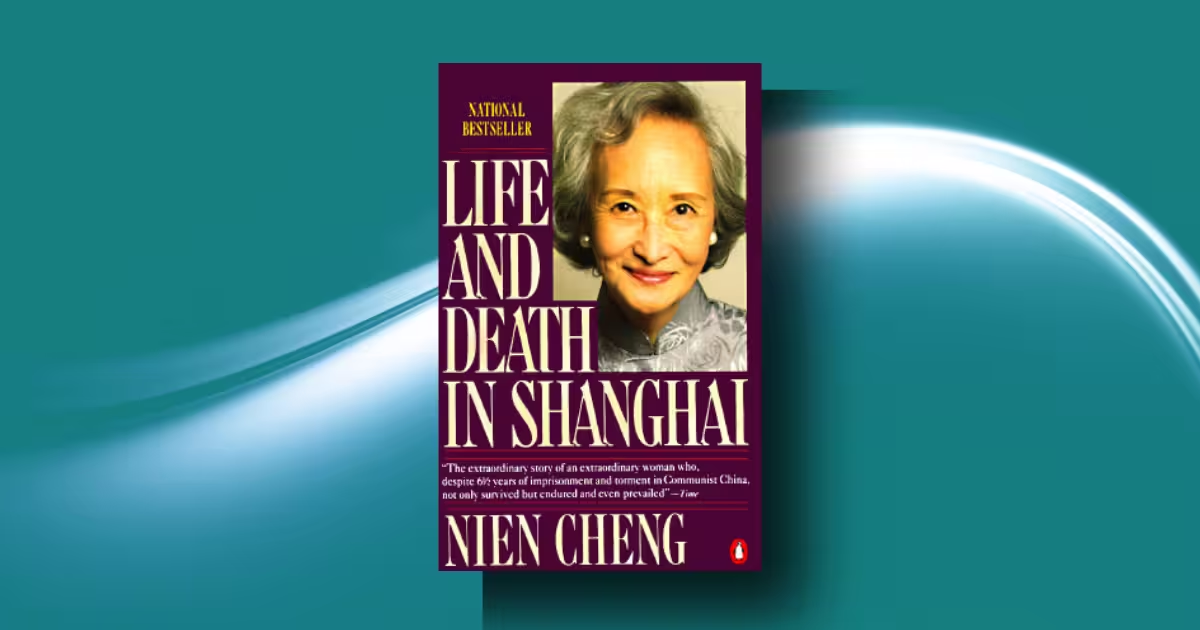
What does it take to survive a revolution that destroys not only your freedom, but your child, your home, and your identity? Life and Death in Shanghai answers that question with a courage that still shakes me years after reading it.
Life and Death in Shanghai rest forreaders interested in Chinese history, the Cultural Revolution, human rights, memoir, political repression, feminist resilience, grief narratives, and moral philosophy will find this book unforgettable.
It is ideal for students, researchers, journalists, activists, and anyone seeking to understand how authoritarian systems crush individual lives — and how individuals fight back with dignity.
Life and Death in Shanghai may be emotionally overwhelming for readers sensitive to themes of suicide, torture, psychological abuse, or state violence. Those seeking light reading or fictional escapism will likely find this too raw, too real, and too heavy.
Table of Contents
1. Introduction
Life and Death in Shanghai is a nonfiction memoir by Nien Cheng, first published in 1986 by Grove Press (ISBN: 978-0-8021-9615-6). The book is widely regarded as one of the most important firsthand accounts of China’s Great Proletarian Cultural Revolution (1966–1976).
Life and Death in Shanghai belongs to the genres of memoir, political history, Chinese studies, and human rights literature. It chronicles Nien Cheng’s six and a half years of imprisonment and persecution in Shanghai during Mao Zedong’s Cultural Revolution — a period that historians estimate caused 1.5 to 2 million deaths, and persecuted over 100 million people across China.
Nien Cheng was not a political activist. She was a widow, a mother, and a former senior executive at Shell Oil in Shanghai — a woman who believed in law, civility, and personal integrity. Her world collapsed overnight when the Red Guards arrived.
As she writes in her Author’s Note:
“This book is a factual account of what happened to me during the Cultural Revolution. The events are recorded in chronological order, just as they occurred… Every word spoken at the time… was vitally important. Indeed, my survival depended on what was said to and by me.”
The central argument of Life and Death in Shanghai is not merely that the Cultural Revolution was brutal — that is already historically established — but that totalitarian ideology annihilates truth, morality, and humanity, and that individual conscience is the final line of defense against systemic evil.
Life and Death in Shanghai is not a political manifesto; it is a moral document.
2. Historical and Political Context
To understand Life and Death in Shanghai, we must understand the Cultural Revolution.
In May 1966, Mao Zedong launched the Great Proletarian Cultural Revolution to purge “bourgeois” elements and reassert ideological control. What followed was a decade of chaos:
- Universities closed.
- Intellectuals were humiliated, beaten, imprisoned, or killed.
- Families were torn apart.
- Children denounced parents.
- Suicide rates soared.
- Property was confiscated.
- Truth became treason.
According to Chinese official figures released after Mao’s death, over 1.7 million people died, though independent historians place the number much higher. Millions more were tortured, displaced, or driven to suicide.
Shanghai, China’s most cosmopolitan and intellectual city, became a central battleground. Former professionals, foreign-educated elites, artists, and business leaders were among the first targets.
Nien Cheng belonged to this class.
3. Life and Death in Shanghai Summary
🔹 Part I: The Wind of Revolution
Chapter 1: Witch-hunt
The story opens in July 1966, when Nien Cheng’s peaceful life in Shanghai abruptly collapses. She is a widow living with her daughter Meiping, maintaining a refined household that symbolizes a bygone China.
She describes her home as:
“An oasis of comfort and elegance in the midst of the city’s drabness.”
That oasis becomes a crime.
Red Guards storm her house, vandalize her belongings, and publicly humiliate her. Her books — symbols of thought and learning — are burned in her garden:
“I saw that a bonfire had been lit in the middle of the lawn. The Red Guards were standing around the fire carelessly tossing my books onto the flames. My heart tightened with pain.”
This is not just destruction of property; it is destruction of identity.
Chapter 2: Interval Before the Storm
After the initial raid, Cheng is placed under surveillance. She is neither arrested nor free — a limbo that mirrors the psychological cruelty of the Cultural Revolution.
She becomes hyper-aware of every movement, every word, every knock.
The political atmosphere becomes increasingly hostile. Newspapers scream slogans like:
“Hit back at the rightist wind of reversing the verdict of the Cultural Revolution!”
Truth is no longer a fact; it is a political position.
Chapter 3: The Red Guards
Cheng attempts to understand her persecutors. Instead of demonizing them, she reflects:
“Is it not true that we all possess some destructive tendencies in our nature? The veneer of civilization is very thin. Underneath lurks the animal in each of us.”
This passage reveals the moral depth of the book: Cheng does not write from hatred but from moral clarity.
Chapter 4: House Arrest
She is confined to her home. Friends disappear. Servants are interrogated. Isolation sets in.
Yet even in confinement, Cheng refuses to lie or fabricate confessions — a decision that will cost her years of imprisonment but save her soul.
🔹 Part II: The Detention House
Chapter 5: Solitary Confinement
Cheng is arrested and placed in solitary confinement in late 1966. The cell is small, cold, and windowless. She is denied books, paper, or contact with the outside world.
She becomes ill. She bleeds uncontrollably. She is denied medical care until she nearly dies:
“That night, I had the worst hemorrhage ever. In a short while, all the toilet paper and towels in the cell were used up; there was blood everywhere, even on the cement floor.”
This is not incidental cruelty; it is structural.
Chapter 6: Interrogation
Cheng is interrogated repeatedly, accused of being a spy, an imperialist collaborator, and a traitor — all because she worked for Shell Oil and her late husband served the Nationalist government before 1949.
Her interrogators demand confession.
She refuses.
One exchange captures the absurdity and terror of ideological interrogation:
“You must assume a more sincere attitude and make a determined effort to emulate Tao Feng and do your best to reform.”
“I’m not aware of any wrongdoing on my part.”
In Maoist China, innocence is guilt.
Chapter 7: The January Revolution and Military Control
The political situation worsens as radical factions battle for control. The military intervenes. Fear intensifies. Arbitrary violence becomes normalized.
Cheng remains in detention — not because of evidence, but because she refuses to submit ideologically.
Chapter 8: Party Factions
She begins to understand the internal power struggles within the Communist Party — especially the influence of Jiang Qing, Mao’s wife, and the radical faction known as the Gang of Four.
Political purges are no longer about ideology — they are about power.
Chapter 9: Persecution Continued
Her health deteriorates. She is hospitalized under guard, surrounded by other prisoners:
“Their pathetic appearance, dejected air, and bowed heads reminded me forcefully that I was just like them, a nonperson without any rights, quite unable to control my own fate.”
This sentence is not metaphorical — it is literal.
Chapter 10: My Brother’s Confession
Cheng’s brother is forced to “confess” fabricated crimes to protect himself. The regime weaponizes family bonds.
She learns that truth is irrelevant; survival depends on submission.
Chapter 11: A Kind of Torture
Cheng endures psychological torture — sleep deprivation, isolation, uncertainty, humiliation — far more destructive than physical violence.
She reflects that the most devastating torture is not pain, but meaninglessness.
Chapter 12: Release
After more than six years of detention, she is released — not because she is innocent, but because she is ill and politically inconvenient.
Her release is conditional and temporary.
🔹 Part III: My Struggle for Justice
Chapter 13: Where Is Meiping?
Upon release, Cheng is informed — coldly, bureaucratically — that her daughter Meiping is dead.
“She jumped out of the ninth-floor window of the Shanghai Athletics Association building on Nanjing Road in the early morning of June 16, 1967.”
The regime claims suicide. Cheng does not believe it.
Her daughter had been taken for “questioning.” She was 24 years old.
This moment is the emotional core of Life and Death in Shanghai.
Cheng’s grief is unspeakable. Yet she does not collapse. She does not retreat. She decides to seek the truth — not for revenge, but for justice.
Chapter 14: The Search for the Truth
Cheng begins a quiet, methodical investigation into her daughter’s death.
She interviews friends, colleagues, witnesses. She reconstructs Meiping’s final days.
She learns that Meiping was harassed, threatened, and psychologically tortured. The so-called “suicide” was, in truth, state-induced death.
Yet no one will acknowledge responsibility.
This chapter is one of the most devastating portrayals of bureaucratic cruelty I have ever read.
Chapter 15: A Student Who Was Different
Cheng becomes a teacher of English — ironically to young radicals who had once supported the very system that destroyed her life.
One of her students, Da De, becomes both confidant and political informant.
Through him, she learns about internal power struggles, the manipulation of ideology, and the moral emptiness of revolutionary rhetoric.
“The name Da De means ‘great virtue.’ I couldn’t think of anyone I had ever known who was more indifferent either to virtue or to vice.”
This irony is devastating.
Chapter 16: The Death of Mao
Mao Zedong dies on September 9, 1976.
The Cultural Revolution collapses soon after.
Political winds shift. The Gang of Four is arrested. Rehabilitation of victims begins.
For Cheng, this marks the end of one nightmare — and the beginning of another: the long struggle for justice.
Chapter 17: Rehabilitation
In November 1978, twelve years and two months after her arrest, Cheng is officially rehabilitated.
“I was officially rehabilitated and declared a victim of wrongful arrest and persecution.”
She is returned her bank deposits. Her name is cleared.
But her daughter is still dead.
Chapter 18: Farewell to Shanghai
Cheng attends her daughter’s memorial service at Longhua Crematorium.
“The memorial meeting for Meiping… was attended by over two hundred of her friends and fellow artists… The ceremony was simple and dignified… and she moved the audience to tears.”
This scene is both heartbreaking and redemptive.
Cheng finally leaves China.
She emigrates to the United States.
Her farewell to Shanghai is not just geographical — it is existential.
🔹 Epilogue
Cheng reflects on survival, justice, and memory.
She does not seek revenge.
She seeks truth.
She writes:
“My survival depended on what was said to and by me.”
And now, our moral survival depends on remembering her story.
4. Life and Death in Shanghai Analysis
Life and Death in Shanghai is not merely an outstanding memoir — it is one of the most morally important books I have ever read. It is devastating, precise, restrained, and utterly truthful.
Like The Gulag Archipelago or Night by Elie Wiesel, this book does not ask for sympathy. It demands moral reckoning.
Does Cheng support her arguments effectively?
Yes — through:
- Detailed chronology
- Verbatim dialogue
- Historical corroboration
- Personal testimony
- Psychological insight
Her narrative is precise and internally consistent. She never exaggerates. She never sensationalizes. She never manipulates emotion.
She simply records what happened — and lets the truth speak.
Does the book fulfill its stated purpose?
Absolutely.
Its purpose is not to tell a story — it is to bear witness.
As historian Jonathan Spence once wrote (paraphrased), China’s modern history is not just a political transformation but a moral catastrophe. Cheng’s book documents that catastrophe at the human level.
It contributes meaningfully to:
- Chinese historical memory
- Human rights discourse
- Feminist resilience narratives
- Studies of totalitarian psychology
- Trauma and grief literature
5. Strengths and Weaknesses
Strengths
Unparalleled authenticity — This is not reconstructed memory; it is lived truth.
Moral clarity — Cheng never compromises truth, even when it costs her everything.
Psychological depth — Life and Death in Shanghai explores not only what happened, but what it did to the human soul.
Historical importance — It is one of the most reliable firsthand accounts of the Cultural Revolution.
Literary restraint — The prose is elegant, precise, and devastating in its simplicity.
Weaknesses
Emotionally overwhelming — This is not an easy read.
Limited political theory — Life and Death in Shanghai does not deeply analyze ideology at a theoretical level (though it does not need to).
Narrow scope — The story is intensely personal; readers seeking a panoramic national history may want supplementary sources.
However, none of these diminishes the book’s power — they define it.
7. Comparison with Similar Works
- The Gulag Archipelago by Aleksandr Solzhenitsyn — Similar in exposing totalitarian repression, but Cheng’s narrative is more intimate and less ideological.
- Wild Swans by Jung Chang — Both depict Chinese political trauma, but Cheng’s account is more psychologically intense and legally precise.
- Man’s Search for Meaning by Viktor Frankl — Both explore survival under oppression, but Cheng’s work is less philosophical and more judicial.
- Red Scarf Girl by Ji-li Jiang — A youthful perspective on the Cultural Revolution; Cheng offers the adult, maternal, legal, and moral view.
8. Conclusion
Life and Death in Shanghai is essential reading for:
- Students of Chinese history
- Human rights advocates
- Feminist scholars
- Political scientists
- Journalists
- Philosophers
- Anyone who believes truth matters
Life and Death in Shanghai is not merely informative — it is transformative.
It teaches us that:
- Totalitarianism destroys truth.
- Silence enables injustice.
- Survival without integrity is not survival.
- Memory is resistance.
I did not finish this book the same person who started it.







