
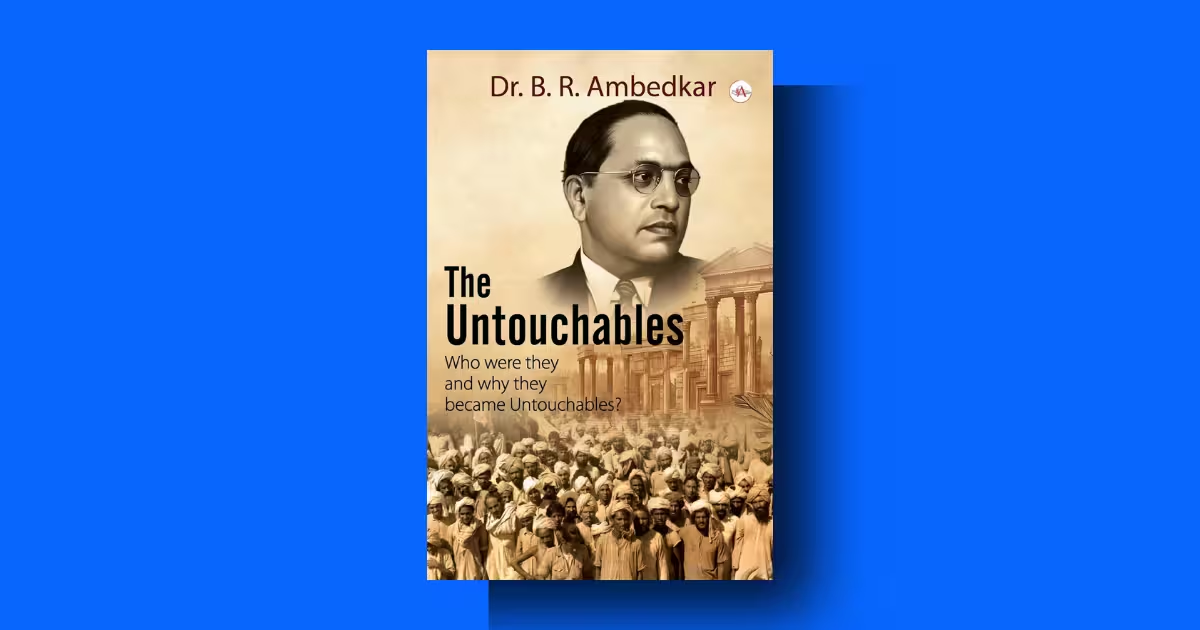

The Untouchables by B. R. Ambedkar asks one of the most difficult questions in the history of Indian society: who were the Untouchables, and how did untouchability become a permanent social institution? Rather than simply describing caste discrimination, Ambedkar investigates its possible historical origins, examining village segregation, the idea of “Broken Men,” Buddhism, beef-eating, and the distinction between temporary impurity and hereditary untouchability.
His argument is provocative, and he openly acknowledges that parts of his reconstruction rely on inference and hypothesis because the historical evidence contains missing links.
Table of Contents
Snapshot
The Untouchables: Who Were They and Why They Became Untouchables? is B. R. Ambedkar’s historical investigation into the origins of untouchability. The book asks why certain communities became permanently separated from other sections of Indian society and why Untouchables traditionally lived outside the village.
Ambedkar’s central thesis has several parts. He argues that the distinction between Hindus and Untouchables did not originate in racial difference or occupation.
Instead, he proposes that the Untouchables developed from “Broken Men” associated with alien tribes and that two major forces contributed to their later treatment as Untouchables: hostility toward Buddhist communities and the continued consumption of beef after other groups had abandoned it.
The book also distinguishes Untouchability from ordinary impurity, arguing that the former became hereditary and permanent. Ambedkar examines the separation of Untouchable communities from village settlements as a crucial part of the historical problem.
Importantly, Ambedkar does not present his historical reconstruction as the final possible explanation. He acknowledges missing evidence and says that his argument sometimes uses inference, circumstantial evidence and hypothesis to connect gaps in the historical record.
In one sentence: The Untouchables is Ambedkar’s attempt to reconstruct how a temporary social distinction became hereditary untouchability, focusing particularly on Broken Men, Buddhism, beef-eating and village segregation.
The book was dedicated to the untouchable saints Nandnar, Ravidas, and Chokhamela. Ambedkar’s thesis remains one of the most radical interventions in Indian social history, and it has only grown more relevant as Dalit scholars continue to debate its implications.
Introduction
The God Equation of caste is that some people were born to be polluted by other people’s shadows. That is the equation. Not a metaphor, not a poetic exaggeration. In the India Ambedkar wrote about in 1948, roughly 50 to 60 million people fell into a category whose mere touch was considered defilement.
The Census Commissioner’s schedule listed 429 separate communities across nine provinces of British India, from the Adi-Dravida of Madras to the Pano of Orissa, all classified as untouchable.
Ambedkar’s The Untouchables: Who Were They and Why They Became Untouchables asks a question that most Indian historians of his time were content to avoid: how did this happen?
I came to this book through The Doctor and the Saint by Arundhati Roy. What struck me first was not the anger, though the anger is there. It was the method. Ambedkar did not simply assert that untouchability was unjust.
He went looking for its origin with the tools of a detective. He read Vedic hymns about cow sacrifice. He compared Irish Brehon laws and Welsh village customs. He looked at anthropometric data on nasal indices.
He asked why the Untouchables lived outside the village, and he refused to accept the easy answer that they had been expelled. The answer, he concluded, was that they had always lived outside—because they were not originally untouchable. They were broken men.
Context of The Untouchables
By 1948, B.R. Ambedkar was not a marginal figure. He was the chief architect of the Indian Constitution, independent India’s first law minister, and a man who had publicly declared in 1935 that though he was born a Hindu, he would not die as one.
He had already published Annihilation of Caste (1936) and Who Were the Shudras? (1946). The Untouchables was a sequel to the Shudras book, and Ambedkar says so explicitly in his preface.
He had intended it as part of a larger project on the three great marginalized classes of Hindu civilization: the Criminal Tribes, the Aboriginal Tribes, and the Untouchables. Only the third volume was completed.
The book was first published by Amrit Book Company in New Delhi and later included in Dr. Babasaheb Ambedkar: Writings and Speeches, Volume 7, released by the Education Department of the Government of Maharashtra in 1990.
The dedication page is telling: “To the memory of Nandnar, Ravidas, Chokhamela, three renowned saints who were born among the untouchables and who by their piety and virtue won the esteem of all.” Ambedkar was not writing as an outsider looking in.
He was writing as a member of the community whose history he was reconstructing.
The Untouchables Summary
Part I: Untouchability Is Not Unique to India, But Hindu Untouchability Is Unique
Ambedkar begins with a comparative survey. He looks at pollution beliefs among the Todas, the Polynesians, the Greeks, the Romans, the Hebrews. Every society he examines had some notion of defilement.
The Greeks purified themselves with lustral water, sulphur, and pig’s blood. The Romans performed lustratio rituals around their fields and city walls. The Hebrews considered contact with unclean animals a source of defilement. So the idea of pollution, Ambedkar argues, is universal.
What is not universal is hereditary, permanent untouchability imposed on an entire class. Primitive societies isolated individuals for specific periods—after birth, after death, after menstruation.
The impurity was temporary and curable. But the Hindu system made impurity permanent. “They are born impure, they are impure while they live, they die the death of the impure, and they give birth to children who are born with the stigma of Untouchability affixed to them”.
No purification rite could remove it. That, for Ambedkar, is the defining feature of Hindu untouchability.
Part II: Why the Untouchables Live Outside the Village
The second part of the book tackles what Ambedkar calls the “problem of habitat.” Why do the Untouchables live outside the village? The Shastras say they should. Manu X.51 commands that “the dwellings of the Chandalas and the Shvapakas shall be outside the village.” But Ambedkar points out that this verse can be read two ways.
It could mean that the Untouchables were always outside and the Shastra merely acknowledged the fact. Or it could mean that they were once inside and were later expelled.
Ambedkar rejects the expulsion theory outright. Transplanting 50 million people from inside villages to outside them would have required an emperor with absolute power over all of India.
No such emperor existed. Therefore, the Untouchables must have lived outside the village from the beginning—before they became untouchables. And the reason they lived outside was that they were Broken Men.
What is a Broken Man? Ambedkar borrows the term from Sir Henry Maine’s study of Irish Brehon law. When a tribe was defeated and scattered, its surviving members became “broken men”—strangers, fugitives, men who had lost their place in the tribal community. In Ireland they were called fuidhirs.
In Wales they were called alltudes. They lived on the outskirts of settled villages because they did not belong to the tribe that owned the village land. They were aliens by blood. The same process, Ambedkar argues, happened in India.
Part III: The Racial Theory Fails
Ambedkar then turns to the most popular explanation of untouchability in his time: race. The theory, advanced by writers like Stanley Rice, held that the Untouchables were non-Aryan, non-Dravidian aboriginals who had been conquered and subjugated. Ambedkar dismantles this theory with two kinds of evidence.
First, anthropometry. He quotes Prof. Ghurye’s data showing that the nasal index of the Chuhra (an Untouchable caste of Punjab) is closer to that of the United Provinces Brahmin than to many “higher” castes from the same region. The Brahmin of the United Provinces has closer physical affinities with the Chuhra than with any caste from his own province except the Chhatri.
If the Brahmins are Aryans, the Untouchables are Aryans. If the Brahmins are Dravidians, the Untouchables are Dravidians. There is no racial separation.
Second, totems. Ambedkar argues that the unit of Hindu society is not the sub-caste but the family organized around exogamous kul and gotra. In Maharashtra, the Marathas and the Mahars (the largest Untouchable caste of the region) share the same kul. In Punjab, the Jats and the Mazabi Sikhs share the same gotras. If they share totems, they share blood. The racial theory collapses.
Part IV: The Two Roots of Untouchability
Here Ambedkar makes his most original move. He identifies two roots from which untouchability sprang.
The first is contempt for Buddhists. Ambedkar argues that the Broken Men were originally Buddhists. They did not revere the Brahmins, did not employ Brahmin priests, and regarded the Brahmins as impure. The Brahmins, in turn, hated the Buddhists and preached contempt against them.
Nilkant’s Prayaschit Mayukha quotes Manu: “If a person touches a Buddhist… he shall purify himself by a bath.” Apararka’s Smriti repeats the doctrine. The Mricchakatika shows a Buddhist monk being beaten and insulted on the street. The hatred was real and widespread.
But contempt for Buddhists alone cannot explain why untouchability attached to the Broken Men specifically. After all, there were many Buddhists. The second root, Ambedkar argues, is beef-eating. The Broken Men ate beef. And beef-eating, in the Brahminical order, became the ultimate marker of pollution.
Part V: The Beef Question
Ambedkar knows this is the hardest part of his argument. Hindus will say they never ate beef. He shows that they did. The Rig Veda describes Indra cooking “fifteen plus twenty oxen” (X.86.14). The Taittiriya Brahmana prescribes the sacrifice of dwarf bulls, humpless bulls, and dwarf heifers.
The Ashvalayan Grahya Sutra describes in detail how, when a man died, an animal was killed and its parts were placed on the corresponding parts of the dead body. Madhuparka, the ritual offering to honored guests, required flesh—specifically cow’s flesh. The guest who received it was called go-ghna, “killer of the cow.”
The turning point came with Buddhism. Buddhist ahimsa made vegetarianism a virtue. The Brahmins, who had once sacrificed cows, adopted vegetarianism as a competitive strategy against Buddhism. But the Broken Men, already outside the Brahminical fold, did not give up beef. They continued to eat the dead cow. And that, Ambedkar argues, became the final seal of their untouchability.
The Untouchables Critique
The Untouchables is not a perfect book. Ambedkar himself admits that his thesis sometimes rests on inference rather than direct evidence. He writes in the preface: “It is a case of reconstructing history where there are no texts, and if there are, they have no direct bearing on the question”.
He compares his method to that of an archaeologist reconstructing a city from broken stones. That honesty is rare in historical writing, and it is one of the book’s strengths.
The weaknesses are real too. Ambedkar’s assumption that the Broken Men were Buddhists is just that, an assumption. He says so. “We have no direct evidence that the Broken Men were Buddhists,” he writes. The circumstantial case is strong, but it is circumstantial. Similarly, his reliance on anthropometric data from the 1920s and 1930s reflects the racial science of his time, even as he uses it to refute racial theories. Modern genetics has complicated the picture further.
Yet the book’s central insight—that untouchability is a historical invention, not a natural or racial fact—has never been seriously refuted.
The Beef, Brahmins, and Broken Men edition, published by Columbia University Press in 2020, describes Ambedkar’s work as a “forensic examination of a wide range of Brahminic literature” and notes that its urgency has only grown as India witnesses violence in the name of cow protection.
Strengths and Weaknesses
What works: The comparative method. Ambedkar’s use of Irish and Welsh parallels is genuinely illuminating. He shows that the separate settlement of broken men is not unique to India; it is a common feature of tribal societies transitioning to settled agriculture. What is unique is that in India the separation became permanent and hereditary.
What frustrates: The editing. Several Amazon reviewers have noted that some editions of this book suffer from rough redaction, with incomplete sentences and missing reasoning. T
he Columbia University Press edition, edited by Alex George and S. Anand with an introduction by Kancha Ilaiah Shepherd, is the most reliable version available.
Comparison with Similar Works
Ambedkar’s book sits alongside a small shelf of foundational anti-caste texts. Annihilation of Caste is more polemical, Who Were the Shudras? is more narrowly focused on the fourth varna, and Waiting for a Visa is autobiographical. The Untouchables is the most historically ambitious of the four. It is also the most methodologically risky.
If you want a contemporary scholarly engagement with Ambedkar’s thesis, the Columbia annotated edition is essential. If you want a broader history of caste, Isabel Wilkerson’s Caste draws on Ambedkar but is not a substitute for reading him directly.
Reader Recommendation
You will love it if: You are interested in the history of caste, the sociology of pollution, or the intellectual origins of Dalit politics. You will love it if you appreciate books that combine rigorous argument with moral urgency. You will love it if you want to understand why Ambedkar is not just a political icon but a serious historical thinker.
You will bounce if: You are looking for a light read, a memoir, or a purely devotional account of Ambedkar’s life. This is a dense, argumentative book. It assumes some familiarity with Vedic literature, Hindu law texts, and comparative anthropology. If those are not your interests, start with Annihilation of Caste or Waiting for a Visa first.
Who benefits most: Students of Indian history, sociology, and law. Activists working on caste and Dalit rights. Anyone who wants to understand why the practice of untouchability persists even after Article 17 of the Indian Constitution abolished it in 1950.
The numbers are sobering. In 2024, 975 untouchability cases were before Indian courts. Only 15 were decided. None ended in conviction.
The pendency rate was 98.5%. Ambedkar’s book explains the deep historical roots of a problem that law alone has not solved.
Conclusion
I finished The Untouchables with a strange feeling. Not sadness exactly. More like the feeling you get when you realize that a question you thought was settled, why do some people live outside the village?, was never really answered until someone had the courage to ask it properly.
Ambedkar asked it properly. He did not have all the evidence. He said so. But he built a case that has not been demolished. The Broken Men were not always untouchables.
They became untouchables. And understanding how that happened is the first step toward understanding why it still happens.





