
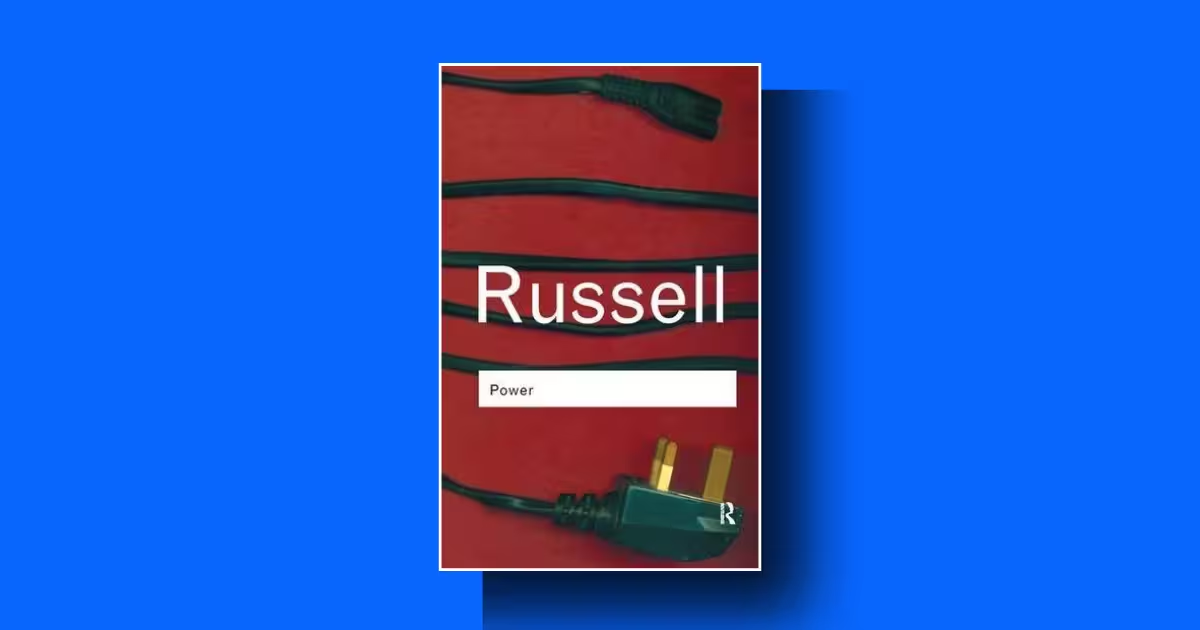
Bertrand Russell’s Power: A New Social Analysis argues that the fundamental concept in social science is power—not wealth, not sex, not class struggle. Written in 1938 as Europe crumbled under fascism and Stalinism, this book diagnoses humanity’s insatiable hunger for power and offers a sobering prescription: democracy, economic equality, and a radically reformed education system are our only defenses against the tyranny that Russell saw coming.
It is not a comfortable read. It is not a cheerful one. But it is essential.
Power is best for readers who want to understand why authoritarianism keeps rising, why democracies fail, and what power actually is. Political science students, history buffs, anyone troubled by the state of modern politics.
Not for readers seeking a practical step-by-step guide to revolution or reform. Russell diagnoses brilliantly but prescribes vaguely. If you want actionable political strategy, look elsewhere.
Table of Contents
1. Introduction
Book: Power: A New Social Analysis
Author: Bertrand Russell (1872–1970)
First Published: 1938 by George Allen & Unwin, London
Latest Edition: Routledge Classics, 2004 (with a new preface by Samuel Brittan and introduction by Kirk Willis)
Pages: 328
Bertrand Russell needs no introduction—but I will give one anyway.
He was a British philosopher, logician, mathematician, historian, writer, social critic, and political activist. He won the Nobel Prize in Literature in 1950. He was imprisoned during the First World War for his pacifist activities. He opposed both World Wars, nuclear weapons, and totalitarianism in all its forms.
By the time he wrote Power, he had already published Principia Mathematica (with Alfred North Whitehead), The Problems of Philosophy, and Marriage and Morals. He was one of the most famous intellectuals in the English-speaking world.
Context
Power: A New Social Analysis was published in October 1938—one month after the Munich Agreement. Hitler had annexed Austria. The Nazi regime was consolidating its grip on Germany. Stalin’s purges were at their peak. Mussolini’s fascism was a decade old. Franco was winning in Spain. Europe was sliding toward war.
Russell wrote this book not as an abstract philosophical exercise but as a warning. He saw totalitarianism rising everywhere and wanted to understand why.
His answer: because human beings are driven by an insatiable desire for power, and unless we understand this drive and build institutions to tame it, we are doomed to repeat the same horrors.
Purpose
Russell’s main objective is stated boldly in the first chapter:
“In the course of this book I shall be concerned to prove that the fundamental concept in social science is Power, in the same sense in which Energy is the fundamental concept in physics.”
This is a direct challenge to both classical economics (which treats wealth as primary) and Marxism (which treats class struggle and economic relations as primary). Russell argues that power is sui generis—it cannot be reduced to economics, military force, or propaganda.
Each form of power is real and irreducible, and they constantly flow into one another.
2. Background
To understand Power, you have to understand where Russell was coming from.
Russell grew up in the Victorian era, a time of liberal optimism. He believed in reason, science, and gradual progress. The First World War shattered that optimism. Russell opposed the war and was imprisoned for his views.
He watched as patriotic fervor—what he would later call “collective hysteria”—turned ordinary people into murderous mobs.
In the 1920s and 1930s, Russell watched fascism and communism rise. He saw that both movements appealed to the same human weakness: the desire to submit to a leader, to feel part of something bigger than oneself, to gain power through identification with a group.
Russell was not a naive liberal. He knew that power was necessary. Without government, there would be anarchy. But he also knew that power corrupts—not because rulers are evil, but because power itself changes people.
The question that haunted him was: How do we keep power from destroying us?
3. Power Book Summary
What I Learned From Reading Power
Russell’s book is divided into eighteen chapters. Let me walk you through the most important ideas.
Chapter 1: The Impulse to Power
Russell begins with a psychological observation: human desires are infinite. Animals are content with survival and reproduction. Humans are not. Russell writes:
“Between man and other animals there are various differences, some intellectual, some emotional. One of the chief emotional differences is that some human desires, unlike those of animals, are essentially boundless and incapable of complete satisfaction.”
Why? Because of imagination. We can imagine triumphs beyond our current reach. We can picture ourselves as gods. And this imagination drives us to seek power—not just enough power to survive, but more power, infinite power.
“Every man would like to be God, if it were possible; some few find it difficult to admit the impossibility.”
Russell identifies two chief infinite desires: Power and glory. They are not identical but closely allied. The Prime Minister has more power than glory; the King has more glory than power. But in practice, they reinforce each other.
Crucially, Russell rejects the economic determinism of both classical economics and Marxism:
“The orthodox economists, as well as Marx, who in this respect agreed with them, were mistaken in supposing that economic self-interest could be taken as the fundamental motive in the social sciences.”
Why? Because once basic needs are met, people pursue power for its own sake—not as a means to wealth, but as an end in itself.
Chapter 2: Leaders and Followers
Russell introduces a crucial distinction: the power impulse has two forms—explicit in leaders, implicit in followers.
Why do people follow leaders? Russell argues it is largely due to fear:
“The impulse of submission, which is just as real and just as common as the impulse to command, has its roots in fear.”
When people are afraid—of enemies, of chaos, of the unknown—they seek out a leader who promises protection. This is why wars and crises produce dictators. Russell draws on Alfred Adler’s psychology, distinguishing between “submissive” and “imperious” types, but adds his own twist: the great leaders are not driven by fear but by exceptional self-confidence.
Russell compares Cromwell, Lenin, and Napoleon.
Cromwell and Lenin were men of profound faith, believing themselves to be instruments of a cosmic purpose. Napoleon was a soldier of fortune, driven by personal ambition. Hitler, Russell writes (in 1938!), must be classed psychologically with Cromwell and Lenin; Mussolini with Napoleon.
Chapter 3: The Forms of Power
Russell defines power simply:
“Power may be defined as the production of intended effects.”
He then classifies power over human beings into three categories:
- Direct physical power—imprisonment, killing, military force.
- Rewards and punishments—economic incentives, employment.
- Influence on opinion—propaganda, education, persuasion.
Russell introduces a key distinction between traditional, revolutionary, and naked power:
- Traditional power rests on habit and custom. It does not need to justify itself constantly. It is stable but can perpetuate injustice.
- Revolutionary power depends on a large group united by a new creed—Protestantism, Communism, nationalism.
- Naked power is power based solely on force, without any acquiescence from the subject.
“Naked power is usually military, and may take the form either of internal tyranny or of foreign conquest.”
Chapter 4: Priestly Power
Russell turns to history. He examines the power of priests—from primitive medicine men to the Catholic Church at its height.
The Catholic Church, Russell argues, was the most powerful priestly organization in history. Why? Because it combined two traditions: Christianity and the Roman Empire. It had a consistent purpose, a higher level of civilization, and the only organization that spanned Western Europe.
Russell traces the rise of papal power from Gregory VII (Hildebrand) in the 11th century to the Avignon papacy in the 14th. The Church’s power was based on moral authority—but that authority was eventually destroyed by its own abuses:
“To an organisation which has ideal ends, and therefore an excuse for love of power, a reputation for superior virtue is dangerous, and is sure, in the long run, to produce a superiority only in unscrupulous ruthlessness.”
Chapter 5: Kingly Power
Russell traces the evolution of kingship from primitive chiefs to absolute monarchs. He notes that kingship, like priesthood, depends on tradition and religion. The king is not just a ruler; he is a sacred person—“the Lord’s anointed”.
But kingship has inherent weaknesses. Hereditary succession produces incompetent rulers. Dynastic wars tear kingdoms apart. And kings become isolated from reality, surrounded by courtiers who tell them only what they want to hear.
“Kings can no longer lead in battle because they are too sacred; they cannot be told unpalatable truths, because they would execute the teller. In time they become mere symbols, and some day people wake up to the fact that they symbolise nothing of any value.”
Chapter 6: Naked Power
This is one of the most gripping chapters. Russell defines naked power as power that “involves no acquiescence on the part of the subject”. It is the power of the butcher over the sheep, of an invading army over a vanquished nation, of the police over conspirators.
Russell illustrates naked power with two historical case studies: Greek tyranny and Renaissance Italy.
He recounts the career of Agathocles, tyrant of Syracuse (361–289 BC). Agathocles rose from humble origins, betrayed everyone who trusted him, murdered his political opponents, and ruled through terror. Russell quotes the ancient historian Diodorus:
“Nay, there was no safety even to them that fled to the temples under the shelter of the gods; but piety towards the gods was crushed and borne down by the cruelty of men.”
Russell then turns to Cesare Borgia and Renaissance Italy. He quotes the historian Creighton:
“Most men in Italy accepted as sufficient Cesare’s remark to Machiavelli: ‘It is well to beguile those who have shown themselves masters of treachery.’ Cesare’s conduct was judged by its success.”
Russell draws a chilling parallel between these periods and his own time:
“Periods of naked power are usually brief. They end, as a rule, in one or other of three ways. The first is foreign conquest… The second is the establishment of a stable dictatorship… The third is the rise of a new religion.”
Chapter 7: Revolutionary Power
Russell examines four historical examples of revolutionary power:
- Early Christianity—which taught that “we ought to obey God rather than man,” weakening the State in favor of the Church or individual conscience.
- The Reformation—which weakened the Church and strengthened the State.
- The French Revolution and Nationalism—which introduced the doctrine of the Rights of Man.
- Socialism and the Russian Revolution—which amalgamated political and economic power.
Russell observes that revolutionary power tends to degenerate into naked power:
“Revolutionary power, as the case of Napoleon shows, is very apt to degenerate into naked power. The clash of rival fanaticism… is distinguished, it is true, from naked power by the fact that it is a group, not an individual, that seeks power, and that it seeks it, not for its own sake, but for the sake of its creed.
But since power is its means, and in a long conflict the end is apt to be forgotten, there is a tendency… for fanaticism to become gradually transformed into the mere pursuit of victory.”
Chapter 8: Economic Power
Russell argues that economic power is derivative, not primary. It depends on law, and law depends on military force.
“Apart from the economic power of labour, all other economic power, in its ultimate analysis, consists in being able to decide, by the use of armed force if necessary, who shall be allowed to stand upon a given piece of land and to put things into it and take things from it.”
He traces the ownership of land back to conquest.
The farmer pays rent because the land “belongs” to the landowner—and the landowner’s title ultimately rests on force. The oil of Persia belongs to the Anglo-Persian Oil Company because the British government is strong enough to enforce its claim.
Russell also notes the separation of ownership and control in modern corporations—a theme later developed by Berle and Means:
“In a modern large corporation, ownership and power are by no means necessarily combined.”
Chapter 9: Power Over Opinion
Russell examines propaganda and the power of ideas. He notes that opinion is often the result of force, not its cause:
“While it is true that opinion is an essential element in military force, it is equally true that military force may generate opinion.”
But Russell also defends the power of reason. He points to the rise of science as an example of persuasion without force:
“The men of science proved to intelligent laymen that a certain kind of intellectual outlook ministers to military prowess and to wealth; these ends were so ardently desired that the new intellectual outlook overcame that of the Middle Ages.”
Chapter 10: Creeds as Sources of Power
Russell asks: does fanaticism make a nation stronger? His answer is mixed.
He cites the classic example of Islam: Mohammed’s fanaticism united the Arabs and led to conquest. But Russell notes that fanaticism faded quickly—the Caliphate soon became latitudinarian and tolerant.
He also cites the failure of fanaticism: the destruction of Jerusalem, the fall of Constantinople, the decay of Spain.
Russell’s conclusion is balanced:
“Social cohesion demands a creed, or a code of behaviour, or a prevailing sentiment… but if this means of cohesion is to be effective, it must be very deeply felt.”
Chapter 11: The Biology of Organisations
Russell treats organizations as organisms with a life of their own. They tend to grow in size and in “density of power”—the degree of control they exert over members.
He notes that modern technology—railways, telegraphs, aeroplanes—has made large empires more stable than in ancient times. A revolt in the Sahara can now be quelled within hours.
“A World State is now a technical possibility, and might be established by a victor in some really serious world-war.”
Chapter 12: Powers and Forms of Governments
Russell compares monarchy, oligarchy, and democracy. He is no starry-eyed democrat:
“The merits of democracy are negative: it does not insure good government, but it prevents certain evils.”
He notes that democracy requires a readiness for compromise—and that this is difficult when people are afraid.
Chapter 13: Organisations and the Individual
Russell examines the impact of organizations on individual lives—from birth to death. He notes that, in many ways, organizations increase freedom. A Chinese peasant, he observes, has far less freedom than an Occidental wage-earner.
But he also warns of the danger: organizations designed to prevent anarchy can become instruments of tyranny.
Chapter 14: Competition
Russell examines competition in economics, politics, and propaganda. He notes that competition tends to destroy itself—the strongest wins, creating monopoly.
He argues that the most important competition today is between States:
“The only way of ending this competition is the abolition of national sovereignty and national armed forces, and the substitution of a single international government with a monopoly of armed force.”
Chapter 15: Power and Moral Codes
Russell distinguishes between positive morality (the moral code enforced by society) and personal morality (the individual conscience). Positive morality, he argues, is often a tool of power:
“One of the purposes—usually in large part unconscious—of a traditional morality is to make the existing social system work.”
He traces how moral codes have reinforced the power of parents, husbands, kings, and priests. But he also notes that personal morality—the conscience of the individual—has been the source of every great moral advance.
Chapter 16: Power Philosophies
Russell critiques philosophies that are inspired by love of power. He targets Fichte, Nietzsche, and pragmatism.
Fichte—the German idealist—began from the ego and ended by arguing that Germans are superior to French. Russell dryly observes:
“Both the Germans and the French, of course, are only emanations of Fichte, but the Germans are a higher emanation, that is to say they are nearer to the one ultimate reality, which is Fichte’s own.”
Nietzsche—the prophet of the superman—rejected Christian morality as “slave morality” and advocated the rule of the hero. Russell notes that Nietzsche’s philosophy, if taken seriously, leads to war and tyranny.
Pragmatism—which defines truth as “what works”—is also a power-philosophy. If truth is what is pleasant to believe, then the powerful can make their own truth.
Chapter 17: The Ethics of Power
Russell argues that love of power is not inherently evil. It is the desire to produce effects—and this can be used for good as well as ill.
“If you love your neighbour, you will wish for power to make him happy. To condemn all love of power, therefore, is to condemn love of your neighbour.”
The key distinction is between power as a means and power as an end. The man who desires power as a means has some other goal—discovery, artistic creation, the happiness of others. The man who desires power as an end will choose his objectives by what is achievable.
Russell concludes:
“The ultimate aim of those who have power (and we all have some) should be to promote social cooperation, not in one group as against another, but in the whole human race.”
Chapter 18: The Taming of Power
Russell confronts the central problem: how do we tame power?
He identifies four conditions:
- Political conditions—democracy, the rule of law, protection of minorities.
- Economic conditions—state ownership of large industries, but with democracy, not instead of it.
- Propaganda conditions—freedom of speech, freedom of the press, exposure to multiple viewpoints.
- Psychological and educational conditions—education that promotes critical thinking, tolerance, and independence of mind.
Russell is blunt about the dangers of state socialism without democracy:
“To suppose that irresponsible power, just because it is called Socialist or Communist, will be freed miraculously from the bad qualities of all arbitrary power in the past, is mere childish nursery psychology: the wicked prince is ousted by the good prince, and all is well.”
He ends with a vision of education that produces citizens, not slaves:
“This is the task of a liberal education: to give a sense of the value of things other than domination, to help to create wise citizens of a free community, and through the combination of citizenship with liberty in individual creativeness to enable men to give to human life that splendour which some few have shown that it can achieve.”
4. Power Analysis
Let me be direct: Power: A New Social Analysis is a magnificent failure—and I mean that as a compliment.
It is a magnificent failure because Russell aimed so high. He wanted to found a new science of society, as Newton founded physics. He did not succeed. The book does not offer a systematic theory of power. It does not give us a new method of social analysis. It is, as many critics noted at the time, more a collection of brilliant observations than a rigorous science.
But it is magnificent because those observations are so brilliant. Russell writes with clarity, wit, and moral seriousness. He sees through pretension. He exposes the self-serving rationalizations of the powerful. He forces you to confront uncomfortable truths about human nature.
George Orwell reviewed the book in 1939. His verdict is worth quoting:
“If there are certain pages of Mr. Bertrand Russell’s book, Power, which seem rather empty, that is merely to say that we have now sunk to a depth at which the restatement of the obvious is the first duty of intelligent men.”
Orwell noted that Russell was better at diagnosing problems than prescribing solutions:
“He sees clearly enough that the essential problem of today is ‘the taming of power’ and that no system except democracy can be trusted to save us from unspeakable horrors… But unfortunately he does not tell us how we are to set about getting these things; he merely utters what amounts to a pious hope that the present state of things will not endure.”
This is a fair criticism. Russell offers hope—but not a roadmap. He believes that “common sense always wins in the end.” Orwell was not so sure.
Does Russell’s Argument Hold Up?
Yes—and no.
Russell’s central claim—that power is the fundamental concept in social science—has been vindicated by history. The 20th century was a century of power: totalitarianism, genocide, nuclear weapons, the Cold War. The 21st century so far has been no different.
But Russell’s optimism about democracy seems, in retrospect, somewhat naive. He believed that democracy, if properly safeguarded, could tame power. He did not fully anticipate how democracies could elect authoritarians, how propaganda could subvert truth, how economic inequality could undermine political equality.
Russell also underestimated the resilience of nationalism. He wrote:
“Nationalism is a stupid ideal, and intelligent people perceive that it is bringing Europe to ruin.”
He was right—but nationalism did not go away. It is stronger today than in 1938 in many parts of the world.
5. Strengths and Weaknesses
Strengths
Clarity of thought and expression. Russell writes with an elegance that is rare among philosophers. His sentences are crisp. His arguments are easy to follow. Even when you disagree with him, you know exactly what he is saying.
Historical breadth. Russell draws on examples from ancient Greece, Rome, medieval Europe, Renaissance Italy, and the modern world. He is not a narrow specialist. He sees patterns across centuries.
Moral courage. Russell wrote this book when fascism was triumphant and communism was ascendant. He criticized both. He did not flatter power. He did not make excuses for tyrants.
Prescience. Russell warned about the dangers of totalitarianism, the concentration of power, and the manipulation of propaganda. These warnings are more relevant today than ever.
Weaknesses
Lack of rigorous theory. Russell does not deliver on his promise of a “new social analysis.” The book is more a series of essays than a systematic science.
Over-reliance on historical examples. Russell uses history to illustrate his points, but he does not engage deeply with the social science literature of his time. One contemporary critic noted that Russell seemed unaware of Max Weber, Émile Durkheim, and other social theorists.
Vague prescriptions. Russell tells us we need democracy, economic equality, and better education—but he does not tell us how to achieve these things in a world dominated by powerful interests.
Optimism that may not be warranted. Russell believes that “common sense” will ultimately prevail. History does not always support this view.
6. Comparison with Similar Works
Power belongs to a tradition of works that try to identify the fundamental driver of human history.
Karl Marx’s Capital (1867) argues that economic relations are primary. Russell rejects this.
Sigmund Freud’s Civilization and Its Discontents (1930) argues that sexual drives are primary. Russell rejects this too.
Friedrich Nietzsche’s Beyond Good and Evil (1886) celebrates the will to power. Russell is critical of Nietzsche but shares his focus on power.
George Orwell’s 1984 (1949) explores totalitarianism through fiction. Russell’s book is a non-fiction counterpart to Orwell’s nightmare vision.
Hannah Arendt’s The Origins of Totalitarianism (1951) examines the same phenomena Russell discusses, but with more historical and theoretical depth.
Where Russell stands out is his clarity and his moral balance. He does not romanticize power, as Nietzsche does. He does not reduce it to economics, as Marx does. He sees power as a fundamental human drive—neither good nor evil in itself, but dangerous unless tamed.
7. Conclusion
Who Should Read This Book?
Power: A New Social Analysis is for anyone who wants to understand why the world is the way it is. It is for anyone who has ever wondered why good people do terrible things, why democracies fail, why tyrants rise, why wars happen.
It is not a comfortable book. Russell does not offer easy answers. He does not tell you what to do. But he gives you the tools to think clearly about power—and that is perhaps the most valuable gift a philosopher can give.
I will leave you with Russell’s own words—a passage that captures the spirit of the book:
“There must be power, either that of governments, or that of anarchic adventurers. There must even be naked power, so long as there are rebels against governments, or even ordinary criminals. But if human life is to be, for the mass of mankind, anything better than a dull misery punctuated with moments of sharp horror, there must be as little naked power as possible.”
And this:
“The really valuable things in human life are individual, not such things that happen on a battlefield or in the clash of politics or in the regimented march of masses of men towards an externally imposed goal.
The organized life of a community is necessary, but it is necessary as a mechanism, not something to be valued on its own account.”
Read this book. It will not cheer you up. But it will make you wiser.







