
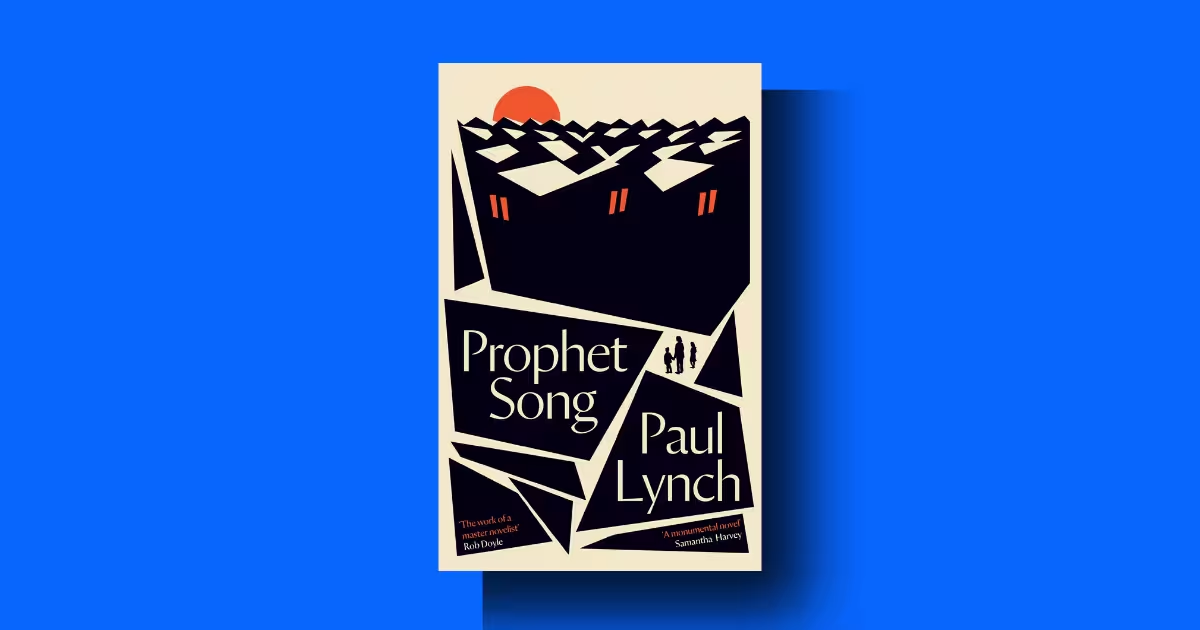
Did you know that the end of the world doesn’t arrive with a bang for everyone at once? As Paul Lynch writes in Prophet Song, “the end of the world is always a local event, it comes to your country and visits your town and knocks on the door of your house.” That’s exactly what happens to Eilish Stack—not in some distant, war-torn country, but in a Dublin that looks remarkably like the one you might recognise. This novel forced me to ask a question I’d rather avoid: How do you know when it’s time to abandon everything you’ve ever known?
Prophet Song is a devastating, Booker Prize-winning novel that follows Eilish Stack, a Dublin mother of four, as her country slides into totalitarianism and civil war, forcing her to make impossible choices to save her children while her husband and eldest son disappear into the regime’s machinery.
Prophet Song good for readers who appreciate literary fiction with a punch, fans of The Handmaid’s Tale or The Road, anyone who wants to understand what it feels like when democracy erodes from the inside, and those who can handle unrelenting bleakness in service of a vital message.
Not for readers seeking a fast-paced thriller with a tidy ending, anyone triggered by graphic descriptions of state violence and child death, or those who prefer conventional punctuation and paragraph breaks—Lynch’s style is deliberately disorienting.
Table of Contents
Introduction
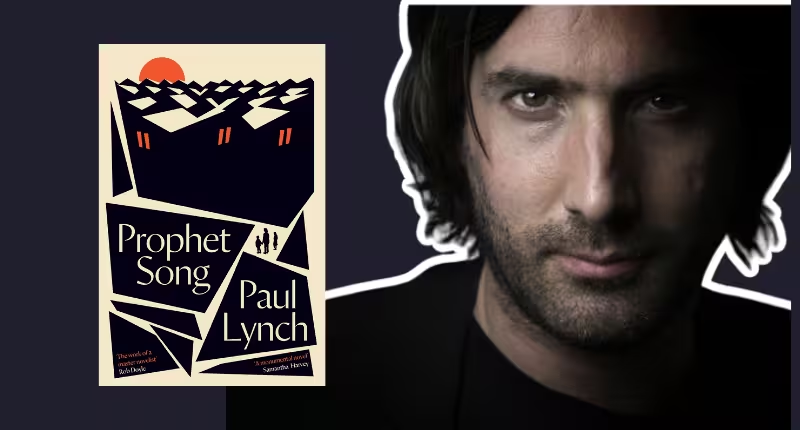
Prophet Song is Irish author Paul Lynch’s fifth novel, published by Oneworld in 2023. It won the Booker Prize that same year, with the judges describing it as “propulsive and unsparing, and it flinches away from nothing.”
The novel imagines a near-future Ireland where the far-right National Alliance Party has seized control, suspended the constitution, and unleashed a secret police force called the GNSB (Garda National Services Bureau).
Lynch has openly stated that the Syrian Civil War and the West’s indifference to the refugee crisis were primary inspirations. He wanted to place ordinary, middle-class Irish citizens—people like you and me—into the same tenuous position as those “others” we see on the news. The result is a novel that feels less like speculative fiction and more like a warning.
Background
Lynch spent four years writing Prophet Song, a process he describes as painstaking. Interestingly, he initially spent six months writing a completely different book before abandoning it. As he recalls: “Then one Friday, about 3pm, I stopped writing and thought, this is the wrong book – I will return on Monday morning and start a new one.” On that Monday, he closed his eyes, and the opening page “arrived pretty much as you read it now.”
The novel became Ireland’s bestselling book of 2023—across all genres, fiction and nonfiction. It also made Lynch the fifth Irish author to win the Booker Prize. In his acceptance speech, he admitted he feared the book would end his career: “The rational part of me believed I was dooming my career,” he said, “though I had to write the book anyway.”
Prophet Song Full Plot Summary
Part One: The Knocking at the Door
Prophet Song opens on a dark, wet evening in Dublin. Eilish Stack, a microbiologist and mother of four, is standing by her kitchen window when she hears a sharp knocking at the door. Two plainclothes officers from the GNSB—Ireland’s newly formed secret police—are on her doorstep. They want to speak with her husband, Larry, who is the deputy general secretary of the Teachers’ Union of Ireland.
Larry is called in for questioning. At the station, he’s shown a document that accuses him of seditious behaviour. When he protests, Detective Inspector Stamp tells him that under the Emergency Powers Act, the burden is on Larry to prove he isn’t a threat to the state. Larry leaves shaken but still defiant.
Soon after, Larry participates in a peaceful union march. The march is violently broken up by security forces using batons and tear gas. Larry doesn’t come home. Eilish learns that he’s been arrested along with other union leaders. She’s told he’s being detained, but nobody will say where or for how long.
Part Two: The Unravelling
Eilish is left to hold the family together. She has four children: Mark (almost 17), Molly (14), Bailey (12), and baby Ben. Larry’s absence creates a void that fills with fear and uncertainty.
Michael Given, the union solicitor, visits to explain that habeas corpus has been suspended. There’s nothing he can do legally. Eilish tries to get passports for her children, but the Department of Justice blocks the applications because she’s now considered a security risk. Her job becomes precarious as the company she works for is taken over by party loyalists.
Meanwhile, the regime tightens its grip. The schools are closed. Mark receives a letter ordering him to report for national service the week he turns seventeen. Eilish decides to hide him. With the help of Carole Sexton—another woman whose husband has disappeared—she arranges for Mark to stay in a granny flat at Carole’s house.
But Mark has other ideas. He’s been watching videos of executions and violence online. He’s angry, restless, and increasingly drawn to the rebel cause. When Eilish tries to send him across the border to Northern Ireland, he refuses. He leaves home to join the rebel forces fighting against the regime.
Part Three: The Breaking Point
Eilish’s father, Simon, is in the early stages of dementia. He lives alone with his dog, Spencer. Eilish visits him regularly, but he’s increasingly confused, sometimes mistaking her for her dead mother. He tells her she should leave the country while she still can.
The situation in Dublin deteriorates. Protests erupt after two detained boys are found dead with marks of torture. Eilish takes Molly and Bailey to a massive protest. It’s violently dispersed, and Mark is nearly arrested.
Then, in the middle of the night, three men attack the house. They spray “TRAITER” in red paint on the walls and car, smash the windscreen, and urinate on the vehicle. The gardaí don’t come. Eilish realises they’ve been marked as enemies of the state.
The civil war reaches Dublin. Airstrikes and shelling become constant. Bailey is struck by shrapnel while out getting milk. Eilish rushes him to St James’s Hospital, where she lies about his age to get him admitted. When she returns the next day, she’s told Bailey was transferred to St Bricin’s Military Hospital overnight.
At St Bricin’s, she’s told Bailey isn’t registered as a patient. She’s directed to the military wing, then to the morgue. In the morgue, she identifies her son’s body. He’s been tortured—his nails torn out, cigarette burns on his torso, a drill bore through his knee. The death certificate says he died of “heart failure.” Eilish’s grief is absolute.
Part Four: The Escape
Eilish’s sister, Áine, who lives in Toronto, has been trying to get the family out. She sends traffickers with false documents and money. Eilish initially refuses, but after Bailey’s death, she has no choice. She, Molly, and Ben join a group of refugees.
They travel by truck, then on foot, then by inflatable boat across the sea. The journey is harrowing. They’re held in a crowded, squalid room for days. At the border, they’re extorted by officials.
The novel ends with Eilish, Molly, and Ben standing on a beach at night, about to board a small boat for an uncertain crossing. Molly is terrified, begging not to go. Eilish takes her hands and says: “to the sea, we must go to the sea, the sea is life.”
Prophet Song Analysis
Characters
Eilish Stack: Eilish is the novel’s unwavering protagonist. A microbiologist by training, she’s a pragmatist who tries to maintain normalcy even as her world collapses. She’s fiercely protective of her children, but she’s also flawed—she lies to them, she denies reality, and she makes mistakes.
What makes her so compelling is her ordinariness. She’s not a hero; she’s a mother trying to hold on. As the novel progresses, she becomes increasingly dissociative, her mind fragmenting under the weight of trauma.
Larry Stack: Larry is the catalyst for the novel’s events.
A principled trade unionist, he believes in the power of peaceful protest. His disappearance haunts the entire narrative—we never learn what happens to him. He represents the thousands of people who have been “disappeared” by authoritarian regimes.
Mark Stack: Mark is caught between childhood and adulthood. He’s angry, idealistic, and desperate to fight back. His decision to join the rebels rather than flee is both brave and tragic. He represents the young people who are radicalised by injustice.
Molly Stack: Molly is the emotional heart of the family. She’s fourteen, sensitive, and deeply affected by her father’s disappearance. She stops eating, stops talking, and withdraws into herself. But she also shows remarkable strength, stepping up to care for Ben when Eilish is incapacitated.
Bailey Stack: Bailey is twelve, the second youngest. He’s rebellious, foul-mouthed, and struggling to understand why his father and brother have gone. His death is the novel’s most devastating moment.
Simon Stack: Eilish’s father is in the early stages of dementia. He’s often confused, but he also has moments of startling clarity. He tells Eilish: “you believe in rights that don’t exist, the rights you speak of cannot be verified they are a fiction decreed by the state.” He represents the older generation that has seen it all before.
Áine: Eilish’s sister in Toronto. She represents the perspective of the diaspora—those who left and can see the disaster unfolding from a distance.
Prophet Song Themes and Symbolism
The Banality of Totalitarianism: Lynch doesn’t depict the regime as cartoonishly evil. Instead, he shows how totalitarianism creeps in through bureaucracy, paperwork, and incremental changes.
People don’t notice their freedoms being eroded until it’s too late. As one character says: “All your life you’ve been asleep, all of us sleeping and now the great waking begins.”
The Erosion of Free Will: The novel asks whether free will is possible when you’re caught up in forces beyond your control. Eilish makes choices, but each choice is constrained by the regime’s logic. She’s never truly free.
Grief and Trauma: The novel is fundamentally about grief—grief for a husband, a son, a country, a way of life. Eilish’s grief manifests physically; her hair falls out, her body trembles. The novel suggests that trauma doesn’t just affect the mind; it inhabits the body.
Domesticity vs. Chaos: Lynch repeatedly contrasts mundane domestic tasks with the violence outside. Eilish cleans the kitchen, does the laundry, and makes dinner while the world burns. This juxtaposition is deeply unsettling.
The White Ribbons: Molly ties a white ribbon to the cherry tree every week her father is gone. The ribbons become a symbol of hope, memory, and the passage of time.
The Worm: Bailey repeatedly talks about “the worm.” It’s a symbol of the regime—something that burrows into everything, corrupting from within. “The worm is turning,” he says, “it is gaining in power, the worm does what it likes.”
Prophet Song Evaluation
Prophet Song is an outstanding, groundbreaking, and profoundly important novel. It’s not an easy read—it’s relentless, claustrophobic, and often unbearable. But that’s precisely the point. Lynch forces us to sit with the horror, to feel it in our bones. He doesn’t let us look away.
Strengths
The Prose: Lynch’s writing is extraordinary. The novel has no paragraph breaks, creating a breathless, compulsive rhythm that mimics Eilish’s mounting panic. Sentences wind on for pages, gathering momentum. It’s disorienting, but it’s also immersive.
The Emotional Impact: I haven’t read a book that has shaken me so intensely in many years. The novel’s bleakness is earned—it reflects the reality of life under totalitarianism.
The Plausibility: This is what makes Prophet Song so terrifying. It doesn’t feel like science fiction. It feels like a warning.
Weaknesses
Relentless Bleakness: Some readers may find the novel too unrelenting. There’s almost no relief, no moments of joy or hope. This is intentional, but it can be exhausting.
Characterisation: Some secondary characters feel underdeveloped. Larry, in particular, is more of a symbol than a person.
The Ending: The ending is ambiguous. We don’t know if Eilish, Molly, and Ben survive the crossing. This is thematically appropriate—refugees don’t get tidy endings—but it may frustrate some readers.
Impact
Prophet Song resonated with me on a visceral level. I found myself thinking about it for days after finishing. It made me question my own assumptions about safety, freedom, and the fragility of democracy.
Comparison with Similar Works
Prophet Song has been compared to Margaret Atwood’s The Handmaid’s Tale, George Orwell’s 1984, and Cormac McCarthy’s The Road. Like those novels, it uses speculative fiction to explore urgent political questions. But Prophet Song is distinct in its setting—a contemporary, familiar Dublin—and its focus on the domestic sphere.
Personal Insight: Five Lessons from Prophet Song
Lynch has said that Prophet Song was inspired by the Syrian Civil War and the West’s indifference to refugees. The novel asks a question that’s more urgent than ever: How do you know when it’s time to leave?
Here are five lessons I took from the novel:
✅ Democracy isn’t self-sustaining. It requires active defence. The characters in Prophet Song don’t notice their freedoms being eroded until it’s too late.
✅ The personal is political. Eilish’s family is destroyed by political forces. There’s no separation between the private and public spheres.
✅ Silence is complicity. People who stay silent enable the regime. Speaking out is dangerous, but silence is worse.
✅ Trauma is inherited. Ben, the baby, will carry the trauma of this experience even if he doesn’t remember it. The novel suggests that trauma is passed down through generations.
✅ Hope is a form of resistance. Despite everything, Eilish keeps going. She doesn’t give up. That’s the most radical act of all.
Prophet Song Quotes
Here are some of the most powerful passages from the novel:
“The end of the world is always a local event, it comes to your country and visits your town and knocks on the door of your house and becomes to others but some distant warning, a brief report on the news, an echo of events that has passed into folklore.”
“All your life you’ve been asleep, all of us sleeping and now the great waking begins.”
“You believe in rights that don’t exist, the rights you speak of cannot be verified they are a fiction decreed by the state.”
“What my father needs is … to be surrounded by his memories, to have the past within reach.”
“The worm is turning, it is gaining in power, the worm does what it likes.”
“To the sea, we must go to the sea, the sea is life.”
Conclusion
Prophet Song is a devastating, necessary novel. It’s a warning, a lament, and a testament to the resilience of the human spirit. Paul Lynch has written a book that will stay with you long after you’ve turned the final page.
I recommend this novel to anyone who wants to understand what it feels like when democracy dies—not with a bang, but with a knock at the door. It’s not an easy read, but it’s an essential one.







