
Do you know why you fall for certain people, stay with others, and can’t seem to make it work with anyone else?
I’ve spent years wondering about this. Reading relationship advice, scrolling through articles, listening to podcasts, nothing ever gave me the full picture. Most advice tells you what to do, but never why you feel what you feel. That’s where The New Psychology of Love changed everything for me.
Overview
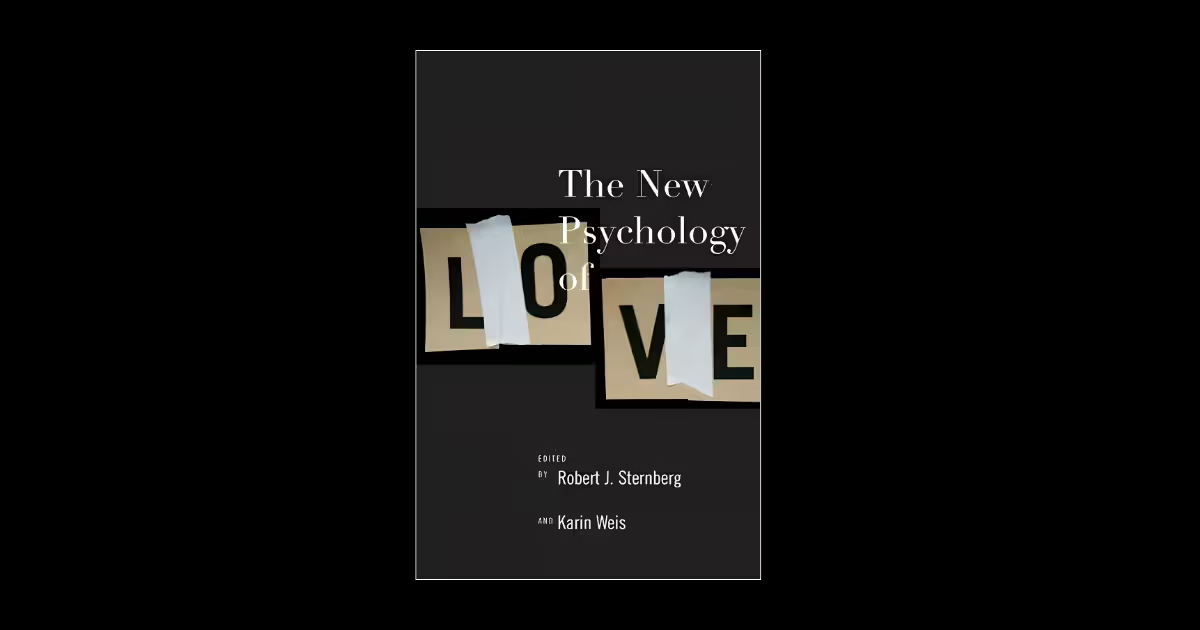
The New Psychology of Love isn’t another self-help book promising to fix your relationship in ten easy steps. It’s an academic collection edited by renowned psychologist Robert J. Sternberg and Karin Weis, published by Yale University Press in 2006. The book brings together more than a dozen expert contributors, the biggest names in love research, to present the full range of psychological theories on love.
Think of it as a complete map of the science of love: biological, taxonomical, implicit, and cultural.
If you’re the kind of person who wants to understand why love works the way it does, why you feel what you feel, why relationships succeed or fail, this book is for you. If you’re looking for quick fixes or dating tips, you’ll probably bounce off it hard.
Reader Recommendation
Who will actually love The New Psychology of Love:
- Psychology students and academics who want a comprehensive overview of love research
- Curious readers who enjoy thinking deeply about human behavior
- Anyone who’s ever wondered why their relationships follow certain patterns
- People interested in evolutionary psychology, attachment theory, and cultural differences in love
Who should probably skip The New Psychology of Love:
- Readers looking for practical dating advice or relationship tips
- Anyone who finds academic writing dry or dense
- People who want a single unified theory of love (this book gives you many, and they don’t always agree)
- Casual readers who prefer pop-psychology over research-based content
One Amazon reviewer put it perfectly: “One who is a novice in relation to academic work on the fascinating phenomenon of love will find this book an excellent introduction to the field”.
Another noted it provides “numerous perspectives instead of focusing on just one or a few like some texts do”.
Table of Contents
1. Introduction
Book: The New Psychology of Love
Editors: Robert J. Sternberg and Karin Weis
Publisher: Yale University Press
Publication Date: 2006
Pages: 338
Context
The New Psychology of Love is the follow-up to The Psychology of Love, which Sternberg co-edited with Michael Barnes in 1988. By the early 2000s, that earlier volume was out of date. New theories had emerged, old ones had been modified, and new data supported approaches that didn’t exist in 1988.
Robert J. Sternberg is one of the most influential psychologists of our time. He’s known for his triangular theory of love, his work on intelligence, and his research on creativity and wisdom. Karin Weis was a graduate student at the University of Heidelberg when she co-edited this volume.
The book brings together contributors including Helen Fisher (biological anthropologist), David Buss (evolutionary psychologist), Phillip Shaver (attachment researcher), Ellen Berscheid (relationship researcher), and many other leading figures.
Purpose
The book’s central argument is straightforward: no single theory adequately answers all our questions about the nature of love. Instead, different theories explain different aspects of love, and understanding love requires understanding all of them.
The editors asked every contributor the same five questions:
- How would you define love?
- What theory of love do you propose or utilize?
- What evidence supports and disfavors this theory?
- How is your approach similar to and different from related approaches?
- What are the practical implications of your theory?
This uniform structure makes it possible to compare theories directly. The result is a comprehensive, engaging comparison of contemporary data and theories, what the publisher calls “today’s definitive account of the nature of love”.
2. Background
The study of love has come a long way. When The Psychology of Love was published in 1988, the scientific study of love was relatively new. Psychologists had largely surrendered the topic to poets, songwriters, and philosophers.
Love was considered too elusive for systematic study. It didn’t seem measurable or analyzable.
That changed dramatically between 1988 and 2006. Researchers developed new scales, the Perceptions of Love and Sex Scale, the Love Stories Scale, the “Sexy Seven Measure.” Biological assessment methods improved dramatically. Cross-cultural research exploded. The number of studies increased many times over.
The New Psychology of Love captures this transformation. It keeps pace with the latest research while providing historical context for how we got here.
3. The New Psychology of Love Summary
This section is the heart of the article. I’ll walk you through what I learned from each part of the book, so you don’t need to read it yourself unless you want the full depth.
Part I: Biological Theories
Chapter 2: A Dynamical Evolutionary View of Love (Douglas T. Kenrick)
Kenrick argues that love is a set of evolved decision biases designed to serve genetic interests. These biases influence attention, memory, and decision-making. For example, altruistic behavior is more likely toward relatives than strangers because we share genes with relatives.
The key insight here is that different kinds of love solve different problems. The love you feel for a partner is different from the love you feel for offspring. Men and women have different decision biases because they face different reproductive challenges.
Cultural differences exist, but they arise from variations in social and physical ecology, behaviors adaptive in one environment aren’t necessarily adaptive in another.
Chapter 3: A Behavioral Systems Approach (Phillip R. Shaver and Mario Mikulincer)
Shaver and Mikulincer propose three innate behavioral systems: attachment, caregiving, and sex.
The attachment system ensures safety by keeping us close to people who can provide support. It activates when we encounter threats and seek proximity to caregivers.
The caregiving system is altruistic, it provides support to others in need. Its focus is on another person’s well-being and development.
The sexual system exists to pass genes to the next generation. It makes us sensitive to signals of fertility and interest, helps us increase our own attractiveness, and provides strategies to arouse potential partners.
When goals repeatedly can’t be achieved, secondary strategies come into play: hyperactivation (intensifying efforts to force the partner to comply) or deactivation (turning off the entire system to avoid frustration).
Chapter 4: The Evolution of Love (David M. Buss)
Buss states that love is an adaptation that evolved to solve problems of reproduction. It provides sexual access, signals fidelity, and indicates commitment.
Key findings:
- Love is universal, not limited to Western cultures
- Love appears primarily in long-term mating contexts
- Men are more likely than women to fall in love at first sight
- Men express themselves more violently when they lose love
- Women are more likely to be jealous and dismiss sex without love
Buss also explores the dark side: when love fails, it can lead to violence, stalking, and murder. He documents that roughly half of the 3,400 women murdered annually in America are killed by husbands, boyfriends, or ex-partners, the ones who presumably loved them.
Chapter 5: The Drive to Love (Helen Fisher)
Fisher, a biological anthropologist, identifies three interrelated brain systems:
- Sex drive (testosterone-driven): desire for sexual contact with multiple partners
- Attraction/romantic love (dopamine and norepinephrine): focused attention on one particular mate
- Attachment (oxytocin and vasopressin): feelings of security and comfort
Fisher’s fMRI research shows that romantic love activates the ventral tegmental area (VTA) and caudate nucleus, the brain’s reward system. This is why romantic love feels addictive. In fact, the brain activity of people in love resembles that of people on cocaine.
She also explains why romantic love typically lasts 12-18 months, long enough to conceive and raise a child through infancy, then the intensity fades as attachment takes over.
Chapter 6: A Biobehavioral Model of Attachment and Bonding (Leckman, Hrdy, Keverne, and Carter)
This chapter examines the biology of bonding across species. Key findings:
- Oxytocin and opioids are crucial for bonding in mammals
- Early life experiences shape parental behavior across generations
- Infant responsiveness is influenced by both genes and environment
The authors show that early parental love and romantic love share many features: altered mental states, intrusive thoughts, heightened awareness of the other, and a sense of responsibility for the beloved’s well-being.
Importantly, early interventions can enhance parental sensitivity and attachment security in children, meaning we can actually improve people’s capacity for love through targeted programs.
Part II: Taxonomies of Love
Chapter 7: Styles of Romantic Love (Clyde Hendrick and Susan S. Hendrick)
The Hendricks build on John Alan Lee’s 1973 taxonomy of six love styles:
- Eros: passionate, erotic love
- Ludus: game-playing, uncommitted love
- Storge: friendship-based love
- Pragma: practical, calculating love
- Mania: obsessional love
- Agape: altruistic, selfless love
Each person has a “love profile” showing how much they exhibit each style. These profiles can change over time and across relationships.
The research shows:
- Eros correlates with agreeableness, extraversion, and conscientiousness
- Ludus correlates with neuroticism and negatively with agreeableness
- Men endorse ludus more than women
- Women endorse storge and pragma more than men
The practical implication: couples therapy can use love styles to help partners understand themselves and each other.
Chapter 8: Searching for the Meaning of “Love” (Ellen Berscheid)
Berscheid argues that “love” is a single word covering multiple phenomena. She proposes four distinct types:
- Attachment love: unlearned, serves the need for protection, activated by threat
- Compassionate love: concern for another’s welfare, altruistic
- Companionate love/liking: based on reward and punishment principles
- Romantic love: incorporates sexual desire
The key insight: “being in love” means something different from “loving” someone. To be “in love” with someone, that person must be both liked and sexually attractive. Love alone isn’t enough.
Chapter 9: A Duplex Theory of Love (Robert J. Sternberg)
This is Sternberg’s own theory, comprising two subtheories:
The Triangular Theory of Love proposes three components:
- Intimacy: feelings of closeness and connectedness
- Passion: drives leading to romance and physical attraction
- Decision/Commitment: the decision to love and commitment to maintain that love
Different combinations produce eight types of love:
| Type | Intimacy | Passion | Commitment |
|---|---|---|---|
| Non-love | No | No | No |
| Liking | Yes | No | No |
| Infatuated love | No | Yes | No |
| Empty love | No | No | Yes |
| Romantic love | Yes | Yes | No |
| Companionate love | Yes | No | Yes |
| Fatuous love | No | Yes | Yes |
| Consummate love | Yes | Yes | Yes |
The Theory of Love as a Story suggests that our personal attributes interact with our environment to create stories about love. Everyone has their own love story and seeks to fulfill it.
Examples include the fairy tale (prince and princess), the horror story (terrorizer and victim), and the business story (two partners). Relationship success depends partly on the similarity or compatibility of partners’ stories.
Chapter 10: Giving and Receiving Communal Responsiveness as Love (Margaret S. Clark and Joan K. Monin)
Clark and Monin define love as communal responsiveness: an unconditional reaction that focuses on the partner’s welfare, attends to expressed needs, and doesn’t exploit vulnerabilities.
Five forms of responsiveness:
- Helping (when someone is injured or needs something)
- Supporting future goals (listening, providing advice)
- Creating something collaboratively (dancing, playing games)
- Caring behaviors when the other has transgressed (forgiveness)
- Symbolic (showing care when no clear need exists)
Communal responsiveness provides security and comfort. Trust is central, without trust that the partner cares, people can’t reveal vulnerabilities or accept support.
Part III: Implicit Theories of Love
Chapter 11: A Prototype Approach to Studying Love (Beverley Fehr)
Fehr examines not how scientists view love, but what ordinary people believe love to be. Using prototype analysis (identifying features that best represent a concept), she found:
- Companionate features (trust, caring, honesty, friendship) are considered most central to love
- Passionate features (sexual passion, physical attraction) are considered peripheral
In other words, ordinary people think love is fundamentally about companionship, not passion. This contradicts the stereotype that young people define love in terms of romance.
Gender differences emerged:
- Women subscribe to a more companionate conception
- Men hold a more passionate concept
- Women have more of a friendship orientation
- Men report falling in love at first sight more often
These prototypes have real implications. When prototypical features are violated (e.g., a partner betrays trust), love is perceived as more damaged than when non-prototypical features are violated. Couples who view love prototypically report greater satisfaction.
Part IV: Cultural Theories of Love
Chapter 12: Evolutionary and Cross-Cultural Perspectives (David P. Schmitt)
Schmitt introduces a general dimension called “emotional investment”, comprising intimacy, passion, and commitment. His study of over 15,000 participants from 48 nations found:
- The concept of love is relatively similar across cultures
- Emotional investment correlates positively with country development, secure attachment, and individualism
- Children exposed to high stress (economic hardship, harsh environments) express lower emotional investment
- In most countries, men score lower than women on emotional investment
Chapter 13: Passionate Love: Cross-Cultural and Evolutionary Perspectives (Debra Lieberman and Elaine Hatfield)
Lieberman and Hatfield argue that although passionate love is a cultural universal, cultural values influence its meaning:
- In the US, love is associated with happiness
- In China, love is associated with sadness
- The concept of romantic love fits well in individualistic American culture but less well in collectivist Chinese culture
However, the differences between Western and Eastern cultures are diminishing. Young people increasingly adopt Western patterns: gender equality in love and sex, and marrying for love rather than arranged marriage.
The chapter also covers mechanisms to avoid inbreeding:
- Kin detection: recognizing who is related
- Disgust: avoiding situations where sexual contact with relatives could occur
Chapter 14: Individualism, Collectivism, and the Psychology of Love (Karen K. Dion and Kenneth L. Dion)
The Dions argue that beliefs about the relationship between individual and group influence love:
Individualistic societies:
- Marriage is based on love
- Relatively permissive view of love
- Lower likelihood of ever having been in love
- Lower sense of perceived success in family life
Collectivist cultures:
- Love based on friendship and altruistic goals
- Emphasize caregiving rather than intense affect
Cultural differences also affect how intimacy develops:
- US couples maintain high intimacy while keeping space for autonomy
- Japanese couples attend to extended family needs early in marriage and develop greater intimacy later
Conclusion: The Nature and Interrelations of Theories of Love (Karin Weis)
Weis discusses how the different theories relate to each other. She explores:
- Whether different kinds of love have a common denominator
- The influence of context, personality, time, and culture on love
- The mechanisms proposed to achieve goals associated with love
She concludes that although there’s still no single agreed-upon theory, the theories overlap considerably. Different theories explain different aspects of love, and understanding love requires understanding all of them.
However, Weis notes a critical problem: there’s still no common conceptual vocabulary of love. When researchers talk about “romantic love” or “attachment love,” they don’t always mean the same thing. This lack of shared language hinders progress.
4. The New Psychology of Love Analysis
What makes this book genuinely valuable is its refusal to pick a side. Most books on love present one theory as the answer. This one says: “Here are all the theories. Compare them. See what fits.”
The book is comprehensive in a way few others are. It covers evolutionary biology, brain chemistry, attachment theory, personality psychology, cultural anthropology, and more. Reading it feels like getting a graduate-level education in love research.
The uniform structure (each contributor answers the same five questions) makes comparison easy. You can see exactly where theories agree and where they diverge.
However, the book is dense. One reviewer noted it’s “heavy reading but fascinating”. Another said “it was more theoretical than useful”. If you’re looking for practical advice, this isn’t your book.
The conclusion chapter could be stronger. One Amazon reviewer noted the book “would have benefited from a stronger Conclusions chapter in which the love theories could have been given a more robust treatment and the future challenges laid out more perspicaciously”.
5. Strengths and Weaknesses
Strengths
Breadth of coverage. The book presents biological, taxonomical, implicit, and cultural theories, the full range of psychological approaches to love.
Quality of contributors. The lineup includes the biggest names in love research: Sternberg, Fisher, Buss, Shaver, Berscheid, and more.
Comparative structure. All contributors answer the same five questions, making direct comparison possible.
Research-based. Every theory is supported by empirical evidence, not just speculation.
Up-to-date (for its time). The book captures the state of love research in the mid-2000s, building on the 1988 volume.
Weaknesses
Dense academic writing. This isn’t light reading. It’s a textbook, not a beach read.
Limited practical application. If you want advice, you won’t find much. The book explains why love works, not how to make yours work better.
Weak conclusion. The final chapter could have done more to integrate the theories and chart future directions.
Aging research. Published in 2006, the book doesn’t cover research from the last 15+ years. A new edition would be valuable.
6. Comparison with Similar Works
The Psychology of Love (1988): The original volume that started it all. The New Psychology of Love is a direct update, covering new theories and research that emerged in the 18 years between editions.
Attached by Amir Levine and Rachel Heller: Focuses exclusively on attachment theory in relationships. Much more practical and accessible, but covers only one theory.
The Evolution of Desire by David Buss: Deep dive into evolutionary psychology of mating. Excellent but narrowly focused on one perspective.
Why We Love by Helen Fisher: Fisher’s popular book on the neuroscience of love. More accessible than the edited volume but covers only her own research.
The Five Love Languages by Gary Chapman: Practical and popular, but not scientifically rigorous. The New Psychology of Love is essentially the opposite.
What makes The New Psychology of Love unique is its comprehensiveness. No other book presents the full range of scientific theories on love in one place. If you want to understand love from every angle, this is the book.
7. Conclusion
The New Psychology of Love is the definitive academic overview of love research from the mid-2000s. It’s not for everyone, if you want quick fixes or dating advice, look elsewhere. But if you’re genuinely curious about why love works the way it does, why relationships succeed or fail, and what science has discovered about the most powerful human emotion, this book is essential reading.
The book’s central message is humbling: love is too complex for any single theory to explain. Understanding love requires understanding biology, evolution, attachment, personality, culture, and personal stories. No single perspective captures the whole picture.
One reviewer captured the experience perfectly: “By laying out a complete map of the field, this book succeeds in bringing other rival theories to the fore, letting the reader detect their overlaps on the one hand and distinct merits on the other, drawing on one’s personal love experiences in so doing”.
Reading this book won’t fix your relationship. But it will help you understand why it works the way it does, and that understanding is the first step toward anything better.







