Do you really know who first told the world about the 1971 Bangladesh genocide, and what it cost him?
Most people have heard of the 1971 Bangladesh Liberation War. Many know that millions died. But few know the name of the man who first broke the story to the Western world, a Pakistani journalist who risked everything, including his family’s safety, to tell the truth.
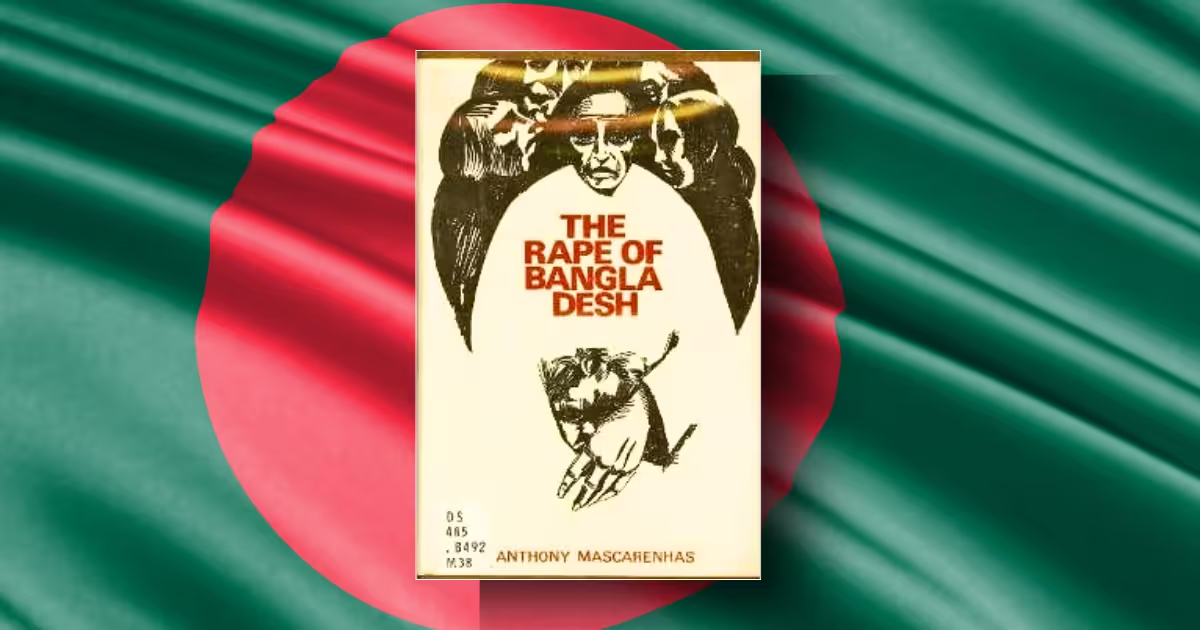
That man was Anthony Mascarenhas. And his book, The Rape of Bangla Desh, published in 1971, remains one of the most searing firsthand accounts of genocide ever written.
This isn’t just a history book. It’s a confession, a condemnation, and a cry from the conscience of a man who watched his own people commit atrocities he couldn’t ignore.
Overview
The Rape of Bangla Desh is Anthony Mascarenhas’s eyewitness account of the Pakistan Army’s genocide against Bengali Muslims and Hindus in East Pakistan (now Bangladesh) in March–April 1971. Mascarenhas, a Pakistani journalist of Goan Christian heritage, was invited by the military regime on a propaganda tour to show “the return of normalcy.”
Instead, he witnessed mass killings, systematic murder of intellectuals, and a deliberate campaign to crush Bengali identity. He escaped to London, published his findings in The Sunday Times on 13 June 1971, and then expanded his reporting into this book.
His work is widely credited with turning global opinion against Pakistan and hastening India’s intervention, which led to Bangladesh’s independence.
Who will actually love The Rape of Bangla Desh?
- Students of South Asian history, this is primary-source material from someone who was there.
- Journalists and media professionals, Mascarenhas’s ethical dilemma and courage are a masterclass in journalistic integrity.
- Anyone interested in genocide studies, this is a textbook example of how systematic killing is planned and executed.
- Readers who want the unvarnished truth, Mascarenhas doesn’t spare anyone, including the Bengali leadership’s failures.
Who should bounce?
- If you’re looking for a detached, academic analysis with balanced perspectives, this isn’t it. This is raw, emotional, and unapologetically one-sided, because Mascarenhas believed there was only one side worth taking.
- If graphic descriptions of violence disturb you, proceed with caution. The book doesn’t shy away from horror.
Table of Contents
1. Introduction
Title: The Rape of Bangla Desh
Author: Anthony Mascarenhas (Neville Anthony Mascarenhas, 10 July 1928 – 3 December 1986)
Publication Details: Vikas Publications, Delhi, 1971. The book was published in the same year as the events it describes.
Mascarenhas was a Pakistani journalist and assistant editor of The Morning News in Karachi. He later worked for The Sunday Times (London) for fourteen years. He was born into a Goan Catholic family in Belgaum (now in Karnataka, India) and educated in Karachi.
Context of The Rape of Bangla Desh
The Rape of Bangla Desh is a work of investigative journalism and firsthand reportage. It covers the political betrayal of the Bengali people by West Pakistan’s military-bureaucratic elite, the December 1970 elections that gave Sheikh Mujibur Rahman’s Awami League an absolute majority, the subsequent postponement of the National Assembly, and the brutal military crackdown, Operation Searchlight, that began on the night of 25 March 1971.
Mascarenhas was uniquely positioned. He was a Pakistani insider, trusted by the military regime, yet he was also an outsider, a Goan Christian in a Muslim-majority country. This dual perspective gave him access and critical distance.
Purpose of The Rape of Bangla Desh
The book’s central thesis is devastatingly simple: West Pakistan’s military regime, led by President General Yahya Khan, deliberately and systematically committed genocide against the Bengali people to preserve its own power.
Mascarenhas writes in the prologue:
“What I saw in East Bengal was to me more outrageous than anything I had read about the inhuman acts of Hitler and the Nazis. This was happening to my own people. I knew I had to tell the world about the agony of East Bengal or forever carry within myself the agonizing guilt of acquiescence.”
That’s the moral core of the book. Mascarenhas wasn’t a neutral observer. He was a man torn between loyalty to his country and loyalty to humanity. He chose the latter.
2. Background
To understand the book, you need to understand the political landscape of Pakistan in 1970–71.
Pakistan was created in 1947 as a homeland for Muslims of the Indian subcontinent. But from the start, it had a fatal flaw: its two wings, West Pakistan and East Pakistan, were separated by 1,000 miles of Indian territory. They spoke different languages, ate different food, and had different cultures. The only thing holding them together was Islam.
And that wasn’t enough.
Mascarenhas lays out the economic exploitation in cold, hard numbers:
- East Pakistan had 54% of the population but received only 35% of development expenditure.
- Per capita income in West Pakistan was 61% higher than in East Pakistan.
- The central government used East Bengal’s export surplus to finance West Pakistan’s deficits, draining real resources from east to west.
The Bengalis were treated as a colony. And they had had enough.
In December 1970, Pakistan held its first general elections. The Awami League, led by Sheikh Mujibur Rahman, won 167 out of 169 seats allocated to East Pakistan, an absolute majority in the 313-seat National Assembly. Mujib’s Six-Point Programme demanded provincial autonomy, with the federal government responsible only for defence and foreign affairs.
The military regime, led by President Yahya Khan, panicked. Power was slipping from their hands. Instead of accepting the democratic verdict, they conspired to block it.
Zulfikar Ali Bhutto, leader of the Pakistan People’s Party, colluded with Yahya Khan to boycott the Assembly session. On 1 March 1971, Yahya Khan postponed the National Assembly indefinitely.
Bengalis erupted in protest. A massive civil disobedience movement swept East Pakistan. And on the night of 25 March 1971, the Pakistan Army launched Operation Searchlight, a pre-planned campaign of genocide.
3. The Rape of Bangla Desh Summary: What I Learned
Let me be honest: this book shook me. I’ve read about genocides before, the Holocaust, Rwanda, Bosnia. But there’s something different about reading an account written by someone who was there, who saw it with his own eyes, and who knew the perpetrators personally.
Mascarenhas doesn’t just report facts. He takes you inside the mind of a man watching his own country commit atrocities.
The 25 Days That Changed Everything
The book’s most gripping section covers the 25 days between 1 March and 25 March 1971, from Yahya Khan’s postponement of the Assembly to the start of the genocide.
Mascarenhas describes the spontaneous uprising:
“Within minutes shops, offices, restaurants and bazaars had emptied. No meeting had been announced, there was no time for it, but long lines of people were seen making their way to the Paltan Maidan, the traditional forum for public dissent. They were grimfaced and they carried bamboo poles, iron rods, hockey sticks, even coconut fronds stripped of their greenery.”
This wasn’t organized. It was visceral. The Bengalis had been betrayed one too many times.
On 7 March 1971, Sheikh Mujibur Rahman addressed a crowd of over a million at the Dhaka Racecourse. Mascarenhas notes that Mujib stopped short of declaring independence, a decision he later called a catastrophic error:
“Had the Awami League chief been true to his deserved reputation as a revolutionary leader of the masses, he would have led the million-strong crowd to Eastern Command Headquarters four miles away and demanded and received Tikka Khan’s surrender. The people were in the mood for it and would have gladly sacrificed the lives of a few hundred to overwhelm the army. Bangla Desh would have been a reality at a minimum cost.”
Instead, Mujib launched a civil disobedience campaign. It was powerful, but it gave the army time to bring in reinforcements.
The Night the Killing Began
On the night of 25 March 1971, the Pakistan Army struck.
Mascarenhas describes the scene at Sheikh Mujib’s house:
“At about 1.30 A.M., two army jeeps followed by a few trucks halted outside No. 32. Moments later the garden was swarming with soldiers. Some shots were fired at the roof and through a window on the top floor. The soldiers, he said, were not attacking, just threatening. Then in the commotion Sheikh Mujib was heard calling from an upstairs bedroom: ‘Why are you being so barbarous? If you had called me I would have come down to you.’”
Mujib was arrested. He would remain in prison for the rest of the war.
The Genocide
The book’s title, The Rape of Bangla Desh, isn’t metaphorical. Mascarenhas documents systematic rape as a weapon of war. He also documents the deliberate targeting of specific groups:
- Bengali military personnel, the East Bengal Regiment, East Pakistan Rifles, police, and paramilitary forces.
- Hindus, targeted as “Indian agents.”
- Awami League members and supporters.
- Students and intellectuals, the future leaders of Bengali society.
- Bengali professors, teachers, and doctors, the “cream of the intellectual set”.
Mascarenhas writes:
“We are determined to cleanse East Pakistan once and for all of the threat of secession, even if it means killing off two million people and ruling the province as a colony for 30 years.”
That’s not hyperbole. That’s a direct quote from a Pakistani officer at the 16th Division Headquarters in Comilla.
The Moment That Changed Mascarenhas’s Life
The book’s dedication reads:
“To Sebastian and his companions whose cruel death in Comilla opened my eyes and changed the course of my life.”
Sebastian was a Christian man caught “stealing” a bag from a Hindu house. Mascarenhas watched a local martial law administrator casually sentence Sebastian and three others to death:
“The pencil flicked four times as the Bihari Sub-Inspector was ordered to ‘bring these men for disposal tonight.’ We had been enjoying glasses of coconut milk.”
That evening, Mascarenhas heard the screams:
“Minutes later I heard screams and the madding sound of clubs beating on flesh and bone. Then the screaming stopped, as though turned off with a switch. The silence, to my anguished ears, suddenly became the loudest sound in all the world. It has echoed a million times and it still blows my mind.”
That was the moment Mascarenhas decided he had to escape and tell the world.
The Escape
Mascarenhas flew back to Karachi after ten days in East Pakistan. He told his editors he was sick. Then he secretly made plans to get his wife and five children out of the country.
He flew to London in the third week of May 1971. Within 40 minutes of entering Thomson House, the home of The Sunday Times, he was heard, believed, and accepted.
On 13 June 1971, The Sunday Times published his article, titled simply “Genocide” , across a double-page spread.
The world was stunned.
Indira Gandhi, India’s Prime Minister, later told Sunday Times editor Harold Evans that the article had shocked her so deeply it set her “on a campaign of personal diplomacy in the European capitals and Moscow to prepare the ground for India’s armed intervention”.
The war ended on 16 December 1971. Bangladesh was born.
4. My Analysis The Rape of Bangla Desh
This is an extraordinary book, not because it’s beautifully written, but because it’s true.
Mascarenhas wasn’t a literary stylist. He was a journalist. And he wrote with the urgency of a man who knew he might not have much time. The prose is direct, sometimes clumsy, but always honest.
What makes the book so powerful is Mascarenhas’s insider perspective. He wasn’t a foreign correspondent parachuting in. He was a Pakistani, a Goan Christian, yes, but still a Pakistani. He knew the generals. He had drinks with them. He laughed at their jokes. And then he watched them commit murder.
The book’s moral clarity is its greatest strength, and its greatest limitation. Mascarenhas doesn’t do “both sides.” He doesn’t pretend there’s a moral equivalence between genocide and resistance. He names names: Yahya Khan, Tikka Khan, Bhutto. He holds them responsible.
Does he effectively support his arguments? Yes. The book is filled with specific dates, names, places, and direct quotations. Mascarenhas was there. He saw it. He heard it. He even includes the exact words of army officers joking about their “kill counts.”
Does the book fulfill its stated purpose? Absolutely. Mascarenhas set out to tell the world about the agony of East Bengal. He did that, and more. His reporting helped end a war.
5. Strengths and Weaknesses
Strengths
Eyewitness authority. Mascarenhas was on the ground. He saw the bodies. He heard the screams. He spoke to the officers who were doing the killing. This isn’t secondhand reporting, it’s primary-source testimony.
Moral courage. Mascarenhas sacrificed his career, his home, and his safety to tell the truth. He knew he would be branded a traitor. He did it anyway.
Historical documentation. The book preserves details that might otherwise have been lost, the exact dates of political maneuvers, the text of Mujib’s speeches, the sequence of military movements.
The human dimension. Mascarenhas doesn’t just give you statistics. He shows you the faces of the victims, Sebastian, the students at Iqbal Hall, the Hindus of Shankaripatti.
Weaknesses
Emotionally overwrought. This isn’t a criticism so much as a warning. Mascarenhas was traumatized, and it shows. The book is raw, angry, and sometimes repetitive.
Limited scope. The book focuses almost entirely on the events of March–April 1971. It doesn’t cover the full nine-month war or the complex international diplomacy that followed.
One-sided. Again, this isn’t necessarily a flaw, genocide doesn’t have two sides. But if you’re looking for a balanced academic analysis, this isn’t it.
6. Comparison with Similar Works
The Rape of Bangla Desh sits alongside other great works of war journalism, Martha Gellhorn’s reports from the Spanish Civil War, George Orwell’s Homage to Catalonia, Michael Herr’s Dispatches. What sets it apart is that Mascarenhas was reporting on his own country.
For a complementary perspective, read:
Bangladesh: A Legacy of Blood (1986), Mascarenhas’s second book on Bangladesh, covering the aftermath of independence.
The Blood Telegram by Gary J. Bass, a Pulitzer Prize-finalist account of US diplomacy during the 1971 war.
A Stranger in My Own Country by Khadim Hussain Raja, a Pakistani general’s perspective (though critically, it downplays West Pakistan’s oppression).
The Hamoodur Rahman Commission Report, Pakistan’s own official inquiry into the 1971 war, which documented army atrocities.
7. Conclusion
The Rape of Bangla Desh is not an easy read. It will make you angry. It will make you sad. It will make you question what you would do in Mascarenhas’s position.
But it’s a book that needs to be read, not just by historians or journalists, but by anyone who cares about truth, justice, and the cost of speaking out.
Mascarenhas ends the book with these words:
“All this has brought me the odium and scorn of those who were dear to me and the many people I have known in Karachi, Lahore and Rawalpindi. They have damned me as a traitor and a swine. I leave the final judgement to heaven. In all conscience I could only do what I have done.”
That’s the measure of the man. He knew he would be hated. He did it anyway.
Who should read this book?
- Anyone who wants to understand the 1971 Bangladesh Liberation War from the inside.
- Anyone who believes in the power of journalism to change history.
- Anyone who needs a reminder that silence in the face of evil is complicity.
Final verdict: The Rape of Bangla Desh is a flawed, passionate, indispensable book. It’s not the last word on 1971, but it’s the first word that matters.
Related Information / Books / Films
- Books: Bangladesh: A Legacy of Blood by Anthony Mascarenhas; The Blood Telegram by Gary J. Bass; A Stranger in My Own Country by Khadim Hussain Raja; Pakistan: Military Rule or People’s Power? by Tariq Ali.
- Films/Documentaries: Bay of Blood (2023 documentary on Operation Searchlight); Matir Moina (The Clay Bird) by Tareque Masud; 1971: Bangladesh, A Legacy of Blood (documentary).
- Official Reports: The Hamoodur Rahman Commission Report (Pakistan’s own inquiry into the 1971 war).