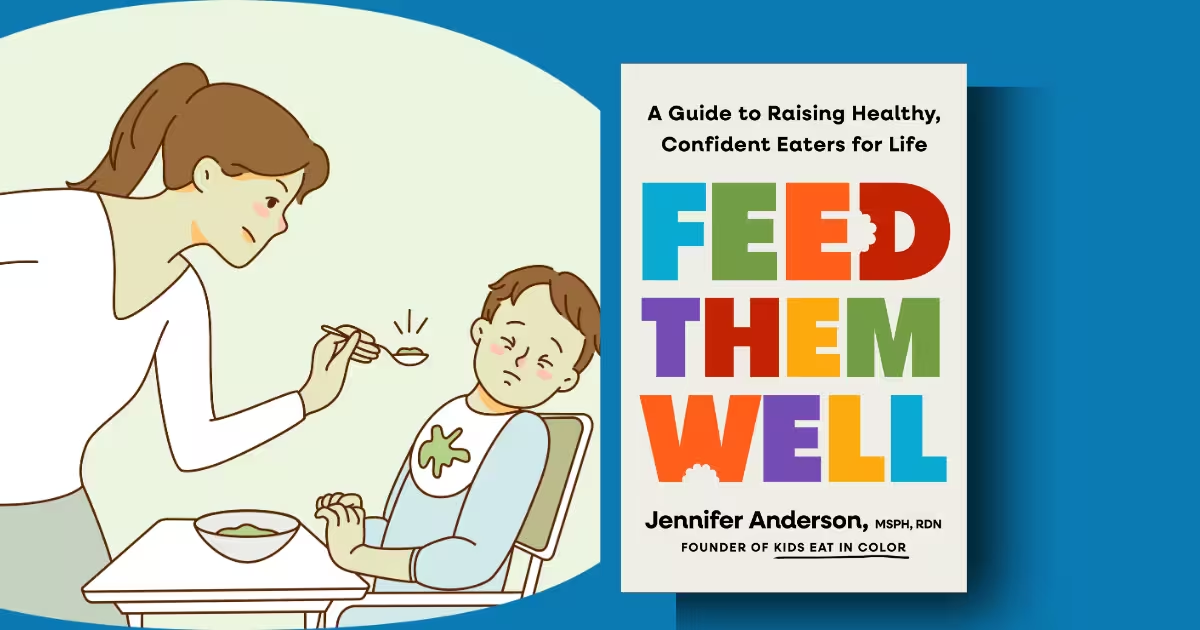

Feed Them Well: A Guide to Raising Healthy, Confident Eaters for Life by Jennifer Anderson offers a refreshing answer to one of parenting’s most stressful questions: how do you help children develop a healthy relationship with food without turning every meal into a battle?
In this review, I explore Anderson’s evidence-based approach to picky eating, nutrition, family meals, food anxiety, and “embodied independence”, and why this 2026 parenting book may be especially valuable for parents tired of conflicting advice and guilt around feeding their children.
Introduction
I remember the exact moment I realized feeding my child was going to be harder than I ever imagined. My son, who had been a chunky baby with plump, kissable cheeks, suddenly stopped gaining weight. The pediatrician’s words hit me like a punch to the gut: “He’s not gaining weight.” I felt like a failure. And I am a registered dietitian with a master’s degree in public health from Johns Hopkins.
This is the opening scene of Jennifer Anderson’s Feed Them Well: A Guide to Raising Healthy, Confident Eaters for Life (Flatiron Books, September 8, 2026). And it’s probably the most relatable opening to a parenting book I have ever read.
Anderson, the founder of Kids Eat in Color, a trusted resource with over two million followers, doesn’t pretend to have all the easy answers. She admits that even with all her training, she found herself pushing a smoothie into her son’s hand, demanding he drink it, only to realize later it “tasted like sand.”
What makes this book different from the endless pile of parenting and nutrition guides out there? Anderson doesn’t offer another collection of recipes or a rigid meal plan. Instead, she gives you a framework for thinking about feeding your kids. It’s about navigating the noise, the fear, the guilt, and the conflicting advice, and finding a path that actually works for your unique family.
About the Author: Why Her Credentials Matter
Before we dig into the content, let me tell you why I trust what Anderson has to say. She’s not just another influencer with a nutrition Instagram account. Jennifer Anderson is a registered dietitian nutritionist (RDN) with a Master of Science in Public Health from the Johns Hopkins Bloomberg School of Public Health.
But her credentials go beyond the degrees. She has worked as a nutrition consultant for the USDA national office SNAP-Ed program, coordinated youth nutrition programs at a food bank, and performed research in inner-city food deserts. She brings an understanding of how food access, poverty, and systemic issues affect what families can actually put on the table. This isn’t someone who assumes every parent has the time, money, or energy to make everything from scratch.
In 2019, she founded Kids Eat in Color, which has grown into a platform trusted by over two million parents. She’s also a mom of two, which means she’s lived the chaos she writes about.
The Core Problem Anderson Identifies
Here’s the thing Anderson wants you to understand right away: feeding your kids has become unnecessarily complicated, and it’s not your fault.
She traces this back to several forces that are bigger than any individual family:
First, there’s the food environment. In the US, food and beverage corporations spend billions of dollars annually marketing food to kids. Anderson points out that hyperpalatable foods, highly processed foods engineered to be difficult to stop eating, make up over 56 percent of young children’s diets and over 60 percent of the diets of six- to eighteen-year-olds. As she writes, “These foods tend to be low in protein, dietary fiber, micronutrients (vitamins and minerals), and phytochemicals”.
Second, there’s diet culture. This is the pervasive messaging that thinness is the ultimate goal, that certain bodies are “bad,” and that your worth is tied to what you eat and how you look. Anderson doesn’t mince words: “The thin ideal is pervasive in our culture, putting a certain body type on a pedestal, one that is slim and smooth, or built and muscular with low body fat.”
Third, there’s the information overload. We have instant access to more research and advice than ever before, yet we’re more confused than ever. Anderson explains that most of what we see online is based on individual studies, “drops in the bucket”, rather than the full body of research.
The result? Parents are anxious, guilty, and constantly second-guessing themselves. Anderson’s goal is to give you permission to stop chasing perfection and start making decisions that actually work for your family.
Feed Them Well Summary
The Five Pillars of Eating with Embodied Independence
The heart of Feed Them Well is Anderson’s framework for raising kids who can trust their bodies and make good food choices, even when you’re not there. She calls this “embodied independence.”
Let me break down what this means and how she teaches parents to cultivate it.
Pillar 1: Feed with Curiosity
The first pillar is about how you approach all the advice and research coming at you. Anderson argues that you need to be curious, not blindly obedient to “the rules.”
She spends considerable time explaining how research actually works, the difference between observational studies (which can only show correlations) and experimental studies (which can show causation). She uses the example of reading books about veggies to your child. An observational study might show that kids who read veggie books eat more veggies. But an experimental study might find that only some kids respond positively, some show no change, and some actually eat fewer veggies after the story.
The point? You have to try things and see what works for your child. “Your child might fall into the group that eats more carrots after reading a story about a carrot-loving bunny, but they also might not change or even eat fewer carrots than ever. The only way to know whether stories help your child eat better is to get curious, try it, and pay attention to what happens.”
Anderson also introduces the concept of “how over what”, focusing on how you approach feeding rather than obsessing over exactly what your child eats. She writes, “When we commit to honoring these core values, rather than insisting that our kids need to eat a certain number of vegetables a day or have a certain BMI, we emphasize the how over the what.”
Pillar 2: Eat with Embodied Independence
This is the central concept of the book. Embodied independence means your child can live in their body, listen to it, and trust it, while also having the knowledge and skills to take care of it.
Anderson explains that embodiment is about being “positively connected to and experiencing their body.” It includes interoception, the ability to recognize what your body is experiencing, like hunger, fullness, thirst, or anxiety.
This is where things get practical. Anderson recommends creating a “home restaurant” with predictable rules. You decide the menu, the timing, and the boundaries. Your child decides how much to eat. She writes, “As a parent, you can feel confident saying, ‘This is what’s for dinner.’ Hard stop. Unless your child has a health concern, the more consistently and firmly you hold this boundary, the better.”
She also tackles the tricky issue of food restriction. Anderson does something few parenting experts do: she admits she changed her mind. After reviewing the research for this book, she concluded that food restriction likely doesn’t have the dramatic negative effects on most children that many experts claim. She introduces the concept of “psychological reactance”, when people feel their freedom is taken away, they may try extra hard to get it back. But for many kids, setting limits early on can actually prevent obsession.
Instead of thinking in terms of restriction, she recommends “structured permission”, clear boundaries delivered with warmth and without shame.
Pillar 3: Eat Together
Family meals are a core priority for Anderson. She and her husband have moved mountains to make them happen, including juggling work schedules and turning down activities that conflicted with dinnertime.
Why? Because the research is compelling. Anderson cites studies showing that children in families that eat together are more likely to have lower levels of anxiety, depression, and suicidal ideation. Parents who hold family meals tend to have better mental health and lower stress. Kids who eat family meals have higher-quality diets and eat more fruits and vegetables.
But Anderson is realistic. She defines a family meal as “any meal or snack where a child eats with at least one adult.” It doesn’t have to be dinner, and it doesn’t have to be everyone all at once. Her mother’s approach stuck with her: “I decided that no one needs to eat alone. When someone sits down to eat, I stop whatever I’m doing and sit down with them.”
Pillar 4: Eat Without Judgment
This pillar is about countering the two loud messages kids hear constantly: (1) food is good or bad, and (2) you should eat a lot of hyperpalatable food.
Anderson argues that categorizing foods as “healthy” or “unhealthy” is not only unhelpful but potentially harmful. She writes, “To say foods are good or bad is confusing, especially because a lot of people disagree about exactly which foods are healthy and which foods are unhealthy.”
Instead, she recommends teaching kids that “what I eat doesn’t make me good or bad.” Foods are morally neutral. Different foods do different things in our bodies. Some foods provide a lot of nutrients; some are mostly for fun. Both have a place.
She provides age-appropriate scripts for talking about food, from toddlerhood through the teen years. For a preschooler asking about candy, you might say: “Candy has energy in it. Some foods do a lot of things in our bodies; some foods do a few things. Candy does a few things, and we eat it for fun. Eating for fun is important for us!”
Pillar 5: Eat What Nourishes Us
The final pillar gets into the nitty-gritty of nutrition. But Anderson makes it manageable with her Health Impact Tiers framework.
Here’s how it works:
Tier 1: Living , This is the foundation. Food allergies, medical conditions, choking hazards, food safety, and getting enough calories. Nothing else matters if your child isn’t safe and fed.
Tier 2: Growing , Protein, addressing food reactions, resolving nutrient deficiencies, movement, and sleep.
Tier 3: Thriving , Fat, fiber, water, and avoiding the heavy hitters like high-mercury fish, processed meats, and sugar-sweetened beverages.
Tier 4: Optimizing , Variety, micronutrients, filtered water, and reducing added sugars, sodium, and saturated fat.
Tier 5: Fine-Tuning , Phytochemicals, probiotics, dietary plant diversity, artificial dyes, and heavy metals.
Tier 6: Individualizing , Additives, pesticides, organic foods, and other personal choices.
The brilliance of this framework is that it tells you what to focus on first. If you’re struggling to get your child to eat anything, don’t worry about organic food or food dyes. Focus on Tiers 1 and 2. Get the basics right, and the rest can come later.
Anderson also provides a simplified “Nutrition Basics” version for parents who don’t want to get into the weeds: protein and fat at every meal, a veggie or fruit at every meal, a red/orange and dark green vegetable every day, whole grains, variety, and water as the primary drink.
The Six-Step Plan for Navigating Food Dilemmas
Part two of the book is where things get really practical. Anderson acknowledges that sometimes you simply cannot follow the “best practices.” Maybe you have a child with a medical condition, or extreme picky eating, or you’re dealing with relatives who won’t respect your boundaries.
She offers a six-step plan for navigating these tough situations:
- Separate fact from fiction. Get clear on what’s actually happening versus the scary story you’re telling yourself.
- Pick the priority. You can’t solve everything at once. Choose the one thing that matters most right now.
- Brainstorm, with a twist. List all your options, even the “bad” ones. Use words like “may” and “might” to keep yourself open to unconventional solutions.
- Take a risk reduction approach. Acknowledge that any strategy comes with risks, but you can take steps to minimize them.
- Think like a scientist and start an experiment. Try something, watch what happens, and be willing to change course.
- Celebrate your wins, then continue to tweak your experiment. Give yourself credit for trying, then keep observing and adjusting.
Anderson walks readers through this framework with several case studies: a toddler whose grandparents keep giving her sweets, a family dealing with weight stigma from relatives, a baby struggling with starting solid foods, and an extreme picky eater with ARFID.
What I Learned About Picky Eating
One of the most valuable sections of the book is Anderson’s treatment of picky eating. She distinguishes between typical picky eating, which is incredibly common and usually resolves on its own, and extreme picky eating or ARFID (avoidant/restrictive food intake disorder), which requires professional intervention.
For typical picky eating, Anderson recommends:
- Keep serving the foods. It can take many exposures before a child is willing to eat something.
- Don’t call your child a picky eater. If they internalize the label, it becomes harder for them to change.
- Make meals fun. She suggests “toothpick magic”, cutting food into bite-size pieces and putting a toothpick in each one.
- Use nonfood rewards like stickers or special privileges for trying new foods, but avoid using dessert as a reward.
For extreme picky eating, Anderson is clear: the standard advice isn’t enough. These kids often need help from specialists, dietitians, occupational therapists, feeding therapists, or psychologists. She also mentions the PSA-Eat screener, a tool parents can use to determine if their child’s picky eating might be ARFID.
The Research That Shaped the Book
Anderson doesn’t just share her opinions; she backs them up with research. Throughout the book, she references hundreds of studies. Here are some of the most striking statistics she cites:
- Hyperpalatable foods make up over 56% of young children’s diets and over 60% of six- to eighteen-year-olds’ diets.
- Children ages two to five now eat about 3 snacks per day, compared to 1.3 snacks per day in 1977.
- 95% of children in the US are not meeting fiber recommendations.
- Over 60% of children ages two to four, 80% of children ages five to thirteen, and over 70% of children fourteen and older eat more added sugars than recommended.
- Over 90% of kids eat too much sodium.
- 80% or more of children up to age eighteen eat more saturated fat than recommended.
These numbers paint a sobering picture, but Anderson doesn’t use them to scare parents. She uses them to show why the food environment is stacked against us, and why we need a practical, doable approach rather than perfectionism.
Feed Them Well Analysis
I’ll be honest: I’ve read a lot of parenting and nutrition books. Many of them left me feeling more anxious than when I started. They told me all the things I was doing wrong without giving me a realistic path forward.
Feed Them Well is different.
Anderson acknowledges the struggle because she’s lived it. She doesn’t pretend to have all the answers. She admits she’s made mistakes, like the smoothie incident with her son, or the time she accidentally made her child suspicious of tacos by trying to sneak in mushrooms. She’s honest about the fact that even she doesn’t follow every practice in the book every single day.
What I appreciate most is her willingness to change her mind. She admits that she used to believe food restriction was always harmful, but after reviewing the research for this book, she concluded that the evidence doesn’t support that blanket claim. That kind of intellectual honesty is rare, and it makes me trust her more, not less.
The book also gives you actual scripts to use. Anderson provides language for talking to kids about food, for setting boundaries with relatives, for navigating weight conversations with doctors. This is incredibly helpful because in the moment, it’s hard to find the right words.
Strengths and Weaknesses
What Works
The framework is practical. The Health Impact Tiers and the Six-Step Plan give you a clear way to prioritize and problem-solve. You don’t have to do everything at once.
The research is solid. Anderson cites hundreds of studies and explains them in plain language. She’s transparent about what we know and what we don’t.
The tone is non-judgmental. Anderson never makes you feel like a bad parent. She acknowledges that every family has different resources, challenges, and needs.
The scripts are useful. Having actual words to say in difficult situations is a game-changer.
What Could Be Better
The book is dense. At 368 pages, it’s a lot to get through. Some parents might find it overwhelming.
The research can be complicated. Anderson does a good job explaining it, but some sections still require careful reading.
It’s not a quick fix. This book is about changing how you think about feeding your kids, which takes time and practice. If you’re looking for a simple list of “10 foods to feed your child,” this isn’t it.
How It Compares to Other Parenting Books
Feed Them Well sits in a category of its own. It’s not a recipe book, not a strict meal plan, not a “how to get your kid to eat broccoli in 5 days” guide.
It’s closest in spirit to books like Intuitive Eating by Evelyn Tribole and Elyse Resch, but adapted for parents and children. Anderson even discusses intuitive eating and explains why it doesn’t always work for kids in the same way it works for adults.
It’s also similar to Virginia Sole-Smith’s work on diet culture and anti-fat bias, but Anderson brings a registered dietitian’s perspective on the actual nutrition science.
Where this book stands out is its emphasis on embodied independence and its practical, research-backed frameworks. It gives you a way to think about feeding your kids that you can apply in any situation, rather than a set of rigid rules.
Who Should Read This Book
This book is for you if:
- You’re tired of feeling anxious and guilty about what your kids eat.
- You want to raise kids who have a healthy relationship with food and their bodies.
- You’re dealing with picky eating, food battles, or pressure from relatives.
- You want evidence-based advice that doesn’t assume you have unlimited time and money.
- You’re looking for actual scripts and practical strategies, not just abstract advice.
This book might not be for you if:
- You’re looking for a quick-fix or a simple list of “good” and “bad” foods.
- You don’t have the time or energy to read a 368-page book right now (though Anderson’s social media and blog offer shorter-form content).
- You’re already confident in your feeding approach and not looking to change.
Conclusion
Feed Them Well is the book I wish I’d had when my son stopped gaining weight. It would have saved me years of worry and self-doubt.
Jennifer Anderson has written a guide that is both evidence-based and deeply humane. She acknowledges the real challenges parents face, from the food environment to diet culture to the conflicting advice that bombards us daily, and gives us practical tools to navigate them.
The book’s central message is one of courage, not perfection. Anderson writes, “You don’t have to be certain to be courageous. We are all desperate for certainty, especially when it comes to raising our kids in the best way possible.” But certainty is in short supply. What we need is the courage to try, to adapt, and to trust ourselves.
If you’ve ever felt overwhelmed by the task of feeding your kids, read this book. It won’t give you all the answers, but it will give you a better way to ask the questions.
Related Resources
- Kids Eat in Color (website and Instagram): Anderson’s platform with over two million followers offering evidence-based advice on child nutrition
- PSA-Eat Screener: A tool for identifying ARFID and extreme picky eating
- Intuitive Eating by Evelyn Tribole and Elyse Resch: The original framework for intuitive eating
- Virginia Sole-Smith’s work: Writing on diet culture and anti-fat bias in parenting
- Ellyn Satter’s Division of Responsibility: A classic framework for feeding children