

Every year, thousands of readers pick up a canonical novel — something they’ve been told is essential, transformative, life-changing — and quietly wonder if they’ve missed something. They haven’t. Sometimes the emperor really has no clothes.
This list isn’t about bad books. Most of these novels have something going for them. Some have a great first act. Some have genuinely brilliant prose. A few changed the culture in real, measurable ways. But all fifteen have, at some point, been treated as beyond criticism — placed in a kind of literary protective custody where questioning them felt like a personality flaw. That’s exactly the problem.
Overrated doesn’t mean bad. It means the reputation has outrun the reality. And after enough time, the gap between what we’re told to think and what we actually feel deserves to be named.
These 15 novels — from Dostoevsky to Donna Tartt, Kerouac to Yann Martel — have been canonised, curricula-ised, and celebrated to a degree that often obscures their real weaknesses. This piece argues that honest literary criticism means being willing to say when the hype doesn’t hold.
Table of Contents
The 15 Most Overrated Novels of All Time
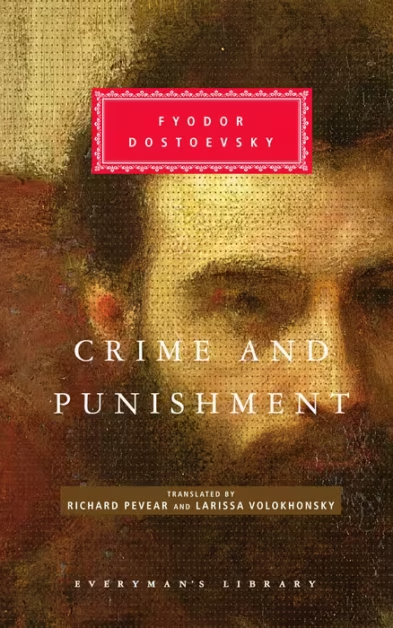
1. Crime and Punishment by Fyodor Dostoevsky (1866)
Let’s start with the one that gets people defensive. Hard to believe that one of the most celebrated novels is also one of the most overrated novels of all time.
Crime and Punishment is genuinely important. It marked a turning point in the psychological novel, and Raskolnikov’s slow unravelling remains one of literature’s more gripping portraits of a mind at war with itself. Harold Bloom called it “the best of all murder stories” and said it “alters our consciousness.”
That’s not nothing.
But the novel’s greatest champion might also have had its sharpest critic. Vladimir Nabokov — no philistine — described Dostoevsky’s work as that of “a rather mediocre” writer with “wastelands of literary platitudes in between” his flashes of brilliance. Of Crime and Punishment specifically, Nabokov dismissed the central premise with characteristic sharpness: “Raskolnikov for some reason or other kills an old female pawnbroker and her sister.”
That “for some reason or other” is doing a lot of work.
Because once you peel back the theological scaffolding — the Christian redemption arc, the heavy-handed symbolism, the Sonya-as-salvation subplot — what you have is a 500-page novel that spends roughly 480 of those pages telling you the same thing: guilt is corrosive, conscience is inescapable.
True. Not subtle.
The pacing is relentless in the wrong direction: repetitive, circular, prone to melodrama. Characters who exist solely to deliver philosophical arguments. And the ending, widely praised, can also be read as an abdication — a writer who built an intricate philosophical trap and then unlocked it with a Sunday school key.
What it does brilliantly: the claustrophobic psychology of the early sections, the interrogation scenes with Porfiry. What it doesn’t do: earn its canonical status as unambiguously the greatest thing Dostoevsky ever wrote, when The Brothers Karamazov arguably does everything Crime and Punishment attempts and does it better.
READ INSTEAD: The Brothers Karamazov (Dostoevsky)
2. Oliver Twist by Charles Dickens (1837–1839)
Dickens is one of the great novelists. Oliver Twist is one of his weakest books given how loudly it’s celebrated.
It’s a novel of social protest — and a necessary one. The conditions of the Victorian workhouse, the exploitation of child labour, the casual cruelty of the Poor Law system — Dickens puts all of it on the page with the moral clarity of a man genuinely furious. That anger is real, and it produces some of the most memorable set pieces in nineteenth-century fiction: the workhouse, the pickpockets, Fagin’s den.
But Oliver Twist has a protagonist problem. Oliver himself is barely a character. He’s a plot mechanism — a symbol of innocence passed from villain to villain to prove that innocence exists. He has no interiority, no development, no agency. Things happen to Oliver.
He reacts mostly by crying or fainting. For a novel that’s supposed to be about him, he’s the least interesting person in it.
The novel is also frequently cited as a source of antisemitic characterisation, particularly in the portrayal of Fagin. Dickens was later troubled enough by this himself that he revised the text in the 1867 edition, reducing the number of times Fagin is referred to as “the Jew.” The revision helped; the original depiction remains a problem that is often glossed over when the book is taught.
The plot collapses into coincidence in the final act — a melodrama of long-lost families and convenient inheritances that reads less like a resolved story than an author who needed to wrap things up.
Dickens wrote Bleak House, Great Expectations, and Dombey and Son. Oliver Twist is the novel people know, but how it ends in the list of the most overrated novels of all time is definitely depressing for some readers.
READ INSTEAD: Great Expectations (Dickens)
3. Lady Chatterley’s Lover by D.H. Lawrence (1928)
The trial that made this novel famous — Regina v. Penguin Books Ltd, 1960 — probably did more for its reputation than anything Lawrence actually wrote. “Is it a book you would wish your wife or servants to read?” asked the prosecution, and the question was so perfectly absurd that the defence practically won on the spot.
The novel gained its cultural status as a landmark in the fight against censorship. That fight mattered. The legal victory mattered. But separating the book from the case, you have something considerably less impressive.
Lady Chatterley’s Lover has stretches of prose that are unmistakably Lawrence — fierce, physical, attentive to the body’s intelligence in ways that few of his contemporaries attempted. The critique of industrial England, the English class system, the emotional numbness Lawrence saw spreading through modern life — this is the stuff he genuinely understood and wrote about with real authority.
What he didn’t do well: write a believable relationship.
Connie Chatterley and Mellors are primarily a vehicle for Lawrence’s theories about sex and vitality rather than two people you believe in. Mellors in particular is less a character than a mouthpiece — the virile working man as philosophical counterweight to the paralysed Clifford.
The explicit passages, which caused the legal uproar, are not especially well-written once the scandal fades. They’re earnest to the point of inadvertent comedy.
Lawrence wrote better books. Sons and Lovers is more honest. The Rainbow is more ambitious. This one gets the reputation largely because of a courtroom drama it wasn’t there for.
READ INSTEAD: Sons and Lovers (Lawrence)
4. Tender Is the Night by F. Scott Fitzgerald (1934)
Here’s the problem with Tender Is the Night: you can tell it desperately wants to be great. You can feel Fitzgerald reaching. He spent nine years on it, drew on his most painful autobiographical material — his wife Zelda’s psychiatric breakdowns, his own alcoholism, the slow dissolution of their lives among the wealthy expatriates of the French Riviera — and believed he was writing his masterpiece.
The novel received mixed reviews on publication and was a commercial failure.
It was only later, particularly after Fitzgerald’s death in 1940, that critical opinion began to shift in its favour. Today it is sometimes called his most accomplished work — a claim that, when you read it alongside The Great Gatsby, is difficult to sustain.
The structural problems are real. Literary critics at the time of publication noted the novel’s uneven quality — beautiful prose alongside an awkward structure that confused rather than intrigued. The flashback at the novel’s centre doesn’t complicate the story so much as fracture it.
Dick Diver’s decline, which should feel inevitable, sometimes feels inert — a man drifting downward without the reader fully understanding why each step downward follows from the last.
Fitzgerald himself recognised this. He left notes for a chronological revision that would fix the structure; he died before completing it. The revision was published posthumously in 1951 but is generally considered inferior to the original, and the structural dissonance remains.
It’s a novel about waste — of talent, of love, of possibility — and that theme is genuinely moving. But the execution is uneven in ways the reputation tends to minimise.
READ INSTEAD: The Great Gatsby (Fitzgerald)
5. Animal Farm by George Orwell (1945)
This is the one that will produce the most pushback, so let’s be precise about the argument.
Animal Farm is effective. It’s brilliantly concise, immediately readable, and its central allegory — the Russian Revolution decoded through a barnyard fable — is executed with real precision. Orwell knew exactly what he was doing, and he did it cleanly. The novel’s famous closing line earns its place in literary history.
But there is a difference between effective and profound, and Animal Farm is regularly treated as though it’s the latter. The allegorical simplicity that makes it accessible is also its limitation.
Professor Mary Vincent, in a widely cited analysis, called it “powerfully written but fundamentally untruthful” — arguing that Orwell’s experience in the Spanish Civil War led him to a reductive reading of the Soviet Union that flattened the actual complexity of what happened.
The novel says: some animals will always be more equal than others. What it doesn’t do — and what a more probing work might have done — is grapple with why revolutions fail, what structural conditions allow authoritarianism to take hold, or what a better alternative looks like.
As one academic analysis put it, the novel “offers no concrete solutions” and is “limited to criticism and exposure of weaknesses, to saying what not to do rather than what to do.”
For a work so frequently assigned as a guide to totalitarianism, it’s remarkably incurious about the mechanics of power.
READ INSTEAD: Nineteen Eighty-Four (Orwell)
6. On the Road by Jack Kerouac (1957)
Truman Capote said it was not writing but typing. That’s too dismissive, but it points at something real.
On the Road became a cultural monument — the Beat Generation’s founding text, the novel that told a generation it was acceptable to leave, to move, to not settle down. That’s a legitimate cultural role, and the book played it with genuine force. Its influence on Bob Dylan, the Doors, and the hippie movement that followed is well-documented.
As a novel, it’s considerably more fragile. The prose is deliberately shapeless — Kerouac’s “spontaneous bop prosody” was an aesthetic choice, but one that makes the book exhausting rather than exhilarating across 300 pages.
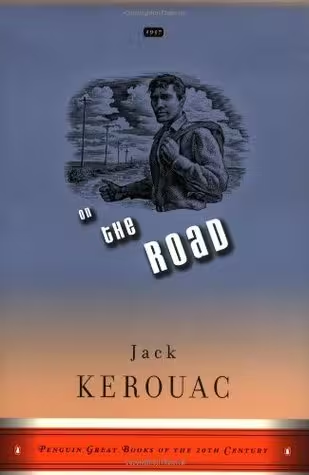
The characters — particularly Dean Moriarty, modelled on Neal Cassady — are treated with an uncritical reverence that the text never earns. Dean abandons his children, steals cars, treats women as pit stops on a journey that’s entirely about him. Sal Paradise narrates this as though it’s spiritual enlightenment.
What the novel actually is, once the mythology is set aside, is a story about restlessness that mistakes movement for meaning. Critics at the time noticed: Time magazine, in its original assessment, called the post-WWII generation short on talent compared to Fitzgerald and Hemingway, and labelled Kerouac “a literary James Dean.” That was harsh, but the comparison — style over substance, the image of rebellion more compelling than its content — is not entirely unfair.
READ INSTEAD: Dharma Bums (Kerouac) — or, more honestly, Go by John Clellon Holmes, which covers the same ground with more literary control.
7. Couples by John Updike (1968)
Couples is perhaps the least well-known book on this list, which raises an obvious question: if it’s relatively obscure, how can it be overrated?
Because within the specific conversation about American fiction of the 1960s, and within Updike’s own reputation, it punches far above its weight. It appeared on the cover of Time magazine in April 1968. It was a bestseller. It was treated as a serious social novel — a diagnosis of suburban malaise, sexual liberation, and the spiritual hollowness of the American professional class.
What it actually is: an extremely long account of ten couples in a Massachusetts suburb having affairs with each other. Updike’s prose, at its best, is extraordinary — precise and sensuous, attentive to surfaces in ways that illuminate something beneath them.
But Couples uses that prose in the service of characters who are largely interchangeable in their privilege, their restlessness, and their willingness to mistake adultery for existential inquiry.
The social critique that admirers point to — the novel as an anatomy of how a community replaces religious faith with eros — is present, but it sits atop 450 pages of people sleeping with other people’s wives and debating it at dinner parties. The ratio of insight to length is punishing.
READ INSTEAD: Rabbit, Run (Updike) — where the same themes are explored with more compression and more actual character.
8. Nights at the Circus by Angela Carter (1984)
Angela Carter is a genuinely important writer. The Bloody Chamber is one of the most distinctive short story collections in the English language. Magic realism at its best is electric.
Nights at the Circus is not Angela Carter at her best.
It is a novel about Fevvers, a trapeze artist who may or may not have wings, and the journalist Jack Walser who follows her across Europe and into Siberia to determine whether she’s real. The premise is rich. Carter’s prose is, as always, extraordinary — baroque, carnivalesque, committed to its own extravagance in a way that demands you meet it on its terms.
The problem is sustainability. What works brilliantly for 80 pages becomes episodic and self-indulgent across 300. The novel’s structural looseness — its willingness to go wherever Carter’s imagination leads without much regard for narrative tension — is both its strength and its failure. Walser, who should anchor the reader, disappears for long stretches.
The Siberian section, taking up much of the final third, has attracted criticism for precisely this reason: it loses momentum and substitutes incident for development.
Carter’s admirers say this is the point — that the novel resists conventional structures as part of its feminist project. That’s a legitimate reading. It’s also possible that a shorter, tighter version of Nights at the Circus would have been a better book, and that critical reverence for Carter’s reputation has made it harder to say so.
READ INSTEAD: The Bloody Chamber (Carter)
9. The Bonfire of the Vanities by Tom Wolfe (1987)
The Bonfire of the Vanities is a formidable piece of work. Tom Wolfe spent time riding with police officers, attending court hearings, and building the kind of documentary foundation that most novelists would never consider. The result is a novel that captures 1980s New York — its hierarchies, its racial tensions, its financial excess — with a specificity that few novels of its era match.
The problem is that Tom Wolfe is better at spectacle than people.
His strengths come from journalism: social observation, status anxiety, the surface details of how people perform class and power. His limitation, as critics have noted, is that his characters function primarily as New York types. Sherman McCoy, Larry Kramer, Peter Fallow — they’re recognisable, but they’re also somewhat hollow at the centre. The EBSCO literary analysis put it plainly: “Wolfe’s forte is not characterization but rather his penetrating social intelligence, which typically finds expression in satire.”
That’s true, but it means the novel asks you to care about characters who exist mainly as vectors for Wolfe’s social commentary.
The racial politics of the novel have also aged awkwardly. The Bronx residents are rendered largely as an undifferentiated threat. The critique of how racial anxieties are manipulated by media and politics is sharp, but the execution is sometimes more caricature than criticism.
It works better as a time capsule than a novel. As the definitive novel of the 1980s, as it’s sometimes called, it earns that tag. As one of the great American novels, the claim is harder to sustain.
READ INSTEAD: American Pastoral (Philip Roth)
10. American Psycho by Bret Easton Ellis (1991)
American Psycho arrived in 1991 amid extraordinary controversy. Simon & Schuster dropped it before publication following protests from feminist organisations, primarily the National Organization for Women, who objected to its depictions of graphic violence against women. The book found another publisher, and its notoriety guaranteed it an audience. In Australia, it still cannot be sold to readers under eighteen and must be sold in shrink-wrap.
The satirical argument for the novel is not without merit. Patrick Bateman — the Wall Street psychopath who may or may not be actually killing anyone — is a vehicle for an indictment of 1980s consumer capitalism. The brand obsession, the status anxiety, the interchangeability of everything including human life — it’s a real critique, and Ellis executes the banality of Bateman’s world with unsettling precision.
But the satire doesn’t require the detail. As one critic put it, “its one-note satire would find a better home in a short story.” The hundreds of pages of graphic torture and sexual violence are not transformed by the satirical intent — they remain what they are. The argument that they are “necessary” to the novel’s project is one the novel makes largely on its own behalf, and it’s not entirely convincing.
What’s more interesting is the unreliable narrator question at the novel’s core: does Bateman actually commit these crimes, or are they fantasies produced by a mind corroded by the culture he inhabits?
That ambiguity is genuinely compelling. It’s just buried under pages of material that many readers, reasonably, find impossible to get through.
READ INSTEAD: Less Than Zero (Ellis) — the same world, the same moral vacuum, with considerably more restraint.
11. The Secret History by Donna Tartt (1992)
The Secret History is, by any honest measure, a very good novel. The premise — a group of classics students at a small Vermont college commit murder, and the novel opens by telling you so — is brilliantly constructed. The reversal of the whodunit structure, revealing the crime upfront and spending 500 pages on the why and the what-comes-after, is a genuine formal achievement.
So why is it on this list?
Because in the thirty years since publication, The Secret History has acquired a critical aura that positions it as one of the great American novels of the late twentieth century, and that claim doesn’t quite hold up. The novel’s greatest strength — its atmosphere, its seductive portrait of a claustrophobic academic world, its investment in the idea that beauty can justify transgression — is also its weakness. The characters are types as much as people.
Henry is a cold abstraction. The twins are gothic decoration. Richard, the narrator, is largely passive throughout a novel in which he is the moral centre.
The ending is rushed compared to the careful construction of everything before it. And the novel’s central philosophical proposition — that an excess of Apollonian rationality deadens us to the darker, more vital forces that classicists access through Greek — is stated more than dramatised.
Donna Tartt’s The Goldfinch, which won the Pulitzer in 2014, attracted a substantial critical backlash that The Secret History somehow avoided. Both novels share similar structural problems; the latter’s reputation has simply been more protected.
READ INSTEAD: The Goldfinch (Tartt) — flawed, but more ambitious.
12. Amsterdam by Ian McEwan (1998)
Ian McEwan won the Booker Prize for Amsterdam in 1998, a win that McEwan himself has described with something approaching ambivalence.
In a 2023 interview with the Booker Prize committee, he acknowledged the backlash, noting the novel’s “misfortune was to win the Booker Prize, at which point some people began to dismiss it.” The 1998 chair of judges, Douglas Hurd, described it as a “quiet year” with “no sensational or overpowering entries.”
That context matters. Amsterdam didn’t win because it was McEwan at his best; it won because 1998 didn’t offer stiff competition.
The novel is a black comedy about two friends — a newspaper editor and a composer — who make a euthanasia pact and then betray each other through vanity and small-mindedness. McEwan’s precision is everywhere: the prose is clean, the satire of British intellectual self-regard is sharp, the construction is almost clinically efficient.
But it is, as critics have noted, a “quiet” book. It lacks the emotional weight of Atonement, the moral complexity of Saturday, the sustained dread of The Comfort of Strangers. The final act — a twist that depends on a coincidence bordering on farcical — has been widely criticised as a “cheap trick.”
For a Booker winner by one of Britain’s most accomplished novelists, it’s remarkably thin.
READ INSTEAD: Atonement (McEwan)
13. White Teeth by Zadie Smith (2000)
White Teeth was greeted on publication as a generational event. Zadie Smith wrote it at twenty-four. It won the Whitbread First Novel Award. It appeared on every list of important debut fiction of the new millennium. It was, it seemed, exactly what British fiction needed: sprawling, multicultural, funny, ambitious, and deeply contemporary.
Twenty-five years on, some of that first impression holds. Smith’s ear for dialogue is real. Her management of multiple families across generations — the Joneses, the Iqbals, eventually the Chalfens — shows a structural ambition that most debut novelists would never attempt.
And the central themes, the way history follows immigrant families forward into the present, the absurdity of trying to escape your own roots, remain genuinely interesting.
But White Teeth also has a problem that’s been noted in repeated critical assessments: the novel resists meaning. As one extended analysis put it, White Teeth “seems to exist in a critical No Man’s Land, where attempts to fix its meaning are endlessly deferred.”
Is it a celebration of multiculturalism or a critique of it? Is it sympathetic to its characters or mocking them? The novel’s polyphonic ambition — letting everyone speak, refusing to adjudicate — produces richness in some scenes and shapelessness in others.
The ending, specifically, has been widely criticised for being unable to resolve what it’s spent 500 pages building. The Chalfens, introduced in the novel’s second half, tilt the whole structure sideways without adding enough to justify it.
READ INSTEAD: NW (Smith) — tighter, stranger, more honest.
14. Life of Pi by Yann Martel (2001)
Life of Pi won the Booker Prize in 2002 and has sold over 12 million copies worldwide, according to Yann Martel’s publisher. It was adapted into a film by Ang Lee that won four Academy Awards. It is, in short, a phenomenon.
The novel has a genuine structural conceit at its heart: a shipwrecked boy shares a lifeboat with a Bengal tiger named Richard Parker, and the story he tells may or may not be the actual story of what happened. The ambiguity is purposeful. The ending offers a second, grimmer version of events and asks: which story do you prefer?

This is interesting territory.
The problem is what surrounds it. The first section — Pi’s religious upbringing, his simultaneous embrace of Hinduism, Christianity, and Islam — is often cited as essential grounding, but it runs considerably longer than it needs to and the theology it sets up (“believing in God is choosing the better story”) is, as critic Pankaj Mishra noted in a review, more assertion than argument. Martel, as Mishra observed, “is unable to reveal adequately the precise nature, or vacillations, of Pi’s faith.”
The book tells you God is real because the tiger story is a better story. That’s a novelist’s argument, not a philosophical one.
The carnivorous island — a floating island of algae that eats human flesh at night — is where many readers’ goodwill runs out. It’s not that magical realism can’t work; it’s that this particular element feels unearned.
READ INSTEAD: The Old Man and the Sea (Hemingway) — a shorter, starker, more honest book about a man and an ocean.
15. The Alchemist by Paulo Coelho (1988)
No list of overrated novels is complete without it.
The Alchemist has sold over 65 million copies, making it one of the bestselling books in history. It has been translated into more than 80 languages. Paulo Coelho is beloved by readers on every continent. Any criticism of this book is going to feel, to many people, like an attack on something deeply personal.
Acknowledged. And still.
The novel is a fable about a shepherd boy named Santiago who pursues his “Personal Legend” — his destiny — across North Africa to the Egyptian pyramids, where he expects to find treasure. The universe, Coelho tells us throughout, conspires to help those who pursue their dreams. “When you want something, all the universe conspires in helping you to achieve it.”
The philosophy here is not complex.
Critics have consistently noted its simplicity: the narrative is predictable, the prose (even allowing for translation) is deliberately unadorned to the point of flatness, and the spiritual message — follow your heart; the world will help — is not examined so much as repeated. What does it mean for the universe to conspire for one person’s Personal Legend? Whose Personal Legend wins when two people want the same thing?
The book doesn’t ask.
Finally, I have considered that The Alchemist is one of the most overrated novels of all time. What it does is comfort. It tells readers that their dreams are valid, that the universe is on their side, that struggle is meaningful because it leads to treasure. These are not small things to offer, and the emotional impact on millions of readers is real and should be respected.
But as literature — as a work that examines experience, sits with complexity, and refuses easy answers — it does almost none of those things.
READ INSTEAD: The Stranger (Camus) — a short, uncomfortable novel about meaning that doesn’t promise the universe is on your side.
FAQs
1: What makes a novel overrated rather than just bad?
An overrated novel usually has something in it — a style, an idea, a moment, a historical importance. The problem is that the reputation assigned to it exceeds what the text actually delivers. A bad novel is simply unsuccessful on its own terms. An overrated novel succeeds, partially, but is treated as though it succeeds completely.
2: Are these novels worth reading despite being overrated?
Yes, most of them. Reading a canonical novel critically — knowing what you’re looking for, knowing what critics have noted as its weaknesses — is a more honest and often more rewarding experience than reading reverently. You’ll find more in Crime and Punishment if you go in knowing it has structural problems.
The same goes for most titles on this list.
3: How is “overrated” different from “I didn’t like it”?
Personal preference and critical assessment aren’t the same thing. A novel can be overrated and you can still love it — that just means your experience of it matched its reputation. The argument here is that these novels have been assigned cultural authority that doesn’t hold up under close, honest scrutiny, not that they’re unenjoyable.
4: Why is Crime and Punishment on this list but not The Brothers Karamazov?
Because The Brothers Karamazov earns its reputation more completely. It’s longer, more structurally complex, more philosophically rigorous, and the characters are more fully realised.
Crime and Punishment is often treated as the better book because it’s the more famous one — that’s exactly the kind of reputation gap this list is addressing.
5: Is calling a classic novel overrated a valid critical position?
Yes. Literary reputations are not established by the texts themselves but by the critical institutions — universities, prize committees, syllabi, publishing traditions — that promote them.
Those institutions have biases, blind spots, and historical contexts of their own. Subjecting canonical works to the same scrutiny applied to contemporary fiction is not disrespectful. It’s how criticism actually works.