
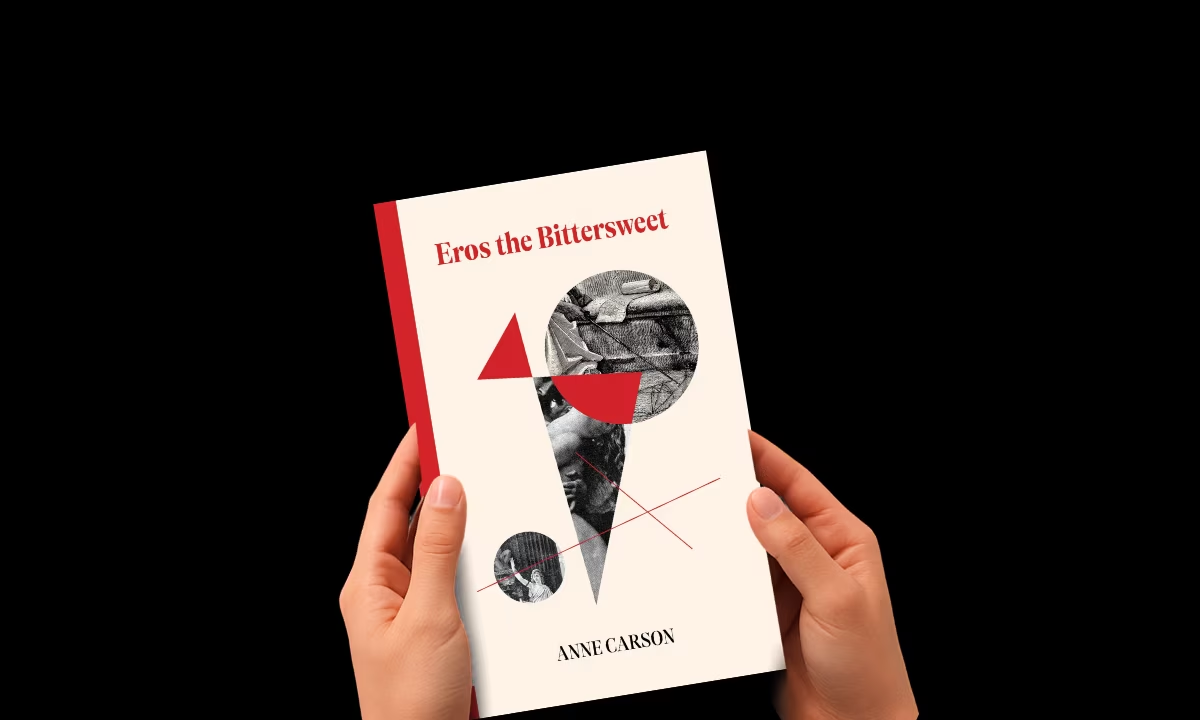

Eros the Bittersweet argues that desire is built on lack. You can only want what you do not have, so love needs a gap to survive: a rival, an obstacle, a delay, a closed door. Carson calls this structure a triangle (lover, beloved, and whatever stands between them) and finds it everywhere, from Sappho’s fragments to the ancient Greek novel to Plato’s Phaedrus.
Her boldest claim is that the Greek alphabet, by giving words hard edges, taught early poets to feel the edges of the self, and so to write about love as invasion and loss.
The prose is brilliant and compressed. The literacy argument is speculative, and Carson more or less admits it. Read it if you care about poetry, philosophy, or the strange logic of longing. Skip it if you want a practical book about relationships.
Table of Contents
Why does wanting someone so often feel better than having them?
Most of us have known the feeling, even if we would not admit it out loud. The waiting is electric. The message that has not arrived yet is more alive than the one that has. Then the thing we wanted actually happens, and something goes slack.
Anne Carson wrote a whole book about that slack, and about the tension that comes before it. Eros the Bittersweet was her first book.
It started life as a doctoral thesis at the University of Toronto in 1981, came out from Princeton University Press in 1986, and has been reprinted ever since, most recently in the Princeton Classics series in 2023.
On paper it is a study of how ancient Greek poets, novelists and Plato wrote about erotic desire. In practice it reads like a series of short, sharp meditations on why love hurts, why reading feels like flirting, and why the most important person in a love poem is usually not the beloved.
I read it straight through from the Dalkey Archive edition, then went back over the sections that stung. Here is what is in it, what works, and where I think Carson overreaches.
Eros the Bittersweet Details at a Glance
| Detail | Information |
|---|---|
| Author | Anne Carson (born 1950, Toronto) |
| Original publisher | Princeton University Press, 1986 |
| Editions | Dalkey Archive Press (1998); Princeton Classics (March 2023) |
| Origin | Reworked from Carson’s 1981 University of Toronto doctoral thesis, Odi et Amo Ergo Sum |
| Length | About 170 pages of text in the Dalkey edition, in 34 short sections plus a preface |
| Genre | Essay, classical scholarship, literary criticism |
| Recognition | Voted onto the 1999 Modern Library readers’ list of the 100 best nonfiction books of the 20th century |
Suggested readers for Eros the Bittersweet
Eros the Bittersweet is best for:
Readers of poetry, especially anyone who has met Carson through Autobiography of Red or her Sappho translations, students of classics, comparative literature or philosophy who want Plato and Sappho read side by side, anyone who likes short, dense essays they can reread a page at a time.
And, writers curious about why readers fall for books the way they fall for people
Eros the Bittersweet is not for:
Readers looking for relationship advice or the psychology of attachment, anyone who wants a single, linear argument with a tidy conclusion, readers put off by blocks of Greek text (Carson translates everything, but the originals sit on the page), and people who want love examined from the beloved’s side as much as the lover’s.
Eros the Bittersweet Summary
Carson does not use numbered chapters. Eros the Bittersweet runs as 34 short sections, most of them three to six pages long, each with its own title. They fall into roughly six movements, which is how I will walk through them.
The Preface: A Philosopher Chasing Tops
Eros the Bittersweet opens with Kafka’s story “The Top,” about a philosopher who hangs around children so he can snatch their spinning tops. Every time a top starts spinning he is sure he is about to understand everything. Every time he catches one, he feels sick.
Carson’s point is that he does not really want understanding. He wants the chase. The running, breathless and not yet arrived, is the pleasure. That one image contains the whole book.
Movement One: The Bittersweet Triangle (“Bittersweet” to “The Reach”)
Bittersweet. Carson starts with a single word from Sappho, glukupikron, usually translated “bittersweet” but literally “sweetbitter.” She reads Sappho’s fragment 130 closely: eros arrives “again,” loosens the limbs, and comes creeping in from outside, impossible to fight off.
Carson argues that Sappho is not describing a love affair that starts sweet and turns sour. She is describing one moment in which pleasure and pain arrive together. Eros comes from outside the lover’s will, which makes it a kind of enemy.
Carson then lines up the long tradition of love-and-hate in a single feeling: Aphrodite threatening Helen on the walls of Troy, Menelaos in his empty palace, Catullus’s famous “I hate and I love.”
Gone. The Greek word eros, Carson notes, means want or lack. You cannot desire what you already have. She calls witnesses from every century: Diotima in Plato’s Symposium, Simone Weil on hunger, Emily Dickinson, Sartre, Simone de Beauvoir, Lacan. All of them, in different words, say the same thing. Desire runs on absence.
Ruse. This is the heart of Eros the Bittersweet and the section most people remember. Carson reads Sappho’s fragment 31, the poem in which Sappho watches a man sitting close to the woman she loves and falls apart: tongue broken, fire under the skin, ears drumming, greener than grass. Scholars have long argued over whether the poem is about jealousy.
Carson says no. Sappho does not want the man’s seat; she would be destroyed in it. The poem is about the shape of desire itself, which needs three points: lover, beloved, and something in between that keeps them apart. The man is not a rival. He is a structural necessity.
Carson ends the section with a line that sums up her whole approach: “Eros is a verb” (p. 17).
Tactics. If desire needs a gap, lovers will find ways to create one. Carson surveys them: the troubadours’ “love from a distance,” the endless chases of Greek myth, the pursuit-and-flight scenes on Greek vases, the shy glance held back by aidos (a kind of erotic modesty).
She lingers on Alkibiades in Plato’s Symposium, wrapping Socrates in his own cloak and lying all night beside him with nothing happening, and compares it to Tristan laying a sword between himself and Iseult.
She also covers the Athenian double standard that told men to pursue boys and praised boys who refused, and the Cretan custom of ritual abduction. Society, she suggests, builds the lover’s divided heart into its rules.
The Reach. A three-line Sappho fragment about an apple left on the highest branch, which the apple-pickers forgot, then corrects itself: no, they could not reach it. Carson shows how the grammar never arrives at a main clause, how the meter tightens, how the sounds reach after each other. The poem is about wanting and it performs wanting. The apple stays up there forever.
Movement Two: The Edge of the Self (“Finding the Edge” to “Alphabetic Edge”)
Finding the Edge. Desire teaches us where we end. Carson compares it to infants learning to see edges by wanting them not to be there. Reaching for someone shows the lover the hole in himself.
Her line on love poetry is one of the best in the book: the real subject is “Not the beloved. It is that hole” (p. 30). She then turns to Aristophanes’ myth in the Symposium, where humans were once round double creatures split in half by Zeus and now spend their lives hunting for their other halves.
Logic at the Edge. The lover reasons like someone making puns. He sees a person he never knew he lacked and decides that person was always a missing part of himself.
Carson catches Socrates doing exactly this with the Greek word oikeios (which means both “akin to me” and “mine”) in Plato’s Lysis. She brings in Virginia Woolf’s Neville from The Waves, who feels himself “mixed up” with Bernard as Bernard walks toward him, and Bruno Snell’s famous (and contested) thesis that the Greek sense of an individual self was born in moments of blocked desire.
Her one-line verdict on the lover’s wish to merge: “Words do have edges. So do you” (p. 35).
Losing the Edge. Nietzsche thought being in love made a person feel richer and more complete. The Greek lyric poets did not. For them, love melts, pierces, crushes, bites, grinds to powder.
Carson asks why these particular poets were so frightened of losing control of their bodies, and proposes an answer: they were among the first Greeks to write their poems down.
Reading and writing, she argues, train a person to shut out the senses and control the body. Someone trained that way would experience a sudden flood of emotion from outside as a real threat.
Archilochos at the Edge. A close reading of a three-line fragment by Archilochos in which desire curls up under the poet’s heart, pours mist over his eyes, and steals the lungs from his chest.
Carson explains that for the Greeks the lungs (phrenes) were the seat of breath, perception and thought, and that oral culture imagined the world as a continuous flow of breath with no hard edges. Writing breaks that flow. Written words sit apart from each other and from the reader.
Alphabetic Edge. Here Carson makes her most daring move. The Greek alphabet was the first writing system to separate vowels from consonants. A consonant cannot be pronounced on its own; it marks the start and stop of a sound. It is, in her reading, an abstraction, a thing of edges.
She ties this to the delight early Greeks took in letters: a scene from Euripides in which an illiterate man describes the shapes of the letters in “Theseus,” plays in which actors danced the alphabet, the reed pen invented to keep letter edges clean. She admits her motive plainly: “I am writing this book because that act astounds me” (p. 61).
Movement Three: Imagination (“What Does the Lover Want from Love?” and “Symbolon”)
What Does the Lover Want from Love? On the surface, the beloved. In fact, Carson says, the lover wants the reaching itself. Union would end everything.
She gathers modern evidence: Stendhal’s idea of “crystallization,” in which a bare branch left in a salt mine comes out glittering; Anna Karenina comparing the real Vronsky with the imagined one; Emma Bovary writing to a phantom; Kawabata’s novelist who loses interest in his wife once he gets used to the gap between his handwritten pages and the typed and printed versions she produces.
She returns to Aristophanes’ myth: when the god Hephaistos offers to weld two lovers into one forever, Aristophanes insists no lover could want anything else.
Carson points out that his own round creatures, once whole, got restless and tried to storm Olympus.
Symbolon. Carson links loving to knowing. Both involve reaching from what you have toward what you lack.
She uses Velázquez’s painting Las Meninas, with its mirror at the back showing the king and queen standing exactly where the viewer stands, as an image of the “blind point” where we try to see ourselves seeing.
Metaphor works the same way, holding two meanings in tension. The section ends with the Greek symbolon: half of a broken knucklebone carried as a token, matched against the other half. Every lover, Carson says, is half a knucklebone.
Movement Four: Novels and Letters (“A Novel Sense” to “Realist”)
A Novel Sense and Something Paradoxical. The ancient Greek romance, which its authors called “erotic sufferings,” exists to keep lovers apart for as long as possible: pirates, shipwrecks, false deaths, rival suitors, chastity.
Carson compares the reader’s relationship to the novel with the lover’s relationship to the beloved. We want the ending and we do not. Everyone in the chain is saying “not yet.” Readers stand at an angle to the story, seeing both what the characters believe and what is true. That double vision, she says, “is almost like being in love” (p. 85).
My Page Makes Love. A reading of Longus’s Daphnis and Chloe, especially a scene in which Daphnis climbs a bare tree to pick the one apple left at the top.
Longus expects us to recognise Sappho’s apple, and Carson shows how a single “and” in his Greek (which translators always change to “but”) holds an impossibility in suspension.
Letters, Letters. Letters in novels always arrive at an angle, creating a third presence between two people. Carson reads three: a letter that interrupts a wedding in Achilles Tatius, a royal message written on a baby’s wrap in Heliodoros (explaining why a Black queen bore a white daughter: she was looking at a painting of Andromeda at the moment of conception), and a princess in the Latin Apollonius of Tyre who rewrites her father’s list of suitors.
Folded Meanings and Bellerophon Is Quite Wrong After All. Early writing was private and folded: wax tablets that closed on themselves, lead strips folded around questions to the oracle at Dodona. Carson ends this run with the oldest story in Greek about writing: Bellerophon in the Iliad, sent off carrying a folded tablet that orders his own death, which he never reads.
Realist. A short summing-up. The reader wants from reading what the lover wants from love: a reach toward something not yet grasped. The unknown has to stay unknown or the novel ends. Carson compresses it into a formula: “all eros is, to some degree, desire for desire” (p. 109).
Movement Five: Time (“Ice-pleasure” and “Now Then”)
Ice-pleasure. A fragment of a lost satyr play by Sophocles compares desire to children grabbing a piece of ice: delightful and new at first, then you cannot hold it and cannot put it down.
Carson argues for keeping the manuscript reading of the first line, which binds desire to the passing day, and shows how the poem sets two kinds of time against each other, the time of melting and the time of novelty wearing off.
Now Then. Lovers are always waiting. Carson turns to a tiny Greek word, deute, that the lyric poets use again and again. It combines “now, look!” with “once again.” Sappho uses it at the start of fragment 130: here it comes again.
Carson suggests that writing gave these poets a new relationship to time, since a written word stays on the page while a spoken one vanishes, and that this taste of control is exactly what a lover craves. This sets up the last part of the book.
Movement Six: Plato’s Phaedrus (“Erotikos Logos” to “Mythoplokos”)
The final third of Eros the Bittersweet is a sustained reading of Plato’s Phaedrus, broken into a dozen short sections.
Phaedrus has fallen for a written speech by the orator Lysias, which argues that a boy should give his favours to a man who does not love him rather than one who does.
Carson’s sharpest observation is that Lysias’s whole case depends on viewing love from its end. The non-lover stands at “then,” safely past desire, and never risks “now.” Socrates’ first speech agrees that the conventional lover harms his beloved by trying to freeze him in time, keeping him young, dependent and away from philosophy.
Carson then follows Plato’s images of what happens when people try to step out of time: the epitaph on Midas’s tomb, whose lines can be read in any order; Midas himself, starving among gold; the cicadas who were once humans so enchanted by song that they forgot to eat and died singing; the “gardens of Adonis,” pots of seedlings forced to bloom in eight days and thrown away.
Plato puts writing in the same category. A written text, like a painting, looks alive but cannot answer a question.
Then comes the turn. Socrates asks Phaedrus to reread the beginning of Lysias’s speech, twice, looking for the moment love begins. It is not there; Lysias opens in the past tense.
Carson points out that the Greek verb “to read” literally means “to know again,” so “If you are reading, you are not at the beginning” (p. 152). Socrates’ answer to Lysias is to defend madness: the god-sent mania of love, which grows wings on the soul and lets it remember the reality it once saw.
Carson reads the deliberately broken line of verse in which the gods call Eros “Pteros,” the winged one, and notes that the extra letters wreck the meter. Divine meaning costs human form.
The dialogue then stops talking about love and starts talking about writing, and Eros vanishes from it. Carson treats this not as a flaw but as the point: “That is the most erotic thing about Eros” (p. 167).
The last section, Mythoplokos, imagines a city without desire, where nobody tells stories or spins tops, then sets Sappho’s name for Eros (“weaver of fictions”) beside Socrates’ (“sophist”).
Socrates claimed to know only “erotic things,” and Carson reads that as a love of the gap between known and unknown. Of the risk he took in chasing it, she writes that “he was in love with the wooing itself” (p. 173). The book ends on a question: who is not?
What Carson Is Really Arguing
Stripped down, Eros the Bittersweet makes four claims, and they stack.
First, desire is lack. This is the oldest and safest claim, and Carson gives it a dense body of evidence. She does not invent it; she borrows it from Plato and finds it in Weil, Sartre and Lacan.
Second, lack needs a structure, and that structure is a triangle. This is her real contribution. The third point need not be a person. It can be a veil, a sword, a rule, a letter, a delay, a piece of grammar that refuses to finish.
Once you see the triangle you see it everywhere, which is both the strength of the idea and its danger.
Third, the alphabet changed how Greeks felt love. Writing, Carson suggests, sharpened the sense of personal boundaries, and early lyric poets, newly literate, experienced eros as an invasion of a self they had only just learned to guard. This is the most original claim and the least proven.
Fourth, reading is erotic in the same way love is. A reader reaches for a meaning that stays slightly out of grasp, enjoys the delay, and both wants and dreads the ending.
The Plato chapters push this further: writing tempts us with the illusion of controlling time, which is exactly what the anxious lover wants and what Socrates says we must refuse.
The four claims fit together neatly. Whether they hold up separately is another question.
Personal Reflection: Reading Carson in an Age of Read Receipts
I went into Eros the Bittersweet expecting a classics thesis with nice sentences. I came out feeling slightly caught. Carson has a way of describing something you have felt and never put into words, then moving on before you have finished blushing.
The section that stayed with me longest was “Ruse.” I had read Sappho’s fragment 31 before, and like most readers I took it as a poem about jealousy: a woman watching someone else sit close to the person she loves. Carson’s reading reorganised the poem in my head.
The man is not a rival. He is the measure of distance that makes the feeling possible at all. Sappho is not asking to take his place. She is showing what desire looks like from inside, and it looks like a triangle.
Once I had that triangle in my head I could not stop seeing it. I thought of the three small dots that appear when someone is typing a message, and of how long a person can stare at them. Lover, beloved, and a blinking ellipsis in between. Carson wrote Eros the Bittersweet in the 1980s about poets who wrote on papyrus and wax, but her description of the reach that never quite arrives fits a phone screen uncomfortably well.
The “seen” notification with no reply is a very modern version of Sappho’s apple on the highest branch.
I also thought, inevitably, of Rabindranath Tagore’s Shesher Kobita (1929), which many Bengali readers will know far better than any Greek fragment.
Amit and Labanya, in love, decide to marry other people because they believe daily married life would kill what they have. Amit even explains it with an image: his love for Ketaki is like water in a jug, refilled and used up each day; his love for Labanya is a vast lake that cannot be brought home.
Tagore’s lovers deliberately keep the gap open. Carson would recognise them at once. Her line from “The Reach,” “A space must be maintained or desire ends” (p. 26), could be printed on the novel’s title page.
And yet I found myself arguing with Eros the Bittersweet as often as nodding. Carson’s lovers are almost always alone. The beloved is a point on a diagram, a laugh across a room, an apple.
That is honest to the poems she reads, but it leaves out the experience most people actually live with: love that is returned, that goes on for years, that has to survive breakfast. Tagore at least lets us see what Amit gives up by choosing the lake. Carson rarely asks what the lover’s beautiful distance costs the person kept at the far end of it.
The closest she comes is the Phaedrus section, where Socrates describes the lover who keeps his beloved young and dependent so his own pleasure can last. That passage felt like Eros the Bittersweet quietly answering its own romance of longing, and I wish she had stayed there longer.
What I admire most is her refusal to tidy things up. At several points Carson asks a question and then says plainly that she does not know how to answer it.
The essay on Bellerophon ends with exactly that admission. In a field where critics often sound certain about things no one can know, that candour felt like a kind of respect for the reader.
Eros the Bittersweet is not a book I will read once. The sections are short enough to read on a bus, and dense enough that each one repays a second pass. I suspect I will come back to it the way Carson’s philosopher keeps running back to the children’s tops: half hoping for understanding, mostly enjoying the chase.
Strengths and Weaknesses
Strengths
The prose. Carson writes academic argument in sentences a poet would envy. George B. Walsh, reviewing the book in Classical Philology, called her style “a constant source of pleasure.” I agree.
The reading of Sappho’s fragment 31. The triangle idea is simple, portable and genuinely changes how you read the poem.
Range without showing off. Sappho, Plato, Heliodoros, Stendhal, Woolf, Kafka, Kawabata and Velázquez sit together comfortably because each one is doing work in the argument.
Short sections. Each piece can be read on its own, which suits a book this dense.
Intellectual honesty. Carson flags her speculations as speculations and admits when a question has no answer.
Weaknesses
The literacy thesis rests on contested ground. Carson builds on Eric Havelock’s work on the Greek “literate revolution” and on Bruno Snell’s account of the discovery of the self. She herself notes that Snell’s thesis provoked wide dissent.
Later scholarship, notably Rosalind Thomas’s Literacy and Orality in Ancient Greece (1992), stressed how heavily Greeks continued to rely on oral communication and memory well into the fourth century BC, which makes a sharp break between oral and literate minds harder to sustain.
Carson calls her own alphabet question unanswerable; readers should take the chapter as a brilliant hypothesis, not a finding.
Lover-centred to a fault. Eros the Bittersweet theorises the one who wants, almost never the one who is wanted. Much of the source material involves Athenian pursuit of adolescent boys and ritual bride abduction, and Carson describes these customs accurately but mostly as evidence for the structure of desire rather than as relationships with a weaker party in them.
That is my reading, not a criticism I found in the published reviews, but it shaped how I felt about the middle chapters.
Repetition. Phrases such as “blind point,” “stereoscopy” and “shift of distance” return so often in the later sections that they start to feel like a private vocabulary.
A narrow archive. The evidence is overwhelmingly Greek and European, with occasional visits to Japan through Kawabata and Bashō. The claims about how humans love are larger than the sample.
The Greek on the page. Everything is translated, but blocks of untransliterated Greek and technical points about meter (correption, elision) will slow general readers.
How It Compares to Other Books on Love
Plato’s Symposium. Carson’s Eros the Bittersweet is in many ways a long footnote to Diotima and Aristophanes. If you have not read the dialogue, start there; our review of why Plato’s Symposium still matters is a good primer. Carson takes Aristophanes’ myth of split humans and asks the question Plato’s speaker ducks: would the lovers really accept being welded together?
Erich Fromm’s The Art of Loving. Almost the opposite book. Fromm treats love as an active practice of care and commitment, something you learn and sustain. Carson treats it as a wound that stays open. Reading them together is useful, and our piece on why The Art of Loving is the best book about love makes the case for Fromm’s side. For the long view across both, see The Philosophy of Love: Plato to Erich Fromm.
C.S. Lewis, The Allegory of Love. Lewis traces courtly love in medieval literature, the same “love from a distance” Carson mentions in passing with the troubadours. Our review of The Allegory of Love covers that ground in depth.
Denis de Rougemont’s Love in the Western World (1939). De Rougemont argued that romantic passion feeds on obstacles and made much of the sword Tristan lays between himself and Iseult. Carson uses the same image. Her contribution is to push the pattern back to Sappho and to treat it as a structure of perception rather than a cultural disease.
René Girard’s Deceit, Desire and the Novel. Girard’s theory of triangular desire, in which we want what a rival or model wants, is the obvious neighbour; Carson cites him. The difference is that Girard’s third point is always another person, while Carson’s can be anything that keeps lover and beloved apart.
Dante’s Inferno. Carson closes her novels section with Francesca, damned for a kiss that began over a book. If that moment interests you, our review of Dante’s Inferno looks at the canto in context.
Freud and modern science. Carson briefly invokes Freud on transference, the patient falling for an analyst built mostly from imagination. For the psychoanalytic and biological angles, see our pieces on Freud’s Psychology of Love and why we fall in love. For more titles in this vein, our list of the best books about love is a good next stop.
FAQs
What is Eros the Bittersweet about
It is an essay on erotic desire in ancient Greek literature. Anne Carson argues that desire depends on lack and needs three elements (lover, beloved, and something between them), and she traces that pattern through Sappho, the Greek novel and Plato’s Phaedrus.
Where does the word “bittersweet” come from?
Carson takes it from Sappho’s Greek compound glukupikron, which literally reads “sweetbitter.” Eros the Bittersweet opens with a reading of the fragment in which Sappho uses it.
Do I need to know Greek to read it?
No. Carson translates every passage she quotes. Knowing some Greek helps with the sections on meter and grammar, but the argument is clear without it.
Was Eros the Bittersweet Carson’s dissertation?
It is a reworked version of her 1981 University of Toronto doctoral thesis, Odi et Amo Ergo Sum (“I Hate and I Love, Therefore I Am”), published as a book in 1986.
How long is Eros the Bittersweet?
About 170 pages of main text in the Dalkey Archive edition, split into 34 short sections.
Conclusion: Is Eros the Bittersweet Worth Reading?
Yes, with the right expectations. This is not a guide to love and it is not a neutral survey of Greek attitudes to sex. It is a single, stubborn idea pursued through poems, novels and philosophy with unusual grace: that desire lives in the gap, and that the gap is not a defect to be fixed but the thing itself.
Some of it is speculation dressed in beautiful sentences, especially the argument about the alphabet. Some of it ignores what love looks like after the chase ends.
But the best sections, on Sappho’s triangle, on the apple out of reach, on Lysias and the lover who wants to stop time, change the way you read love poetry for good. Forty years after it first appeared, the book still feels less like scholarship than like being caught mid-thought by someone who has watched you wait by the phone.
Rating: 4.5/5
Eros the Bittersweet
Eros the Bittersweet argues that desire is built on lack. You can only want what you do not have, so love needs a gap to survive: a rival, an obstacle, a delay, a closed door. Carson calls this structure a triangle (lover, beloved, and whatever stands between them) and finds it everywhere, from Sappho's fragments to the ancient Greek novel to Plato's Phaedrus.
URL: https://www.sopranu.com/eros-the-bittersweet-anne-carson-review/
Author: Anne Carson
4.5
Pros
- Beautiful, compressed prose that gets better on a second reading
- One memorable central idea: desire needs three points, not two
- A reading of Sappho’s fragment 31 that changes how you see the poem for good
- Short sections you can read one at a time
- Ties lyric poetry, the ancient novel and Plato into a single argument
- Every Greek passage comes with Carson’s own translation
- Honest about where it is guessing
Cons
- The argument that the alphabet changed how Greeks felt love is speculative and contested by later scholars
- Almost entirely about the lover; the beloved rarely gets a voice
- Little to say about love that is returned and lasts
- Evidence is mostly Greek and European
- Pet phrases like “blind point” and “stereoscopy” repeat heavily in the Plato sections
- Blocks of Greek text and talk of meter can slow general readers
- Offers nothing practical for anyone looking for relationship advice





