The Testaments is a faster, more satisfying thriller than The Handmaid’s Tale, and a less frightening one. Margaret Atwood’s 2019 sequel trades one woman’s trapped, whispering dread for three testimonies, a hoard of stolen secrets and a ticking clock.
I think that trade works, with some caveats. It is a good read for anyone who wanted to know how Gilead fell, and a poorer one for readers who wanted the original’s ambiguity left alone.
Table of Contents
Overview
What it is: A sequel set fifteen years after the first novel, told through Aunt Lydia’s hidden manuscript and two witness transcripts from young women.
Who survives: Agnes, raised in Gilead, and Nicole, raised in Canada, escape with proof that brings the regime down. Becka, the Aunts’ most loyal Supplicant, does not.
The central idea: Power runs on records, and records can be turned against the powerful.
The ending: A 2197 academic symposium confirms the escape worked and Gilead collapsed. Aunt Lydia’s own fate is left open.
My verdict: 4/5. Gripping, funny in a very dark way, and lighter than its predecessor.
Introduction
The Testaments is by Margaret Atwood, published on 10 September 2019 in the United States by Nan A. Talese/Doubleday and in Canada by McClelland & Stewart. It is the sequel to The Handmaid’s Tale, which has sold about 8 million English-language copies.
The sequel was a hit too: it sold 125,000 copies in the US in its first week. It also shared the 2019 Booker Prize with Bernardine Evaristo’s Girl, Woman, Other, and Atwood, then 79, became the oldest winner in the prize’s history.

Quick Verdict
A sharp, quick-moving dystopian thriller that answers the question “How did Gilead fall?” with spycraft, blackmail and two brave girls. Recommended for fans of political thrillers and anyone who finished The Handmaid’s Tale wanting more.
Should You Read It?
| Pros | Cons |
|---|---|
| Aunt Lydia is a superb, morally slippery narrator | Less ambiguity and less dread than the original |
| Fast pacing, with short chapters and a real escape plot | Daisy’s teenage voice is sometimes thin |
| Shows how Gilead works from the inside | Agnes can read as too passive for much of the book |
| Satisfying payoff to a 34-year-old question | The Historical Notes explain a little too neatly |
| Works as a standalone, though the first book helps | Some readers find the tone lighter than the subject |
What Is It About?
Three narrators, Aunt Lydia, Agnes and Nicole, are drawn together as Gilead begins to rot from within. Lydia has spent years gathering evidence against the men who rule. Two girls become her messengers, and one of them is carrying a secret that could end the regime.
Rating: 4/5
Background
The Handmaid’s Tale ended with Offred stepping into a van, her fate unknown. Atwood has said readers kept asking what happened next, and the question that came up most often was how Gilead fell. In her acknowledgements she says the new book was written in response to that. She has also said that nothing in the Gilead books lacks a real-world precedent.
That rule holds in the sequel: the Pearl Girls, the purges and the marriage market all echo human history.
The Testaments Plot Summary
Three voices, one statue
The book opens with Aunt Lydia’s voice, in what she calls the Ardua Hall Holograph. She has been honoured with a statue while still alive, and she hates how clumsy it is. She is writing in secret, in blue drawing ink, and hiding the pages inside a nineteenth-century book by Cardinal Newman in the Ardua Hall library.
She tells the reader that she has buried many bones over the years and now wants to dig some up. Lydia is the most powerful woman in Gilead, and she has survived by knowing where the bodies are buried and keeping files to prove it.
The other two narrators speak in numbered witness transcripts. Agnes Jemima is the daughter of a high-ranking Commander, Kyle, and his Wife Tabitha, and she grows up inside Gilead’s pink, white and plum school uniforms. She is taught that girls are “precious flowers” in glass houses, and that men are tigers with searchlight eyes. She is also taught, kindly, by Aunt Estée, that marriage will not be so terrible. Agnes does not believe her. When Tabitha dies, Commander Kyle marries Paula, who is brisk and efficient and wants her own baby. Agnes becomes a spare part in her own home.
Daisy lives in Canada with Neil and Melanie, who run a secondhand clothes shop called The Clothes Hound. She is nearly sixteen, a normal teenager with a driving test ahead of her.
On the day before her birthday, her world ends. A bomb destroys the shop and kills Neil and Melanie. A hard, practical woman named Ada picks Daisy up and tells her that she is not who she thinks she is. Ada and a man named Elijah, both part of the Mayday resistance, reveal that she is Baby Nicole, the infant who was smuggled out of Gilead years ago.
Gilead treats her as a saint and a symbol, and her photograph hangs in every Aunt’s office. The girl who thought she was an ordinary Canadian is the most famous child in a country she has never seen.
The marriage market and the Aunts
Agnes learns that her own wedding is being arranged. The Aunts show her photographs of three candidates. The first is Commander Judd, an elderly Son of Jacob who has buried several Wives and has not fathered a child.
Agnes pictures herself as cold and bloodless as a Handmaid who died in childbirth in her father’s house. She considers running away and has nowhere to go.
Her friend Becka, Dr. Grove’s daughter, is also being married off. Becka is so desperate that she cuts her wrist with garden secateurs and bleeds over the daisies. Agnes ends up escaping marriage the only legal way: she joins the Aunts and enters Ardua Hall as a Supplicant. Becka follows her there.
Inside Ardua Hall, the girls study, pray and learn the “Reading Room” lessons. Aunt Estée has told them the story of the concubine in the Book of Judges as a tale of noble sacrifice. When Agnes finally opens the Bible, she finds that Estée lied. The woman was shoved out of a door, raped and cut into twelve pieces, and she never chose anything.
That discovery breaks something in Agnes. She had never doubted Gilead’s honesty before. Now she begins to doubt Gilead.
Lydia, meanwhile, has been listening. She has microphones in the walls and cameras she placed herself, and she has been collecting the shameful secrets girls whisper. In Becka’s case it took years for the cause of her distress to come out, and Lydia stored it away. She does not treat this as cruelty. She treats it as a tool.
How Lydia became Lydia
Through the Holograph, we learn that Lydia was a judge before Gilead. She grew up in a trailer park with a violent father and a family on the wrong side of the law.
After the regime took power, she was held in a stadium and then in the “Thank Tank.” She came out of it wearing a penitential brown robe, and Commander Judd, who had interrogated her, made her an Aunt. She now sits at the top of the women’s side of Gilead, alongside the hateful Aunt Vidala, the nervous Aunt Elizabeth and the head-counting Aunt Helena. She is also Judd’s creature, or so he believes.
She keeps recurring dreams of standing with a rifle at a stadium firing squad, shooting women she has known.
Lydia has been playing a double game for years.
She photographs the top-classification crime files of the Commanders and builds up a cache of proof that could destroy them. She also manages the Pearl Girls, the young Aunts sent abroad to recruit converts. One of them, Aunt Adrianna, dies in Canada, officially by suicide.
Her companion, Aunt Sally, hurries home and tells Lydia that Adrianna attacked her, and also that the couple running The Clothes Hound had a daughter of about the right age to be Baby Nicole. Lydia tells Sally to keep the suspicion to herself.
The Eyes’ agents have already bombed the shop. Lydia’s fingerprints are on everything, and she keeps them off the evidence.
Nicole enters Gilead
Mayday plans to use Nicole. They give her a fake identity, the runaway “Jade,” and a tattoo of the words GOD and LOVE on her arm. The tattoo hides a microdot that carries Lydia’s evidence. Nicole is sent into Gilead as a Pearl Girl convert, and Aunt Lydia receives her there.
In Ardua Hall, she meets Agnes and Becka. Nicole is sharp-tongued, bored by the lectures and bad at pretending. She does not fit in. Agnes, who is gentle and pious, takes her for a rough convert and prays for her.
Lydia leaves files for Agnes in the Reading Room. One tells Agnes that her mother is alive and that she has a younger sister, Nicole, who was smuggled out of Gilead as a baby. Underneath, in Lydia’s handwriting, is a note: Baby Nicole is here in Gilead. Agnes realises that her sister is the girl in the next room.
The book never names Agnes’s mother, though the Hulu adaptation makes her June, the original Offred, and the Historical Notes treat the fugitive Handmaid as the likely author of her tapes.
The raid, the wedding and the run
Two days before Agnes and Becka are to receive their pearls and become full Pearl Girls, Lydia arrives in their room, out of breath. Commander Judd has raided the Ardua Hall printing press and learned that Jade is Baby Nicole.
He wants to marry her on Gilead television, as quickly as possible, to boost his own standing. For Nicole, that is a death sentence, because Judd’s file shows what happens to his wives. Lydia tells Agnes and Nicole they must leave in the morning.
The plan is built on sacrifice. Nicole will take the pass of Aunt Immortelle, which is Becka’s name as an Aunt. Becka must hide inside Ardua Hall for forty-eight hours so no one counts a missing Aunt. To explain Nicole’s disappearance, she writes an elopement note, claiming she has run off with an Economan plumber named Garth. Lydia tells them the passwords, “May day” and “June moon,” and explains the route: a car to Portsmouth, a bus, a pickup truck, a motorboat. It is a brilliant, ugly plan, and Becka’s part is the ugliest.
The next day the cover story is tested. Aunt Helena discovers the missing girl, the Aunts shake their heads, and a search team is sent out. Aunt Vidala is found in a coma behind Lydia’s statue.
She had seen Jade in a silver Pearl Girls dress, and the narration implies she was knocked out for it. Judd summons Lydia, trembling with rage. Poor Aunt Immortelle is found dead in the cistern, where she had hidden. Lydia calls her a willing sacrifice.
Vidala later wakes and whispers that Lydia did this and will hang for it. Lydia gives Elizabeth the idea that Vidala’s pillow needs rearranging, and keeps a vial of morphine for herself.
The sea
Agnes and Nicole travel by ship, the Nellie J. Banks, commanded by a man named Captain Mishimengo. Nicole’s tattoo is infected, and she runs a fever.
When the boat has engine trouble in the Bay of Fundy, the captain puts them in an inflatable in Canadian waters, in fog and fast tides. Agnes prays. They row without knowing how. Nicole is barely conscious. They reach land, the message intact.
The Historical Notes
The novel ends on a conference transcript from 2197. Professor James Darcy Pieixoto presents the three documents to an audience at the Thirteenth Symposium on Gileadean Studies.
He explains that the microdot in Nicole’s tattoo exposed the Commanders’ plots against one another, setting off the Ba’al Purge, a military coup and a popular revolt that brought Gilead down. He tells his audience that the Holograph and the transcripts were found in separate places, one inside a Newman book at an auction, the other in a Labrador university library.
He shows a statue of Lydia, found in an abandoned chicken farm with its nose broken.
He closes with a memorial in Boston. It honours Becka, Aunt Immortelle, and was put up by her sisters Agnes and Nicole, their mother, their two fathers, their children and their grandchildren, with thanks to “A.L.” The girls lived.
The mother lived. Lydia’s own end, the footsteps at the door and the morphine, stays unwritten.
Analysis
Characters
Aunt Lydia is the book. She is cruel, funny, self-deceiving and brave, and Atwood lets her be all of them at once. Her humour is the most surprising thing about the novel: she mocks her own statue, her colleagues’ feet and her cold milk. But she also describes Becka’s sacrifice with a hard, clinical calm.
The book asks whether the good she does cancels the evil she has done. I think the honest answer is no, and Lydia seems to agree, which is why she refuses the trial she believes is coming.
Agnes is the true believer who learns to doubt. Her growth is quiet, and the turning point is a Bible she was never supposed to read. Some readers find her passive, but I read her as a girl who has been taught since the age of five that her body is a danger to men.
Her courage is an act of faith that survives losing faith in Gilead.
Nicole is the opposite: quick, rude and Canadian. She grows more slowly than Agnes but is more physically brave. Their friendship, which has to cross a wall of tone and belief, is the emotional heart of the book.
The scene on the boat, with Agnes mending Nicole’s fever with lemon juice and prayer, is the best of the book.
Becka is the book’s hidden tragedy. She is the first person Agnes loves, and she is sacrificed with a single paragraph of gratitude. I wish Atwood had given her more space.
Judd, Vidala, Elizabeth and Helena are drawn as small, scheming men and women, which fits the book’s point that tyranny is run by mediocrities.
Themes and Symbolism
Records as power. Almost every plot turn depends on paper. Lydia hoards files. The Bloodlines Genealogical Archives reveal Agnes’s family. A microdot in a tattoo carries a regime’s secrets out of the country. Even the ending is a conference about documents. In Gilead, women are not allowed to read, so writing becomes a weapon.
Complicity and redemption. Lydia betrays and saves in the same week. The book will not grant her forgiveness, and it will not condemn her to a single reading either.
The body as property. Marriage, childbirth, the Handmaids and the stoning of girls who lose their virginity all treat women’s bodies as the state’s. The “precious flower” lesson is the cleanest symbol: a girl is a thing to be kept behind glass.
Truth against pious lies. Aunt Estée’s tale of the noble concubine is a lie told in kindness. When Agnes reads the original, the book shows how a regime edits scripture.
Statues and ruins. The statue that opens the book is the same one found, noseless, at the end. Atwood is telling us how history treats the powerful: slowly, and with pigeons.
Evaluation
The Testaments is an unexpectedly funny, fast-moving, morally untidy novel that trades the original’s suffocating hush for a spy story with a very old woman at its centre.
Strengths
Lydia’s voice is a gift. The structure of three testimonies keeps the book moving, and the chapter titles hint at the layering. The escape sequence is tense and cleanly told.
Weaknesses
Daisy’s voice can sound like a generic teenager, and Agnes’s early chapters are slow. The Historical Notes tie everything up in a way that takes away some of the original’s menace. Some Goodreads readers feel the sequel weakens the first book’s mystery, and I understand why, even if I do not agree.
Impact and controversy
The joint Booker Prize caused an argument because it meant Evaristo, the first Black woman to win, shared the prize. That is not Atwood’s fault, but it did cloud the win. Intellectually, the book left me thinking about how many regimes end through paperwork instead of battle. Emotionally, Becka stayed with me longer than I expected.
Comparison with similar works
Against The Handmaid’s Tale, this is brighter and more plot-driven. Against Orwell’s 1984, it is far more hopeful about what a small group can do. Against Suzanne Collins’s The Hunger Games, it shares the teenage resistance but has a much older, nastier mentor.
Adaptation
Hulu’s The Testaments premiered on 8 April 2026, starring Chase Infiniti as Agnes, Lucy Halliday as Daisy and Ann Dowd as Lydia. It was renewed for a second season in May 2026, and Infiniti received an Emmy nomination for lead actress in a drama.
The series differs from the book in several ways. It sets the girls in an elite preparatory school run by Lydia, a coming-of-age drama instead of a spy thriller. TIME called it a surprisingly fresh young-adult turn and noted that Lydia’s return to Gilead’s leadership is hard to believe after her stance at the end of the original series.
The Hollywood Reporter liked the performances but found the whole well-made and conventional. In the novel, Lydia’s loyalty is a secret the reader gets to watch her keep. On screen, the show has to resolve the contradiction from earlier seasons.
Box office does not apply, since this is a streaming series, and I found no verified viewership figures.
Personal Insight: What Gilead Teaches About Records and Reading
The most important idea in The Testaments is that reading and record-keeping are forms of power. Gilead bans women from literacy because a girl who can read can check a lie, as Agnes does with Judges.
Today, UNESCO estimates 2.4 million Afghan girls are shut out of secondary school, and Afghanistan is the only country to bar girls and women from secondary and higher education. Atwood’s novel does not predict that. It shows what such a ban is for.
Five lessons I took from it:
- Keep copies. Lydia’s files outlast her regime because she made them before anyone asked.
- Treat literacy as infrastructure. The first thing a closed system takes is the ability to check its claims.
- Count the cost of cleverness. Lydia’s plan saves two girls and kills a third. Ask who pays for a clever plan.
- Ask who writes the history. Pieixoto’s 2197 jokes show how easily a scholar turns suffering into lecture material.
- Prefer dull courage. Photographing files in a library is less glamorous than a speech, and it is what works.
Quotable Lines and Passages
I am keeping direct quotation to a minimum for copyright reasons, so most of these are paraphrased, with chapter references.
Chapter I: Lydia’s first line, “Only dead people are allowed to have statues,” sets up her dry wit and the book’s final image.
Chapter II: Agnes describes the “precious flower” lesson, in which girls are glass-house treasures that men will trample. It is the book’s cleanest image of the body as property.
Chapter VII: Lydia warns that if she falls, she will pull the temple down with her, which is her whole strategy in one sentence.
Chapter XXIV: Agnes tells a feverish Nicole that love is a discipline, like prayer. It is the book’s gentlest moment.
Historical Notes: The Boston memorial ends with a verse from the Song of Solomon, “Love is as strong as death,” which is a public-domain line from scripture.
Conclusion
The Testaments is not the shock the first book was, and it does not try to be. It is a dark comedy, a spy story and a confession wrapped around a hard question: how does a cruel regime fall? Atwood’s answer is a good one, with careful records, a few brave girls and one very old, very guilty woman.
I would recommend it to readers who like political thrillers, anyone who watched the Hulu series, and fans of morally complicated narrators.
I would not start here if you have never read The Handmaid’s Tale, though the book works alone. It is worth reading because it argues that people matter more than the machine.
The Testaments
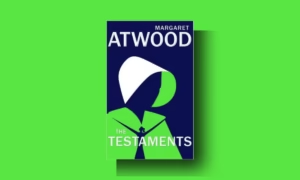
The Testaments is a faster, more satisfying thriller than The Handmaid's Tale, and a less frightening one. Margaret Atwood's 2019 sequel trades one woman's trapped, whispering dread for three testimonies, a hoard of stolen secrets and a ticking clock.
URL: https://www.sopranu.com/the-testaments-margaret-atwood-ending-explained/
Author: Margaret Atwood
4
Pros
- Array
Cons
- Array