
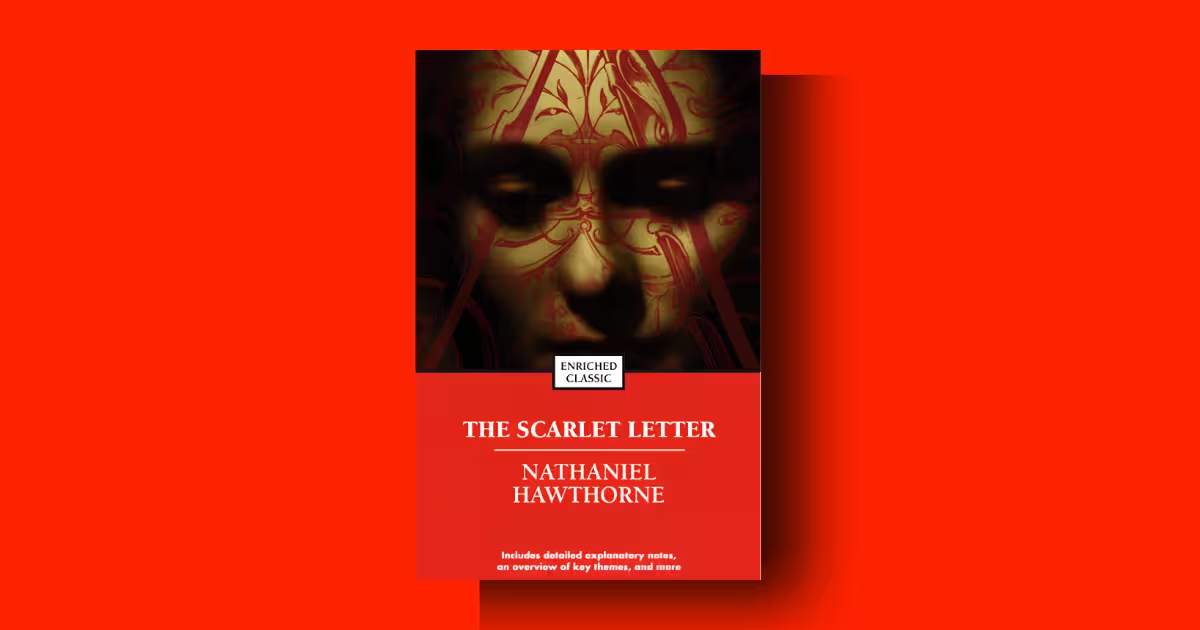

The Scarlet Letter is a historical romance set in 1640s Puritan Boston, telling the story of Hester Prynne, a woman forced to wear a scarlet “A” for adultery after giving birth to a child whose father she refuses to name. It’s a psychological exploration of shame, guilt, revenge, and the brutal judgment of society, and it’s just as relevant today as when it was first published in 1850.
Reader recommendation: You’ll love The Scarlet Letter if you enjoy literary fiction with deep psychological depth, historical settings, and themes that still resonate with modern life. Skip it if you’re looking for a fast-paced plot or romance with a happy ending, this is a slow burn that rewards patience.
Table of Contents
1. Introduction
I first picked up The Scarlet Letter because I kept seeing it mentioned everywhere—on syllabus lists, in articles about cancel culture, in discussions about women’s autonomy. It’s one of those books that’s been assigned in high schools for generations. But I’ll be honest: I didn’t expect to be so personally affected by a novel written in 1850.
Published by Ticknor, Reed & Fields in Boston in March 1850, Nathaniel Hawthorne’s masterpiece was an immediate success. The first printing of 2,500 copies sold out in just 10 days. For Hawthorne—who was 45 years old at the time and had struggled financially for years—this was a career-defining moment.
But what makes this book endure, 175 years later? After reading it, I think I finally understand.
2. Background: Hawthorne’s Personal Connection
Here’s something I found fascinating: Hawthorne wasn’t writing about abstract Puritans. He was writing about his own ancestors.
Nathaniel Hawthorne was born Nathaniel Hathorne on July 4, 1804, in Salem, Massachusetts. His great-great-grandfather, William Hathorne, was a magistrate who ordered brutal punishments, including public whippings, against Quakers and others who violated Puritan norms. His great-grandfather, John Hathorne, was one of the judges during the Salem witch trials of 1692.
Hawthorne actually changed the spelling of his name, adding the “w”, to distance himself from this legacy.
In the novel’s introductory section, “The Custom-House,” Hawthorne writes openly about this burden:
“He was likewise a bitter persecutor; as witness the Quakers, who have remembered him in their histories, and relate an incident of his hard severity towards a woman of their sect”.
He even imagines what his ancestors would think of him, a “writer of story-books”, and concludes they would consider him an “idler”.
This personal guilt runs through the entire novel. Hawthorne wasn’t just telling a story about Puritans, he was reckoning with his own family’s history of judgment and persecution.
3. The Scarlet Letter Summary
Part One: The Scaffold
The novel opens in a way that immediately grabs you. A crowd has gathered outside the prison in Boston—not for an execution, but to witness the public shaming of a young woman named Hester Prynne.
Hester emerges carrying her three-month-old baby, Pearl, and wearing a scarlet letter “A” embroidered on her chest. She’s been convicted of adultery, but she refuses to name the father.
“On the breast of her gown, in fine red cloth, surrounded with an elaborate embroidery and fantastic flourishes of gold thread, appeared the letter A.”
What struck me immediately is Hester’s defiance. She’s supposed to be humiliated, but she doesn’t cower. She stands on the scaffold with a “haughty smile” and a “glance that would not be abashed.” The crowd is angry—especially the women, who think her punishment is too lenient.
In the crowd, Hester notices a small, misshapen man. It’s her husband, the one everyone thought was lost at sea. He’s been living with Native Americans and has just arrived in Boston. He assumes the name Roger Chillingworth and vows to discover the father of Hester’s child.
Hester is questioned by the ministers, including the young Reverend Arthur Dimmesdale, who is clearly troubled. She refuses to speak.
“Never!” replied Hester Prynne. “It is too deeply branded. Ye cannot take it off.”
Part Two: The Secret
After her release from prison, Hester settles in a small cottage on the outskirts of town. She supports herself and Pearl through her extraordinary needlework—which becomes quite fashionable, ironically, despite being made by a “sinner.”
But she’s isolated. The children of the town throw mud at her. The adults cross the street to avoid her. Pearl grows up wild and unruly, with no playmates except her mother.
Pearl is fascinated by the scarlet letter. She throws flowers at it. She touches it. She asks her mother about it constantly. Hester tries to explain, but Pearl seems to understand more than a child should.
Meanwhile, Chillingworth has become Dimmesdale’s physician. The minister is deteriorating, physically and mentally. He’s thin, pale, and constantly clutching his chest. Chillingworth, suspecting the truth, insinuates himself into Dimmesdale’s life and begins a slow psychological torture.
“There is a fatality, a feeling so irresistible and inevitable that it has the force of doom, which almost invariably compels human beings to linger around and haunt, ghost-like, the spot where some great and marked event has given color to their lifetime.”
Part Three: The Forest
Seven years pass. Hester has become a respected figure in the community through her charity work. The meaning of the scarlet letter has shifted in the public mind—from “Adulteress” to “Able.”
But Dimmesdale is dying. Hester decides she must tell him the truth about Chillingworth.
She meets Dimmesdale in the forest, where no one can see them. She reveals that Chillingworth is her husband. Dimmesdale is horrified.
Here’s where it gets intense. Hester proposes they escape together, leave Boston, start a new life in Europe. Dimmesdale resists at first, but eventually agrees.
“What we did had a consecration of its own,” Hester tells him.
Hester removes the scarlet letter and throws it into the stream. Her hair falls loose. She’s transformed—for a moment, she’s the passionate woman she was seven years ago. The sun breaks through the trees. It’s a brief moment of hope.
Part Four: The End
But Pearl refuses to cross the brook until Hester puts the letter back on. The child won’t accept her mother without the symbol of her shame.
They plan to sail for England on the ship that’s docked in the harbor. But Chillingworth has booked passage on the same ship.
On Election Day, Dimmesdale delivers the greatest sermon of his career. He’s energized, transformed. The crowd is moved to tears.
But after the sermon, Dimmesdale calls Hester and Pearl to the scaffold, the same place where Hester was shamed seven years ago. In front of the entire town, he confesses.
“People of New England!… behold me here, the one sinner of the world! At last!—at last!—I stand upon the spot where, seven years since, I should have stood.”
He tears open his shirt, revealing a scarlet letter carved into his own chest, whether by self-inflicted wounds or supernatural means, we never learn. He collapses and dies in Hester’s arms.
Chillingworth, deprived of his revenge, dies within the year. He leaves his fortune to Pearl.
Hester disappears for a while, then returns to Boston. She lives out her days in the cottage, advising women who come to her for counsel. She never removes the scarlet letter again.
“At some brighter period, when the world should have grown ripe for it, in Heaven’s own time, a new truth would be revealed, in order to establish the whole relation between man and woman on a surer ground of mutual happiness.”
4. The Scarlet Letter Analysis
4.1. Characters
Hester Prynne is one of the most complex female characters in American literature. She’s simultaneously a sinner, a victim, a survivor, and a rebel. What I found most compelling is her refusal to be defined by her shame. She doesn’t run away; she stays and builds a life. She transforms the scarlet letter from a symbol of sin into a symbol of ability.
But she’s also tragic—she loses her passion, her beauty fades, and she becomes almost nun-like in her austerity.
“The scarlet letter was her passport into regions where other women dared not tread. Shame, Despair, Solitude! These had been her teachers, —stern and wild ones,—and they had made her strong, but taught her much amiss.”
Arthur Dimmesdale is the hypocrite. He’s the community’s most beloved minister, but he’s hiding a terrible secret. His physical deterioration mirrors his spiritual decay. I found him frustrating, he could have confessed years ago and been free, but I also understood his cowardice. He has everything to lose: his reputation, his position, his life’s work. His final confession is both heroic and pathetic.
Roger Chillingworth is the embodiment of revenge. He starts as a wronged husband but transforms into something demonic. Hawthorne describes him as “a striking evidence of man’s faculty for transforming himself into a devil.” His obsession with revenge destroys him as much as it destroys Dimmesdale.
Pearl is the most symbolic character—she’s the living embodiment of Hester’s sin. But she’s also the only character who’s truly free. She doesn’t care about society’s rules. She’s wild, untamed, and often cruel. But she’s also the only one who forces the other characters to confront the truth.
4.2. Themes and Symbolism
The Scarlet Letter Itself: The “A” is the most obvious symbol, but its meaning shifts throughout the novel. Initially, it stands for “Adulteress.” Over time, it becomes “Able.” By the end, it’s “Angel.” But it’s also a constant reminder of society’s power to define and punish.
Public vs. Private Shame: Hester’s shame is public; Dimmesdale’s is private. Which is worse? Hawthorne seems to suggest that public shame, while brutal, is ultimately more bearable than private guilt. Hester survives and even thrives; Dimmesdale is destroyed.
Sin and Redemption: The novel challenges Puritan theology. Hester’s sin leads to her strength. Dimmesdale’s sin leads to his destruction. The novel suggests that the real sin isn’t adultery, it’s hypocrisy and the refusal to be honest about who you are.
Nature vs. Society: The forest represents freedom, passion, and truth. The town represents judgment, repression, and hypocrisy. Hester and Dimmesdale can only be honest with each other in the forest.
Gender and Power: Hester is punished by a patriarchal society that doesn’t hold Dimmesdale equally accountable. But Hester emerges as the stronger character. She’s the one who survives, who builds a life, who becomes a counselor to other women.
5. Evaluation
My Verdict
The Scarlet Letter is an extraordinary novel. I went in expecting a dry, moralistic Victorian novel. What I found was a psychologically rich, emotionally devastating exploration of shame, guilt, and resilience.
Hawthorne’s prose is dense and sometimes difficult, but it’s also deeply rewarding. He’s not just telling a story, he’s exploring the darkest corners of the human heart.
D. H. Lawrence called it “a perfect work of the American imagination”. I think that’s accurate, but it’s also a work of profound human insight.
Strengths
Psychological depth: The characters are so fully realized that they feel like real people.
Symbolism: The scarlet letter is one of the most powerful symbols in literature.
Thematic richness: The novel explores sin, guilt, shame, revenge, gender, and society—and it handles all of them with nuance.
Hester Prynne: She’s an unforgettable character—strong, flawed, and deeply human.
Weaknesses
Pacing: The novel is slow. If you’re looking for action, you’ll be disappointed.
Prose style: Hawthorne’s sentences are long and complex. It takes effort to read.
Dimmesdale: I found him frustrating. He spends the whole novel suffering when he could just confess.
Impact and Controversy
The novel was controversial when it was published. The subject matter, adultery, was considered scandalous. But the critics recognized its genius. Graham’s Magazine called Hawthorne a “genius”.
Today, the novel continues to resonate. In a 1998 New York Times letter, a reader compared President Clinton’s public humiliation to “Hawthorne’s powerful description of Puritan totalitarianism”. In the age of social media and cancel culture, the novel feels eerily contemporary.
6. Comparison with Similar Works
The Scarlet Letter is often compared to other works of American Romanticism:
Young Goodman Brown (also by Hawthorne): A shorter exploration of Puritan hypocrisy and the nature of evil.
Moby-Dick by Herman Melville: Published the following year (1851), it shares Hawthorne’s psychological depth and symbolic richness. Melville actually dedicated Moby-Dick to Hawthorne.
The House of the Seven Gables (also by Hawthorne): His follow-up novel, which explores similar themes of ancestral guilt and Puritan legacy.
Wuthering Heights by Emily Brontë: Published in 1847, it similarly explores passion, guilt, and the destructive power of secrets.
7. Adaptation
Film Adaptations
The 1995 film starring Demi Moore as Hester, Gary Oldman as Dimmesdale, and Robert Duvall as Chillingworth is… not good. It was a box office disaster—budgeted at $46 million, it grossed only $10.4 million domestically. It received seven Razzie Award nominations.
The problem? The filmmakers radically changed the story. Hester and Dimmesdale have a passionate affair (rather than the ambiguous relationship in the book), and the ending is completely different. It’s a classic example of a Hollywood adaptation that misses the point entirely.
There have been other adaptations—silent films, TV movies, and stage productions—but none have captured the novel’s psychological depth.
8. Personal Insight: Why This Book Matters Today
Here’s what I keep thinking about after finishing The Scarlet Letter: we still do this.
We still shame people publicly. We still destroy lives over moral transgressions. We still love to watch the powerful fall.
In 1695, the Massachusetts Bay Colony passed a law requiring adulterers to wear the letter “A”. Today, we don’t wear physical letters—but we have social media, public shaming, cancel culture. The mechanism is different, but the psychology is the same.
Five Lessons from The Scarlet Letter:
1. Public shame doesn’t purify; it destroys. Hester’s public shaming doesn’t make her a better person—it isolates her, hardens her, and nearly breaks her.
2. Private guilt is worse than public shame. Dimmesdale suffers far more than Hester because he hides his sin. His secret destroys him.
3. Hypocrisy is the real sin. The Puritan community is obsessed with punishing Hester, but they ignore their own flaws. The novel asks: who are we to judge?
4. Women bear the burden of moral judgment. Hester is punished; Dimmesdale is protected. This double standard persists today.
5. Resilience is possible. Hester survives, rebuilds her life, and becomes a source of wisdom for others. She’s not destroyed by her shame—she transforms it.
9. The Scarlet Letter Quotable Lines
“She took the baby on her arm, and, with a burning blush, and yet a haughty smile, and a glance that would not be abashed, looked around at her townspeople and neighbours.”
“It had the effect of a spell, taking her out of the ordinary relations with humanity, and inclosing her in a sphere by herself.”
“My heart was a habitation large enough for many guests, but lonely and chill, and without a household fire. I longed to kindle one!”
“There is a fatality, a feeling so irresistible and inevitable that it has the force of doom, which almost invariably compels human beings to linger around and haunt, ghost-like, the spot where some great and marked event has given color to their lifetime.”
“Let the black flower blossom as it may!”
“Let men tremble to win the hand of woman, unless they win along with it the utmost passion of her heart!”
“The scarlet letter was her passport into regions where other women dared not tread. Shame, Despair, Solitude! These had been her teachers, —stern and wild ones,—and they had made her strong, but taught her much amiss.”
“At some brighter period, when the world should have grown ripe for it, in Heaven’s own time, a new truth would be revealed, in order to establish the whole relation between man and woman on a surer ground of mutual happiness.”
“Be true! Be true! Be true! Show freely to the world, if not your worst, yet some trait whereby the worst may be inferred!”
10. Conclusion
The Scarlet Letter is not an easy read. The language is dense, the pacing is slow, and the subject matter is heavy. But it’s also one of the most rewarding books I’ve ever read.
What makes it endure, I think, is its honesty. Hawthorne doesn’t offer easy answers. He doesn’t tell us that sin is always punished or that confession always brings redemption. He shows us flawed, complex people trying to survive in a judgmental world.
I recommend The Scarlet Letter to:
- Fans of literary fiction with psychological depth
- Readers interested in American history and Puritan culture
- Anyone who’s ever felt judged or shamed
- Students of literature (it’s a classic for a reason)





