
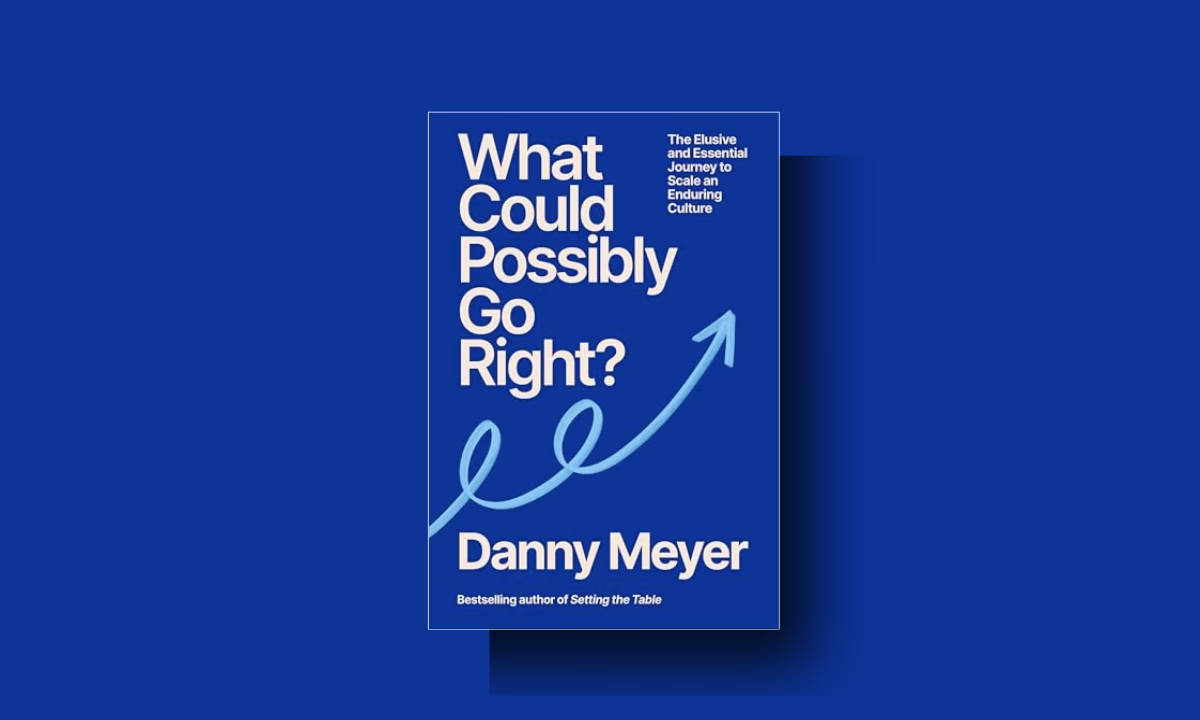

What Could Possibly Go Right? is Danny Meyer’s confession of everything that went wrong, and that is exactly why it works. Published by Random House on September 29, 2026, the Shake Shack founder’s second leadership book opens not with a triumph but with Meyer crying in a restaurant bathroom in September 2010, minutes before telling eight managers he was closing Tabla.
Twenty years after Setting the Table, he now counts 27 restaurants opened and 10 closed, a juice company that lost every dollar invested in it, a french fry reversal that took a full year to admit, and a WeWork courtship he should have ended in a week.
If you want the full summary of What Could Possibly Go Right, the frameworks worth stealing, and an honest verdict on whether Danny Meyer’s optimism survives his own evidence, it is all below.
Table of Contents
Key Takeaways From What Could Possibly Go Right?
The short answer: culture cannot be preserved as a company grows, so you have to use growth to push it forward. Here is What Could Possibly Go Right? at a glance.
What it is: A 336-page business memoir by Danny Meyer, founder of Union Square Hospitality Group (USHG) and Shake Shack. It is the sequel to Setting the Table (2006).
The central question: How do you advance a workplace culture while scaling a business from one restaurant to thousands of employees and hundreds of locations?
The big reframe: An adviser told Meyer to stop asking how to maintain culture and start asking “How can we use our growth to advance our culture?” (Chapter 7).
The culture equation: Culture equals “the wanted behaviors we celebrate” minus “the unwanted behaviors we tolerate” (Chapter 16).
The Shack Trap: Planning to scale a business before it has earned a real following. Meyer fell into it with Creative Juice, Martina and Caffe Marchio.
Close well, not just open well: Tabla’s closing taught him that “Success and failure aren’t always two ends of a spectrum” (Chapter 3).
Hire 100 percenters: People strong in both technical skill (49 percent) and emotional skill (51 percent), which he calls Hospitality Quotient, or HQ.
Behaviors beat values: USHG retired its four Family Values and replaced them with six specific Expected Behaviors you can actually hold people to.
Water the flowers: His grandmother’s garden lesson, “The best way to get rid of the weeds is to grow the flowers,” became his Sunflower Theory of management.
Trust your gut, and know when you are ignoring it: Most of his worst calls came from three triggers: not wanting to disappoint someone, competitive fever, and runaway optimism.
The end goal is essentiality: Mindshare gets people in the door, heartshare brings them back, and essentiality means they cannot imagine life without you.
My verdict: Candid, practical and often funny, but repetitive in places and lighter on hard outcomes than its confidence suggests.
Who Will Love What Could Possibly Go Right, and Who Will Bounce?
You will probably love it if you are:
- A founder or owner moving from one location (or one team) to many, and feeling your culture slip.
- A restaurant, hotel or hospitality professional. This is insider material, from tip law to lease fights.
- A mid-level manager who inherited a culture you did not build and now have to defend.
- A fan of Setting the Table who always wondered what happened next.
- Anyone who learns better from honest failure stories than from tidy success formulas.
You may bounce if you:
- Want management science backed by studies and data. The evidence here is almost entirely Meyer’s own experience.
- Expect a cookbook or a gossipy restaurant tell-all. There is food, and there is drama, but both serve the leadership lessons.
- Dislike profanity. Meyer swears freely, and one of his core hiring mantras is literally an expletive.
- Work alone. Roughly half the book is about org charts, partners, boards and senior teams.
- Want a full business history of Shake Shack. The burger chain gets several chapters, not the whole book.
Introduction
What Could Possibly Go Right? The Essential Journey to Scale an Enduring Culture is a 2026 business memoir by restaurateur Danny Meyer about how he tried, failed, and tried again to keep a people-first culture alive while his company grew from one Manhattan restaurant into a group of restaurants, an events business, an investment fund, and a publicly traded burger chain.
Title, Author and Publication Details
According to Penguin Random House, the hardcover, ebook and audiobook were released on September 29, 2026. The hardcover runs 336 pages, the audiobook lasts 10 hours and 52 minutes, and a 480-page large-print edition followed on October 27, 2026.
In his acknowledgments, Meyer credits Brette Warshaw as his collaborator and Andy Ward as his editor, and he says What Could Possibly Go Right? took three years to write.
One small detail I enjoyed: the title came from Adam Grant. During a fireside chat at Wharton, Grant asked Meyer how he imagines new ideas, and Meyer said he always starts by asking what could possibly go right. Grant told him in a taxi afterward to make that the title.
Context: Who Is Danny Meyer, and What Kind of Book Is This?
Danny Meyer opened Union Square Cafe in New York in 1985, at 27, and went on to found Union Square Hospitality Group, whose restaurants have included Gramercy Tavern, Eleven Madison Park, Tabla, The Modern, Maialino, Manhatta, Ci Siamo and Daily Provisions.
He also founded Shake Shack, which began as a hot dog cart in Madison Square Park. The book’s author bio notes that he was named to the Time 100 list of most influential people, won the 2017 Julia Child Award, and that USHG has won 28 James Beard Awards.
What Could Possibly Go Right? sits somewhere between memoir and leadership manual. Every chapter tells a story (often an embarrassing one), then distills it into a named framework, sometimes boxed off as a sidebar.
If you have read Ben Horowitz or Phil Knight, the rhythm will feel familiar, though Meyer is warmer and far more interested in how people feel at work.
Purpose: What Is the Main Argument of What Could Possibly Go Right?
The thesis is stated in the acknowledgments as plainly as anywhere: “How do you advance your culture as you’re scaling your business?” Meyer’s answer has three parts.
First, culture is not a museum piece to be maintained; it has to move or it dies. Second, culture is defined by behaviors, not slogans, so leaders must name the behaviors they want and stop tolerating the ones they do not. Third, leadership and management are different jobs.
In Chapter 9 he puts it this way: “Management exists to assure compliance and to prevent what could possibly go wrong.” Leadership, by contrast, is driven by the question in the title.
Background
It follows Setting the Table by correcting it. In that 2006 book, Meyer proudly noted on page one that he had never closed a restaurant in 25 years. In the new introduction he writes, “I wish I hadn’t written that sentence, which was both hubristic and naive.”
The world also changed under him. When Setting the Table came out, there were no smartphones, no App Store, no Uber, no DoorDash. Meyer then had to steer a company through the 2007 to 2009 financial crisis, Superstorm Sandy, and a pandemic that shut down the entire hospitality industry for months.
Over those 20 years, he says, he opened 27 restaurants and closed 10, while Shake Shack grew to more than 700 locations across 24 countries.
There is also a personal backstory that runs through the whole book like a bass line. His father, a serial entrepreneur who ran a travel business, went bankrupt twice and died of lung cancer at 59. Meyer admits that his fear of repeating those bankruptcies shaped decades of his decisions, from refusing to open a second Shake Shack to clinging too long to Tabla.
Reading this, I started to see the book less as a business guide and more as a son’s long argument with his father’s ghost.
What Could Possibly Go Right Summary
Below is a chapter-by-chapter summary of What Could Possibly Go Right? Meyer divides the book into four parts and 21 chapters. I have kept the key numbers, names and outcomes so you get the substance, not just the mood.
Part I: How Did Danny Meyer Build His Culture, and Where Did It Crack?
Chapter 1, The Seeds of Culture
Meyer grew up in St. Louis hearing that he was not living up to his potential. He was rejected by a private school, then by Princeton and Brown, and waitlisted at his “safety school,” Trinity College, in March 1976. He begged his way in with a letter, then earned straight A’s in his first semester. That pattern (fall short, get angry, prove people wrong) becomes a theme.
When he opened Union Square Cafe in 1985, he was a 27-year-old former anti-shoplifting-tag salesman running purely on instinct. By the early 1990s the restaurant had three New York Times stars and a James Beard Award for Outstanding Service.
The trouble began in 1994, when he opened Gramercy Tavern with chef Tom Colicchio and suddenly could not be in two places at once. Regulars told him the new place did not feel like his.
So he called an all-staff meeting and made his philosophy explicit for the first time. He defined hospitality as “the act (and art) of being on someone else’s side,” separated service (the technical delivery) from hospitality (how guests feel), and introduced the Virtuous Cycle of Enlightened Hospitality: take care of your colleagues first, then guests, community, suppliers and investors, in that order. He told staff that if a bill was $250, they should deliver $300 worth of hospitality.
To hire for this, USHG distilled six emotional skills into what it calls Hospitality Quotient, or HQ: optimistic warmth, curious intelligence, determined work ethic, genuine empathy, self-awareness and integrity. “Learn-it-alls thrive at USHG. Know-it-alls languish,” he writes.
He also rejects the label “soft skills” with a line I copied into my notebook: “Soft skills are hard. If they were easy, everyone would have them.”
My favorite detail here is his test for a high-HQ child. When a kid bakes Toll House cookies, does the kid say “Look what I made” or “Look what I made for you“? Those two extra words, he argues, reveal the wiring.
The chapter closes on a high. In the 2004 Zagat Survey, Union Square Cafe ranked first and Gramercy Tavern second among New York’s favorite restaurants. “The foundation felt incredibly solid,” he writes, “until it wasn’t.”
Chapter 2, Speed Bumps in Paradise
In 2001 Colicchio announced he would open his own restaurant, Craft, right in Gramercy Tavern’s backyard, while staying on as Gramercy’s chef. When Meyer pushed back, he received a letter from an investor’s law firm warning that firing Colicchio could breach his fiduciary duty.
Meyer backed down, and for six years he was, in his words, divorced to his partner rather than from him. Staff did not know whose team they were on.
At the same time, tension grew between the restaurants and the new home office, which the restaurants funded through a 3 percent management fee. Meyer’s own competitive streak made it worse: he wanted each new restaurant to beat the previous one, partly to prove he was not an imposter.
The emotional whiplash peaks in two reviews. In January 2007, Frank Bruni of The New York Times gave three stars to both Eleven Madison Park and The Modern on the same day, but The Modern’s stars applied only to its casual Bar Room, not its formal Dining Room, splitting one team in two.
Then in August 2009, Union Square Cafe dropped from three stars to two, the first star Meyer had ever lost. He was so shaken that he drove out of Citi Field and, without meaning to, ended up on the departures ramp at LaGuardia. A week later Eleven Madison Park received four stars.
His conclusion: he needed to stop being Danny Meyer the Restaurateur and become the leader of a hospitality company.
Chapter 3, Failing Up
This is the heart of the book. Tabla, Floyd Cardoz’s modern Indian restaurant, opened in 1998 to three stars from Ruth Reichl and early annual revenues near $8 million.
But it had 283 seats across three dining areas, two kitchens and two bars, and a break-even point around $7 million. Floyd’s homestyle Bread Bar eventually took off, which quietly cannibalized the pricier upstairs menu. Two bad summers in a row wiped out the patio season.
The team tried everything, even swapping a Ganesh statue whose trunk faced left for one whose trunk faced right. In each of its last two years, Tabla lost close to half a million dollars, and USHG used bank loans to make payroll.
“It took me two years longer than it should have to make the call,” Meyer admits. What changed his mind was his partner Richard Coraine (RC) pointing out that keeping a money-losing restaurant open was not generous at all: staff had gone two years without raises. Meyer reframed the question. Could USHG be known for how humanely it closes a restaurant?
So instead of padlocking the doors, Tabla gave four months’ notice, ran résumé workshops and job fairs, and held farewell dinners before its final service on December 30, 2010.
The lease was sold to Gastón Acurio’s La Mar Cevicheria (after Meyer, trying to be a gracious guest in Lima, ate roughly 20 sea urchins and paid for it for three days). Investors got back about $1.08 on the dollar. Nobody lost money.
The chapter ends with a second loss. In 2011, after Eleven Madison Park won its third Michelin star, chef Daniel Humm and general manager Will Guidara wanted to take on the NoMad Hotel project outside USHG. Having sworn never to repeat the Colicchio arrangement, Meyer told them they would have to buy Eleven Madison Park.
They did, and told him their goal was to make it the best restaurant in the world. In April 2017 it topped The World’s 50 Best Restaurants list.
Chapter 4, It Seemed Like a Good Idea at the Time
Shake Shack’s origin story is gloriously unplanned. Meyer helped raise $11 million to revive Madison Square Park, and in 2001 an art installation by Thai artist Navin Rawanchaikul needed someone to run a hot dog cart. Over his colleagues’ objections, USHG volunteered, staffing it with Eleven Madison Park’s off-season coat-check team. People lined up by the hundreds.
After post-9/11 summers in 2002 and 2003, the cart became a permanent kiosk in 2004. On day one the custard machine broke; on day two they ran out of burgers; on day three the line doubled.
Meyer explains why the model worked: no chefs, sommeliers, tablecloths or big wine inventory meant Shack-Level Operating Profit (SLOP) of 20 to 25 percent, against 7 to 15 percent at USHG’s best fine-dining rooms. He also rewrites the old Rule of Two (you can only pick two of quality, speed and low cost) as .65 + .65 + .70 = 2.
Remarkably, he gave the Shake Shack business to Eleven Madison Park’s investors, and the kiosk’s profits subsidized its fancy parent. He resisted opening a second Shack for years, fearing he would become a “chain guy,” and because the Upper West Side space Randy Garutti wanted cost about $440,000 a year, against roughly $10,000 when the previous tenant moved in during 1977.
When the second Shack finally opened in October 2008, it was the first time in 24 years Meyer had done anything twice. Both lines got longer.
Part II: Can a Company Grow Without Losing Its Soul?
Chapter 5, One Foot on the Accelerator, the Other on the Brake
With six New York sports venues being built or renovated around 2006, USHG partnered with Aramark. It lost the MetLife Stadium bid (a “bullet dodged,” since football has only eight or nine home games), turned down the Yankees’ idea of a global “Yankee Steak” chain, and landed at the Mets’ new Citi Field with Shake Shack, Blue Smoke, a taqueria and a fries stand.
When the Mets asked them to raise Shake Shack prices by about 25 percent because the lines took two innings, Meyer refused to protect the brand’s value. At Saratoga Race Course he worried burger smoke would rattle the horses, until a track official reminded him that horses are vegetarian.
They also learned the hard way that gamblers avoid barbecue sauce because they need clean fingers to flip the Daily Racing Form.
Chapter 6, The Great Recession Intercedes
The 2007 to 2009 crash nearly sank USHG. Meyer hired his friend Jeff Flug, a former Goldman Sachs and JPMorgan fixed-income executive, in July 2009.
When Bank of America refused to renew USHG’s loan, Flug moved it to JPMorgan on better terms. He sold the Big Apple Barbecue Block Party (which drew up to 120,000 people but cost USHG about $1 million a year), cut the employee dining discount from 50 to 20 percent, and dropped perks like Mets tickets and gym memberships.
He also led “One Ball of Wax,” rolling dozens of separately owned restaurants into one company in 2010. Leonard Green & Partners then invested $75 million for 39.5 percent of USHG.
By the time Flug left in June 2015, USHG’s debt ratio had dropped from 8x to 0.7x, by Meyer’s account. Yet long-time staff grumbled, “That doesn’t sound like Danny.” Meyer admits he had spent years treating profit as an afterthought and failed to explain that profitability is the fuel for raises and promotions.
The chapter’s cautionary tale is Creative Juice. Desperate for revenue, and wanting to please Related Companies (which had bought 49 percent of USHG’s events arm), Meyer agreed to a cold-pressed juice business inside Equinox gyms despite only “sort of” liking the idea.
Five stores were planned in three months.
The juice did not click, açai bowls and turkey chili did not save it, and it closed exactly one year after launch with a 100 percent loss. Meyer calls it “a business plan in search of passion” and coins the phrase that names Chapter 11: the Shack Trap.
Chapter 7, Culture Is Like a Shark
Everyone kept asking how he would maintain his culture while growing. He collected definitions: Whole Foods’ Walter Robb said culture is “the way we do things around here,” and UCLA’s athletic director compared it to a newborn baby you must feed constantly and clean up after immediately.
USHG crowdsourced about 45 values from staff and boiled them down to four Family Values: Excellence, Hospitality, Entrepreneurial Spirit and Integrity.
To reinforce them, the company borrowed “Caught Doing Right” slips from the Tennessee chain Pal’s Sudden Service, and made Setting the Table required reading (five years late, he concedes), which gave everyone a shared vocabulary. “Center the salt shaker” means do it with excellence. “WAGNC” on a reservation means Write a Great Next Chapter, because the guest had a bad visit last time.
A case in point: at a cramped 26-person dinner for Ermenegildo Zegna, olive oil spilled down a guest’s new suede Calvin Klein dress. The general manager tracked down the store, bought the identical dress that night, and had it delivered the next morning with a basket of salami, wine, biscotti, a handwritten note, a $500 gift card, and, of course, a bottle of olive oil.
The turning point came from Zingerman’s co-founder Ari Weinzweig (“I’m a proud capitalist”) and consultant Erika Andersen, who told Meyer his question was flawed. Culture cannot be maintained. “Culture is like a shark; it can’t stay in one place,” he concludes. From then on, only 100 percenters would get promotions, so growth itself would reinforce what mattered.
Chapter 8, Sprezzatura
Hotelier Ian Schrager asked Meyer three times to open a restaurant in the Gramercy Park Hotel. The third offer, during the recession, came with $2.9 million for redesign and a $1 million development fee. This chapter is also the book’s most personal.
Meyer recalls falling for Rome on his 12th birthday, working as a tour guide for his father there, and a painful night in a Roman trattoria when his drunk father berated his mother’s family until Meyer walked out into the rain.
The fallout led him, at 21, to confront his father and reconcile with his mother, a closeness that lasted 45 years.
That Roman love became Maialino (his old tour-guide nickname, meaning “little pig”). He explains his three triggers for a new restaurant (context, concept or chef), his research trip eating six to eight versions of every Roman classic, and the Italian idea that defines his style. “Sprezzatura happens when you’re able to make hard look easy,” he writes.
He adds the Swan Theory: 51 percent of the swan floats gracefully above water while 49 percent paddles hard beneath it.
There is a lovely kicker. New York Times critic Sam Sifton gave Maialino two stars and quoted Stephen Sondheim’s “sorry-grateful” lyric about the roast pig. Two weeks later Sondheim himself came in, ordered that dish, and signed the review: “To Danny, I’m only grateful.”
Chapter 9, Think Like a Winemaker
Great vineyards win year after year by obsessing over soil, grape selection, training, pruning, house style and labeling. Meyer applies this to people. “No grape can taste any better than the health of the soil,” he writes, and the soil is culture.
Around 2012 he hired a chief restaurant officer (Sabato Sagaria, who had once stunned Meyer at an Aspen hotel by setting up every ingredient for his late father’s namesake cocktail) and a chief culture officer from the Great Place to Work Institute. Trust surveys showed the problem: staff believed in the values but not in managers who were not walking the talk. One person cannot own a whole culture, he concluded.
After Flug’s exit, RC asked whether the culture was “fractured or broken.” At an offsite, Meyer reclaimed direct leadership and introduced the Four Gears of Leadership: Coach, I Know What I Want, Trust and Delegate, and Consensus. He admits he had stayed too long in “Trust and Delegate.”
Chapter 10, The Bigger We Get, the Smaller We Need to Act
That line was Randy Garutti’s mantra for Shake Shack, and it shaped the chain’s growth. Each Shack had to feel “of its place.” The 80/20 Rule standardized 80 percent of menu and design while making at least 20 percent local, with collaborations from bakers, butchers and chefs in each city and a share of local specials donated to charity.
Expansion was unusual: international first. Kuwait’s Alshaya, which runs Starbucks franchises across the Middle East, signed a deal for 20 Shacks. The first opened at Dubai’s Mall of the Emirates, followed by Kuwait, Qatar, Istanbul, Moscow, London, Tokyo and Seoul. Select Equity invested $20 million at an $86 million valuation, and with $5 million from friends and family, that was all the outside money Shake Shack needed before going public.
In Moscow, sanctions after the 2014 Crimea occupation forced the beef source to change from Scotland to Australia to Argentina to Uruguay; the three Russian Shacks closed in 2019.
Then comes the fries fiasco, which made me laugh out loud.
After Pete Wells wrote in a one-star review, “Can’t one of his chefs show him how to make a decent French fry?”, Shake Shack spent heavily converting every kitchen to fresh-cut fries in August 2013, complete with “Heard” T-shirts mailed to the critics. The fresh fries were often limp and oily. Customers begged for the crinkle cuts, Jessica Seinfeld’s Instagram jab went viral, and after a year Randy walked into Meyer’s office and admitted they had botched it.
Potato science sided with frozen: they are flash-frozen at peak season and coated in starch. The return of the crinkle cut became the brand’s best-performing Instagram post ever. Lesson: they had listened to a few critics over thousands of fans.
The IPO on January 30, 2015, is told with real suspense. Shake Shack gave stock options to all managers and let every tenured employee, including $12-an-hour staff, buy shares at the offering price.
With the deal 200 times oversubscribed, bankers suggested pricing as high as $26, but USHG chose $21 so hourly workers were not priced out.
The first share traded at $46 after more than two hours of silence. Jim Cramer then quietly warned Meyer it might be “the worst day of your life,” since 63 Shacks were now valued at roughly $25 million each. Meyer closes with Viktor Frankl’s idea that success, “like happiness, cannot be pursued; it must ensue.”
Part III: Why Do Smart Leaders Keep Repeating the Same Mistakes?
Chapter 11, The Shack Trap
After the IPO, imposter syndrome and envy inside USHG pushed Meyer into “innovation overdrive.” He gave $2 million of IPO proceeds as bonuses to non-Shack managers, then green-lit a string of concepts meant to be the next big hit.
Marta, a Roman pizza restaurant in the Martha Washington Hotel, worked but had thin margins because people ordered pizza as their main course and skipped expensive wine; then a new hotel owner covered the foyer in Playboy-bunny photos and pumped artificial scent into the lobby.
Martina, a fast-casual pizza spinoff pitched with projections of 90 pies an hour, closed in 18 months. Caffe Marchio (named after the Italian word for “trademark,” because his lawyers kept rejecting names) died because it sat six steps above a quiet street. “We were prioritizing scale over mission, a formula that was doomed to fail,” he concludes.
He also recounts picking Chipotle on Jim Cramer’s Mad Money in 2009 and building the “Meyer Hospitality Index” of 15 companies, which he says gained 375 percent from February 2009 to 2014 against 128 percent for the S&P 500. That led to Enlightened Hospitality Investments, a fund he co-founded in 2015 with his college roommate Mark Leavitt.
Chapter 12, Finishing the Hat
Union Square Cafe’s landlord offered ten more years, with no renewal option, at triple the rent. Meyer refused both to renew and to close. After the final service at 21 East 16th Street on December 12, 2015, the restaurant spent a year homeless, then reopened at Park Avenue South and 19th Street in December 2016 as what RC called a “thirty-year-old start-up.”
The new bar was built 27 feet and 1 inch long, exactly like the old one; half the original mahogany bar went upstairs as a secret spot for regulars; the old art came along. At the first pre-shift meeting, Meyer recited Sondheim’s “Finishing the Hat” and barely got through it. The following April, the Times restored the third star.
A spare space next door became Daily Provisions, built around a “Better Alternative to Home” (BATH): coffee, a maple cruller, a breakfast sandwich, soups, sandwiches and roast chicken, each meant to be a top-three version of itself. A second location opened three years later.
Chapter 13, Hospitality Included
In 2015 Meyer learned that culinary school graduates at North End Grill were working as waiters because cooks’ pay could not cover New York rent.
Under New York law, servers could not share tips with cooks, and over Meyer’s career, he says, cooks’ hourly wages rose about 50 percent while tipped workers’ pay rose roughly 200 percent. After playing John Lennon’s “Cold Turkey” to his stunned senior team, he declared, “Tips have become a drug for all of us.”
USHG eliminated tipping, raised menu prices, gave up about $1 million a year in federal Tip Tax Credits, and launched at The Modern. The media loved it, Time named him to its 2015 list of 100 most influential people, and cooks ended up earning 20 to 25 percent more.
But few competitors followed, an antitrust lawsuit filed in early 2016 (dropped in 2017) silenced him for a year and a half, and guests struggled to read all-inclusive prices. The program ended during the pandemic. His four questions before speaking publicly are worth keeping: does it align with our values, will it improve anything, does it need saying, and does it need to be me?
Chapter 14, Gut Check
Meyer calls himself “upsighted”: great at seeing what could go right, poor at seeing what could go wrong. He lists the three triggers that make him override his gut and five gut-check questions, including “Would we do this thing if someone gave it to us for free?”
Then come three cautionary stories. GreenRiver, a restaurant on the 18th floor of a Chicago hospital, earned a Michelin star but closed after two and a half years; on his first visit, the elevator opened onto patients with IV stands. “The word hospital may live within hospitality,” he writes, but that is no reason to put a restaurant in one. The WeWork courtship with Adam Neumann included a $10,000 bet on the 2016 election, a cash-only dinner at Rao’s settled when a man arrived with a wad of hundred-dollar bills, a proposal that USHG fund 100 percent of costs for 50 percent ownership, and finally a letter demanding $10 million for “wasting seven months” of WeWork’s time.
(WeWork withdrew its IPO in 2019 and filed for bankruptcy in November 2023.) Manhatta, on the 60th floor of 28 Liberty with views of four airports, earned one star from Pete Wells, who called the food “a bit safe, conservative, and slightly dated.” Meyer agrees they had leaned on the view.
Chapter 15, How Could You Not Know?
By 2017 the senior team was at war. Staff thought they had been shut out of “Danny’s tree house.” Leaders formed their own meeting that excluded him. Then four respected managers staged an intervention in his office, telling him the dysfunction at the top was obvious to everyone.
Meyer responds with three useful tools. Microcaring (asking curious questions) beats micromanaging (elbowing into the work). Culture carriers must be publicly praised or they burn out.
And teams need balanced social styles (analyticals, drivers, expressives and amiables), whereas his team had too many drivers and expressives. A facilitator exposed another flaw: “Too often we relied upon being nice at the expense of being kind.” Over 18 months he eliminated or replaced most of the C-suite.
The chapter also covers two harassment complaints involving chefs at North End Grill and Gramercy Tavern. HR’s mediation approach failed the people who complained, both men eventually lost their jobs, and USHG added written protocols and a 24-hour hotline.
Then a legal push to make hourly staff sign arbitration agreements triggered a revolt, with angry employees waiting in reception. Meyer asked labor activist Saru Jayaraman to help mediate, and the policy was withdrawn.
Chapter 16, Turning Point
Succession planning stumbled when Ron Parker, his COO, declined the idea of becoming CEO and resigned in the middle of a deal. USHG ended its rocky partnership with Related, bought back the 49 percent stake at a high price, and brought in Compass Group as the new partner for Union Square Events.
In May 2019 Meyer hired Chip Wade, the former president of Red Lobster, which had 704 locations. Wade won Meyer over partly by mentioning he had once bought 115 copies of Setting the Table for his team.
Then the big rethink. Family Values had two flaws: a business is not a family (and nobody fires family), and you cannot hold anyone accountable to an abstract word. After ethicist Dov Seidman told the team that the best companies “outbehave” their competitors, Meyer wrote his culture equation and recast the values as six Expected Behaviors: Center the salt shaker; Play to win with a humble swagger; Turn over the rocks and always be connecting dots; Bring a charitable assumption and err on the side of generosity; Write a great next chapter; and Leave our campsite better than we found it.
He ends with his grandmother Louise’s “Carbon Monoxide Garden” beside a St. Louis parking lot, where she taught him to water flowers rather than pull weeds. That became the Sunflower Theory: shine your attention on top performers, and the middle majority will turn toward the light.
Part IV: What Happens When Everything Stops?
Chapter 17, Crossing the Bridge
In early March 2020, a Port Authority executive who had attended a breakfast at The Modern tested positive for Covid-19. USHG closed The Modern mid-lunch, then all nine of its New York restaurants after dinner on March 12, five days before the city’s mandate.
Revenue went to zero. With roughly two months until insolvency, Meyer asked his leaders to picture the rope bridge in Indiana Jones and the Temple of Doom: what must be left behind to cross?
On March 25, 2020, Floyd Cardoz died of Covid-19. The texts Meyer reproduces from Floyd’s final days are hard to read. Within 48 hours USHG went from about 2,000 employees to 75, with every layoff delivered by a supervisor and none by email; a second round cut it to 49.
A pregnant employee’s email led to HUGS, an employee relief fund that raised $2.1 million in nine months and gave $2,500 grants. “Policies too often handcuff the heart. Guidelines allow you to use it,” he writes.
Shake Shack received a federal PPP loan on April 10, the same day the program ran out of money, and became a public villain. It returned the loan within 36 hours, and Meyer says other companies then returned well over $2 billion. After George Floyd’s murder, Meyer took two days to email his team and was criticized at a 400-person staff call, not just for the delay but for years of falling short with employees of color.
He worked with consultant Dr. James Pogue, took on the role of de facto chief diversity officer, and set goals on gender balance, equal pay and a workforce reflecting New York.
Chapter 18, DFS
Outdoor dining returned in June 2020 with five tables at Marta, and grateful guests tried to press big tips on servers. Within weeks Meyer shelved Hospitality Included and brought back tipping, while sharing a percentage of revenue with cooks.
Blue Smoke and Jazz Standard, both opened in 2002, closed when their landlord would not cut the rent; Untitled at the Whitney, Vini e Fritti and Caffe Marchio also went.
USHG announced on July 29, 2021, that staff and indoor guests would need proof of vaccination by September 7. Rehiring from an empty labor pool led to DFS, an acronym for “Don’t Settle” with an expletive in the middle. The CW/CW Performance Matrix is the chapter’s best tool:
- Can and Will: celebrate, continuously.
- Can’t but Will: teach, for up to six months.
- Can but Won’t: coach, for up to three months.
- Can’t and Won’t: warn, immediately, with two months at most.
He adds the Jigsaw Puzzle Theory for people who are almost a fit, and a warning that people who are exited leave “either as ambassadors or as terrorists.” About 80 percent of the rebuilt 2,000-person team was new.
Chapter 19, Change Your Grip
A tennis pro told Meyer his old grip would only get him so far. Applied to USHG, that meant ending the promote-from-within rule for chefs, since none of the homegrown chefs’ new restaurants had earned three Times stars. Outside hire Hillary Sterling opened Ci Siamo in October 2021, survived an Omicron shutdown 60 days in, and earned a Times Critic’s Pick that called it “the best and most confident restaurant” from Meyer’s company in years.
On the money side, Leonard Green wanted out. After a January 2024 trip with Brookfield’s Bruce Flatt, Brookfield bought the stake at a $225 million valuation. Meyer’s two checkboxes for any investor are shared values and matched time horizons, and his Tree Bark Theory explains why outgrowing a partner is natural.
Finally, after a friend reminded him he did not need the title, Meyer made Chip Wade CEO and became founder and executive chairman. They split decisions with a DCI chart (Decision maker, Consulted, Informed), with two rules: one D or there is no decision, and too many C’s stall everything.
Chapter 20, Stubborn, Persistent Resilience
This chapter is a two-year saga to bring Maialino back. The Gramercy Park Hotel’s leaseholder was evicted by the landowner in June 2022. USHG opened a Maialino pop-up in October 2022 inside the Redbury Hotel, which was later converted into housing for asylum seekers (the city offered hotels up to $200 per room per night for up to two years).
The pop-up and Marta closed after three days of trying to share a lobby with security checkpoints. A new hotel owner signed a letter of intent with Meyer, then went with another operator eight months later. A deal for the old Paul & Jimmy’s space collapsed over a landlord’s building violations.
Finally, a developer converting a building on Irving Place offered its ground floor. The New York Times broke the news, and Meyer says the announcement drew more loving responses than any post he had made.
Chapter 21, Essentiality
The book ends where it began, with Tabla. After Meyer called Tabla a failure on Tim Ferriss’s podcast, a doctor wrote to him: he fell in love with his wife at a Floyd Cardoz cooking class there in 2003, married her in the upstairs room in 2006, grieved a loss there, and said goodbye on closing night after the premature birth of their first child.
That letter gave Meyer his final idea. An essential restaurant is one people cannot imagine their lives without. “Essentiality is not perfection,” he writes.
It is earned through small, specific gestures, repeated daily.
He shares the chain Mindshare to Heartshare to Essentiality, Piero Selvaggio’s “Day One Mentality,” a Shake Shack manager who paid for the meal of a woman in a wheelchair who could not get through a closed ramp, and a former reservationist who heard a caller having a stroke, got help to her, and was later remembered in the woman’s will.
His closing test, written in the 1980s, still stands: guests should leave raving so much that they must return and tell their friends. And every project begins with two questions: what could possibly go right, and “will we have done something that matters?”
What Are the Main Frameworks in What Could Possibly Go Right?
If you only want the tools, here they are in one place.
| Framework | What It Means | Chapter |
|---|---|---|
| Virtuous Cycle of Enlightened Hospitality | Care for staff first, then guests, community, suppliers, investors | 1 |
| Hospitality Quotient (HQ) | Six emotional skills that predict who thrives | 1 |
| 51/49, the 100 Percenter | 51% emotional skill plus 49% technical skill | 1, 8 |
| The L of Leadership | One hand supports, the other pushes | 2 |
| New Rule of Two | Quality, speed and cost at .65 + .65 + .70 | 4 |
| The Shack Trap | Planning to scale before earning a following | 6, 11 |
| Culture Is Like a Shark | Culture must move forward or die | 7 |
| Swan Theory / Sprezzatura | Make hard work look effortless | 8 |
| Think Like a Winemaker | Soil (culture) decides everything | 9 |
| Four Gears of Leadership | Coach, I Know What I Want, Trust and Delegate, Consensus | 9 |
| 80/20 Rule | 80% standard, 20% local | 10 |
| Gut Check | Five questions before any deal | 14 |
| Microcaring vs Micromanaging | Ask, don’t elbow in | 15 |
| Social Styles | Analytical, driver, expressive, amiable | 15 |
| Culture Equation | Behaviors celebrated minus behaviors tolerated | 16 |
| Expected Behaviors | Six specific, ownable behaviors | 16 |
| Sunflower Theory | Shine light on top performers | 16 |
| Two Pockets of Problems | Hard problems vs avoided problems | 17 |
| CW/CW Matrix | Can/Will performance quadrants | 18 |
| Jigsaw Puzzle Theory | Stop forcing an almost-fit | 18 |
| Tree Bark Theory | Growth requires shedding | 19 |
| DCI Model | Decision maker, Consulted, Informed | 19 |
| Mindshare to Heartshare to Essentiality | The path to being irreplaceable | 21 |
What Could Possibly Go Right Review: Is It Worth Reading?
What Could Possibly Go Right? is a generous, funny and occasionally exasperating book, and the most candid founder memoir I have read this year. Meyer does something rare for a famous businessman: he puts his losses on the table with the numbers attached.
Does Meyer Support His Arguments With Evidence?
Mostly with stories, and that is both the strength and the limit. When he gives numbers, they are telling: SLOP of 20 to 25 percent against 7 to 15 percent, a debt ratio cut from 8x to 0.7x, cooks earning 20 to 25 percent more under Hospitality Included. Yet the outcomes of his biggest cultural reforms are often described rather than measured. He says the diversity work accelerated his goals “by at least five years,” but he does not share the resulting figures.
His most data-like claim, the Meyer Hospitality Index, needs a pinch of salt. A 375 percent gain from February 2009 is measured from near the bottom of a market crash, the list included Apple, Amazon and Google, and one of his 15 picks, Bed Bath & Beyond, filed for bankruptcy in 2023. That is a fun anecdote, not proof that hospitality drives returns.
Does What Could Possibly Go Right? Fulfill Its Purpose?
Yes, for the most part. It answers its central question (how to grow culture while scaling) with a clear progression: from intuition, to stated values, to measurable behaviors. Kirkus Reviews, in its July 2026 notice, praised its “refreshingly oblique look at common problems” and called it “worthy reading for budding entrepreneurs,” which matches my experience.
Strengths: What I Found Compelling
The candor is real. Tabla, Creative Juice’s total loss, the fries, GreenRiver, Martina, the arbitration revolt, the slow George Floyd response: Meyer narrates each without spin, and he names his own role.
The tools are usable on Monday morning. The CW/CW matrix, the DCI chart and the gut-check questions work in a five-person office as well as a restaurant group. As someone who runs a small online publication, I recognized my own Shack Trap instantly: planning a series before a single piece has found readers.
It is genuinely entertaining. Twenty sea urchins in Lima, the vegetarian horses, Adam Neumann’s emergency cash delivery and Sondheim’s autograph all land.
The emotional core is honest. The father who went bankrupt twice, the reconciliation with his mother, and the texts from Floyd Cardoz give the business lessons weight.
Weaknesses: Where What Could Possibly Go Right? Falls Short
It repeats itself. Kirkus noted “a few too many repetitions of his buy-in mantras,” and I agree. HWDB, the salt shaker and the 51/49 split return again and again.
The title fights the evidence. Meyer admits that many of his worst decisions came from his “what could possibly go right” wiring stuck in overdrive. What Could Possibly Go Right? would be sharper if it wrestled harder with that contradiction instead of resolving it with “listen to your gut.”
The safety nets are underplayed. His first two restaurants were funded largely by his own and his family’s money, a $75 million private equity check arrived at a hard moment, and Shake Shack’s profits covered other losses. Advice like “close sooner” assumes you have a portfolio to absorb the hit.
Some hard chapters feel brief. The harassment complaints are framed mainly as an HR process failure, and we hear little from the people who were affected.
Small editing wobbles. Untitled at the Whitney is said to have run five years in Chapter 18 and nine years in Chapter 21, and the book never reconciles the two.
What Books Are Similar to What Could Possibly Go Right?
The closest companion is obviously Setting the Table (2006), Meyer’s first book. Read that one for the philosophy and this one for what happened when the philosophy met scale, debt and a pandemic.
Next is Unreasonable Hospitality (2022) by Will Guidara, the same Will Guidara who bought Eleven Madison Park from Meyer in 2011. Reading the two together is fascinating, because you see the 2011 split from both sides. I covered Guidara’s book in my Unreasonable Hospitality review, and I would read it right after Meyer’s.
The Culture Code (2018) by Daniel Coyle, who blurbs Meyer’s book, offers the research-based version of many ideas Meyer reaches through experience. Small Giants (2005) by Bo Burlingham, which profiled USHG, is the case for staying great rather than big, the exact tension Meyer spends half this book resolving. For a founder’s memoir with similar honesty about near-disasters, try Phil Knight’s Shoe Dog (2016).
If the purpose-first argument appeals to you, my piece on Simon Sinek’s Start With Why makes a good pairing. For a useful counterweight to Meyer’s nonstop upside thinking, read my summary of Rethinking Positive Thinking, Gabriele Oettingen’s research on why pure optimism can keep you stuck. And since Meyer quotes Man’s Search for Meaning at the emotional peak of the IPO chapter, my review of Frankl’s Yes to Life adds context. For a broader shelf, see my list of the 10 best books for entrepreneurs.
On screen, FX’s The Bear, especially the Season 2 episode “Forks,” dramatizes the service-versus-hospitality distinction Meyer keeps returning to.
FAQs About What Could Possibly Go Right
Is What Could Possibly Go Right a sequel to Setting the Table?
Yes. It picks up roughly where the 2006 book ended and opens by retracting that book’s boast that Meyer had never closed a restaurant.
When was What Could Possibly Go Right published, and how long is it?
Random House published it on September 29, 2026. The hardcover has 336 pages and the audiobook runs 10 hours and 52 minutes.
What is the Shack Trap?
Meyer’s term for planning to scale a business before it has earned an enthusiastic following or proven it can make money. He fell into it with Creative Juice, Martina and Caffe Marchio.
Why did Danny Meyer close Tabla?
Tabla lost close to half a million dollars in each of its last two years, partly due to high overhead, 283 seats across two levels, and weak patio seasons. Meyer says he waited two years too long, and told Food & Wine in October 2026, “I dawdled through Tabla for two years before I closed it.”
What is Danny Meyer’s definition of culture?
Culture is the wanted behaviors you celebrate minus the unwanted behaviors you tolerate. On HBR IdeaCast in September 2026, he also put it more simply: “culture’s what happens when you’re not in the room.”
What are USHG’s six Expected Behaviors?
Center the salt shaker; play to win with a humble swagger; turn over the rocks and keep connecting dots; bring a charitable assumption; write a great next chapter; and leave the campsite better than you found it.
Conclusion: Who Should Read What Could Possibly Go Right?
What Could Possibly Go Right? is best for people responsible for other people: founders, general managers, department heads and anyone promoted from doing the work to leading those who do it.
It is written for a general audience, with no jargon you cannot follow, though restaurant professionals will get the most out of the industry detail on tips, leases and critics. Specialists in organizational psychology may find the evidence thin.
What stays with me is not the IPO or the Michelin stars. It is that letter from a doctor in the Bay Area who met his wife at Tabla, the restaurant Meyer was so ashamed to close.
Meyer spent two years treating Tabla as a failure, and it took a stranger’s email to show him what it had meant. If you are holding onto something out of pride, or afraid to start something because it might end, this book makes a quietly persuasive case that how you finish counts as much as how you begin.




