
Overthinking at night is what happens when your brain, finally free of noise and tasks, picks up every unfinished worry from the day and plays it back louder than it deserves. You switch off the light, and within minutes you are replaying a conversation from lunch, counting money that isn’t due until next month, or wondering whether your life is going in the right direction at all.
I know this pattern well, and the good news is that it is predictable. The same handful of thoughts shows up night after night, and once you can name them, they lose a surprising amount of their grip.
Table of Contents
At a Glance
Overthinking at night is repetitive, unproductive thinking that delays sleep or wakes you up. It is extremely common: University of Michigan research led by Susan Nolen-Hoeksema found 73% of people aged 25 to 35 described themselves as overthinkers.
Night makes worry feel bigger. A 2007 UC Berkeley study found the brain’s emotional centre was over 60% more reactive after sleep loss, and darkness removes the distractions that keep thoughts in proportion during the day.
Seven thoughts do most of the damage: the conversation replay, the unfinished list, money math, the body scan, the life audit, the relationship decode, and the fear of not sleeping itself.
Four tools have actual research behind them: a five-minute to-do list before bed (Baylor University, 2018), a scheduled daytime “worry period,” cognitive shuffling, and getting out of bed when you can’t sleep.
If night-time worry is constant and spills into your days, cognitive behavioural therapy for insomnia (CBT-I) has the strongest long-term evidence.
What Is Overthinking at Night?
Overthinking at night is a loop of repetitive thoughts, usually negative, that runs when you are trying to fall asleep or after you wake up in the small hours. Psychologists split it into two close cousins. Rumination looks backward (“Why did I say that?”), while worry looks forward (“What if the meeting goes badly?”). Both feel like problem-solving. Neither usually is.
The late psychologist Susan Nolen-Hoeksema spent years studying this. Her research at the University of Michigan, summarised in her book Women Who Think Too Much, surveyed people across age groups and reported that 73% of 25 to 35 year-olds overthink, compared with 52% of 45 to 55 year-olds and just 20% of 65 to 75 year-olds, according to the University of Michigan’s own news release on the work. She also found women were somewhat more likely to fall into it, at 57% versus 43% for men.
Those numbers stopped me when I first read them. They suggest overthinking is not a rare quirk of anxious people. It is closer to the default setting for adults in their late twenties and early thirties, the exact years when careers, relationships, money and identity all seem to be decided at once.
Why Does Overthinking Get Worse at Night?
Overthinking gets worse at night because three things change at once: your distractions disappear, your body is tired, and your emotional brain loses some of its brakes.
During the day, your attention is constantly pulled outward. Emails, traffic, other people’s voices, the kettle. Your worries are still there, but they have to compete. At night, the competition stops. The room is dark, your phone is (hopefully) face down, and the only thing left to look at is the inside of your own head.
Then there is the biology. In October 2007, Matthew Walker’s team at UC Berkeley and Harvard Medical School published a study in Current Biology that kept volunteers awake for about 35 hours and then showed them increasingly upsetting images inside a brain scanner.
Walker reported that the emotional centres of the brain were more than 60% more reactive in the sleep-deprived group than in people who had slept normally.
The amygdala, the region tied to fear and strong emotional reactions, was firing harder, and its connection to the prefrontal cortex, the part that puts emotions into context, had weakened.
Now, I want to be careful here. You are not usually 35 hours awake at 2 a.m. Still, if you have been sleeping badly for a few nights, you are carrying a lighter version of the same problem. The thought “my boss seemed annoyed with me” lands harder at night than it would at 11 a.m. with coffee in your hand.
Finally, there is a feedback loop. Allison Harvey’s cognitive model of insomnia, published in Behaviour Research and Therapy in 2002, argues that people with sleep problems tend to worry about sleep itself and about how they will function tomorrow.
That worry triggers physical arousal, which makes sleep harder, which feeds more worry. In other words, the thinking does not just come with poor sleep. It can keep poor sleep going long after the original stress has passed.
The 7 Thoughts That Keep You Awake
Here is the part I find most useful. When I started paying attention to my own nights, I noticed the thoughts were not random. They came in a few recognisable shapes. The list below is my own grouping, built from that experience and from the research above, so treat it as a practical map rather than a clinical category.
1. The Conversation Replay
The conversation replay is the thought that rewinds a moment from your day and plays it again, frame by frame, looking for the mistake. “Did that joke land wrong?” “Why did I talk so much in the meeting?” “She went quiet after I said that.”
Typically, this is rumination in its purest form. It feels like you are learning something. In truth, you are rarely gathering new information, because the other person is asleep and you can’t ask them. Nolen-Hoeksema called overthinking a kind of distorting lens: when your mood is low, your mind selectively pulls up the negative parts of a memory and skips the neutral or warm parts.
What helps: Ask yourself one plain question. “Is there something I can actually do about this tomorrow?” If yes, write a single line on paper (“Text Rina: sorry I cut you off”). If no, the replay has nothing left to give you, and you are allowed to let it go unfinished.
2. The Unfinished List
The unfinished list is the stream of tasks that suddenly lines up the moment your head hits the pillow. The form you forgot to submit. The email you need to send. The groceries. Your brain seems to treat bedtime as the perfect moment for a project review.
This one has some of the best research behind it. In 2018, Michael Scullin, director of Baylor University’s Sleep Neuroscience and Cognition Laboratory, ran an experiment with 57 university students in a sleep lab, published in the American Psychological Association’s Journal of Experimental Psychology.
Half the students spent five minutes before bed writing a to-do list for the next few days. The other half wrote about tasks they had already finished. Sleep was measured with overnight polysomnography, which tracks brain activity and is considered the gold standard.
The to-do list group fell asleep faster. Scullin told reporters the average difference was about nine minutes, which he compared to the effect seen in some sleep medication studies. Even more interesting, the more specific the to-do list was, the faster people fell asleep. Writing about completed tasks showed the opposite trend.
The theory is simple. When the list lives on paper, your brain no longer has to rehearse it to avoid forgetting.
What helps: Keep a notebook by the bed, not your phone. Spend five minutes writing tomorrow’s tasks in specific terms. “Call the bank about the card fee at 10 a.m.” beats “sort out bank stuff.”
3. The Money Math
The money math thought is the late-night calculation you run over and over: rent minus salary, the credit card balance, the school fee due next month, the “what if I lose my job” scenario.
Money worry is especially sticky at night because it mixes a real problem with zero ability to act. Banks are closed. Your budget spreadsheet is in another room. So your mind keeps adding the same numbers and getting the same uncomfortable answer.
What helps: Set a fixed “money hour” once a week, in daylight, where you look at the actual figures. When the night math starts, remind yourself that you have an appointment with this problem on, say, Saturday at 10 a.m. Your brain is more willing to drop a worry when it trusts that the worry has a scheduled time.
4. The Body Scan
The body scan is the anxious attention you pay to physical sensations once the room goes quiet. A faint headache becomes a possible tumour. A skipped heartbeat becomes a heart problem. A twinge in your side becomes a reason to search symptoms at 1 a.m.
Harvey’s 2002 model describes exactly this kind of selective attention and monitoring: when you are anxious in bed, you start scanning for threats, and the scanning itself makes ordinary sensations feel alarming.
What helps: If a symptom is new, persistent or severe, take it seriously in daylight and see a doctor. But at night, avoid searching symptoms online. Searching rarely calms anyone down at 1 a.m. Write the symptom down with the date and time, which gives your doctor useful information and gives your mind a place to put it.
5. The Life Audit
The life audit is the big, foggy question that arrives without warning. “What am I doing with my life?” “Am I behind everyone else?” “Did I choose the wrong career, the wrong city, the wrong partner?”
Nolen-Hoeksema actually named this type of question in her work. Overthinking, she wrote, ranges from small things like a friend’s offhand comment to large questions about what you are doing with your life. I find the life audit the most exhausting of all seven, because it has no clear edges. You can’t solve “my whole life” between midnight and 3 a.m., and the attempt leaves you feeling smaller than when you started.
What helps: Shrink it. At night, the honest answer to a big life question is almost always “I don’t know yet, and I don’t need to know tonight.” If the question keeps coming back for weeks, that is a sign it deserves real daytime attention, perhaps a conversation with someone you trust or a few sessions with a counsellor. If you want a calm daytime companion for these questions, our summary of The Meaning of Your Life and the review of Four Thousand Weeks both deal directly with the fear of wasting time.
6. The Relationship Decode
The relationship decode is when you analyse someone else’s behaviour like a detective. Why did he reply with just “ok”? Why hasn’t my friend called? Was my mother’s tone strange on the phone? Your brain builds theories, and at night the theories tend to be the worst possible versions.
Again, the sleep research matters here. If emotional reactivity rises when you are tired, then your interpretations of other people become harsher and less forgiving exactly when you are least able to check them.
What helps: Follow a simple rule I use: no relationship conclusions after 11 p.m. You can notice the feeling. You can even name it (“I feel hurt that she didn’t reply”). But the verdict waits until morning, when you can actually ask the person or see the situation in proportion. Most of my night-time decodes turned out to be wrong.
7. The Fear of Not Sleeping
The fear of not sleeping is the thought that turns overthinking at night into a self-fulfilling cycle. “It’s already 1:30. If I fall asleep now, I’ll get five hours. I’ll be useless tomorrow. I have that presentation.” You check the clock. It’s 1:47. The panic grows.
This is the very heart of Harvey’s cognitive model. She proposed that people with insomnia worry about their sleep and the daytime consequences of losing it, and that this worry creates arousal and distress, which then makes sleep harder. Consequently, the fear of not sleeping is often the thing that keeps you awake, more than whatever started the night.
What helps: Turn the clock away from you. Seriously. Knowing the exact time gives your brain fresh numbers to worry about. Also, remind yourself of a fact many people find calming: one bad night is uncomfortable, but you have survived bad nights before and still functioned the next day.
Is Overthinking at Night a Sign of Anxiety?
Overthinking at night can be a sign of anxiety, but on its own it isn’t a diagnosis. Almost everyone does it sometimes, especially during stressful periods like exams, a job change, a breakup or a bereavement.
The line worth paying attention to is frequency and spillover. If you overthink most nights for weeks, if it is affecting your mood and energy during the day, or if the worry feels uncontrollable even in daylight, then it may be part of an anxiety disorder or depression, and talking to a doctor or therapist makes sense.
Nolen-Hoeksema’s research linked chronic overthinking with depression and anxiety In a paper with Zaje Harrell, she also reported that overthinkers were more likely to turn to alcohol to cope with distressing thoughts, which is worth knowing if a nightcap has become your sleep strategy.
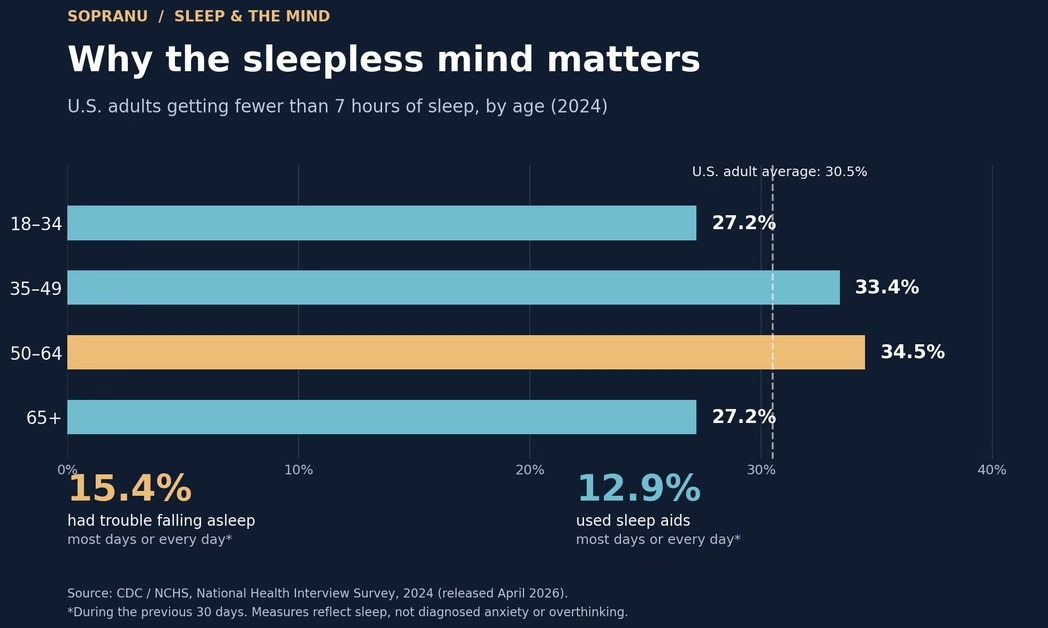
Also, keep the scale in mind. The US Centers for Disease Control and Prevention reported that in 2024 roughly 30.5% of American adults slept less than seven hours a night on average, and about 12.9% said they used sleep aids most days in the previous month.
Baylor University, citing the National Sleep Foundation, notes that around 40% of American adults have trouble falling asleep at least a few times a month. You are not unusual, and you are not broken.
How Do I Stop Overthinking at Night?
You stop overthinking at night by giving your thoughts somewhere else to go, a different time to happen, and a different job for your brain to do. Trying to force thoughts out with willpower rarely works. Here are the four approaches I trust most, because each has at least some research behind it.
Write a Specific To-Do List for Five Minutes
As described above, Scullin’s 2018 Baylor study found a five-minute, specific to-do list helped people fall asleep faster than writing about completed tasks.
Note the limits: it was a lab study of 57 healthy university students, and Scullin himself said a larger sample would help, especially to test effects in people with anxiety or depression. Still, it costs nothing, and it is the first thing I would try.
Give Your Worries a Daytime Appointment
This technique is called worry postponement or stimulus control for worry. The idea, developed by Thomas Borkovec and colleagues in the early 1980s, is that worry becomes linked to many places and times, including your bed. So you deliberately move it to one fixed time and place each day.
In research by Sarah McGowan with Evelyn Behar at the University of Illinois at Chicago (a 2012 thesis, published with Behar in 2013), 46 participants were randomly assigned to two weeks of either a daily 30-minute, time-and-place-restricted worry period or an acceptance-based control.
The worry-period group improved more on worry, anxiety, negative mood and insomnia symptoms.
A more recent randomised trial in Clinical Psychology in Europe also found worry postponement reduced worry in people with generalised anxiety disorder, though earlier research in clinical groups was more mixed.
How to do it:
- Pick a 15 to 30 minute slot, early evening, not close to bedtime. For example, 6:30 p.m.
- Sit in the same chair each time. Not your bed.
- During the day and night, when a worry shows up, note it in a word or two and tell yourself, “Not now. 6:30.”
- At 6:30, go through the list. Solve what you can. Let the rest sit.
Try Cognitive Shuffling
Cognitive shuffling, formally called serial diverse imagining, was developed by Luc Beaudoin, a cognitive scientist at Simon Fraser University in Canada. You pick a random, neutral word, such as “bedtime,” then for each letter you imagine a series of unrelated objects: B for banana, bicycle, bakery; E for elephant, envelope, and so on.
Beaudoin suggests holding each image for roughly 5 to 15 seconds and not trying to connect them into a story.
His reasoning is that the brain naturally drifts through disconnected images as it falls asleep, so the exercise mimics sleep onset while keeping your mind too busy for worry. His 2016 study involved 154 college students. I should be honest: the evidence base is still small, and Beaudoin has said himself that more research is planned. In my own experience it works better for the unfinished list and the replay than for strong emotional worries.
Get Out of Bed When You Can’t Sleep
This one sounds backwards, but it is a core part of CBT-I. In 1972, psychologist Richard Bootzin described stimulus control therapy for insomnia, built on the idea that your bed should become a strong cue for sleep, not for lying awake and thinking.
If you are awake and frustrated for a long stretch, get up, go to another room with dim light, and do something quiet and boring until you feel sleepy again.
Many clinicians suggest about 20 minutes as a rough guide, though I could not find a single fixed number in the original research, so go by feel rather than the clock.
When Self-Help Is Not Enough
If overthinking at night has gone on for months, cognitive behavioural therapy for insomnia (CBT-I) is the treatment with the strongest long-term evidence. Sleep specialists quoted in a March 2026 report on cognitive shuffling, carried by the Boston Globe, made this point directly, noting that cognitive tricks like shuffling are not substitutes for CBT-I when insomnia is chronic.
Many CBT-I programmes now run online or through apps, which makes them easier to access than they were a decade ago.
A Simple 30-Minute Wind-Down for Overthinkers
Here is the routine I settled on after a lot of trial and error. It is not a clinical protocol, just a practical sequence that pulls the research above together.
| Time before bed | What to do | Why |
|---|---|---|
| 30 min | Put your phone on charge outside the bedroom or across the room | Removes the late-night symptom search and doom-scroll |
| 25 min | Write a specific to-do list for tomorrow (5 minutes) | Offloads the unfinished list (Scullin, 2018) |
| 20 min | Write one line for each worry still buzzing, then close the notebook | Signals the worry has a home and a later appointment |
| 15 min | Dim lights, read something calm on paper | Lowers stimulation; paper avoids notifications |
| In bed | Turn the clock away, start cognitive shuffling if thoughts return | Reduces clock-watching and gives the mind a neutral task |
| If awake a long time | Get up, sit in dim light, return when sleepy | Stimulus control (Bootzin, 1972) |
If you want to understand the sleep side more deeply, our summary of Why We Sleep by Matthew Walker covers the science behind the 2007 amygdala study, and the review of Dreamland by David K. Randall is a lighter, story-led read. For the light-at-night question, our piece on nighttime light exposure and heart damage is worth a look too.
What I Learned From My Own Sleepless Nights
I used to think overthinking at night meant I was a deep person who felt things more than others. There is a little romance in that idea, and I held on to it for a long time. The truth was less flattering. Most of what I thought about between midnight and 3 a.m. was not deep at all. It was the same five or six worries, wearing slightly different clothes each night.
What changed things for me was not a single trick. It was the moment I realised my 2 a.m. self was an unreliable narrator. That version of me was tired, emotionally louder, and cut off from the people and facts that would have corrected him. Once I stopped treating his conclusions as truth, I could listen to the thoughts without obeying them.
I also stopped expecting perfection. Some nights I still lie awake. The difference is that I now know which of the seven thoughts is visiting, and I have a small response ready for each one. That alone makes the night feel shorter.
There is a line of thinking in Marcus Aurelius that helped too. He wrote repeatedly about separating events from the judgements we attach to them.
If you want that idea in more detail, our review of Meditations and its key lessons is a good place to start, and Amanda Montell’s look at modern anxious thinking in The Age of Magical Overthinking explains why so many of us feel this way right now.
FAQs About Overthinking at Night
Why do I overthink only at night and not during the day?
You overthink at night mainly because the distractions that occupy your attention during the day disappear, and fatigue makes your emotional brain more reactive. Research from UC Berkeley in 2007 found emotional brain regions were more than 60% more reactive after sleep loss, which helps explain why night-time thoughts feel heavier.
Why do I wake up at 3 a.m. and start overthinking?
Waking briefly during the night is normal, because sleep moves through cycles. The problem starts when a worry catches you during one of those brief wakings and keeps you alert. Alcohol, late caffeine, stress and an irregular schedule can make these awakenings more noticeable. If 3 a.m. waking happens most nights for weeks, a doctor can help rule out other causes such as sleep apnoea or depression.
Is it normal to overthink every night?
It is common, but it is not something you have to accept. Nolen-Hoeksema’s research found that 73% of adults aged 25 to 35 described themselves as overthinkers. However, if it happens nearly every night and affects your days, consider speaking with a professional about anxiety or insomnia.
Does writing things down really help you sleep?
Writing things down can help. A 2018 Baylor University study found that people who wrote a specific to-do list for five minutes before bed fell asleep about nine minutes faster than those who wrote about completed tasks. The study was small, with 57 participants, so it is promising rather than definitive.
What is the fastest way to stop overthinking at night?
There is no instant switch, but the quickest options are cognitive shuffling (imagining a stream of random, unrelated objects) and getting out of bed briefly if you can’t sleep. Both interrupt the loop instead of fighting it directly.
Can overthinking at night cause insomnia?
Yes, it can contribute. Allison Harvey’s 2002 cognitive model of insomnia describes how worry, especially worry about sleep itself, creates arousal and distress that make it harder to fall and stay asleep, which can keep insomnia going over time.
The Bottom Line
Overthinking at night is not proof that something is deeply wrong with you. It is what a tired, unoccupied brain does when it finally has space. The seven thoughts, the replay, the list, the money math, the body scan, the life audit, the relationship decode and the fear of not sleeping, are loud mostly because the night makes them loud.
You don’t have to win an argument with them.
Write the list. Give your worries a daytime appointment. Shuffle some random images. Get up if you need to. And when it feels like the problems are bigger than you can handle, remember the simplest rule I know: nothing decided at 3 a.m. is final until it survives breakfast.