
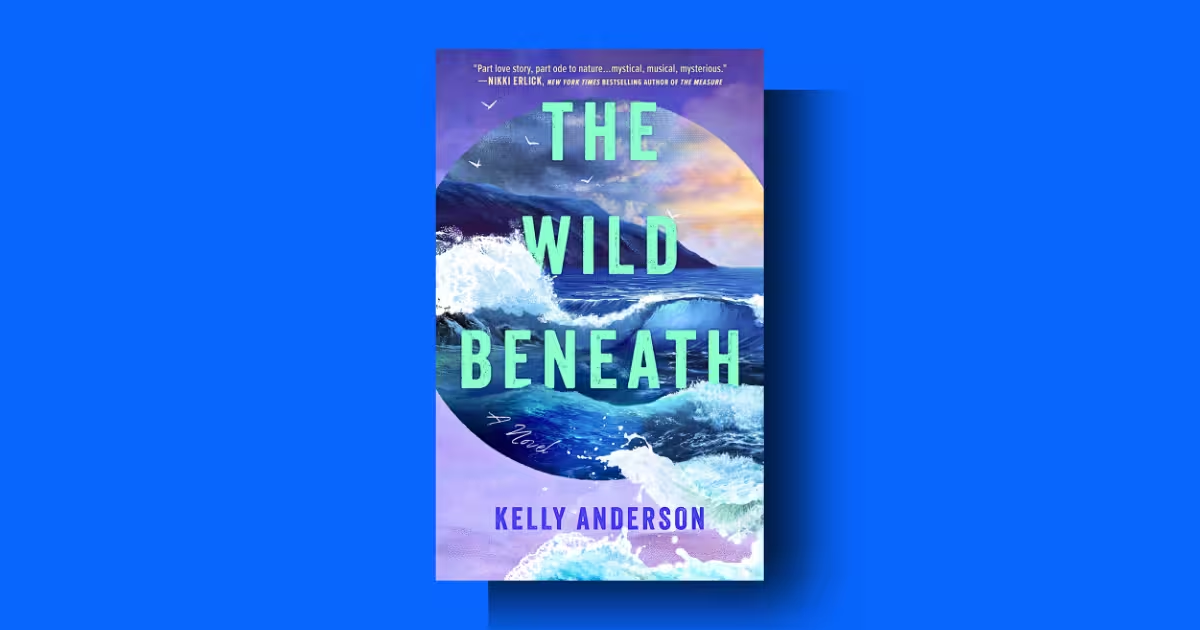

Do you remember the last time a book made you feel like you were breathing salt water? Kelly Anderson’s debut novel The Wild Beneath does exactly that; it seeps into your bones like the Pacific tide and refuses to let go. This isn’t just a story about a tsunami or a love triangle; it’s an exploration of something far more primal: the question of where we truly belong and whether we can ever fully escape the pull of our origins.
Overview
A woman raised on a sailboat in the Pacific Northwest must choose between a stable life on land with her childhood sweetheart and a mysterious connection to the sea embodied by a wordless stranger who washes ashore after a devastating tsunami, only to discover that the choice isn’t about men at all, but about remembering who she really is.
Reader recommendation
The Wild Beneath is best for readers who love atmospheric literary fiction with magical realism elements, fans of Where the Crawdads Sing and The Time Traveler’s Wife, anyone who has ever felt an inexplicable pull toward the ocean, and those who appreciate stories where nature itself is a character.
The Wild Beneath is not readers who prefer fast-paced thrillers or tidy resolutions with every question answered. This book asks you to sit with ambiguity and embrace the unexplainable.
Table of Contents
1. Introduction
The Wild Beneath by Kelly Anderson was published on August 4, 2026, by Park Row Books (HarperCollins).
It was selected as Reese Witherspoon’s August 2026 Book Club pick, which has already catapulted this debut novel into the spotlight.
Anderson, a family physician with fellowships in HIV and emergency medicine, spent fifteen years at St. Michael’s Hospital in Toronto before writing this book. She began writing it in 2019 while “quietly drowning inside [her] own life as a doctor.”
The Wild Beneath has drawn comparisons to Charlotte McConaghy’s Wild Dark Shore, Delia Owens’ Where the Crawdads Sing, and Audrey Niffenegger’s The Time Traveler’s Wife.
2. Background
The Pacific Northwest coast, specifically the Cascadia Subduction Zone, serves as both setting and silent character in this novel.
The Cascadia Subduction Zone is a real 1,000-kilometer fault line running from northern Vancouver Island to California. Scientists have long warned that a massive earthquake. potentially magnitude 9.0 or higher, is overdue in this region, with the last major event occurring in 1700.
Anderson uses this real geological threat as the catalyst for her story, grounding the magical elements in tangible scientific reality.
The novel also draws on Indigenous oral traditions and coastal folklore about people who can transform into sea creatures or communicate with marine life. These mythological elements blend seamlessly with the story’s realistic portrayal of grief, survival, and human connection.
3. The Wild Beneath Summary
Part One: Low
The Wild Beneath opens with a prologue that reads like poetry. A massive earthquake strikes the Cascadia Subduction Zone, triggering a devastating tsunami that sweeps through coastal British Columbia. The wave is described as a “liquid mountain” and a “song” that the ocean sings. The destruction is complete and catastrophic.
We then meet Annie MacLeod, a young woman in her early twenties who has been digging for clams on the beach near her grandmother Ruth’s cabin. It’s been four days since the tsunami. Her parents, Aiden and Mara, were out on their sailboat Amphitrite when the wave hit, and Annie has received no word of their survival.
Annie’s grief manifests as a physical presence in her life. She describes it as being like sand—impossible to fully clean away, always gritty under her fingernails, embedded in every corner of her existence. She wears earplugs constantly because the world has become unbearably loud since the tsunami.
While searching the beach, Annie discovers a naked young man lying unconscious on the sand. He’s tall, with translucent skin and grey-silver eyes. He emits a strange thumping sound that only Annie can hear—a vibration that seems to come from deep within the earth or sea. She drags him up the thirty-foot bluff to Ruth’s cabin with her grandmother’s help.
Ruth, a retired nurse, examines the mysterious stranger. His pulse is dangerously slow, 32 beats per minute, and his blood appears bluish rather than red. Despite these alarming signs, his oxygen saturation is 98 percent. Ruth names him “Walker” because the first word he speaks is “walking.”
The narrative then flashes back twenty years to show us Annie’s parents. Aiden MacLeod is a former doctor who gave up medicine to sail the Pacific with his wife Mara. Mara is pregnant and insists on giving birth in the ocean rather than a hospital. Aiden delivers Annie in the cold salt water, holding her in his numb hands as she takes her first breath.
We see Annie’s unconventional childhood unfold on Amphitrite.
She’s a natural swimmer, able to hold her breath far longer than her father. She befriends Evan Hale, the son of the local timber baron Isaac Hale, during summers in Hale’s Landing. Evan is gentle and kind, with chocolate-brown eyes and a deep connection to the forest—his late mother Celeste taught him that trees can hear us.
Back in the present, Walker slowly begins to recover. He’s fascinated by ordinary objects: rice, spices, books. He speaks in fragments and riddles. Annie discovers that his presence silences the overwhelming noise she’s been hearing. His hum, as she calls it, makes everything bearable.
Evan, now a young man working for his father’s logging company, is grieving too. He’s been avoiding Annie, throwing himself into work at Hale Timber. When they finally reunite on the beach, there’s tension between them. Annie feels abandoned; Evan feels trapped by his father’s expectations.
Ruth reveals a family secret: Mara was found on a beach with amnesia after a boating accident. She was hospitalized for psychosis, talking about “water gods” and sea creatures. Aiden met her at the hospital and eventually bought Amphitrite so she could live on the water, which seemed to heal her. Annie is shaken by this revelation, wondering if she might inherit her mother’s “craziness.”
Walker continues to grow stronger, helping with chores and repairs. He’s drawn to the sea and swims for hours, seemingly unaffected by the cold. Annie is increasingly attracted to him, though she’s still in love with Evan.
Part Two: Slack
Ruth’s health deteriorates, she has leukemia and needs blood transfusions. Evan agrees to take her to Vancouver for treatment while he tows log booms for Hale Timber. Walker stays behind with Annie.
Annie and Walker grow closer. He shows her visions of the underwater world when they touch. She can see the seafloor, coral, and marine life as if she’s there. It’s intoxicating and terrifying. They have sex in the berth of Polaris, a derelict sailboat Walker is repairing in the shipyard. During the act, Annie feels like she’s merging with the ocean itself.
Evan confronts Walker, accusing him of manipulating Annie. Walker responds with cryptic statements about love and sacrifice. Evan storms off.
Part Three: Flood
A storm hits while Evan is towing the log booms. Walker is on the tug with him. The sea becomes violent. Evan is thrown overboard—his life jacket fails to inflate. Walker dives in to save him, pulling Evan back to the surface. But Walker is swept against the rocks and disappears beneath the waves.
Evan survives and returns to shore with Annie’s whalebone necklace, which Walker had been wearing. He tells Annie that Walker is dead. Annie is devastated.
The coast guard arrives and announces a mandatory evacuation. Everyone must leave Hale’s Landing by October. Ruth, still hospitalized in Vancouver, dies of complications from her leukemia.
Annie and Evan relocate to Vancouver. Annie enrolls in medical school, following in her father’s footsteps. She and Evan rebuild their relationship. Six years pass. Annie becomes an emergency physician. She and Evan live together in an apartment, attending symphony concerts and trying to build a normal life.
But something is wrong. Annie can’t shake the feeling that Walker is still alive. She starts hearing his hum again, especially near the water. She begins swimming in the ocean at night, drawn back to the sea.
Evan inherits Hale Timber after Isaac’s death. He signs the papers, planning to transform the company into a sustainable forestry operation.
Annie finally tells Evan the truth: she believes Walker is still alive and she needs to find him. Evan reveals his own secret: he watched Walker drown but never told her the full story. Despite their love, Annie knows she has to return to Hale’s Landing.
Part Four: High
Annie takes a barge north. She discovers that Polaris is gone—Walker has sailed away in it. Henry confirms that Walker appeared again, naked and confused, just as before. He sailed out less than a week ago without a radio or GPS.
Annie takes Galene, Henry’s fishing boat, and sails after him. She’s guided by the hum, which pulls her north. A whale appears beneath her—it seems to be guiding her. Annie falls overboard and nearly drowns, but the whale saves her, carrying her through the water. She experiences visions of her mother, of the sea’s ancient stories, of her own birth.
Walker is waiting for her on Polaris. He explains that the hum isn’t from him—it’s from the sea itself. He’s a messenger, or perhaps something more. The sea has been trying to reach Annie her entire life. Her mother Mara was connected to the ocean in the same way, she was one of the “singers,” people who can hear and communicate with the sea.
Walker tells Annie that she belongs to both worlds: land and sea. She can connect to both as long as she doesn’t get too far from either. He takes her swimming with the whale. Annie dives deep, experiencing the entire history of the ocean and her family. When she surfaces, Walker is gone.
Part Five: Ebb
Annie sails back to Hale’s Landing. Evan is waiting for her. They meet on the beach as a humpback whale breaches nearby. The Wild Beneath ends with them listening together, holding hands, as the song of the sea echoes around them.
4. The Wild Beneath Analysis
4.1. The Wild Beneath Characters
Annie MacLeod: The protagonist is a study in contrasts. She’s fiercely independent yet desperately lonely. Raised on the sea, she’s physically incapable of fully adapting to life on land. Her journey is one of self-discovery—learning that her “difference” isn’t a flaw but a gift.
Annie’s character arc moves from grief-stricken survivor to confident woman who embraces her connection to the natural world. Her choice at the end isn’t between Evan and Walker; it’s between denying who she is and accepting it.
Walker: The enigmatic stranger is the novel’s most mysterious figure. He appears from the sea, speaks in riddles, and seems to exist between worlds. Is he human? A sea creature? A messenger? The novel deliberately leaves this ambiguous.
Walker’s role is to awaken Annie to her true nature. His sacrifice (drowning to save Evan) isn’t an end but a transformation—he returns to the sea, which is where he belongs. His final disappearance suggests that he was never meant to stay on land.
Evan Hale: Evan represents the land, stability, duty, the human world. He’s deeply good but trapped by obligation to his father and his family’s logging legacy. His arc is about breaking free from that legacy and finding his own path.
By the end, he’s transformed Hale Timber into a sustainable operation and learned to listen to the trees the way his mother taught him. He loves Annie completely but must learn to let her be who she is.
Mara MacLeod: Annie’s mother is The Wild Beneath‘s hidden heart. We learn that Mara was found on a beach with amnesia, hospitalized for psychosis, and only found peace when she returned to the sea.
She’s one of the “singers”, people who can hear the ocean’s song. Her love for Aiden and Annie is genuine, but her true home is the water. Mara’s story explains Annie’s own connection to the sea.
Ruth MacLeod: Annie’s grandmother is the anchor of the land-based world. Practical, stoic, and deeply loving, Ruth represents the value of stability and human connection. Her death is a turning point for Annie, cutting her last tie to a conventional life.
Aiden MacLeod: Annie’s father is a complex figure. He gave up a successful medical career for love of Mara and the sea. He’s the bridge between worlds—a man of science who embraces the mystical. His love for Mara and Annie is unconditional.
4.2. The Wild Beneath Themes and Symbolism
The Ocean as a Living Entity: The sea is not just a setting in this novel—it’s a character with agency, voice, and desire. The tsunami is described as a “song” the ocean sings. The sea “wants” things, “takes” things, and “spits back” what it doesn’t want. This animism reflects Indigenous and mythological traditions where nature is alive and conscious.
The Duality of Land and Sea: The novel is structured around opposing forces: land versus sea, stability versus freedom, human connection versus wildness. Annie is torn between these worlds, and her journey is about finding balance rather than choosing one over the other. Walker tells her she can connect to both “as long as [she doesn’t] get too far away from one or the other.”
Grief and Transformation: Annie’s grief over losing her parents manifests as a physical weight—like sand that can’t be washed away. But grief also opens her to new possibilities. It’s through loss that she rediscovers her connection to the sea.
Listening and Connection: The novel repeatedly emphasizes the importance of listening—not just with ears but with the whole body. Annie’s father teaches her that animals communicate seismically, through vibration. Mara tells her to “listen with your whole body.” Walker’s hum is something Annie feels in her bones before she hears it with her ears. This theme suggests that true understanding requires more than intellectual comprehension—it requires embodied presence.
Sacrifice and Love: Walker’s sacrifice of himself to save Evan is the novel’s most explicit exploration of this theme. But there are other sacrifices too: Aiden giving up medicine for Mara, Evan giving up his father’s approval for Annie, Annie giving up stability for the unknown. Love, the novel suggests, often requires letting go.
The Whale as Symbol: The humpback whale that appears throughout the novel is a symbol of the ocean’s wisdom and power. It’s connected to Mara (who was found on a beach like a beached whale), to Walker (who seems to communicate with it), and to Annie (who rides it to her transformation). The whale represents the wild, untamable force of nature that humans can never fully control.
The Sand Dollar: Annie’s habit of pairing sand dollars together symbolizes her desire for connection and belonging. She wants things to be in pairs, to not be alone. This is both her strength and her vulnerability.
5. The Wild Beneath Evaluation
The Wild Beneath is a quietly astounding debut that deserves its place as a Reese’s Book Club pick. It’s a novel that works on multiple levels: as a love story, as a family drama, as a meditation on grief, and as a work of magical realism that asks profound questions about our relationship to the natural world.
Strengths
Atmospheric Writing: Anderson’s prose is lyrical and immersive. Readers have described feeling like they’re “stepping inside” the story, tasting salt air and feeling the pull of the tide. The Pacific Northwest setting is rendered with vivid detail.
Unique Premise: The combination of a tsunami disaster, a love triangle, and magical realism is unusual and compelling. The novel doesn’t fit neatly into any single genre, which makes it feel fresh.
Emotional Depth: The grief Annie experiences is palpable and authentic. Anderson, who worked as a physician, understands trauma and its aftermath intimately.
Thematic Coherence: The novel’s themes—listening, belonging, sacrifice—are woven throughout the narrative without feeling heavy-handed.
Weaknesses
Pacing: Some readers have noted that the novel’s pacing is unhurried. This works for the atmospheric quality but might frustrate readers seeking more plot momentum.
Ambiguity: The Wild Beneath leaves many questions unanswered. What exactly is Walker? What happened to Mara during the tsunami? Some readers may find this frustrating.
Underdeveloped Secondary Characters: Characters like Henry and Rosie are sketched rather than fully realized. The novel is so focused on Annie’s perspective that other characters sometimes feel like background.
Impact
The Wild Beneath resonated deeply with me. I found myself thinking about it long after finishing—about the pull of the ocean, the way grief can feel like a physical weight, and the question of what it means to truly belong somewhere. The scene where Annie nearly drowns but is saved by the whale is genuinely transcendent.
Comparison with Similar Works
The Wild Beneath shares DNA with several beloved novels:
Where the Crawdads Sing by Delia Owens: Both feature a female protagonist deeply connected to nature, raised in isolation, who must navigate love and loss.
The Time Traveler’s Wife byAudrey Niffenegger: The love story has a similarly epic, time-bending quality.
Wild Dark Shore by Charlotte McConaghy: Both novels explore the tension between human connection and the wildness of nature.
Remarkably Bright Creatures by Shelby Van Pelt: Both feature marine life (octopus/whale) as a central symbolic presence.
6. Personal Insight with Contemporary Relevance
The Cascadia Subduction Zone: Fiction Meets Reality
One of the most striking aspects of The Wild Beneath is its grounding in real geological threat. The Cascadia Subduction Zone is a 1,000-kilometer fault line running from Vancouver Island to Northern California. Scientists estimate there’s a 10-15% chance of a magnitude 8.0 or larger earthquake in this region within the next 50 years. The last major event occurred in 1700, and the pressure has been building ever since.
Anderson doesn’t just use this as a plot device; she makes it integral to the story’s themes. The tsunami that destroys Annie’s world is a literal disaster, but it also represents the collapse of her old identity. The ocean takes everything—her parents, her home, her sense of self—but it also offers the possibility of transformation.
This resonates with our current moment, when climate change and natural disasters are increasingly part of our collective consciousness. The Wild Beneath asks: when the world as we know it ends, what remains? What do we carry forward?
Five Lessons from The Wild Beneath
1. Grief is not something to “get over” but something to integrate. Annie’s grief over her parents never fully disappears; it becomes part of her, like sand that can’t be completely washed away.
2. Listening with your whole body is a form of wisdom. The Wild Beneath repeatedly emphasizes that true understanding comes through embodied presence, not just intellectual analysis.
3. Belonging isn’t about choosing one thing over another. Annie doesn’t have to choose between land and sea, Evan and Walker. She can belong to both worlds.
4. Love sometimes requires letting go. Walker’s sacrifice, Evan’s willingness to let Annie go, Aiden’s decision to leave medicine—all show that love often means releasing control.
5. The natural world is alive and communicative. The ocean, the trees, the whales—they all have voices if we learn to listen.
7. The Wild Beneath Quotes
“Her grief is like this. Sprinkles of it in what she manages to eat, gritty against her teeth even when the food tastes fine.”
“You can listen with your whole body, Annie.”
“The ocean is inside us.”
“Once upon a time there was a girl named Annie, who wanted the sea.”
“We’re the singers, but the sea is the song.”
“She wants your story, too.”
8. Conclusion
The Wild Beneath is a remarkable debut that deserves attention. It’s a novel that asks big questions—about love, loss, belonging, and our relationship to the natural world—without offering easy answers. Anderson’s prose is lyrical and immersive, her characters are complex and flawed, and her themes resonate deeply with our contemporary moment.
This is a book for readers who want to be transported, who aren’t afraid of ambiguity, and who believe that the natural world has stories to tell if we only learn to listen. It’s a book that will stay with you long after you’ve turned the last page.
Recommendation: Fans of literary fiction with magical realism elements, readers who loved Where the Crawdads Sing or The Time Traveler’s Wife, and anyone who has ever felt the pull of the ocean should pick up this book.