
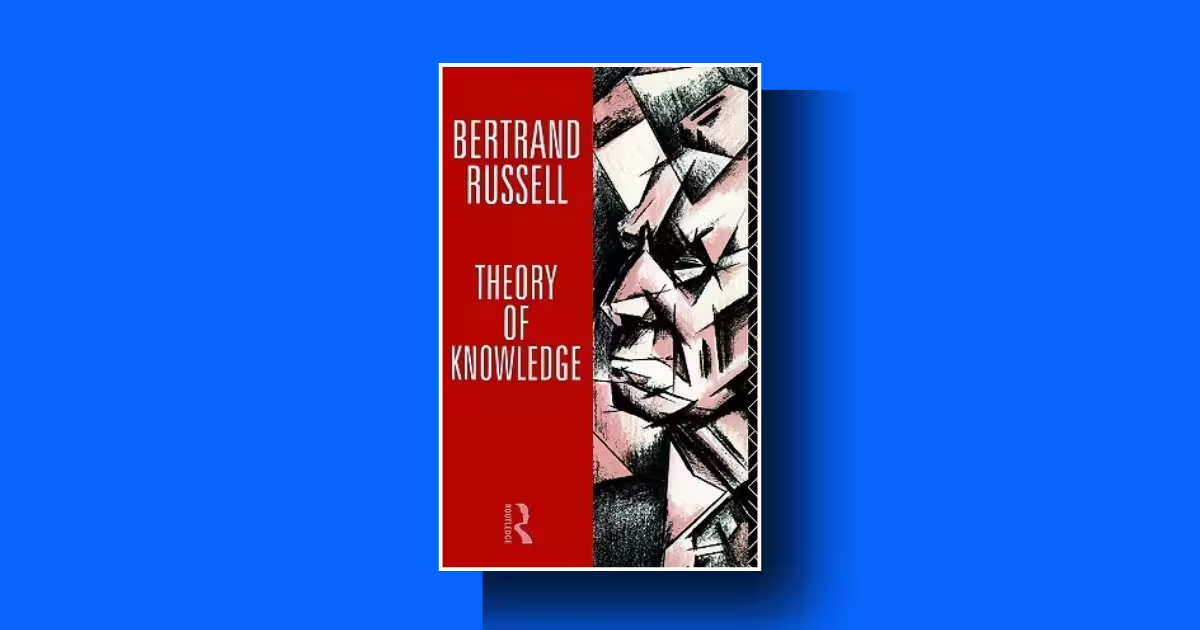
What does it actually look like when a forty-year-old genius is told, calmly and precisely, by his own twenty-four-year-old student, that the theory at the center of his new book does not work? In May and June of 1913, Bertrand Russell found out, and the manuscript he put down that summer sat unread for 71 years before anyone else saw it.
Overview
In just 31 days, between 7 May and 7 June 1913, Bertrand Russell wrote 350 pages of what he intended as his next major philosophical book after Principia Mathematica. Then Ludwig Wittgenstein, his own student at Cambridge, convinced him that the theory of judgment at its center did not hold up, and Russell stopped writing and never finished it.
The manuscript was not even known to exist until 1967, when Russell’s papers were catalogued for sale to McMaster University, and it did not reach print until 1984, as Theory of Knowledge: The 1913 Manuscript, edited by Elizabeth Ramsden Eames with Kenneth Blackwell.
It is Volume 7 of The Collected Papers of Bertrand Russell, and according to Routledge’s own listing, it is the only book-length work on epistemology that Russell left unpublished in its original form.
This is not a tidy, finished book. It is a philosopher’s working draft, stopped mid-argument by a personal and intellectual crisis, and that is exactly what makes it worth reading.
Suggested readers
Theory of Knowledge is for readers who already have some footing in analytic philosophy and want to see where logical atomism actually came from, rather than reading about it secondhand. It is for anyone curious about the Russell-Wittgenstein relationship who wants primary material instead of another paraphrase.
It is for students of epistemology who want to watch a correspondence theory of truth get built, piece by piece, with the joints still showing.
It is not for someone looking for a first introduction to Russell. Start with The Problems of Philosophy instead, and come back to this one later. It is also not for a casual afternoon of reading, since several chapters lean on dense symbolic notation, and the manuscript ends without a conclusion, because Russell genuinely never wrote one.
Table of Contents
1. Introduction
Theory of Knowledge: The 1913 Manuscript is a work by Bertrand Russell (1872 to 1970), edited by Elizabeth Ramsden Eames in collaboration with Kenneth Blackwell. It was first published in 1984 by George Allen & Unwin as Volume 7 of The Collected Papers of Bertrand Russell, reissued in paperback by Routledge in 1992, and reissued again as a standalone paperback in 2016 (248 pages).
The original 1984 edition runs to lv plus 258 pages, a length confirmed by the Internet Archive’s own catalog record for the physical volume.
Russell needs little introduction to anyone who has taken a philosophy course, but his credentials matter here specifically because this is a book about what happened to him in the middle of his career. By 1913, he had already co-written the three volumes of Principia Mathematica with Alfred North Whitehead, a project that took over a decade and left him, by his own later account, mentally exhausted.
He had also just published The Problems of Philosophy in 1912, a short and famous introduction to epistemology that ends on an open question: what is acquaintance, and how does it ground everything else we claim to know? Theory of Knowledge was his attempt to answer that question in full technical detail.
He would go on to win the Nobel Prize in Literature in 1950 and receive the Order of Merit in 1949, but none of that had happened yet in the summer of 1913. In 1913, he was simply trying to write the book that would follow Principia Mathematica.
The genre here is analytic epistemology in the technical, logic-driven style Russell helped invent, not knowledge in a broad cultural sense. The book splits into two halves. Part I, “On the Nature of Acquaintance,” deals with the most basic relation Russell thought existed between a mind and the world.
Part II, “Atomic Propositional Thought,” deals with belief, judgment, truth, and certainty, meaning what happens once a mind moves past simple acquaintance and starts forming full beliefs.
The purpose of Theory of Knowledge, stated plainly in its own opening pages, is to defend one specific claim: that acquaintance is a direct, two-term relation between a subject and an object, a relation that does not require subject and object to share any common nature, and one that every other cognitive act, including attention, memory, imagination, and belief, already presupposes. Russell built his entire epistemology on that claim.
Then, a little over a third of the way into defending it in full, he stopped, and he never picked the project back up in its original form.
2. Background
To understand why Theory of Knowledge exists in the strange, unfinished form it does, you need the story of 1913, and it is a genuinely dramatic one for a philosophy book.
Russell finished his share of the work on Principia Mathematica in 1910. Ludwig Wittgenstein arrived at Cambridge as Russell’s student the following year and quickly became his closest philosophical companion, someone Russell described in warmly paternal terms in his private letters.
By 1913 the two men were meeting constantly, and Wittgenstein was already developing the ideas that would eventually become the Tractatus Logico-Philosophicus.
Russell began writing Theory of Knowledge on 7 May 1913 and worked at a pace that is startling by any standard.
According to Theory of Knowledge‘s own editorial introduction, he reached page 350 by 7 June, a rate of more than eleven manuscript pages a day for a month straight, while Ottoline Morrell, the woman he was involved with at the time, was away in Lausanne seeking treatment from a Swiss physician for nervous exhaustion.
Russell wrote to her almost daily during this period, and it is largely from those letters, held at the Humanities Research Center at the University of Texas and on microfilm at the Bertrand Russell Archives, that Eames and Blackwell reconstructed the manuscript’s day-by-day timeline.
Wittgenstein started raising objections almost immediately.
By 20 May, Russell mentioned that his student had arrived with what amounted to a refutation of an earlier theory of judgment, though Russell did not take it seriously at first, since he felt he had already moved past that theory. Within a week, the criticism became harder to dismiss.
Russell later described Wittgenstein dismissing an important section of the new material as fundamentally mistaken, and by June, Wittgenstein had put his objection in writing: a correct analysis of judgment, he argued, needed to guarantee that a proposition like “A is in relation R to B,” or its denial, follows directly, without borrowing some extra assumption from outside the theory.
Russell’s theory, in Wittgenstein’s view, could not do this.
The day after a conversation about it in mid-June, Russell confided to Ottoline that he had felt suicidal, and that everything going wrong for him at that point traced back to Wittgenstein’s attack on his work. He kept writing for a short while longer, reaching page 350 on 7 June, but that is where the manuscript stops.
He never wrote the planned Part III on inference, and he never returned to the project in its original form.
Three years later, in a letter to Ottoline dated 4 March 1916, he summed up the experience in a line that has since been quoted in nearly every serious account of the Russell-Wittgenstein relationship, including a detailed retelling on McMaster University’s own Bertrand Russell Research Centre site: “My impulse was shattered, like a wave dashed to pieces against a breakwater.”
He went on, in the same letter, to say that philosophy had lost its hold on him because of it, more than the war ever did.
The first six chapters of Part I were later reworked and published separately as a series of articles in The Monist across 1914 and 1915, under the umbrella title “On the Nature of Acquaintance.”
According to the book’s own editorial investigation, the missing first 142 pages of the physical manuscript correspond exactly to those six chapters, and were most likely removed from the original pages for typesetting and simply never returned, once the material existed safely in printed form.
That is why the surviving handwritten manuscript that McMaster University eventually acquired begins only at Chapter VII.
Russell’s papers, this manuscript among them, were not catalogued until 1967, two years before his death, and Theory of Knowledge itself did not reach print until 1984, 71 years after it was written.
3. Theory of Knowledge Summary
Because the surviving physical manuscript itself opens in the middle of an argument (the first six chapters exist only through the 1914 to 1915 Monist reconstruction), a full summary has to walk through both halves of the book as published.
Part I: On the Nature of Acquaintance opens with Russell defining his central technical term. Acquaintance, in Chapter I (“Preliminary Description of Experience”), is a direct relation between a subject and an object that does not require the object to be mental, or even to exist in the present.
Russell states plainly that acquaintance can hold between a mind and something in the past, something abstract, or a universal, and that every other cognitive relation, from sensation to memory to belief, already assumes acquaintance is in place.
He sets this claim against three rivals: the neutral monism of William James and Ernst Mach, a “content” theory in which a third mental entity sits between subject and object, and pure idealism, in which everything that exists is mental.
Chapter II (“Neutral Monism”) is Russell’s sustained argument against the first, and in his own estimate the most serious, of those rivals. James and the American realists had argued that there is no distinctive “mental” character to experience at all, that mind and matter are made of the same neutral stuff arranged differently depending on context.
Russell gives this position a full chapter’s worth of genuine consideration, then argues it cannot account for certain features of experience, memory in particular, without quietly reintroducing the very distinction it claims to erase.
Chapter III (“Analysis of Experience”) takes on the “content” theory, in which a mental idea or content mediates between mind and object, so that when you perceive a table, you are really perceiving your idea of the table rather than the table itself.
Russell rejects this, arguing that it makes acquaintance itself unintelligible, since you would then need a further relation connecting you to your own idea, and the regress never ends.
Chapter IV (“Definitions and Methodological Principles in Theory of Knowledge”) lays out the logical toolkit Russell uses for the rest of the book, including his account of the “sense” of an asymmetrical relation, which is his explanation for why “A is earlier than B” and “B is earlier than A” describe different facts even though they are built from exactly the same ingredients.
Chapter V (“Sensation and Imagination”) separates genuine sensation from memory-images and acts of imagination, arguing that all three involve acquaintance with objects that really exist, though objects of different kinds, and that vividness alone, a criterion borrowed from Hume, is not a reliable guide to which kind of acquaintance is actually taking place.
Chapter VI (“On the Experience of Time”) tackles the specious present, the puzzle of how a stretch of time can be experienced as a single “now” even though it has parts that are strictly earlier and later than one another.
Russell treats succession and simultaneity as directly perceivable relations rather than inferred ones, which supports his broader claim that temporal facts, like relational facts generally, come to us through direct acquaintance rather than reasoning.
Chapters VII through IX close out Part I with increasingly technical material. Chapter VII (“On the Acquaintance Involved in Our Knowledge of Relations”) argues that we can be acquainted with relations themselves, not only with the things they relate. Chapter VIII (“Acquaintance with Predicates”) extends the same claim to qualities and properties.
Chapter IX (“Logical Data”) closes the part by cataloguing the basic logical materials, including disjunction, negation, and generality, that Russell believes we grasp directly rather than by inference.
Part II: Atomic Propositional Thought shifts from simple acquaintance to full belief and judgment, and this is where the book’s real drama lives, both philosophically and biographically, since this is the section Russell was writing when Wittgenstein’s criticism landed.
Chapter I (“The Understanding of Propositions”) opens by defining atomic and molecular propositions, roughly, propositions with no internal propositional parts versus those built out of simpler ones, and wrestles with what a “proposition” actually is once you stop treating it as a purely grammatical unit.
Chapters II and III (“Analysis and Synthesis” and “Various Examples of Understanding”) work through what it means to understand a proposition without necessarily believing or disbelieving it, using concrete worked examples in a style closer to a logic textbook than a traditional philosophical essay.
Chapter IV (“Belief, Disbelief, and Doubt”) lays out Russell’s multiple relation theory of judgment, the theory Wittgenstein would go on to attack.
On this account, believing that “A is in relation R to B” is not a two-term relation between a believer and a single fact or proposition. It is a multiple relation, connecting the believer directly to A, to R, and to B all at once, with no separate “proposition” standing between them. Russell needed this theory to avoid treating false beliefs as beliefs about a fact that does not exist, which had troubled his earlier work.
Chapter V (“Truth and Falsehood”) builds a correspondence theory of truth on top of that same apparatus.
A belief is true, on Russell’s account, when there exists a “corresponding complex,” meaning an actual arrangement of the same objects the belief concerns, arranged the way the belief asserts. Russell works through, in careful technical detail, how a symbolism can capture the difference between “A is earlier than B” and “B is earlier than A,” even though both facts involve exactly the same three ingredients, by tracking what he calls the “position” each term occupies within the fact.
Chapter VI (“Self-Evidence”) takes on the foundationalist question of where justification has to stop.
Russell argues that some beliefs must be self-evident, meaning true and independent of inference, or else every chain of justification would run in a circle or regress forever, and he spends the chapter trying to define self-evidence in a way that guarantees truth without simply assuming it from the start.
Chapter VII (“Degrees of Certainty”) is the last chapter Russell wrote, and it breaks off unfinished.
He argues that belief is not all-or-nothing but comes in degrees, from full conviction down through doubt to disbelief, and that each degree counts as a genuinely distinct relation between believer and fact rather than one relation felt with varying intensity.
The chapter, and the manuscript, ends here, on page 350, with the planned Part III on inference never begun.
If you take away only one thing from this summary, let it be the shape of that gap: a fully built theory of belief and truth, immediately followed, in the historical record if not on the page itself, by the exact objection that broke it.
That gap tells you more about how philosophical ideas actually get replaced than most finished books on the subject ever manage to.
4. Theory of Knowledge Analysis
Judged purely as argument, Theory of Knowledge is rigorous almost to a fault.
Russell does not simply assert his positions, he builds them, defining terms before he uses them and testing his own claims against the strongest version of each rival theory he can construct, particularly in the neutral monism chapter, where he arguably gives James and Mach a more serious hearing than most of their own defenders did at the time.
Does Theory of Knowledge succeed at what it sets out to do? Only partially, and that is not really a criticism of Russell so much as a description of what happened to him.
The multiple relation theory of judgment, the load-bearing structure of Part II, has a specific weakness that later commentators, following Wittgenstein, have spent decades analyzing: because a judgment like “A believes that A is in relation R to B” only lists A, R, and B as separate objects the believer is connected to, nothing in the bare form of the theory rules out an equally well-formed but nonsensical judgment, one that mixes up which term plays which logical role.
Wittgenstein’s own objection, recorded in a June 1913 letter reproduced in the book’s introduction, put this precisely: he insisted that a correct analysis of judgment must guarantee, directly and without any extra premise, that a given relation either holds or it does not.
Russell’s version, on his own later admission, could not guarantee that.
What Theory of Knowledge contributes, then, is not a completed epistemology so much as an unusually honest record of a theory failing in real time, at the hands of its own author, in full view. Scholars have kept returning to it for exactly that reason. T
he manuscript has drawn sustained academic attention since its 1984 publication, including reviews in History and Philosophy of Logic by I. Grattan-Guinness, in the Australasian Journal of Philosophy by Aleksandar Pavkovic, and in Dialogue by Jocelyne Couture, along with a full 1992 doctoral dissertation by John Edwin Shosky that treats the manuscript’s rediscovery as a genuine case of philosophical amnesia. That is a serious, sustained body of scholarly engagement for a book its own publisher markets, accurately, as unfinished.
5. Strengths and Weaknesses
What I found most compelling about this book is its honesty. Most published philosophy hides its false starts. Theory of Knowledge cannot hide anything, because it stops exactly where Russell’s confidence did.
You get the neutral monism chapter at full strength, the time chapter working through genuinely difficult perceptual puzzles with real patience, and then, in Part II, you get to watch a theory of belief and truth built in real time by someone who does not yet know it is about to fail. That is rare.
Most accounts of intellectual crises are written after the fact, with hindsight smoothing over the mess. This one is the mess, preserved on the page.
The scholarly apparatus Eames and Blackwell built around the manuscript is a genuine strength in its own right, not just packaging.
Their introduction alone runs to more than fifty pages, reconstructing Russell’s day-by-day progress almost entirely from his letters to Ottoline Morrell, and their editorial notes track manuscript revisions, cross-reference the Monist articles line by line, and even catch a spot where Russell forgot to change the word “chapter” to “article” during a later revision. Few critical editions of any philosopher’s unpublished work are sourced this carefully.
The weaknesses are just as real, and mostly built into the nature of the material rather than into the editing. The first six chapters of Part I do not survive in the physical manuscript at all, so what you are reading there is a reconstruction from journal proofs rather than Russell’s original handwritten pages.
The symbolic notation in Part II, things like “xRy” and chains of subscripted positions labeled C1 through Cn, will be genuinely tough going for anyone without prior exposure to Russell’s logical notation. And, most obviously, there is no ending.
Russell never wrote Part III, so Theory of Knowledge simply stops mid-argument, on a chapter about degrees of certainty that itself never reaches a real conclusion.
If you need narrative closure from your nonfiction, this book will frustrate you on principle, since the missing ending is the entire point of what happened to Russell in 1913.
6. Comparison With Similar Works
If you want the finished, confident version of the epistemology Russell was reaching for here, read The Problems of Philosophy (1912) first, the short book this manuscript was meant to expand on. If you want to see where Russell’s thinking actually landed after the crisis of 1913, Our Knowledge of the External World (1914) is the book he wrote instead, in a more cautious, phenomenalist register, and it rewards reading immediately after this one, for the contrast alone.
For readers who want to stay with Russell but shift into an entirely different register, my review of Marriage and Morals covers his 1929 book on sex, family, and social convention, and shows just how far his interests ranged once he left technical epistemology behind.
My review of In Praise of Idleness covers the 1935 essay collection where Russell turns the same exacting logical habits toward economics and work, in much lighter prose than anything in Theory of Knowledge.
And my review of What I Believe looks at the 1925 essay that cost him a teaching post in New York, a useful reminder that the same man who could spend nine pages defining “acquaintance” also wrote some of the most quoted provocations in twentieth-century atheism.
Outside Russell’s own body of work, Rosalind Carey’s Russell and Wittgenstein on the Nature of Judgement is the fullest academic treatment of the exact dispute this manuscript records, and it is worth seeking out if this review has left you wanting the philosophical argument in full technical depth rather than the biographical version told here.
7. Conclusion
I would recommend Theory of Knowledge: The 1913 Manuscript to readers who already have some grounding in Russell or in early analytic philosophy and want primary material rather than a summary of a summary.
It is not a general audience book, and it was never meant to be one. It sits closer to a laboratory notebook than a published argument, and its value lies precisely in that rawness.
If you are a specialist in the history of analytic philosophy, or a graduate student working on Russell or Wittgenstein, this book is close to essential, not because it succeeds as an argument but because it documents, with unusual precision, exactly how one of the twentieth century’s most self-assured philosophers hit a wall he could not get past.
If you are a general reader simply curious about Russell, start elsewhere, with The Problems of Philosophy or one of his popular essays, and come back to this one once you want to see the machinery behind the confidence.







