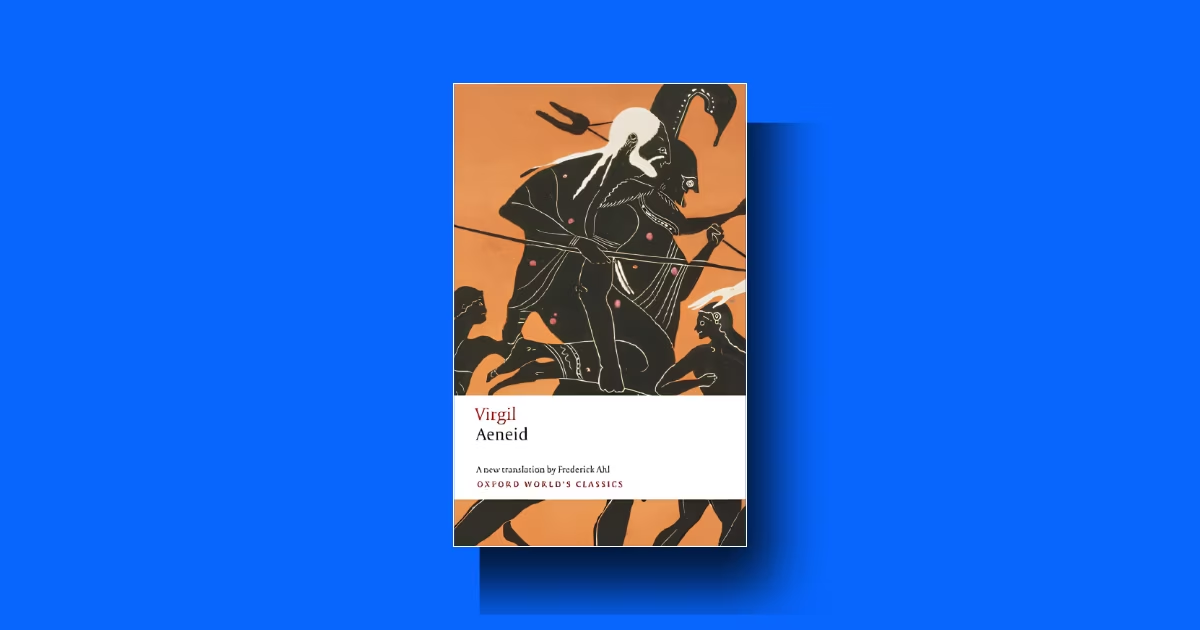

The Aeneid by Virgil is Rome’s founding epic, a 9,896-line poem in twelve books about a refugee from a burned city who becomes the ancestor of an empire. It was left unfinished when Virgil died in 19 BC. And it ends in the strangest way a national epic could end: the hero stands over a beaten enemy who is begging for his life, hesitates, and kills him anyway.
No victory parade, no wedding, no city founded on the page. Just a sword, a groan, and a soul going down among the shadows. I finished the poem in Frederick Ahl’s Oxford World’s Classics translation and sat with that last line for a long time, because the man who breaks the rule of mercy is the same man his father once told to spare the defeated.
That contradiction is the angle of this Aeneid review, and I think it is the key to the whole The Aeneid.
Table of Contents
The Aeneid in 60 Seconds
What is The Aeneid about? It follows Aeneas, a Trojan prince who escapes the fall of Troy with his father, his son, and his household gods, wanders the Mediterranean for about seven years, has a doomed love affair with Queen Dido of Carthage, visits the underworld, and finally fights a war in Italy against the Rutulian prince Turnus to win a homeland for his people.
How does it end? Aeneas defeats Turnus in single combat. Turnus asks to be spared. Aeneas almost agrees, then sees the sword-belt Turnus stripped from Aeneas’ young friend Pallas, flies into a rage, and kills him. The poem stops there.
Is it worth reading in 2026? Yes, if you can handle long battle catalogues in Books 9 to 12. Books 2, 4, and 6 (the fall of Troy, Dido, and the underworld) are among the best things ever written in verse.
Which translation? I read Frederick Ahl’s 2007 Oxford version. It keeps the same number of lines as Virgil’s Latin and imitates the six-beat hexameter, so it is fast, playful, and sometimes a little odd. Great for readers who want Virgil’s sound; less great if you want plain modern prose.
Big takeaway: Virgil wrote a poem that praises Rome’s destiny and counts its cost in the same breath. Readers have argued for two thousand years over which voice wins.
Reader Recommendation for The Aeneid
You will probably love it if:
- You have read Homer’s Iliad or Odyssey and want to see how a Roman poet answered them.
- You care about stories of exile, displacement, and starting over in a country that does not want you.
- You are reading Dante, Milton, or Shakespeare and keep running into Virgil (Dante literally makes him his guide through Hell).
- You like tragic love stories. Book 4 of The Aeneid is one of the saddest breakups in literature.
- You are a student or teacher looking for a translation with serious notes. Ahl’s edition includes a long introduction by Elaine Fantham, explanatory notes, a chronology, maps, and an indexed glossary.
You may bounce if:
- You want a hero you can cheer for without reservation. Aeneas is dutiful, sad, and often cold.
- You dislike long lists of warriors being speared in specific body parts. Books 10 to 12 have many.
- You expect a novel’s pacing. This is a poem built for reading aloud, and it repeats, circles back, and stops to describe shields.
- You want clear political messaging. Virgil is praising Augustus and, many scholars argue, quietly worrying about him at the same time.
Introduction: Title, Author, and Edition Details
The Aeneid (Latin Aeneis) was written by Publius Vergilius Maro, known in English as Virgil or Vergil. According to the chronology in my edition, he was born on 15 October 70 BC at Andes near Mantua in northern Italy and died at Brindisi in 19 BC on his way back from Greece. The biographers say he spent eleven years on the poem.
The edition I read is Aeneid, Oxford World’s Classics, translated with notes by Frederick Ahl, with an introduction by Elaine Fantham. Ahl taught Classics and Comparative Literature at Cornell University. In his Translator’s Note he explains that his version uses an English form of Virgil’s hexameter, “a swift-moving line varying between twelve and seventeen syllables,” and that it has “the same number of lines” as the Latin.
That second point is a gift: when I quote Book 4, line 169 below, you can find the same line in any Latin text or commentary.
A 2008 Cornell Chronicle profile reported that Ahl wanted to restore Virgil’s wordplay and meter, and quoted him saying that the most unforgivable thing about a translation is to be boring. After finishing it, I would say he mostly kept that promise.
Background: Why Virgil Wrote The Aeneid
To understand The Aeneid by Virgil, you have to know the century Virgil lived through. He was born into a Roman Republic that was tearing itself apart. The chronology in the Oxford edition lists the milestones: civil war in 49 BC, Julius Caesar’s assassination on 15 March 44 BC, Octavian’s defeat of Antony and Cleopatra at Actium in 31 BC, and Octavian taking the title “Augustus” in 27 BC. V
irgil also saw land confiscated from northern Italian towns to settle veterans after 41 BC, close to his own home region.
Virgil had already written the Eclogues and the Georgics when, around 29 BC, he began the epic. Augustus claimed descent from Aeneas through Aeneas’ son Iulus, so a poem about Aeneas was also a poem about the ruling family.
The chronology notes that in 23 BC Virgil read Books 2, 4, and 6 to Augustus and his sister Octavia after the death of her son Marcellus. Fantham’s introduction adds the well-known ancient story that when Virgil read the Marcellus passage, Octavia fainted.
Then there is the manuscript. Virgil fell ill returning from Greece and died in 19 BC. The Oxford chronology says the poem, “which he had wanted to destroy as unfinished,” was published by order of Augustus, possibly edited by his friends Varius and Tucca. You can still see the unfinished state in the text: a number of half-lines that Virgil never completed. So the most famous poem in Latin survives because an emperor overruled a dying poet. I find that fact hard to shake off while reading it.
One more piece of context helps. Rome fought three Punic Wars against Carthage and destroyed the city in 146 BC. Virgil’s readers knew how that story ended, so every tender scene between Aeneas and the Carthaginian queen Dido carries a shadow of future war.
The Aeneid Summary
What happens in The Aeneid?
In short, a defeated Trojan leads survivors from the ashes of Troy to Italy, loses almost everyone he loves on the way, and wins a war that lets his descendants found Rome. Below is my full retelling, including the ending. I have split it into instalments that follow Virgil’s own structure: Books 1 to 6 are the “Odyssey” half (wandering), Books 7 to 12 the “Iliad” half (war).
Part One: Storm, Carthage, and a Story Told at Dinner (Book 1)
The poem opens in the middle of things. Seven years after Troy has fallen, the Trojan fleet has just left Sicily and can finally see open water toward Italy.
The goddess Juno hates them. She has several old grudges: the Judgement of Paris, which insulted her beauty; the honours given to the Trojan boy Ganymede; and a prophecy that a people descended from Troy will one day destroy her favourite city, Carthage. So she bribes Aeolus, king of the winds, with the offer of a nymph for a wife, and he lets a storm loose on the fleet.
Neptune, annoyed that someone else is stirring his sea, calms the waves. Aeneas lands on the coast of Libya with only seven ships. He shoots seven deer to feed his men and gives them a speech full of hope he does not feel. Up on Olympus, his mother Venus complains to Jupiter, and Jupiter reassures her with a prophecy: Aeneas will fight a war in Italy, his son Ascanius (also called Iulus) will rule, Romulus will found Rome, and Jupiter will give the Romans “empire that has no end.”
Venus then appears to Aeneas disguised as a huntress and tells him where he is.
This is Carthage, a new city being built by Dido, a Phoenician queen who fled Tyre after her brother Pygmalion murdered her husband Sychaeus. Wrapped in a mist, Aeneas walks into the city and sees, in Juno’s temple, paintings of the Trojan War. He weeps. Then Dido arrives, and so do the Trojan captains he thought had drowned. Dido welcomes them all generously.
Venus does not trust Juno’s city. She sends Cupid, disguised as Ascanius, to sit on Dido’s lap at the banquet and set her on fire with love for Aeneas. At the end of the feast, Dido asks Aeneas to tell his story from the beginning.
Part Two: The Fall of Troy (Book 2)
Aeneas narrates the last night of Troy. The Greeks pretend to sail away, leaving a huge wooden horse on the shore. The priest Laocoön warns the Trojans not to trust Greek gifts and hurls a spear into the horse’s side.
Then a Greek named Sinon, who has let himself be captured on purpose, tells a skilful lie: the horse is an offering to Minerva, and if the Trojans bring it inside the walls, Troy will be safe. Right after that, two giant serpents come out of the sea and kill Laocoön and his two sons. The Trojans read this as divine punishment for his spear, and they drag the horse into the city.
That night, Greek soldiers climb out of the horse and open the gates. The ghost of Hector appears to Aeneas in a dream and tells him to flee with Troy’s gods. Instead, Aeneas grabs weapons and runs into the street to fight. He and a small band put on Greek armour, win a few skirmishes, and lose most of their men.
From a rooftop, Aeneas watches Achilles’ son Pyrrhus (Neoptolemus) kill Priam’s son Polites in front of his father and then slaughter old King Priam at the altar.
Aeneas thinks of his own family. He also sees Helen hiding and considers killing her, but Venus stops him and shows him the truth: the gods themselves are tearing Troy down. His father Anchises refuses to leave until a flame appears around the head of little Iulus and a shooting star confirms the omen.
Aeneas carries his father on his shoulders, holds his son by the hand, and tells his wife Creusa to follow behind. In the chaos she disappears. Aeneas runs back into the burning city screaming her name.
Her ghost appears, larger than life, tells him that a new kingdom and a new royal bride wait for him in the west, and asks him to keep loving their son. Three times he tries to embrace her, and three times she slips through his arms like air.
Part Three: Seven Years of False Starts (Book 3)
Aeneas continues the story. The refugees build ships and sail. In Thrace, when Aeneas pulls up shrubs to decorate an altar, the plants bleed: they have grown from the spear-shafts that killed Priam’s son Polydorus, murdered for his gold. The Trojans leave. At Delos, Apollo’s oracle tells them to seek their “ancient mother.”
Anchises guesses Crete, so they settle there, and a plague strikes. In a dream, Aeneas’ household gods explain that the right “mother” is Italy, the land of their ancestor Dardanus.
On the Strophades islands, the Harpies foul the Trojans’ food, and the Harpy Celaeno curses them: they will not build their city until hunger drives them to eat their tables. At Buthrotum they find Helenus, a Trojan prophet now ruling a small copy of Troy, married to Hector’s widow Andromache.
Helenus gives Aeneas directions and tells him to visit the Sibyl at Cumae. Near Mount Etna the Trojans rescue Achaemenides, a Greek sailor Odysseus left behind, and they barely escape the blinded Cyclops Polyphemus. Finally, at Drepanum in Sicily, Anchises dies. Aeneas ends his tale there.
The storm in Book 1 hit him soon after.
Part Four: Dido (Book 4)
This is the book of The Aeneid most people remember. Dido confesses to her sister Anna that she has not felt this way since her husband died, though she swore she would never remarry. Anna encourages her. Juno sees a chance to keep Aeneas away from Italy and proposes a deal to Venus: let them marry. Venus agrees, knowing Jupiter will not allow it to last.
During a royal hunt, Juno sends a storm. Dido and Aeneas shelter in the same cave, and there, with lightning for torches and nymphs howling on the mountain tops, they sleep together. Virgil’s verdict is chilling.
In Ahl’s words: “That first day caused death, that first day began the disasters” (4.169). Dido begins calling it marriage. Rumour, a monster with a tongue and an eye for every feather, spreads the news, and the African king Iarbas, whom Dido had rejected, complains to his father Jupiter.
Jupiter sends Mercury to find Aeneas dressed in Tyrian purple and supervising Carthage’s building works. The message is blunt: you are not building your own city. Leave. Aeneas secretly orders the fleet to get ready, but Dido finds out.
Their confrontation is brutal. She begs; he answers coldly that going to Italy is not his choice. She curses him. Anna tries to persuade him to delay, but he stays firm, compared to an old oak that the Alpine winds cannot uproot, and Virgil says his tears flow in vain.
Dido builds a pyre, pretending it is a magic ritual to cure her love. Mercury warns Aeneas a second time, and the Trojans sail at night. At dawn Dido sees the empty harbour and calls down a curse: eternal hatred between her people and his, and an avenger to rise from her bones. (Roman readers heard Hannibal in that line.)
Then she climbs the pyre and stabs herself with Aeneas’ own sword. Juno pities her long death and sends Iris to cut a lock of her hair and release her soul.
Part Five: Games in Sicily and a Lost Helmsman (Book 5)
From the sea, the Trojans see the glow of a fire over Carthage, not knowing it is Dido’s pyre. A storm pushes them back to Sicily, where their friend Acestes rules, exactly a year after Anchises’ death. Aeneas holds funeral games: a boat race, a foot race (in which Nisus trips a rival so his friend Euryalus can win), a boxing match, an archery contest, and a display of horsemanship by the Trojan boys called the “Game of Troy.”
Meanwhile Juno sends Iris to the Trojan women, who are tired of wandering. They set fire to the ships. Jupiter sends rain and saves all but four. Aeneas, advised by the old seer Nautes and by the ghost of Anchises, leaves the weary and elderly behind to found a town in Sicily. On the last night of the voyage to Italy, the god Sleep throws the helmsman Palinurus overboard. Neptune had promised a single life as the price of safe passage.
Part Six: The Underworld (Book 6)
At Cumae, Aeneas consults the Sibyl, who delivers a frenzied prophecy of war in Italy. He asks to visit his father among the dead. She tells him the descent is easy and the return is the hard part, and says he must first find a golden bough and bury a dead comrade, the trumpeter Misenus. Two doves guide him to the bough.
With the Sibyl, Aeneas crosses into the underworld. He sees crowds of unburied souls who cannot cross the Styx, among them Palinurus. The ferryman Charon takes them over, the Sibyl drugs the three-headed dog Cerberus, and they pass infants, the falsely condemned, suicides, and the Fields of Mourning where those who died of love wander.
Dido is there. Aeneas weeps and swears he left her against his will. She will not look at him. She turns away and returns to her first husband Sychaeus.
Aeneas meets Deiphobus, Priam’s son, mutilated by the Greeks, and then passes the walls of Tartarus, where the Sibyl describes the punishments of the worst sinners.
He leaves the golden bough at Proserpina’s gate and enters Elysium. There he finds Anchises, who explains how souls are purified and reborn, and then shows him a parade of future Romans: the Alban kings, Romulus, Augustus, the early kings, the heroes of the Republic. Anchises gives the famous speech telling Romans that their art is to rule nations, impose the habit of peace, spare those who submit, and war down the proud. The parade ends with a sad young man, Marcellus, Augustus’ nephew and heir, who is fated to die young.
Finally, Anchises sends Aeneas and the Sibyl back to the world through the Gate of Ivory, the gate of false dreams, which is one of the most debated details in the poem.
Part Seven: Arrival and the Outbreak of War (Book 7)
The Trojans sail up the Tiber. At their first meal, eating flat loaves of bread used as plates, Iulus jokes that they are eating their tables. The Harpy’s curse is fulfilled; this is home. King Latinus of Latium has an only daughter, Lavinia, and omens have warned him to marry her to a foreigner. He welcomes the Trojan envoys and offers Aeneas his daughter.
Juno is furious and says she will raise hell if heaven will not help her. She sends the Fury Allecto. Allecto poisons Queen Amata, who wants Lavinia to marry the Rutulian prince Turnus, and drives her into Bacchic madness.
Allecto then appears to Turnus and fires him with rage. Finally, she makes Iulus’ hounds chase a tame stag belonging to Silvia, daughter of the king’s herdsman. Iulus wounds it, the farmers attack, blood is spilled, and war begins. Latinus refuses to open the Gates of War, so Juno pushes them open herself.
The book of The Aeneid ends with a catalogue of Italian forces, including the tyrant Mezentius and his son Lausus, and the warrior maiden Camilla.
Part Eight: Evander and the Shield (Book 8)
The river god Tiberinus appears to Aeneas in a dream, tells him to look for a white sow with thirty piglets as a sign, and to seek allies from the Arcadian king Evander, who lives on the future site of Rome.
Aeneas finds the sow and sails upriver. Evander welcomes him, tells the story of how Hercules killed the fire-breathing monster Cacus, and walks him through the places that will become the Capitol and the Forum.
Evander entrusts his only son, young Pallas, to Aeneas and directs him to the Etruscans, who have rebelled against the cruel Mezentius.
Venus asks her husband Vulcan to make armour for Aeneas. The shield shows the future history of Rome: the she-wolf with Romulus and Remus, the geese that saved the Capitol, and at the centre, the Battle of Actium, where Augustus defeats Antony and Cleopatra. Aeneas lifts it onto his shoulder, delighted by pictures he cannot understand.
Part Nine: The Siege of the Trojan Camp (Book 9)
With Aeneas away, Juno sends Iris to urge Turnus to attack. Turnus tries to burn the Trojan ships, but the goddess Cybele turns them into sea nymphs. At night, the friends Nisus and Euryalus sneak out to reach Aeneas.
They slaughter sleeping Rutulians, but Euryalus takes a shining helmet as spoil, and its gleam betrays them. Euryalus is caught and killed; Nisus throws himself on the killers and dies on his friend’s body. Virgil stops the story to promise them fame for as long as Rome stands. Euryalus’ mother’s lament is heartbreaking.
The next day, Iulus kills his first man, and Turnus breaks inside the Trojan walls, fights alone, and escapes by leaping into the Tiber.
Part Ten: Pallas Dies (Book 10)
Jupiter calls a council of the gods, listens to Venus and Juno argue, and declares he will let fate take its course. Aeneas returns with Etruscan ships and Pallas. On land, Pallas fights bravely until Turnus chooses to face him. Turnus kills the boy and strips off his heavy sword-belt, engraved with the Danaids murdering their husbands on their wedding night. Virgil warns that the day will come when Turnus will wish he had never touched it.
Hearing the news, Aeneas goes berserk. He takes eight young captives to sacrifice at Pallas’ funeral and kills men who beg for mercy. Juno saves Turnus by luring him onto a ship with a phantom of Aeneas. Aeneas then faces Mezentius. Mezentius’ son Lausus steps in to protect his wounded father, and Aeneas kills him, then feels pity looking at the boy’s face. Mezentius rides back to fight and dies asking only to be buried with his son.
Part Eleven: Truce, Debate, and Camilla (Book 11)
Aeneas builds a trophy from Mezentius’ armour and sends Pallas’ body home with a thousand men and a lament that is as much apology as eulogy. Evander asks only that Turnus pay for his son’s death.
During a truce for burials, the Latins learn that the Greek hero Diomedes refuses to help them. In council, the orator Drances attacks Turnus, and Turnus agrees to fight Aeneas one on one if needed. Before that can happen, the Trojans advance. Camilla leads the cavalry and kills many before the Etruscan Arruns spears her while she is distracted by a gleaming Trojan costume. Diana’s nymph Opis shoots Arruns in revenge.
The Latins flee.
Part Twelve: The Duel and the Ending (Book 12)
Turnus finally agrees to settle the war in single combat. Latinus and Aeneas swear a treaty. Juno, though, persuades Turnus’ sister, the nymph Juturna, to break it.
Disguised as a soldier, Juturna stirs up the Rutulians, an augur hurls a spear, and full battle breaks out. An arrow from an unknown archer wounds Aeneas; Venus heals him with a herb. Juturna, now acting as her brother’s charioteer, keeps Turnus away from Aeneas. Aeneas attacks the city of Latinus directly. Queen Amata, believing Turnus dead, hangs herself.
Turnus sees the city burning and goes to face Aeneas. His sword breaks: in his hurry he had grabbed his charioteer’s blade instead of his father’s. Aeneas chases him. In heaven, Jupiter asks Juno to give up.
She agrees on one condition: the Latins keep their name, language, and dress, and the name of Troy dies. Jupiter grants it and says the mixed people will surpass all others in their devotion to the gods. He then sends a Dira, a fury in the shape of a small owl, to beat at Turnus’ face and shield. Juturna recognizes it and abandons her brother in grief.
Turnus lifts a huge boundary stone, but his strength fails him, as in a dream. Aeneas’ spear hits him in the thigh. Turnus falls to his knee, admits he has lost, gives up Lavinia, and asks Aeneas, for the sake of his own father Anchises, to return him or his body to his old father Daunus. Aeneas hesitates.
The words begin to work.
Then he sees Pallas’ belt on Turnus’ shoulder. He cries out that it is Pallas who strikes this blow and drives his sword into Turnus’ chest. Turnus’ life flees, groaning and resentful, to the shades below.
The Aeneid Ending Explained
Why does The Aeneid end so suddenly, and why does Aeneas kill Turnus? The plain facts first: the poem stops with Turnus’ death. There is no marriage to Lavinia, no founding of Lavinium, and no funeral. Those future events are only promised earlier through prophecies (Jupiter in Book 1, Anchises in Book 6, the shield in Book 8, Jupiter and Juno in Book 12).
There are two main readings. The ancient commentator Servius, writing in the fourth century AD, saw no problem: according to the Open University’s summary of the debate, he argued that Aeneas was dutiful both in considering mercy and in avenging Pallas. Revenge was a Roman virtue; Augustus himself built his reputation on avenging Julius Caesar. On this reading, Aeneas keeps his promise to Evander and ends the war.
The modern “pessimistic” reading, which W. R. Johnson labelled the “Harvard School” in his 1976 book Darkness Visible (naming scholars such as Adam Parry and Michael Putnam), sees the ending as deliberately troubling. Aeneas had heard his father tell Romans to spare the defeated. Turnus is defeated, on his knees, and appeals to Anchises by name.
Aeneas kills him “burning with fire of the Furies,” the same language Virgil uses for Juno, Allecto, Dido, and Turnus. The hero finishes the poem in the grip of the very rage the poem blamed for all the suffering.
My own reading sits closer to the second view, but I do not think Virgil lets us feel clean either way. He gives Aeneas a real reason (Pallas, a boy he promised to protect) and a real alternative (mercy).
Then he cuts the poem off, leaving the reader standing in the gap. Since the poem was unfinished, some readers wonder if Virgil planned more. We cannot know. What we do know is that the last word belongs to the dead man’s protest, not to the winner.
The Aeneid Analysis and Critique
The Aeneid Characters
Aeneas. Who is Aeneas, really? He is a man defined by a word Virgil keeps attaching to him: pius, meaning dutiful toward gods, family, and country. In the second line of Ahl’s translation he is “fate’s refugee,” and that phrase stayed with me more than any battle. Aeneas is not a natural hero like Achilles.
He is tired, frightened, and often lonely.
In Book 1 he gives his crew a cheerful speech, telling them, “Maybe the day’ll come when even this will be joy to remember” (1.203), and then Virgil immediately tells us he was hiding his gloom behind a hopeful face. That gap between public duty and private grief is the whole character.
His development is not a straight upward line.
In Books 2 and 3 he is reactive, almost passive, carried by omens and ghosts. In Book 4 he chooses duty over love, and the coldness of that choice shocked me more on this reading than it did years ago. When Dido pleads, “he, in his great heart, felt all the anguish,” yet “in his mind, he remained unmoved; tears flood, but are wasted” (4.448–449).
Whose tears? Latin scholars still argue about it, and Ahl’s English keeps the ambiguity. After Book 6, Aeneas becomes a commander, and after Pallas dies in Book 10, he becomes something darker. So the arc bends from refugee to founder to killer. I do not think Virgil wants us to admire every step.
Dido. Is Dido the real hero of the first half? For many readers, including me, yes. She is introduced as a refugee herself, a woman who fled a murderous brother, organized a fleet, and built a city from nothing. V
enus describes her escape as “a bold coup, led by a woman” (1.364). She is generous, intelligent, and a good ruler, until love breaks her judgement.
Virgil treats her with enormous sympathy: the narrator says she died a death “neither deserved nor predestined” (4.696). Her silence in the underworld in Book 6 is, to me, the most powerful rejection in literature. She simply turns away.
Fantham’s introduction points out that Roman readers would have linked Dido with Cleopatra, another African queen who kept a Roman leader from his duty. That political shadow makes her tragedy more uncomfortable, not less.
Turnus. Turnus is often called the villain, but he is closer to a tragic figure. He was promised Lavinia before Aeneas showed up. The Fury Allecto infects him with madness; he did not start the war alone. He is brave, reckless, proud, and loved by his people and his sister. His mistake is the belt.
When he strips Pallas’ sword-belt, Virgil breaks in to warn that a day will come when he’ll wish he could purchase an unscathed Pallas. The ending proves that line right. By the final scene, when Turnus asks for mercy and admits “I’ve deserved this” (12.931), he has more dignity than the man standing over him.
Anchises. Aeneas’ father is both burden and guide. Aeneas literally carries him out of Troy. Dead, he becomes the voice of Roman destiny in Book 6. His instructions about mercy become the measuring stick for the ending.
Juno. She is the engine of the plot. Almost every disaster, from the storm to the burning ships to the war in Italy, begins with her anger. The poem’s early question, “Anger so great: can it really reside in the spirits of heaven?” (1.11), is answered with a yes, over and over. Her surrender in Book 12 is fascinating: she wins the survival of the Latin language and name, so in a sense she gets the last political word.
Pallas, Nisus and Euryalus, Lausus, Camilla. Virgil fills the war books with young people who die. Pallas, Euryalus, and Lausus are boys; Camilla is a young woman warrior. Each death is described with care and grief, including the image of Euryalus dying like a flower cut down by a plough (9.435). These deaths make the war feel expensive rather than glorious.
Ascanius/Iulus. He matters more as a symbol than a person. He is the future, the ancestor of the Julian family and so of Julius Caesar and Augustus.
The Aeneid Themes and Symbolism
1. Duty versus desire. What is the main theme of The Aeneid? Most readers would say pietas, duty. The poem keeps setting what Aeneas owes (to the gods, his son, his people) against what he wants (to die at Troy, to stay with Dido, to grieve). He almost always chooses duty. Virgil makes us feel the price each time. When he tells Dido “Going to Italy’s not my choice” (4.361), it sounds both honest and evasive.
2. The cost of empire. Virgil’s famous line from Book 1 sums it up: in Ahl’s version, “Planting the Roman nation’s roots was a task of immense scale” (1.33). The poem shows the scale in bodies: Creusa, Anchises, Palinurus, Dido, Pallas, Lausus, Camilla, Turnus, and many more. Jupiter promises an empire without end, but the poem spends most of its lines counting losses.
3. Refugees and displacement. This theme is my angle. The Trojans are homeless for years. They are turned away, cursed, attacked, and treated as invaders when they finally arrive.
Dido is also a refugee, and Carthage is a refugee city. In Book 6 of The Aeneid, the image of souls waiting at the river, each one stretching out hands “in a yearning love for the shore on the far side” (6.314), read to me like a description of people waiting at a border. And then the story flips: the refugees become the conquerors of Italy. Virgil does not hide how quickly victims can become aggressors.
4. Anger (furor) and its return. The poem opens with Juno’s anger and closes with Aeneas’ anger. Furor, the uncontrolled rage Virgil associates with the Furies, seems to be defeated when Jupiter pushes Juno to give up. But it survives in the hero himself. That circular structure is what makes the ending so disturbing.
5. Two voices: praise and doubt. Virgil praises Augustus openly, in Jupiter’s prophecy, in the parade of heroes, and on the shield with Actium at its centre. Yet the poem also includes the grief of Octavia’s son Marcellus, the Gate of Ivory, and a final killing. Scholars call this the “two voices” of Virgil. I found both voices real.
Key symbols:
The wooden horse: a gift that destroys. Laocoön’s warning in Ahl’s version is witty: “I am afraid of Danaäns, not least when they offer donations” (2.49). It became the English proverb “Beware of Greeks bearing gifts.”
The paintings in Juno’s temple (Book 1): Aeneas sees his own tragedy turned into art and weeps. The famous phrase sunt lacrimae rerum appears here; Ahl renders it “Human events stir tears; what dies has the power to move minds” (1.462).
The golden bough: a passport to the underworld and a sign that Aeneas is chosen.
The Gates of Sleep: real ghosts leave by the gate of horn, false dreams by the gate of ivory. Anchises sends Aeneas out by the ivory gate (6.898). Does that make the vision of Rome’s glory a false dream? Nobody has settled this.
The shield of Vulcan: Rome’s whole future carried on the shoulders of a man who cannot read it. Ahl: “Ignorant as to its substance, yet awed by the artwork” (8.730).
Pallas’ sword-belt: engraved with a massacre of bridegrooms on their wedding night. It decides Turnus’ fate and hints that the marriage that ends the war is also soaked in blood.
Fire: Troy burns, Dido burns in love and then on her pyre, the ships burn, Latinus’ city burns, and Aeneas burns with fury at the end.
Evaluation: My Verdict on The Aeneid by Virgil
The Aeneid is a magnificent and deeply uneasy poem, a national epic that seems to lose faith in its own hero in the last twenty lines. I closed it feeling that I had been handed a monument and a confession at the same time.
Strengths: What Works
Books 2, 4, and 6. Put simply, these three books are as good as literature gets. The fall of Troy is cinematic, Dido’s collapse is psychologically exact, and the underworld is strange, sad, and beautiful.
Sympathy for the losers. Virgil gives some of his best lines to people history defeated: Dido, Turnus, Mezentius, Juturna, the mother of Euryalus.
Structure. Twelve books, two halves, prophecies at the start, middle, and end. It is carefully built, even unfinished.
Ahl’s translation. It is quick and full of sound. Because it matches the Latin line numbers, cross-checking is easy, and the notes are detailed without being dry.
Weaknesses: What Frustrated Me
Aeneas can be hard to like. His silence toward Dido and his rampage after Pallas push him far from the hero we want.
Battle fatigue. Books 10 to 12 have long catalogues of minor warriors dying. Even as a patient reader, I skimmed some passages.
The politics. Readers who dislike flattering portraits of power will wince at the Augustus passages.
Ahl’s style is not for everyone. His hexameter sometimes produces awkward word order and unexpected colloquialisms. Readers who want smooth modern English may prefer another version.
Impact and Controversy
The poem’s influence is enormous. Dante chose Virgil as his guide through Hell and Purgatory in the Divine Comedy, and the Wikipedia entry on The Aeneid traces its influence on Milton’s Paradise Lost, Spenser’s Faerie Queene, and Camões’ Os Lusíadas. Gavin Douglas’s Eneados of 1513 was the first full translation into Scots, an Anglic language.
More recently, Sarah Ruden became, in 2008, the first woman to publish a full English translation, and Shadi Bartsch’s version followed in 2021.
The main controversy is political. Is The Aeneid propaganda for Augustus, or a quiet protest? Both sides have strong evidence, and I do not think it can be settled. What moved me emotionally was simpler. The poem refuses to pretend that winning is the same as being right.
As for reader reception, based on the data I could check on 30 September 2026, the Goodreads page for this Ahl edition showed an average of 3.88 from about 149,000 ratings. Please note that Goodreads often combines ratings from several editions and translations on one page, so I cannot confirm how many of those ratings are for Ahl’s version specifically.
Comparison With Similar Works
Homer’s Iliad: The Aeneid‘s second half answers it directly. Both end with a death, but the Iliad ends with Achilles returning Hector’s body in pity, while Virgil ends with Aeneas refusing pity. That contrast is the single most useful comparison I know. Sopranu’s review of The Iliad by Homer makes the point that Homer’s war epic closes in grief rather than glory; Virgil closes in something colder.
Homer’s Odyssey: Books 1 to 6 follow its pattern, from the storm to the storytelling at a foreign court to the visit to the dead. But Odysseus is trying to get home; Aeneas is trying to build a home he has never seen.
Madeline Miller’s retellings: Readers who came to the classics through The Song of Achilles or Circe will find in Dido a character ripe for the same kind of reimagining.
Ursula K. Le Guin’s Lavinia (2008): a novel that gives the silent bride of Book 12 a voice. It is the best companion read I know for The Aeneid.
Dante’s Inferno: read it after The Aeneid and you will catch dozens of borrowed images, including Charon and the souls like falling leaves.
Adaptations: Book vs. Screen and Stage
The Aeneid has never had a big-budget Hollywood adaptation, which surprised me. Here is what exists, based on the sources I checked:
| Adaptation | Year | Format | Notes |
|---|---|---|---|
| Dido and Aeneas, Henry Purcell | 1680s (usually dated 1688/1689) | Opera | Focuses on Book 4 only |
| Les Troyens, Hector Berlioz | Composed 1856–1858 | Grand opera | Covers the fall of Troy and Carthage |
| The Avenger (La leggenda di Enea), dir. Giorgio Venturini | 1962 (Italy); US release 1965 | Film | Steve Reeves as Aeneas, Gianni Garko as Turnus |
| Eneide, dir. Franco Rossi | 19 Dec 1971 – 30 Jan 1972, RAI | TV miniseries | 7 episodes, 311 minutes; Giulio Brogi as Aeneas |
| Le avventure di Enea | 1974 | Film | 100-minute theatrical cut of Rossi’s series |
Book vs. adaptation. According to Wikipedia’s entry on the 1962 film, The Avenger covers Aeneas leading Trojan survivors to Italy, so it focuses on the war half with Lavinia and Turnus. As a sword-and-sandal film, it cannot carry the book’s inner conflict.
Rossi’s 1971 Eneide, at 311 minutes across seven episodes, is the most complete screen version and was, according to Wikipedia, well received and distributed internationally. I have not been able to verify how either version handles the final killing of Turnus, so I will not claim a comparison there.
Box office. I could not find reliable box-office figures for The Avenger or for Le avventure di Enea. The information available is insufficient, so I cannot give numbers.
For contrast only, Christopher Nolan’s adaptation of the Odyssey, released on 17 July 2026, had grossed about $1.657 billion worldwide as of 11 September 2026. Studios clearly know there is an audience for ancient epics. The Aeneid‘s refugee story and its dark ending are, in my view, waiting for the same treatment.
Personal Reflection: What a 2,000-Year-Old Refugee Epic Teaches About Mercy Today
The Aeneid begins with a man Ahl calls “fate’s refugee” and ends with that man killing someone who has surrendered. That arc is not ancient history. According to UNHCR’s Global Trends report, published 24 June 2026, 117.8 million people were forcibly displaced at the end of 2025, including 35.6 million refugees. At the same time, modern law has turned Anchises’ advice into a rule: the International Committee of the Red Cross lists the ban on attacking a person who is hors de combat, including someone who clearly expresses an intention to surrender, as Rule 47 of customary international humanitarian law. Here are five lessons I took from reading these facts next to Virgil.
- Refugees are not a separate species. Aeneas, Dido, and Evander are all exiles. Virgil’s founders of great cities are displaced people. A UNHCR figure of 117.8 million is a crowd of future Didos and Aeneases, not a statistic.
- Welcome is fragile. Dido opens her city, and the relationship ends in a curse that lasts generations. Hospitality without honesty goes wrong fast.
- Victims can become aggressors. The Trojans arrive in Italy as refugees and within weeks are at war with the people who live there. Virgil forces us to hold both facts at once.
- Grief is not a licence. Aeneas’ pain over Pallas is real. It still does not make killing a kneeling man right. Rule 47 exists because armies learned this lesson the hard way.
- Mercy is a decision, made in seconds. Aeneas hesitates, and “the words take effect” (12.940). Then a glance at a belt changes everything. Most moral failures look like this: a pause that ends the wrong way.
The Aeneid Quotes: Best Lines and Passages (Ahl Translation)
1. The Opening Lines (Book 1, The Aeneid)
“Arms and the man I sing of Troy, who first from its seashores, / Italy-bound, fate’s refugee, arrived at Lavinia’s / Coastlands.” (1.1–3)
The most famous opening in Latin literature, announcing the epic’s twin themes of war and wandering.
2. Aeneas’ Self-Identification (Book 1, The Aeneid)
“I am Aeneas the Righteous. I carry with me on my vessel / Household gods that I saved from the foe. My fame reaches heaven.” (1.378–79)
Aeneas defines himself by pietas—his righteousness and devotion to gods, family, and mission.
3. Aeneas’ Speech to His Crew (Book 1)
“Crewmates, by now we are hardly strangers to evil and hardship. / We’ve suffered worse. God will grant us an end to these sufferings also. … / Maybe the day’ll come when even this will be joy to remember.” (1.198–203)
The classic articulation of endurance and hope in suffering—forsan et haec olim meminisse iuvabit.
4. The Tears of Things (Book 1)
“Human events stir tears; what dies has the power to move minds.” (1.462)
Sunt lacrimae rerum et mentem mortalia tangunt—one of the most discussed lines in all Latin poetry, spoken as Aeneas views Trojan War scenes on Dido’s temple.
5. Jupiter’s Promise of Empire (Book 1)
“I am imposing no bounds on his realm, no temporal limits. / Empire that has no end is my gift.” (1.278–79)
Imperium sine fine dedi—the foundational promise of Roman world dominion.
6. Laocoon’s Warning (Book 2)
“I am afraid of Danaans, not least when they offer donations.” (2.49)
Timeo Danaos et dona ferentes—the original “beware of Greeks bearing gifts.”
7. The Sibyl on the Underworld (Book 6)
“Going down to Avernus is easy. / All nights, all days too, dark Dis’s portals lie open. / But to recall those steps, to escape to the fresh air above you, / There lies the challenge, the labour!” (6.126–29)
Facilis descensus Averno—the difficulty lies not in descending to death but in returning.
8. Anchises on Rome’s Mission (Book 6,The Aeneid)
“You, who are Roman, recall how to govern mankind with your power. / These will be your special ‘Arts’: the enforcement of peace as a habit, / Mercy for those cast down and relentless war upon proud men.” (6.851–53)
Parcere subiectis et debellare superbos—the definitive statement of Roman imperial purpose.
9. Dido’s Curse (Book 4)
“Rise from my bones, my avenger—and there will be an avenger!— / So you can hound these Dardan settlers with hot fire and cold steel, / Now, or some day in the future, whenever that strength coalesces.” (4.625–27)
Exoriare aliquis nostris ex ossibus ultor—prophesying Hannibal and the Punic Wars.
10. Dido’s Final Curse (Book 4)
“No love must ever exist between our two peoples, no treaties.” (4.624)
Nullus amor populis nec foedera sunto—the eternal enmity between Rome and Carthage.
11. Dido’s Accusation (Book 4)
“Was it your hope to disguise, you perfidious cheat, such a monstrous / Wrong, to get out, with no word said, from this land that I govern?” (4.305–6)
Dido’s confrontation of Aeneas, reversing the Roman stereotype of Punic perfidy.
12. Aeneas’ Defense (Book 4, The Aeneid)
“Going to Italy’s not my choice.” (4.361)
Italiam non sponte sequor—Aeneas claims he leaves not by desire but by divine compulsion.
13. Juno’s Defiance (Book 7)
“If I cannot influence powers above, I’ll move Acheron’s waters.” (7.312)
Flectere si nequeo superos, Acheronta movebo—Juno invokes infernal powers when heavenly ones fail.
14. Fortune Favors the Bold (Book 10, The Aeneid)
“Fortune favours the bold.” (10.284)
Audentis Fortuna iuvat—Turnus’ rallying cry before battle.
15. Aeneas to Ascanius (Book 12, The Aeneid)
“Learn from me, lad, what courage involves and the meaning of effort. / Others can teach you of Fortune.” (12.435–36)
Disce, puer, virtutem ex me verumque laborem, / Fortunam ex aliis—Aeneas’ final lesson to his son.
16. Farewell to Helenus and Andromache (Book 3)
“Live fulfilled lives, you whose struggles with fortune are over / Now. We’re still being challenged by one fate after another.” (3.493–94)
Vivite felices, quibus est fortuna peracta / Iam sua—Aeneas’ bittersweet farewell to those who have found rest.
17. The Death of Turnus (Book 12)
“Life flutters off on a groan, under protest, down among shadows.” (12.952; cf. 11.831)
Vitaque cum gemitu fugit indignata sub umbras—the epic’s final line, describing the soul’s unwilling departure.
18. Mercury’s Warning (Book 4, The Aeneid)
“Woman… changeable and complex constant.” (4.569–70)
Varium et mutabile semper / femina—the gods’ warning about Dido’s volatility.
19. Virgil’s Invocation (Book 1)
“Muse, let the memories spill through me. What divine will was wounded, / What deep hurt made the queen of the gods thrust a famously righteous / Man into so many spirals of chance to face so many labours?” (1.8–11)
Musa, mihi causas memora, quo numine laeso—the epic’s thematic question.
20. The Anger of Juno (Book 1)
“Anger so great: can it really reside in the spirits of heaven?” (1.11)
Tantaene animis caelestibus irae?—the famous question about divine wrath.
Conclusion: Is The Aeneid by Virgil Worth Reading?
Yes. The Aeneid by Virgil is not a comfortable book, and I think that is exactly why it lasts. It begins as the story of a refugee searching for a home and ends as the story of a conqueror who cannot control his anger. Virgil praised Rome and counted Rome’s victims in the same poem, and then he wanted the manuscript burned. We will never know whether he meant to soften that final scene.
Who should read it: readers of Homer, Dante, and Milton; students of Roman history; anyone interested in exile and migration; fans of classical retellings like The Song of Achilles, Circe, and Lavinia.
Which parts to read if you are short on time: Books 1, 2, 4, 6, and 12.
Which translation: Choose Ahl if you want Virgil’s rhythm and wordplay and like detailed notes. If you prefer a plainer modern style, compare a sample page from Ruden or Bartsch before buying.
My final reflection is simple. The poem’s first hero is a man carrying his father out of a burning city. Its last act is a man ignoring a father’s plea. Everything important in The Aeneid happens between those two images.
Sources
- Virgil, Aeneid, trans. Frederick Ahl, intro. Elaine Fantham, Oxford World’s Classics (OUP, 2007/2008).
- Oxford University Press product page
- Cornell Chronicle, “New translation of ‘Aeneid’ restores Virgil’s wordplay and original meter” (2008)
- Wikipedia, Aeneid (line count, adaptations, influence)
- Open University, Introducing Virgil’s Aeneid: The death of Turnus
- Wikipedia, Darkness Visible: A Study of Vergil’s Aeneid
- Wikipedia, Sarah Ruden
- Wikipedia, The Avenger (1962 film) and Eneide (TV serial)
- Wikipedia, The Odyssey (2026 film)
- USA for UNHCR, Five Takeaways from the 2025 Global Trends Report
- ICRC Customary IHL, Rule 47
- Goodreads, The Aeneid (Ahl)