
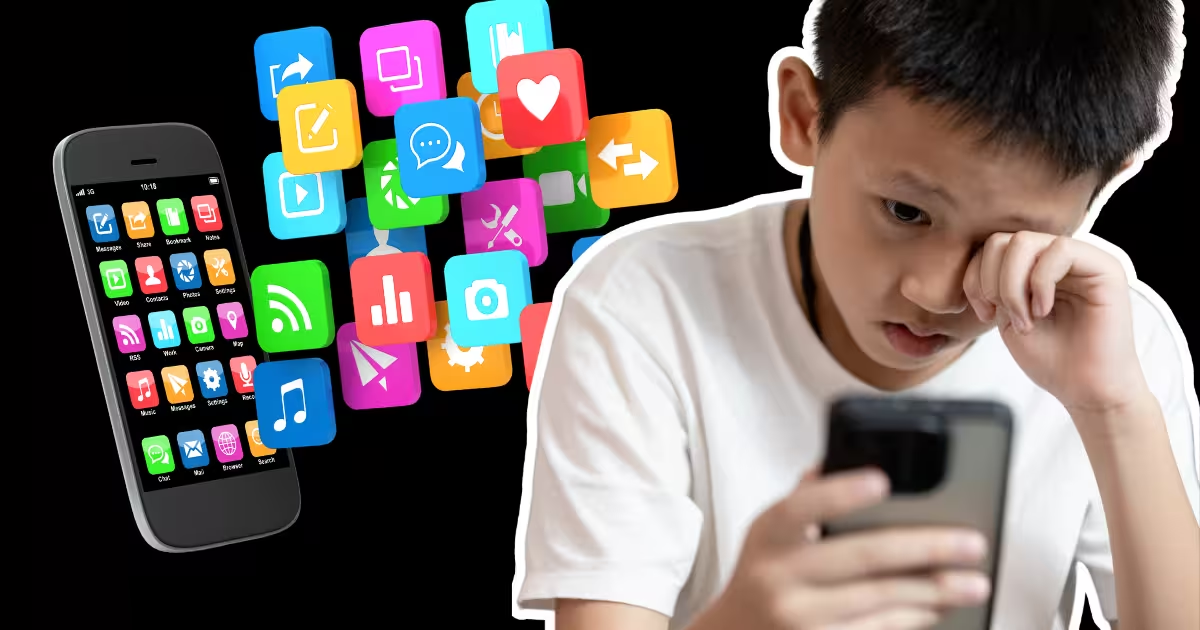

If you have ever looked up from a scrolling session and wondered where the last hour went, you are not alone. The question of why we become addicted to our phones is not about a lack of willpower; it is about a billion-dollar engineering effort aimed directly at the weakness in your brain’s reward system. I used to blame myself for wasting my evenings on pointless videos, but after digging into the behavioral psychology and the hard data, I realized I was fighting a rigged game.
\This article breaks down the exact mechanisms, the statistics, and the philosophical reality of that glowing rectangle in your pocket, so you can finally understand the trap and start taking your time back.
Why do I reach for my phone even when I have nothing important to check? I used to think phone addiction was simply a failure of self-control, but the more I looked at psychology, behavioral research, and books about technology, the less convincing that explanation became.
Table of Contents
Overview
People do not become attached to their phones simply because smartphones are entertaining. The deeper problem is that a smartphone combines several powerful psychological rewards in one small device: social connection, novelty, information, reassurance, entertainment, escape from boredom, and immediate feedback.
Over time, checking the phone can become an automatic response to uncomfortable moments.
I also think we need to be careful with the word addiction. Smartphone addiction is widely discussed in research, but it is not currently a formal diagnosis in the DSM-5-TR. Researchers more often use terms such as problematic smartphone use or problematic technology use. The American Psychiatric Association says excessive and compulsive technology use can cause distress and problems in daily life, while noting that technology addictions are not currently included as formal DSM-5-TR disorders.
That distinction matters because owning a smartphone, spending several hours on it, or enjoying social media does not automatically mean someone is addicted.
The real warning sign is loss of control and harm: when checking the phone repeatedly interferes with sleep, concentration, work, relationships, or ordinary life.
And this is becoming difficult to ignore. Pew Research Center‘s 2025 survey found that 91% of U.S. adults owned a smartphone, compared with only 35% in its first smartphone-ownership survey in 2011.
The question, then, is not simply, “How many hours do I spend on my phone?”
The better question is:
What psychological need am I repeatedly asking my phone to satisfy?
Why We Become Addicted to Our Phones
When I think about phone addiction, I find the word phone slightly misleading.
The phone itself is rarely the entire attraction.
A smartphone is a doorway to dozens of different reward systems. One minute I may be checking WhatsApp, the next I am reading the news, watching a short video, answering an email, checking a notification, searching for an answer, or scrolling through someone’s life.
The device changes, but the psychological mechanism remains remarkably similar: something might be waiting for me.
That uncertainty matters.
If every time I picked up my phone I knew exactly what I would see, the attraction would probably become much weaker. Instead, the next notification might be important. The next message might be from someone I care about. The next video might be funny. The next post might contain something shocking. The next search might answer a question I have been thinking about.
That unpredictability encourages repetition.
Adam Alter examines this broader problem in Irresistible, his 2017 book about behavioral addiction and the design of technology. He argues that many modern digital products are built around mechanisms that encourage continued engagement, including feedback, goals, escalation and social interaction.
For me, this changes the way I think about the problem.
Instead of asking, “Why am I so weak?” I would rather ask, “What has my phone been trained to make me expect?”
That is a much more useful question.
Your Phone Is a Machine for Escaping Boredom
One of the simplest reasons people become dependent on their phones is also one of the easiest to overlook: boredom.
Waiting for a bus? Phone.
Standing in a queue? Phone.
Eating alone? Phone.
Waiting for someone to reply? Phone.
Feeling uncomfortable? Phone.
The problem is not necessarily that we consciously decide to use the device. Often, the movement becomes automatic.
A few seconds of silence appear, and the hand reaches for the phone before the mind has even decided what it wants.
This is where I think phone use becomes philosophically interesting.
Boredom has traditionally been an unavoidable part of being human. You wait. You sit. You stare through a window. Your thoughts wander. Sometimes nothing happens.
The smartphone offers an escape hatch from that emptiness.
But if I remove every moment of boredom from my day, I also remove many of the quiet spaces in which reflection can occur.
Nicholas Carr’s The Shallows asks a related question about the intellectual effects of internet use: whether constant digital stimulation can change the way we read, think and sustain attention. Carr’s argument is broader than smartphone addiction, but it gives us an important way to think about the issue: technology does not merely give us information; repeated patterns of use can influence how we approach information.
That is why I do not think the solution is simply “use your phone less.”
We need to learn how to tolerate not being stimulated.
Notifications Train the Reflex
A notification may seem harmless, whether it is a sound, vibration, red number, or banner across the screen, yet research suggests that even receiving one can disrupt our attention and trigger distracting thoughts, even when we never pick up the phone.
A 2015 experiment published in the Journal of Experimental Psychology: Human Perception and Performance found that cell-phone notifications alone significantly disrupted performance on an attention-demanding task. Participants did not have to interact with the phone for the distraction to occur.
That finding is particularly interesting because it challenges the idea that distraction begins only when I unlock the screen.
Sometimes the interruption begins earlier.
The possibility of information can be enough.

A later study examining smartphone notifications and cognitive control similarly found slower responses when participants encountered smartphone notification sounds compared with control sounds. The researchers also found differences associated with smartphone addiction proneness.
This is one reason I consider turning off unnecessary notifications one of the simplest changes a person can make.
I am not trying to become anti-technology.
I am trying to stop allowing every application to decide when my attention should be interrupted.
We Do Not Always Use the Phone for Pleasure
This is another part of the story that deserves more attention.
Sometimes I do not pick up my phone because I am having fun.
I pick it up because I am anxious.
I want reassurance.
I want to know whether someone replied.
I want to escape an uncomfortable thought.
I want to avoid being alone with myself for five minutes.
This can turn phone use into a form of emotional regulation.
The American Psychiatric Association describes problematic technology use as excessive or compulsive use that can lead to distress and negative consequences. It also notes that people may use technology to avoid or reduce uncomfortable feelings such as anxiety or irritability.
That distinction is important. If my phone is primarily an entertainment device, reducing use may be relatively straightforward.
If my phone has become my emotional escape mechanism, simply deleting an app may not solve the underlying problem.
I may delete Instagram and start compulsively checking YouTube. I may uninstall TikTok and begin refreshing news websites. I may turn off social media notifications and start checking email every five minutes.
The object changes.
The psychological need remains.
Why Uncertainty Makes Checking So Powerful
There is another reason checking can become repetitive: uncertain rewards.
Think about email.
If I knew that nothing new would arrive until tomorrow morning, there would be little reason to check it every ten minutes.
But I do not know.
Maybe someone replied.
Maybe someone sent an opportunity.
Maybe something important happened.
Maybe nothing happened.
That uncertainty can make checking more persistent.
Social media intensifies this because the possible rewards are social. A new message, like, comment or mention can produce a small sense of recognition.
This is where Adam Alter’s Irresistible becomes particularly useful. His discussion is not limited to phones. He examines the wider psychology of products designed around feedback, unpredictability and repeated engagement.
The lesson I take from it is uncomfortable but practical:
I should not expect willpower alone to defeat a system designed to make repeated checking easy.
Changing the environment is often more sensible.
Are You Addicted to Your Phone or Afraid of Being Without It?
This is where nomophobia enters the conversation. Nomophobia, or NO Mobile Phone Phobia, refers to a psychological condition in which people fear being disconnected from their mobile phones.
The term describes distress or anxiety associated with being unable to access or use a mobile phone. It is not a formal DSM-5-TR or ICD-11 diagnosis.
A 2025 systematic review and meta-analysis examined 43 studies involving 36,656 participants across 18 countries. The researchers reported 26% with mild symptoms, 51% with moderate symptoms and 21% with severe symptoms on the measures used in those studies. However, these are self-reported symptom levels, not clinical diagnoses, and the researchers noted substantial variation between populations and measurement approaches.
I think that qualification is essential.
It would be misleading to say that 94% of people are clinically addicted to their phones. They are not.
The study’s pooled estimate refers to nomophobia symptoms measured through questionnaires.
That is very different from saying that 94% of people have a psychiatric disorder.
Still, the finding tells us something worth thinking about: being separated from the phone can itself become uncomfortable for many people.
A 2022 systematic review and meta-analysis also found positive associations between nomophobia and anxiety, smartphone addiction and insomnia. The correlation with insomnia was particularly strong in the included studies, although correlation does not prove that nomophobia causes insomnia.

The systematic review and meta-analysis, encompassing 52 studies with 47,399 participants across 20 countries, found that nomophobia, the fear of being disconnected from one’s mobile phone, is highly prevalent, with approximately 20% of individuals exhibiting mild symptoms, 50% showing moderate symptoms, and 20% experiencing severe symptoms.
University students, particularly those from non-Western cultures, were the most affected by severe symptoms, and prevalence rates peaked in 2021, potentially linked to increased technology use during the COVID-19 pandemic.
The Nomophobia Questionnaire (NMP-Q) was identified as the most sensitive tool for detecting moderate and severe cases. While mild and moderate symptoms are common, severe nomophobia warrants clinical attention due to its associations with mental health issues, sleep disturbances, and safety risks. The study emphasizes the need for prevention and early intervention strategies, especially among young adults.
That distinction between association and causation is something I would never want to lose in a discussion about phone addiction.
The Hidden Cost May Be Sleep, Attention and Relationships
The consequences of problematic smartphone use are not confined to screen time.
A 2020 systematic review and meta-analysis examined 14 studies and found significant associations between problematic smartphone use and poor sleep quality, depression and anxiety. However, the authors also pointed to substantial heterogeneity and methodological limitations, meaning the results should not be interpreted as proof that smartphone use directly causes these conditions.
That caution actually makes the evidence more useful, not less.
We do not need to claim that smartphones cause depression in order to take excessive phone use seriously.
If I stay awake until 1:30 a.m. scrolling, sleep less, wake tired, struggle to concentrate and become irritable with other people, I already have a practical problem.
I do not need a dramatic diagnosis.
I need to change the behavior.
The same applies to relationships.
There is something strangely sad about sitting beside someone we love while both of us stare at different screens.
The phone promises connection with people who are somewhere else while quietly competing with the person who is sitting directly in front of us.
That is not a technological problem alone.
It is a question of attention.
The Research Is Still More Complicated Than “Phones Are Addictive”
This is probably the most important point in this article.
I would be suspicious of anyone who tells you that the science has already settled every question about smartphone addiction.
It has not.
A major scoping review examined 1,305 papers on smartphone addiction and found substantial inconsistency in how researchers define and measure the behavior. The authors noted that problematic smartphone use is heterogeneous and that different people may arrive at excessive use through different pathways.
That means there may not be one single “phone addict.”
One person may constantly check social media because of social reassurance. Another may use gaming as an escape. Someone else may compulsively consume news because uncertainty makes them anxious. Another person may simply have developed an automatic habit of checking the phone whenever boredom appears.
Treating all four people as having exactly the same problem would be poor psychology.
It would also make treatment less useful.
What I Would Do If My Phone Started Controlling My Day
I do not think the answer is throwing the phone into a drawer and pretending modern life does not exist.
For most people, that is unrealistic.
Instead, I would start with friction.
1. Turn off non-essential notifications
Keep calls, essential messages and genuinely important alerts.
Turn off everything else.
If an application needs to interrupt me to remain interesting, I should probably question why I need it.
2. Move addictive apps away from the home screen
This sounds trivial, but it changes the number of steps between impulse and action.
The goal is not to make the app impossible to access.
The goal is to make automatic access slightly less automatic.
3. Create phone-free spaces
I would begin with three:
The bed.
The dining table.
Important conversations.
Those three rules alone can change the relationship with a phone because they protect sleep, meals and human attention.
4. Measure your behavior for seven days
Do not guess.
Look at your phone’s screen-time report.
Record:
- total daily screen time
- number of pickups
- most-used applications
- late-night usage
- notification count
- time spent on genuinely useful activities
The number that surprises you may not be total screen time.
It may be the number of times you picked up the phone without knowing why.
5. Ask one question before unlocking
“What am I going to do on this phone?”
If I have an answer, do it.
Then put the phone down.
If I have no answer, perhaps I am not looking for information at all.
Perhaps I am looking for stimulation.
That distinction can be surprisingly powerful.
What Philosophy Can Teach Us About Phone Addiction
For me, this is where the subject becomes bigger than psychology.
The smartphone is constantly asking a philosophical question:
What deserves my attention?
Attention is not an unlimited resource.
Whatever receives my attention repeatedly becomes part of the shape of my life.
That is why Cal Newport’s Digital Minimalism is useful alongside the psychological literature. Newport argues for choosing a smaller number of digital activities that strongly support what we actually value, rather than allowing every available technology to occupy our time. His proposed approach includes a 30-day digital declutter.
I find the idea more convincing than simply trying to “use my phone less.”
The objective is not fewer minutes for the sake of fewer minutes.
The objective is a life in which technology serves my priorities rather than constantly replacing them.
That is a very different goal.
Johann Hari’s Stolen Focus, published in 2022, approaches the attention problem from another direction, arguing that our difficulty concentrating cannot be reduced entirely to individual willpower. Whatever one thinks of all of Hari’s broader arguments, the book is useful as a reminder that attention is shaped by environments as well as personal choices.
And that is probably the position I have arrived at.
I have responsibility for my attention.
But I am also living inside an environment that competes aggressively for it.
Both facts can be true.
At-a-Glance Takeaways
- Phone addiction is not simply about screen time. Loss of control and negative consequences matter more.
- Smartphone addiction is not currently a formal DSM-5-TR diagnosis. Researchers often use terms such as problematic smartphone use.
- Smartphones combine multiple rewards, including social connection, novelty, entertainment, information and reassurance.
- Notifications can disrupt attention even without directly using the phone.
- Problematic smartphone use has been associated with poor sleep, anxiety and depression, but much of the evidence is observational, so causation should not be assumed.
- Nomophobia means distress about being without or unable to access a mobile phone, and it is not currently a formal psychiatric diagnosis.
- Different people become dependent for different reasons. Boredom, anxiety, loneliness, social reassurance and entertainment can all play a role.
- Willpower is not the only solution. Changing notifications, phone placement and routines can reduce automatic checking.
- The real goal is not to hate your phone. It is to decide what deserves your attention before your phone decides for you.
My Final Thought
I do not think smartphones are the enemy. That would be too easy.
My phone helps me communicate, read, work, research, navigate unfamiliar places, learn things and stay connected with people I might otherwise never reach.
The problem begins when the device stops being something I use and becomes something I automatically obey.
That is the line I now pay attention to.
If I pick up my phone because I have chosen to do something, there is probably no problem.
If I pick it up because I feel bored, anxious, lonely or slightly uncomfortable, without even knowing what I am looking for, I have a different question to answer.
Why am I reaching for the phone right now?
Sometimes the answer is a message.
Sometimes it is information.
And sometimes, uncomfortably, it is an attempt to avoid being alone with my own thoughts.
That is why I think the best way to fight phone addiction is not to begin with the phone.
Begin with the need.
Once I understand what I am trying to escape, obtain or feel when I reach for that glowing rectangle, I have a much better chance of taking my attention back. And perhaps that is the real freedom we are looking for.
Not a life without smartphones.
A life in which we can put them down.