

Last updated on October 29th, 2026 at 03:59 pm
The 101 best films you need to see begin with Oscar Micheaux’s silent drama Within Our Gates (1920) and end with Christopher Nolan’s Oppenheimer (2023), and I have watched every one of them. I did not rank them from best to worst. I lined them up by release year, because cinema’s long argument with itself is easier to follow that way, and I picked each film for three reasons: how many people have loved it, what it changed, and what it can still teach you.
A handful will hurt.
Most will stay with you far longer than their running time.
At a glance
- What this is: 101 films from 1920 to 2023, in order of release, from at least a dozen countries and territories, including Japan, India, Iran, Brazil, South Korea, Sweden and Hong Kong.
- How I chose: popularity, impact, and teachable lessons. It is a personal list, not a final ranking.
- What is new: I removed eight films, added nine, brought the list up to the 2020s, and replaced quotes I could not check with ones I could.
- If you only have time for five: 12 Angry Men, Tokyo Story, The Shawshank Redemption, Parasite and 3 Idiots.
- The lesson that runs through all of them: the stories that last are the ones that make you see a person you would otherwise ignore.
Where Should You Start With the 101 Best Films?
Start with 12 Angry Men (1957) if you want one story in one room, and Parasite (2019) if you want something that feels like today. The other three of my five-film starter pack are quieter: Tokyo Story will make you call your parents, The Shawshank Redemption will remind you why hope is practical, and 3 Idiots will make you think twice about marks, rank and what school is for.
If you have a free weekend, watch them in that order.
How Did I Choose the 101 Best Films?
I chose them by asking three questions of every film: did enough people see it to shape the culture, did it change how films are made or how audiences think, and would a thoughtful viewer still learn something from it today? I began with suggestions from public lists, including those of the British Board of Film Classification, the American Film Institute, Wikipedia and IMDb, and then cut anything I could not defend after watching it.
This list is not a definitive ranking, and I do not pretend it is fair to every country or every era. It is a collection of films that I found powerful, influential and educational. Where I mention Academy Award wins, the counts come from each film’s Wikipedia entry, and they may differ from other sources if you include honorary awards.
What Are the Best Films From the Silent and Early Sound Years, 1920 to 1949?
The best films from 1920 to 1949 are the ones that taught cinema how to talk, how to argue and how to break your heart in under two hours. Some of them are creaky. Several are still sharper than anything released last year.
1. Within Our Gates (1920)
Within Our Gates is the oldest surviving feature film directed by an African American, and I watched it as a rebuttal more than a drama. Oscar Micheaux made it in 1920 as a reply to the racist propaganda of The Birth of a Nation. It follows Sylvia Landry, a Black teacher trying to raise money to save a school for Black children in the South.
The lynching sequence is the hardest part to sit through, and it is the reason Chicago’s censors demanded cuts. The film then went missing for decades before the Library of Congress preserved it in 1993.
My lesson from it is blunt: when the mainstream refuses to tell your story, you build your own camera.
2. All Quiet on the Western Front (1930)
Lewis Milestone’s All Quiet on the Western Front won both Best Picture and Best Director and still plays like an accusation. A teacher’s patriotic speech sends Paul Bäumer and his classmates off to the trenches, and within weeks the glory has gone.
In Erich Maria Remarque’s novel, Paul dies on a day so quiet that the army report notes only that there is nothing new to report. Edward Berger’s 2022 German remake won four Oscars and moves Paul’s death to the last minutes before the armistice.
Different endings, same verdict: the people who start wars are rarely the ones who die in them.
3. M (1931)
Fritz Lang’s M was his first sound film, and he used silence as cleverly as noise. Peter Lorre plays Hans Beckert, a child killer in Berlin who whistles a tune from Grieg before each crime. The police cannot catch him. The city’s criminals, tired of the raids that ruin their business, decide to do it themselves and put him on trial in a cellar.
Lorre’s final plea, that he cannot help what he does, is what turned a thriller into a moral problem for me. Who decides what justice looks like when the crowd is angry enough?
I still do not have a comfortable answer.
4. It Happened One Night (1934)
Frank Capra’s It Happened One Night was the first film to win all five major Oscars: Picture, Director, Actor, Actress and Screenplay. A runaway heiress (Claudette Colbert) and an out-of-work reporter (Clark Gable) share a cross-country bus trip, a hanging blanket they call the walls of Jericho, and a lot of arguing.
Made in the middle of the Great Depression, it lets a rich girl and a broke man meet as equals. The charm is real, but what stays with me is the idea that attraction grows fastest when two people stop performing.
5. Modern Times (1936)
Charlie Chaplin’s Modern Times is the last appearance of the Tramp, and it is a comedy about being treated like a part in a machine. Chaplin’s worker tightens bolts on an assembly line until his arms keep twitching after the whistle, then gets fed by a feeding machine that malfunctions.
The film is mostly silent, with music and sound effects, and the one time we hear Chaplin sing, it is gibberish. I added it to this edition because its question has not aged: what happens to a person when efficiency matters more than the human being doing the work?
Anyone who has felt like a number in a system will recognise the Tramp.
6. The Wizard of Oz (1939)
The Wizard of Oz, directed by Victor Fleming, moves from sepia Kansas to Technicolor Oz, and that single cut is still one of the great reveals in film. Dorothy and her three companions are each looking for something the Wizard turns out not to be able to give: a brain, a heart, courage, a way home.
The twist is that they already had those things. Judy Garland’s “Over the Rainbow” won the Oscar for Best Original Song.
I read the film now as a gentle lesson about self-trust, wrapped inside a children’s story.
There’s no place like home.
Dorothy Gale
7. The Rules of the Game (1939)
Jean Renoir’s The Rules of the Game sets a weekend hunting party at a French country estate and lets the aristocrats and their servants wreck each other with polite lies. It was a commercial failure on release and was later banned, and the film was only restored to something like its full form in 1959.
French audiences in 1939 felt, I suspect, that it showed them a mirror just before the war. Renoir himself plays Octave, the sad clown who sees everything.
The awful thing about life is this: everyone has their reasons.
Octave
8. Gone with the Wind (1939)
Gone with the Wind won eight competitive Academy Awards, including Hattie McDaniel’s Best Supporting Actress award, which made her the first African American to win an Oscar. It follows Scarlett O’Hara through the Civil War and Reconstruction, and Vivien Leigh makes a selfish woman impossible to look away from.
I cannot recommend it without a warning, though.
The film paints slavery and the antebellum South with a golden brush, which is why streaming services have added historical context to it. Watch it as a masterpiece of craft and as a case study in how a nation can romanticise its worst chapter.
Frankly, my dear, I don’t give a damn.
Rhett Butler, voted the No. 1 movie quote by the American Film Institute
9. The Grapes of Wrath (1940)
John Ford’s The Grapes of Wrath took John Steinbeck’s novel and gave the Dust Bowl a face: Henry Fonda’s Tom Joad, an ex-convict walking home to find his family has been evicted from their Oklahoma farm.
The Joads head west to California, where the promised work turns out to be a scheme that keeps wages low. Ford won Best Director, and Jane Darwell won Best Supporting Actress as Ma Joad. Her speech about “the people” going on is the heart of it for me.
This is a film that makes poverty look like a policy choice rather than bad luck, and that argument has not gone away.
Wherever there’s a fight so hungry people can eat, I’ll be there.
Tom Joad
10. Rebecca (1940)
Rebecca was Alfred Hitchcock’s first American film, and it remains the only Hitchcock film to win Best Picture. A shy young woman (Joan Fontaine, whose character is never given a first name) marries the wealthy Maxim de Winter and moves into Manderley, where the dead first wife still seems to run the house through the terrifying housekeeper Mrs. Danvers.
What impressed me is how little the film shows of Rebecca. She is never seen, yet she dominates every scene. Insecurity, I realised, is the real ghost here.
Last night I dreamt I went to Manderley again.
The narrator, opening line
11. Citizen Kane (1941)
Orson Welles was 25 when he directed, co-wrote and starred in Citizen Kane, and the screenplay won the Oscar. The story is told in pieces by the people who knew Charles Foster Kane, a newspaper tycoon whose last word, “Rosebud,” sends a reporter hunting for the meaning of his life.
Gregg Toland’s deep-focus photography kept the foreground and background sharp at the same time, which gave directors a new way to stage a scene. It is based loosely on the publisher William Randolph Hearst, who tried to bury the film.
For decades it topped the Sight and Sound critics’ poll until Vertigo displaced it in 2012. What I took away is quieter than its reputation: a man can own everything and still be missing one small thing.
Rosebud.
Charles Foster Kane
12. Casablanca (1942)
Michael Curtiz’s Casablanca won three Oscars, including Best Picture, and it contributes six lines to the AFI list of the 100 best movie quotes, more than any other film. Nobody says “Play it again, Sam” in it, by the way. Rick Blaine, a cynical nightclub owner in Vichy-controlled Morocco, has to choose between the woman he loves and the cause that needs her husband to escape.
He chooses the cause. That ending is why I think the film has outlasted its wartime propaganda: it argues that love sometimes means letting go for something larger than yourself.
Here’s looking at you, kid.
Rick Blaine, No. 5 on the AFI list
13. The Best Years of Our Lives (1946)
William Wyler’s The Best Years of Our Lives follows three American servicemen coming home to the same town and finding that peace is its own kind of struggle. It won seven competitive Oscars including Best Picture, and Harold Russell, a real veteran who had lost both hands in a training accident, won two awards for playing Homer.
Watching the three men fail to say the right thing to their families, I thought about how little has changed. Every generation of soldiers has to learn how to be a civilian again, mostly alone.
14. It’s a Wonderful Life (1946)
It’s a Wonderful Life was not a hit when Frank Capra released it, and it became a Christmas ritual only after its copyright lapsed and television started airing it again in the 1970s. James Stewart plays George Bailey, a small-town man who gave up every dream to keep his family’s loan company running and, on the worst night of his life, is shown what the town would have been without him.
The film’s quiet argument is that a life’s worth is measured by the people it holds up.
I find that lesson easier to believe in December than in March, which is perhaps why it matters most when you least feel it.
No man is a failure who has friends.
Clarence Odbody
15. Bicycle Thieves (1948)
Vittorio De Sica’s Bicycle Thieves (also called The Bicycle Thief) is the film that taught me how much a tiny object can carry. Antonio Ricci finally gets a job in post-war Rome, but he needs a bicycle for it, and the day it is stolen he and his young son spend hours searching the city.
De Sica cast non-professional actors and filmed in real streets, which is why it became a defining work of Italian neorealism. The final scene, when Antonio gives in to desperation in front of his son, still hurts.
Poverty here does not make people wicked. It makes them tired.
16. All the King’s Men (1949)
Robert Rossen’s All the King’s Men adapts Robert Penn Warren’s Pulitzer Prize-winning novel and won Best Picture, with Broderick Crawford as the Best Actor winner.
He plays Willie Stark, an honest country lawyer who becomes governor of a Southern state and slowly turns into the sort of boss he once fought.
The film makes one point I keep returning to: the first compromise never feels like corruption. It feels like practicality. Anyone who follows politics, in any country, will see how a good cause can become cover for a bad habit.
Which Films From the 1950s Still Matter Most?
The films of the 1950s that matter most are the ones that carried world cinema onto Western screens: Kurosawa, Ozu, Bergman and Ray sat beside Hollywood’s last great studio epics. It was a decade of big ideas in wide frames.
17. All About Eve (1950)
All About Eve is the sharpest backstage drama I have watched, and its dialogue still cuts. Joseph L. Mankiewicz’s film gave Bette Davis her best-known role as Margo Channing, an ageing Broadway star who lets a devoted young fan, Eve Harrington (Anne Baxter), become her assistant. Eve is not what she seems.
The film won six Academy Awards and holds the record for most nominations, at 14, a mark since matched by Titanic and La La Land. What struck me is that nobody in it is a saint. Ambition, flattery and fear feed each other, and you see how easily admiration can become theft.
I detest cheap sentiment.
Addison DeWitt
18. Rashomon (1950)
Akira Kurosawa’s Rashomon gave the English language a new phrase. A samurai is dead and a woman has been attacked, and four people describe what happened: the bandit, the wife, the dead man through a medium, and a woodcutter who saw it. Each account is different, and each one flatters the person telling it.
The film won the Golden Lion at Venice in 1951 and an honorary Oscar, and it opened the West’s eyes to Japanese cinema. It earns its place here because we now live inside the “Rashomon effect” every day, with every viral argument that depends on whose clip you saw first. Truth, the film suggests, is rarely lied about outright.
It is simply edited by the one who tells it.
19. Singin’ in the Rain (1952)
Singin’ in the Rain, directed by Gene Kelly and Stanley Donen, is set in Hollywood in the late 1920s, when sound arrived and silent stars were suddenly asked to speak. Kelly’s Don Lockwood, Donald O’Connor’s Cosmo and Debbie Reynolds’s Kathy have to rescue a ruined picture with a lot of tap and a little trickery.
It looks like pure froth, but I watched it as a story about technology catching people off guard, which is a feeling that anyone who has had to learn a new tool at work will understand. The answer the film gives is cheerful: adapt, laugh, and keep dancing.
20. Tokyo Story (1953)
Yasujiro Ozu’s Tokyo Story is a quiet film about an elderly couple who travel to Tokyo to visit their grown children and discover that nobody has time for them. The only person who is kind is Noriko, the widow of their son killed in the war.
It topped the directors’ poll in the 2012 Sight and Sound survey, and I understand why: Ozu never raises his voice, yet I was close to tears by the end.
The lesson I carried out is a harsh one for those of us with ageing parents. Love is not what you feel. It is what you make time for.
Isn’t life disappointing?
Noriko, followed by “Yes, it is.”
21. From Here to Eternity (1953)
Fred Zinnemann’s From Here to Eternity is set among soldiers stationed in Hawaii in the months before the attack on Pearl Harbor, and it won eight Oscars, including Best Picture.
The beach kiss between Burt Lancaster and Deborah Kerr is what everyone remembers, but I found the bruised pride of Montgomery Clift’s Prewitt, a boxer who refuses to fight, much stronger. Frank Sinatra’s Maggio, beaten to death by a sadistic sergeant, revived his career.
The film makes the case that loyalty to your own conscience can cost more than any enemy ever could.
There are worse things than being dead. Like being forgotten. Nobody’s got a right to be happy while other men ain’t.
Pvt. Angelo Maggio
22. Seven Samurai (1954)
Akira Kurosawa’s Seven Samurai runs around three and a half hours, and I have never felt a minute of it drag. A village of farmers, raided every harvest by bandits, hires seven masterless warriors for nothing but food. Toshiro Mifune’s Kikuchiyo, the wild, half-fake samurai, steals every scene.
The film was remade in the West as The Magnificent Seven in 1960, and its template of assembling a team for a hopeless job still drives half of Hollywood. In the final scene, the surviving samurai look at the farmers planting rice and realise the victory belongs to the farmers, not to them.
That image taught me more about who history really belongs to than any textbook.
This is the nature of war: By protecting others, you save yourselves.
Kambei Shimada
23. On the Waterfront (1954)
Elia Kazan’s On the Waterfront won eight Oscars, including Best Actor for Marlon Brando as Terry Malloy, a former boxer who works for a corrupt dockworkers’ union and has to decide whether to testify against it.
The scene in the back of a taxi with his brother Charley (Rod Steiger) is, to my eyes, the finest piece of screen acting in this entire list.
Kazan had named names to the House Un-American Activities Committee, so many viewers read the film as his defence of informing, and that reading complicates the picture. Still, the question the film asks is universal: when silence protects the powerful, who is the real traitor?
I coulda been a contender. I could’ve been somebody, instead of a bum, which is what I am.
Terry Malloy
24. The Night of the Hunter (1955)
Charles Laughton directed only one film, and The Night of the Hunter was a box-office failure that discouraged him from ever directing again. That failure is one of cinema’s great losses.
Robert Mitchum is Harry Powell, a fake preacher with LOVE and HATE tattooed across his knuckles, who marries a widow to get at the money her executed husband hid, and then hunts her two children down the Ohio River.
The film plays like a nightmare told by a fairy-tale writer. What I took from it is that evil rarely arrives looking evil. It arrives in a good suit, quoting scripture.
Hate’s empty, just like all the other emotions.
Preacher Harry Powell
25. Pather Panchali (1955)
Pather Panchali was Satyajit Ray’s first film and the opening of the Apu Trilogy, and it is the Bengali film I would give to anyone who asks why Indian cinema is more than songs.
Ray shot it on a shoestring over several years, adapting Bibhutibhushan Bandyopadhyay’s novel about a poor family in rural Bengal: the stern mother Sarbajaya, the gentle father Harihar, the daughter Durga and the small boy Apu. It won the Best Human Document prize at Cannes in 1956.
The sequence of Apu and Durga running through the kash flowers to see a train for the first time is one of the happiest moments in film, and the monsoon that follows is one of the saddest. Poverty in Ray’s hands is never a spectacle.
It is just the weather the family lives in.
We poor people have to rely on God. Only He can help us.
26. Rebel Without a Cause (1955)
Nicholas Ray’s Rebel Without a Cause arrived in cinemas after James Dean had died in a car crash, and that fact still shadows every frame. Dean plays Jim Stark, a new boy in town whose parents argue over him as though he were not in the room. He befriends Judy (Natalie Wood) and Plato (Sal Mineo), two other lonely kids.
The film introduced the idea that teenage anger is often a cry for a stable adult. When Jim shouts that his family is tearing him apart, I recognised something that parents today would do well to hear.
You’re a chicken. You’re afraid to live without me.
Judy
27. The Searchers (1956)
John Ford’s The Searchers sends John Wayne’s Ethan Edwards on a five-year hunt for his niece Debbie, taken by Comanche raiders. Monument Valley has never looked better, and Wayne has never been more frightening. Ethan is a racist who may kill the girl he is trying to save, and the film leaves it uncertain whether he is a hero at all.
It has been cited by directors from Spielberg to Scorsese as a major influence, and the last shot, with Ethan outside the doorway of the home he cannot enter, is the best final shot in any Western.
Some men, it tells us, finish their quest and still have nowhere to belong.
I figure a man’s only good for one oath at a time. I took mine to the Confederate States of America.
Ethan Edwards
28. The Seventh Seal (1957)
Ingmar Bergman’s The Seventh Seal opens on a beach during the Black Death, where a knight (Max von Sydow) returning from the Crusades meets Death and challenges him to a game of chess. As long as the game lasts, the knight stays alive. His squire Jöns has no patience for God.
I watched it as a restless argument about faith: if there is no answer from the sky, what is the point of living well? The film offers a gentle reply in a travelling troupe of actors, who find meaning in each other and in a bowl of wild strawberries.
Bergman does not settle the matter, and I admire that.
Is it so terribly inconceivable to comprehend God with one’s senses? Why does He hide in a cloud of half-promises and unseen miracles? How can we believe in the faithful when we lack faith? What will happen to us who want to believe, but cannot? What about those who neither want to nor can believe? Why can’t I kill God within me? Why does He live on in this painful and humiliating way even though I curse Him and want to tear Him out of my heart? Why, in spite of everything, is He a baffling reality that I can’t shake off? Do we ever understand Him? Do not inquire after my name and descent. It’s unimportant.
Jons
29. The Bridge on the River Kwai (1957)
David Lean’s The Bridge on the River Kwai won seven Academy Awards, including Best Actor for Alec Guinness. He plays Colonel Nicholson, a British officer held in a Japanese prisoner-of-war camp in Thailand, who decides his men should build the best railway bridge they can to preserve their dignity.

His pride gets so tangled with the project that he nearly forgets it will serve the enemy. The closing word of the film, shouted by a doctor, is a verdict on all of it.
One day the war will be over. And I hope that the people that use this bridge in years to come will remember how it was built and who built it. Not a gang of slaves, but soldiers, British soldiers, Clipton, even in captivity.
Colonel Nicholson
30. 12 Angry Men (1957)
Sidney Lumet’s 12 Angry Men was his first feature film, and nearly all of it takes place in one sweltering jury room. Eleven jurors are ready to convict a teenager of murder and go home.
Henry Fonda’s Juror 8 asks them to talk about it for a while. One by one the certainty cracks, and we see how much of what we call judgment is really prejudice, impatience and a baseball game waiting.
It is the best argument I know for the principle of reasonable doubt, and for the quiet courage of being the only one who says “wait.”
31. Vertigo (1958)
Vertigo stars James Stewart as Scottie, a retired San Francisco detective with a fear of heights who is hired to follow a man’s wife (Kim Novak) and falls in love with her. Then she seems to die. When he meets a woman who looks like her, he insists on rebuilding her into the first.
In 2012 it replaced Citizen Kane at the top of the Sight and Sound critics’ poll, a decade before the same poll crowned a different film. What unsettles me most is that Scottie’s love is not for a person but for a picture of one. Hitchcock knew how often we do the same.
The man I loved is dead… and I’m free.
Madeleine Elster
32. Some Like It Hot (1959)
Billy Wilder’s Some Like It Hot has Jack Lemmon and Tony Curtis dressing as women to escape the mob after witnessing the St. Valentine’s Day Massacre, and joining an all-female band that includes Marilyn Monroe. It was named the funniest American film by the AFI.
The last line is the best punchline of any comedy I have seen, and I will not spoil how it lands, only that it rides on a single word. The laughs hide a sly point about how rigid our ideas of gender are, a point that is more current now than it was in 1959.
Well, nobody’s perfect.
Osgood Fielding III
33. Imitation of Life (1959)
Douglas Sirk’s Imitation of Life is a glossy melodrama about two single mothers, the white actress Lora (Lana Turner) and her Black housekeeper Annie (Juanita Moore), who raise their daughters side by side.
Annie’s daughter Sarah Jane (Susan Kohner), who is light-skinned, decides to live as a white woman and cuts her mother out of her life. It is a remake of a 1934 film based on Fannie Hurst’s novel, and both Moore and Kohner earned Oscar nominations.
The funeral scene is among the most painful I have watched. It shows what racism takes from a family, and what a child gives up when she is taught that her own skin is something to hide.
“Oh, Miss Lora, you’ll never know how lucky you are being white. It’s like you’re born with a road already laid out in front of you.”, “There’s only one kind of happiness, but misfortune comes in all shapes and sizes.”
Annie Johnson, Imitation of Life quote.
34. Ben-Hur (1959)
William Wyler’s Ben-Hur won 11 Academy Awards, a record that Titanic and the last Lord of the Rings film later matched.
It adapts Lew Wallace’s 1880 novel about Judah Ben-Hur, a Jewish prince in Roman-ruled Jerusalem who is betrayed by his Roman friend Messala and sent to the galleys. Charlton Heston’s chariot race against Messala is still, after all these decades, one of the great action scenes in film.
Yet the part that lingers for me is quieter: a hate that keeps a man alive is also what stops him from living, and the film’s answer is forgiveness.
Your eyes are full of hate, 41. That’s good. Hate keeps a man alive.
Quintus Arrius
Why Do the 1960s Films on This List Still Feel Modern?
They still feel modern because the 1960s were the decade when filmmakers started doubting the systems they grew up under: marriage, war, the studio, even the future. Epics got bigger. The questions got sharper.
35. The Apartment (1960)
Billy Wilder’s The Apartment won five Oscars including Best Picture, and it is a comedy that keeps hiding a bruise. Jack Lemmon plays C.C. Baxter, a junior insurance clerk who lends his flat to senior executives for their affairs, hoping for a promotion.
He falls for the elevator operator, Fran (Shirley MacLaine), who is involved with his boss.
The film asks what a person is willing to trade for a better title, and it answers with the most generous ending in all of Wilder’s work.
Shut up and deal.
Fran Kubelik, the closing line
36. Psycho (1960)
Alfred Hitchcock’s Psycho killed its apparent star about halfway through, and nothing in a thriller has been quite as safe since.
Marion Crane (Janet Leigh) steals money from her employer and checks into the Bates Motel, run by the gentle, awkward Norman (Anthony Perkins). The shower scene, cut together from dozens of short shots and scored with Bernard Herrmann’s shrieking strings, changed how violence was shown on screen.
Yet what unsettles me more is Norman himself. The film insists that the monster looks like the boy next door, which is a far more disturbing idea than any knife.
We’re always quickest to doubt people who have a reputation for being honest.
Marion Crane
37. To Kill a Mockingbird (1962)
Robert Mulligan’s To Kill a Mockingbird turns Harper Lee’s novel into a film that Gregory Peck, as the lawyer Atticus Finch, won a Best Actor Oscar for.
Atticus defends Tom Robinson, a Black man falsely accused of assaulting a white woman in 1930s Alabama, while his children Scout and Jem watch the town reveal itself. Nobody in the courtroom thinks Atticus can win, and he knows it.
What stays with me is how he treats everyone, even his enemies, with the same courtesy. If you want to teach a child empathy, this film does it better than a lecture.
You never really understand a person until you consider things from his point of view, until you climb into his skin and walk around in it.
Atticus Finch
38. Lawrence of Arabia (1962)
David Lean’s Lawrence of Arabia won seven Academy Awards, and it is the film I would most want you to see in a cinema, if one near you ever screens it. Peter O’Toole plays T.E. Lawrence, the British officer who helped lead an Arab revolt against the Ottoman Empire in the First World War.
Lean uses the desert like a character, and the entrance of Omar Sharif out of a mirage is among the most celebrated shots in film. It is not a neutral history, since it leans heavily on Lawrence’s own account.
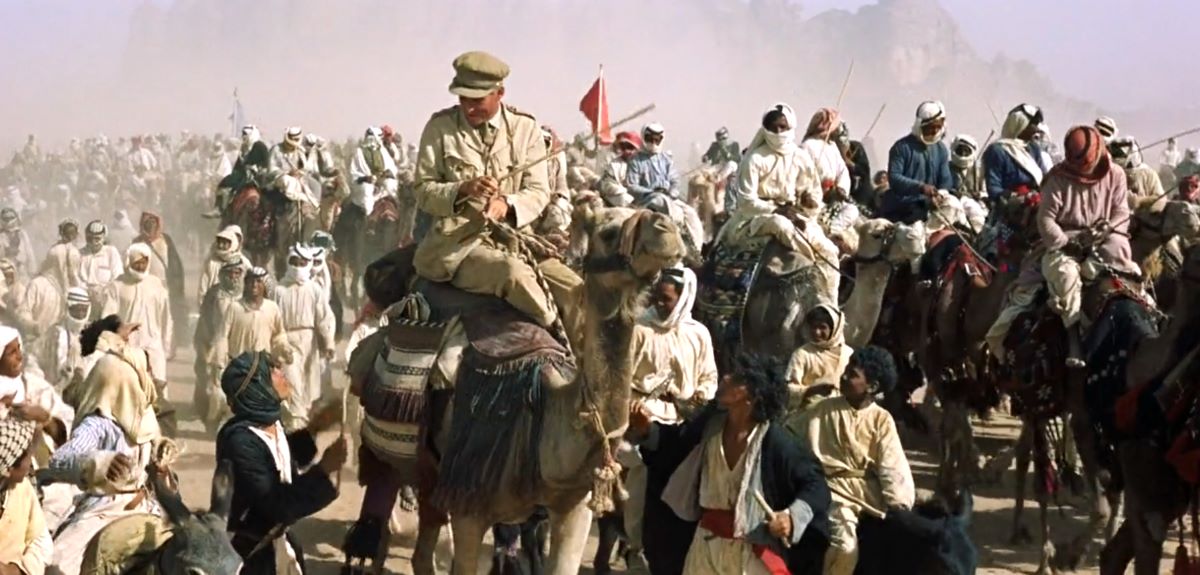
What it does show with great honesty is how a man can fall in love with an idea of himself.
Truly, for some men nothing is written unless they write it.
T.E. Lawrence
39. Dr. Strangelove (1964)
Stanley Kubrick’s Dr. Strangelove is a comedy about the end of the world, and it joins the list because it proves that satire can be more truthful than a documentary.
A deranged American general orders a nuclear strike on the Soviet Union, and the President, his advisers and a Royal Air Force officer scramble to stop it. Peter Sellers plays three roles, including the President and the ex-Nazi scientist of the title.
The joke at the heart of it is that the doomsday machine works exactly as designed, and nobody can undo it. That is a lesson about technology and systems that I find more frightening each time the news mentions an automated decision.
Gentlemen, you can’t fight in here! This is the War Room!
President Merkin Muffley
40. My Fair Lady (1964)
George Cukor’s My Fair Lady adapts the stage musical based on George Bernard Shaw’s Pygmalion, and it won eight Oscars, including Best Picture and Best Actor for Rex Harrison. Audrey Hepburn plays Eliza Doolittle, a Cockney flower seller whom the phonetics professor Henry Higgins trains to pass as a duchess.
The film is a charming comedy, but I also see a hard question inside it. Does changing how a person speaks change who she is, or merely how she is treated? Eliza’s final answer to Higgins is the real climax, and I think she is right to say she can stand on her own.
I’ve grown accustomed to her face.
Professor Henry Higgins
41. The Sound of Music (1965)
Robert Wise’s The Sound of Music won five Oscars including Best Picture. Julie Andrews plays Maria, a young nun who becomes governess to the seven children of Captain von Trapp, a widowed Austrian naval officer, shortly before the Nazi annexation in 1938. The real family left Austria by train, not by climbing a mountain, but the film’s escape is still one of the most thrilling in popular cinema. Beneath the songs there is a plain message that I like: refusing to serve a bad regime is a way of loving your country.
When the Lord closes a door, somewhere He opens a window.
Mother Abbess
42. A Man for All Seasons (1966)
Fred Zinnemann’s A Man for All Seasons won six Academy Awards, including Best Picture and a Best Actor award for Paul Scofield as Sir Thomas More. More, Henry VIII’s Lord Chancellor, will not sign an oath that recognises the king as head of the Church of England, and he will not say why, because silence is the one thing the law cannot punish.
His enemies work around it anyway. Thomas Cromwell’s willingness to bend the law to catch him is, to my eyes, more modern than anything in the news. The film leaves us with a stubborn question about the price of conscience.
I die His Majesty’s good servant, but God’s first.
Sir Thomas More
43. The Good, the Bad and the Ugly (1966)
Sergio Leone’s The Good, the Bad and the Ugly set a template for every cinematic duel with its closing three-way standoff, scored by Ennio Morricone. Clint Eastwood, Lee Van Cleef and Eli Wallach play three men chasing buried Confederate gold across a Civil War backdrop.
The war itself is the grimmest part: at one point, the “Blondie” character watches thousands die over a bridge that means nothing, and says he has never seen so many men wasted so badly.
I came away thinking that Leone’s cynicism is more honest than most patriotic war films, because it admits that greed and the battlefield often share the same road.
When you have to shoot, shoot. Don’t talk.
Tuco
44. The Graduate (1967)
Mike Nichols’s The Graduate won him the Best Director Oscar, and its portrait of Benjamin Braddock (Dustin Hoffman), a college graduate floating through a pool and a bad affair with Mrs. Robinson (Anne Bancroft), is still the best film about drift. Benjamin has done everything he was told to do and has no idea why.
The scene at the end, when he and Elaine escape a wedding and ride away on a bus, then slowly stop smiling, is the part I replay most often. It suggests that running away from a life you do not want is not the same as knowing the one you do.
Mrs. Robinson, you’re trying to seduce me. Aren’t you?
Benjamin Braddock
45. 2001: A Space Odyssey (1968)
Stanley Kubrick’s 2001: A Space Odyssey was co-written with Arthur C. Clarke, and it first confused critics and audiences before it became the highest-grossing North American film of 1968.
It moves from the dawn of humanity, where an ape discovers a tool, through a mysterious black monolith, to a voyage to Jupiter with the shipboard computer HAL. In 2022 it placed in the top ten of the Sight and Sound critics’ poll.
Its fear of a machine that stops obeying has become a daily question, which is why it joins this edition. It asks very little dialogue of its audience and a great deal of patience, and the patience pays off.
Open the pod bay doors, HAL.
Dave Bowman
46. Midnight Cowboy (1969)
John Schlesinger’s Midnight Cowboy is the only film rated X on release to win the Best Picture Oscar, though it was later reclassified. Jon Voight is Joe Buck, a Texan dishwasher who moves to New York hoping to be a hustler for rich women. Dustin Hoffman is Ratso Rizzo, a sick con man who becomes his only friend.
It is a film about two failures who save each other when the city will not, and it taught me that loneliness is often a bigger problem than poverty.
You don’t know the first thing about love. You couldn’t express it if you tried.
Ratso Rizzo
What Did the 1970s Do for Serious Cinema?
The 1970s gave serious cinema its nerve. Directors raised on European art films and TV news took over Hollywood, and they made pictures about corruption, war and moral compromise that the old studios would not have touched.
47. Patton (1970)
Franklin J. Schaffner’s Patton opens with George C. Scott in front of an enormous American flag, delivering a speech to an unseen army, and it never lets go. Scott plays General George S. Patton as a brilliant, vain and impossible man, and he won the Best Actor Oscar and refused to accept it.
The film neither worships nor condemns him, which is why people of very different views can find their own Patton in it. I found it a good study of how talent and arrogance can live inside the same person.
Now I want you to remember that no bastard ever won a war by dying for his country. He won it by making the other poor, dumb bastard die for his country. Americans love a winner and will not tolerate a loser.
General George S. Patton
48. Willy Wonka & the Chocolate Factory (1971)
Mel Stuart’s Willy Wonka & the Chocolate Factory was a modest hit on release and became a classic on television. Roald Dahl, who wrote the book, reportedly disliked it.
Gene Wilder’s Wonka is gentle, unpredictable and a little frightening, and the tunnel scene still makes me uneasy. As a parable it is almost cruel: four children are punished for greed, gluttony, pride and screen addiction, and the poor boy who stays honest wins. The test of the Everlasting Gobstopper is the lesson I would hand to any child.
Honesty, when no one is checking, is the only thing that counts.
A little nonsense now and then is relished by the wisest men.
Willy Wonka
49. A Clockwork Orange (1971)
Stanley Kubrick’s A Clockwork Orange adapts Anthony Burgess’s novel about Alex (Malcolm McDowell), a gang leader in a near-future England who loves Beethoven and violence. After prison, he is “cured” through a conditioning treatment that makes him ill at the thought of cruelty.
Kubrick himself withdrew the film from British cinemas in 1973, and it was only restored after his death. The film’s real subject is not violence but choice: a man made good by force is not truly good.
That argument is now relevant to everything from prison reform to personal data.
The important thing is moral choice. Evil has to exist along with good, in order that moral choice may operate. Life is sustained by the grinding opposition of moral entities.
Alex, the final line
50. The Godfather (1972)
Francis Ford Coppola’s The Godfather won Best Picture, Best Actor and Best Adapted Screenplay. Marlon Brando declined his award and sent an activist, Sacheen Littlefeather, to explain why.
Based on Mario Puzo’s novel, it follows the Corleone crime family and the slow transformation of Michael (Al Pacino), the war hero who wanted no part of the business, into its cold-blooded head.
I watched it as a tragedy about the American dream’s dark mirror. The final scene, with a door closing on Kay, shows what the price of loyalty looks like.
I’m gonna make him an offer he can’t refuse.
Vito Corleone
51. Chinatown (1974)
Roman Polanski’s Chinatown gave Robert Towne an Oscar for Best Original Screenplay. Jack Nicholson is J.J. Gittes, a private detective in 1930s Los Angeles who takes a routine case about adultery and uncovers a plot about the city’s water supply, based loosely on real disputes over the Owens Valley. John Huston’s Noah Cross is a villain who gets away with it.
The film’s final line tells you that some wrongs are too big for any one man to fix, and I think that is the bleakest and most honest ending in American film.
You see, Mr. Gittes, most people never have to face the fact that at the right time and the right place, they’re capable of anything.
Noah Cross
52. All the President’s Men (1976)
Alan J. Pakula’s All the President’s Men follows the Washington Post reporters Bob Woodward (Robert Redford) and Carl Bernstein (Dustin Hoffman) as they trace the Watergate break-in up to the White House.
The film won four Oscars, including Best Supporting Actor for Jason Robards as the editor Ben Bradlee.
There are no car chases, only phone calls and doors. I have rarely felt as tense watching a man type. It makes a stubborn case that the press, at its best, is built on boring, careful work, and “follow the money” is still the best advice a young reporter can get.
53. Annie Hall (1977)
Annie Hall won four Oscars including Best Picture, beating Star Wars for the top prize, and it made Diane Keaton’s wardrobe and stammer part of popular culture. Woody Allen plays Alvy Singer, a neurotic comedian remembering how his relationship with Annie began and why it ended.
It breaks the fourth wall, uses subtitles and animated sequences, and treats romance as something to examine, not just celebrate. Allen’s later off-screen controversies make some viewers uneasy, and they are worth knowing about.
The film’s own joke about love being like a shark that has to keep moving still gets my laugh, and its lesson is a bittersweet one: some relationships end because both people changed.
A relationship, I think, is like a shark. You know? It has to constantly move forward or it dies. And I think what we got on our hands is a dead shark.
Alvy Singer
54. Apocalypse Now (1979)
Francis Ford Coppola’s Apocalypse Now transplants Joseph Conrad’s Heart of Darkness to the Vietnam War. Martin Sheen’s Captain Willard travels up a river to kill Colonel Kurtz (Marlon Brando), an officer who has gone rogue.
The shoot in the Philippines was chaotic, which is documented in the film Hearts of Darkness, and the picture shared the Palme d’Or at Cannes.
The helicopter attack set to Wagner and Robert Duvall’s line about napalm are famous, but the part I keep thinking about is Willard’s journey. The further he goes, the less he can tell sanity from madness, and the film suggests that war does the same to everyone.
We’re all pretty bizarre. Some of us are just better at hiding it, that’s all.
Captain Benjamin L. Willard
55. Kramer vs. Kramer (1979)
Robert Benton’s Kramer vs. Kramer won five Oscars including Best Picture. Dustin Hoffman plays Ted Kramer, an advertising executive whose wife, Joanna (Meryl Streep), walks out and leaves him with their young son.
He has to learn to be a parent, and then fight in court to remain one. The French toast scene is funny and sad at once.
The film shows that being a father is a daily practice, not a title, and it was ahead of its time in treating a mother’s decision to leave as complicated rather than villainous.
I can’t afford to hate anybody. I don’t have that kind of time.
Ted Kramer
What Made the 1980s Films Worth Keeping?
The 1980s films worth keeping are the ones that treated grief, justice and history as adult problems. Blockbusters ruled the multiplex, yet the best films of the decade were made by people who wanted to ask why we hurt each other.
56. Ordinary People (1980)
Ordinary People was Robert Redford’s directing debut, and it won four Oscars, including Best Picture and Best Director, over Raging Bull. Based on Judith Guest’s novel, it follows a wealthy Illinois family after the death of the elder son in a boating accident.
Mary Tyler Moore, cast against her sunny image, plays the mother who cannot show love, and Timothy Hutton plays the surviving son who blames himself. Judd Hirsch’s therapist is the only person in the film who asks the right question.
What stays with me is how silent a grieving house can be, and how often politeness gets in the way of healing.
Feelings are scary. And sometimes they’re painful. And if you can’t feel pain, then you’re not gonna feel anything else, either. You know what I’m saying? You’re here, and you’re alive. And don’t tell me you don’t feel that.
Dr. Berge
57. The Verdict (1982)
Sidney Lumet’s The Verdict stars Paul Newman as Frank Galvin, a drunk and disgraced Boston lawyer who takes a medical malpractice case he expects to settle and instead decides to try. David Mamet’s screenplay is full of small, bruising moments, and the film earned five Oscar nominations without winning any.
I like it because it shows that a person can rebuild his self-respect without being rescued. The courtroom here is not a stage for brilliance.
It is a place where an honest, tired man finally does his job.
58. Gandhi (1982)
Richard Attenborough’s Gandhi won eight Oscars, including Best Picture and Best Actor for Ben Kingsley. It follows Mohandas Gandhi from a South African railway platform, where he is thrown off a train for his skin colour, to the independence of India and his assassination in 1948. As someone from this part of the world, I watched it knowing the history is messier and the man more complicated than any biopic can hold. The film’s argument is simple, though, and it has not aged: a movement that refuses to hit back can still win, because the cost of cruelty falls on those who inflict it.
59. Amadeus (1984)
Milos Forman’s Amadeus won eight Oscars including Best Picture, and F. Murray Abraham took Best Actor for playing Antonio Salieri, the court composer who realises he can recognise Mozart’s genius but cannot match it. The idea that Salieri murdered Mozart is a fiction taken from Peter Shaffer’s play, not history.
What the film gets exactly right is envy.
Salieri’s tragedy is not that he is untalented but that he is talented enough to see what he lacks, and anyone who has watched a colleague or a friend succeed will recognise the sting.
Mediocrities everywhere, I absolve you.
Antonio Salieri
60. Platoon (1986)
Oliver Stone served in Vietnam, and Platoon carries that weight. It won four Oscars including Best Picture and Best Director. Charlie Sheen plays Chris Taylor, a young volunteer caught between two sergeants: Willem Dafoe’s gentle Elias and Tom Berenger’s savage Barnes. The platoon splits into two camps, and the real fight is over who gets to call themselves human.
I find the film more convincing than most war pictures because it gives no real glory to anyone, not even the good men.
I think now, looking back, we did not fight the enemy, we fought ourselves. And the enemy was in us.
Chris Taylor
61. The Last Emperor (1987)
Bernardo Bertolucci’s The Last Emperor was the first Western feature allowed to film inside Beijing’s Forbidden City, and it won all nine Oscars it was nominated for. It tells the life of Puyi, who became emperor at three, was driven out as a child, served as a puppet ruler under Japanese occupation, and ended his days as a gardener in Communist China.
Told in flashbacks from a prison cell, it asks a question few people think to ask. What does a man become when everyone around him has been paid to obey?
The answer, in Puyi’s case, is someone who has never learned to tie his own shoes.
A puppet has lost his strings. He is free. But freedom’s a burden.
Reginald Fleming Johnston
62. Rain Man (1988)
Barry Levinson’s Rain Man won four Oscars including Best Picture and Best Actor for Dustin Hoffman. Tom Cruise plays Charlie Babbitt, a selfish car dealer who discovers that his late father left the fortune to an older brother he never knew, Raymond (Hoffman), an autistic man with extraordinary memory.
Their road trip turns an inheritance fight into a brother story. The film’s version of autism, built around Raymond’s savant talents, is rare in real life, and many advocates have said so.
Even so, it did something meaningful in 1988: it put a person with a disability at the centre of a mainstream hit and made audiences care about him.
I’m an excellent driver.
Raymond Babbitt
63. Dead Poets Society (1989)
Peter Weir’s Dead Poets Society is set in 1959 at Welton Academy, a strict boys’ school, and Tom Schulman’s script won the Oscar for Best Original Screenplay. It is an original story, not a biography of any poet.
Robin Williams plays John Keating, an English teacher who makes his students stand on their desks to see the world differently and quotes Walt Whitman’s “O Captain! My Captain!”
The film’s tragedy comes when one boy, forbidden by his father to act, cannot find a way to live. I love the film’s call to chase poetry and beauty, but its darker point is the one that sticks: a dream that is only tolerated, never supported, can be fatal.
Medicine, law, business, engineering, these are noble pursuits and necessary to sustain life. But poetry, beauty, romance, love, these are what we stay alive for.
John Keating
Which 1990s Films Belong on a Best Films List?
The 1990s films that belong are the ones that rebuilt the big Hollywood drama while independent cinema crashed the party. Tarantino, Spielberg, Darabont and Linklater all did their best work in this decade, and Iran and Hong Kong began to travel globally.
64. Dances With Wolves (1990)
Kevin Costner directed and starred in Dances with Wolves, which won seven Oscars including Best Picture and Best Director. He plays John Dunbar, a Union lieutenant who asks to be posted to a remote frontier fort and slowly befriends the Lakota Sioux, whose language is spoken with subtitles for much of the film.
It was praised for treating Native Americans as full human beings, and criticised, fairly I think, for telling the story through a white man’s eyes. I enjoyed it most as a story about leaving a life that no longer fits.
The strangeness of this life cannot be measured: in trying to produce my own death, I was elevated to the status of a living hero.
John Dunbar
65. The Silence of the Lambs (1991)
Jonathan Demme’s The Silence of the Lambs is the third film to win all five major Oscars, after It Happened One Night and One Flew Over the Cuckoo’s Nest. Jodie Foster’s FBI trainee Clarice Starling visits an imprisoned psychiatrist, Hannibal Lecter (Anthony Hopkins), to get his help catching a killer known as Buffalo Bill.
The conversations between the two are the best two-handers in modern thrillers. They work because Lecter is brilliant, and Clarice is brave enough to give him something personal in return.
What I took from it is that the strongest weapon in any case is attention.
A census taker once tried to test me. I ate his liver with some fava beans and a nice Chianti.
Hannibal Lecter
66. Schindler’s List (1993)
Steven Spielberg’s Schindler’s List won seven Oscars including Best Picture and Best Director. It is based on Thomas Keneally’s Schindler’s Ark, and it tells how Oskar Schindler (Liam Neeson), a German businessman and Nazi Party member, used his factory to save more than a thousand Jews from the death camps.
Shot largely in black and white, with a single child in a red coat, it avoids easy comfort. After its release, Spielberg founded the Shoah Foundation to record survivors’ testimonies.
The film’s central lesson is that hatred depends on ordinary people looking away, and rescue depends on a few refusing to.
Whoever saves one life, saves the world entire.
The inscription on the ring
67. The Shawshank Redemption (1994)
Frank Darabont’s The Shawshank Redemption is adapted from a Stephen King novella and earned seven Oscar nominations without a single win. It was also a box-office disappointment, and its reputation grew on home video and television.
Tim Robbins plays Andy Dufresne, a banker sent to prison for murders he did not commit, and Morgan Freeman narrates as Red, the inmate who becomes his friend.
The film portrays institutionalisation with great precision: an old man who has spent half a century inside cannot cope with the free world. I rewatch it for the final stretch, in which hope, which the prison tries to kill, is the thing that gets Andy out.
Hope is a good thing, maybe the best of things, and no good thing ever dies.
Andy Dufresne
68. Pulp Fiction (1994)
Quentin Tarantino’s Pulp Fiction won the Palme d’Or at Cannes and an Oscar for its original screenplay, and it did more than any other film to make 1990s independent cinema popular. It cuts between three stories about two hitmen, a boxer and a mob boss’s wife, and jumbles the timeline so that a character who dies in the middle is alive at the end.
Samuel L. Jackson’s Jules, who decides to walk away from killing after a near-miracle, gives the film its heart. I consider it a lesson in structure and in how much attitude and dialogue can carry a story.
The path of the righteous man is beset on all sides by the inequities of the selfish and the tyranny of evil men.
Jules Winnfield
69. Forrest Gump (1994)
Robert Zemeckis’s Forrest Gump won six Oscars, including Best Picture and Best Actor for Tom Hanks, beating both Pulp Fiction and The Shawshank Redemption. Forrest, a kind man with a low IQ, drifts through Vietnam, the civil rights era and Watergate while never giving up on Jenny. Critics have argued, with reason, that the film is politically naive. I still find its gentleness disarming. The idea that sincerity can be a form of intelligence is one I keep coming back to.
My mama always said life was like a box of chocolates. You never know what you’re gonna get.
Forrest Gump
70. The Before Trilogy (1995-2013)
Richard Linklater’s Before Sunrise (1995), Before Sunset (2004) and Before Midnight (2013) follow Jesse (Ethan Hawke) and Celine (Julie Delpy), who meet on a train and walk through Vienna all night, then reunite in Paris nine years later, and again in Greece nine years after that.
Almost all of it is conversation, and I could listen for hours. The trilogy is about what time does to love: the first film is hope, the second is regret, the third is the work of staying.
I rank it among the most honest romances ever filmed because it lets the characters grow older.
Isn’t everything we do in life a way to be loved a little more?
Jesse, Before Sunrise (1995)
71. Braveheart (1995)
Mel Gibson directed and starred in Braveheart, which won five Oscars, including Best Picture and Best Director. It follows William Wallace, a 13th-century Scottish commoner who leads a rebellion against King Edward I of England.
Historians have long criticised its accuracy: the famous battle at Stirling Bridge is shown without a bridge, and the French princess Isabella was a small child at the time of the events the film dramatises. I do not defend those errors.
Still, for me this is the one film on the list I could watch a hundred times, because its idea of freedom as something worth dying for is rendered with so much feeling.
They may take our lives, but they’ll never take our freedom!
William Wallace
72. Se7en (1995)
David Fincher’s Se7en follows two detectives, the weary Somerset (Morgan Freeman) and the hot-headed Mills (Brad Pitt), through a rainy city as they track a killer whose murders are modelled on the seven deadly sins.
The final reveal, and the question of what is in the box, is one of the cruellest endings in popular film.
What lifts it above a thriller is Somerset’s quote from Hemingway, which acknowledges the horror but chooses to keep fighting. I take that as a quiet message about despair: you are allowed to admit the world is rotten and still show up.
The world is a fine place and worth fighting for. I agree with the second part.
Somerset
73. Fargo (1996)
Joel and Ethan Coen’s Fargo opens with a title claiming it is a true story, which it is not. It won Oscars for Frances McDormand and for the Coens’ screenplay.
A car salesman hires two criminals to kidnap his wife, and everything goes wrong. Marge Gunderson (McDormand), the pregnant police chief of a small Minnesota town, is the calm centre of the chaos.
Her closing words to the killer she arrests are what I remember best: she is baffled by how much damage a little money can cause.
And for what? For a little bit of money.
Marge Gunderson
74. The English Patient (1996)
Anthony Minghella’s The English Patient adapts Michael Ondaatje’s novel and won nine Oscars including Best Picture. In an Italian monastery near the end of the Second World War, a nurse (Juliette Binoche, who won Best Supporting Actress) cares for a burned man (Ralph Fiennes) who claims to have forgotten his name.
His memories of a desert affair with Katharine (Kristin Scott Thomas) unfold in flashback.
The film asks whether a love that begins in secrecy and betrayal can ever be forgiven, and its answer is as gorgeous as it is sad.
My darling. I’m waiting for you. How long is the day in the dark? Or a week? The fire is gone, and I’m horribly cold. I really should drag myself outside but then there’d be the sun. I’m afraid I waste the light on the paintings, not writing these words. We die. We die rich with lovers and tribes, tastes we have swallowed, bodies we’ve entered and swum up like rivers. Fears we’ve hidden in – like this wretched cave. I want all this marked on my body. We are the real countries.
Not boundaries drawn on maps with the names of powerful men. I know you’ll come carry me out to the Palace of Winds. That’s what I’ve wanted: to walk in such a place with you. With friends, on an earth without maps. The lamp has gone out and I’m writing in the darkness.
Katharine Clifton
75. Children of Heaven (1997)
Majid Majidi’s Children of Heaven was the first Iranian film nominated for the Oscar for Best Foreign Language Film. Ali, a boy in Tehran, loses his sister Zahra’s only pair of shoes, and the two secretly take turns wearing his sneakers to school.
When Ali enters a children’s race to win a pair, the film turns into a race for dignity. It is a very simple story, and I know few films better at showing how large a small loss feels when you have nothing to spare. If you want to introduce a child to world cinema, begin here.
You can borrow my shoes on Monday. I only go to school in the mornings.
Zahra
76. Titanic (1997)
James Cameron’s Titanic won 11 Oscars and became the first film to gross over a billion dollars. Jack (Leonardo DiCaprio), a penniless artist, and Rose (Kate Winslet), an engaged first-class passenger, fall in love on the ship’s maiden voyage.
Underneath the romance there is a film about class, and the way the lifeboats and locked gates were distributed is its sharpest argument. I know the story is overfamiliar. Even so, the second half, built on dread and the scale of the sinking, is among the finest sustained sequences Hollywood has produced.
A woman’s heart is a deep ocean of secrets.
Old Rose
77. Saving Private Ryan (1998)
Steven Spielberg’s Saving Private Ryan begins with the D-Day landing on Omaha Beach, a sequence that changed how war was filmed. It won five Oscars, including Best Director, though it lost Best Picture to Shakespeare in Love.
Tom Hanks’s Captain Miller leads eight men behind enemy lines to find a paratrooper (Matt Damon) whose three brothers have died.
The mission raises the question of whether one life is worth the lives of the men sent to save it. The film’s answer arrives in a dying man’s last words, and it is a demand on all of us who live afterwards.
I just know that every man I kill, the farther away from home I feel.
Private James Ryan
78. American Beauty (1999)
Sam Mendes’s American Beauty won five Oscars including Best Picture. Lester Burnham (Kevin Spacey, whose later off-screen history makes some people unable to rewatch it), narrates from beyond the grave about a suburban midlife crisis that tips into obsession with his daughter’s friend.
The film pricks the surface of the “perfect” American home, and its famous plastic bag drifting in the wind says that beauty can be found even in the ordinary. My lesson from it is the unfashionable one.
A life lived for appearances is a life that no one really lives.
It’s hard to stay mad, when there’s so much beauty in the world.
Lester Burnham
Which 2000s Films Deserve a Place on a Best Films List?
The 2000s films that deserve a place are the ones that proved a big budget and a big idea could coexist, and that opened Hollywood to stories from Hong Kong, Japan, Brazil and India. It was the decade when the global audience arrived.
79. In the Mood for Love (2000)
Wong Kar-wai’s In the Mood for Love is set in 1962 Hong Kong, where two neighbours (Maggie Cheung and Tony Leung) realise that their spouses are having an affair with each other. Leung won Best Actor at Cannes for the role.
Rather than copying their partners, they rehearse conversations, pretend, and sit in narrow corridors without ever crossing a line.
The film is a lesson in restraint, and it taught me that the most painful love stories are the ones where nothing is allowed to happen. Cheung’s cheongsams and Christopher Doyle’s cinematography make longing look like a painting.
Love is all a matter of timing. It’s no good meeting the right person too soon or too late.
Chow Mo-wan
80. Gladiator (2000)
Ridley Scott’s Gladiator won five Oscars including Best Picture and Best Actor for Russell Crowe.
Crowe plays Maximus, a Roman general betrayed by Commodus (Joaquin Phoenix), the emperor’s jealous son, who murders his family and sells him into slavery. Maximus fights his way up through the gladiatorial arena to confront the man who wronged him.
It is a revenge picture, but also a story about duty. Maximus never wants to rule. He wants to go home, which is why the film’s ending, in the wheat fields, works.
What we do in life echoes in eternity.
Maximus
81. The Lord of the Rings Trilogy (2001-2003)
Peter Jackson’s three-film adaptation of J.R.R. Tolkien’s fantasy, The Fellowship of the Ring, The Two Towers and The Return of the King, won 17 Oscars in total, and the last instalment took all 11 of its nominations.
Frodo (Elijah Wood) and his companions set out to destroy the One Ring, a weapon so tempting that even the good cannot hold it without being corrupted. The real hero, to my mind, is Sam, the gardener who simply refuses to leave his friend.
The saga says that power is not defeated by greater power but by loyalty, mercy and small, stubborn acts of kindness.
All we have to decide is what to do with the time that is given to us.
Gandalf
82. A Beautiful Mind (2001)
Ron Howard’s A Beautiful Mind won four Oscars including Best Picture. Russell Crowe plays John Nash, the mathematician who won the Nobel Prize in Economics and lived with paranoid schizophrenia. The film is based on Sylvia Nasar’s biography but changes parts of his life, including how his hallucinations appeared, so it is worth reading the book for the fuller story.
What the film does well is show how a mind can build a convincing world that no one else can see, and it treats his recovery as a daily discipline instead of a cure.
It’s only in the mysterious equations of love that any logic or reasons can be found.
John Nash
83. Spirited Away (2001)
Hayao Miyazaki’s Spirited Away was the first anime to win the Oscar for Best Animated Feature, and it also took the Golden Bear in Berlin. It is the best proof I know that animation is cinema, and one of the films I most want children and adults to watch together.
Ten-year-old Chihiro wanders into a spirit world with her parents, who are turned into pigs after gorging on food they have not paid for. She takes a job at a bathhouse for gods, where the witch Yubaba steals names to control people.
Chihiro’s courage lies in remembering who she is, and the film’s greed-eating monster, No-Face, is the most unsettling mirror of consumer culture I know.
Once you’ve met someone, you never really forget them.
Zeniba
84. City of God (2002)
Fernando Meirelles (with Kátia Lund) directed City of God, which earned four Oscar nominations and introduced many viewers outside Brazil to a world that most of the world’s news had ignored. It follows two boys growing up in a Rio de Janeiro favela, one who becomes a photographer (Rocket, who narrates) and one who becomes a drug lord (Li’l Zé).
Many of the cast were non-professionals from slums. It shows how children inherit violence when a society abandons them. The kinetic editing never lets you look away.
If you run, the beast catches you; if you stay, the beast eats you.
Rocket, quoting a Brazilian saying
85. Catch Me If You Can (2002)
Steven Spielberg’s Catch Me If You Can stars Leonardo DiCaprio as Frank Abagnale Jr., who as a teenager forged cheques and posed as a pilot, doctor and lawyer, and Tom Hanks as the FBI agent who chases him.
Christopher Walken was nominated for an Oscar as Frank’s father. Parts of the real Abagnale’s own account have since been questioned, so I treat it as a story inspired by a life rather than the record of one.
The emotional centre is the boy’s loneliness after his parents divorce, and the film makes a strong point that the best con is the one we run on ourselves.
Two little mice fell in a bucket of cream. The first mouse quickly gave up and drowned. The second mouse, wouldn’t quit. He struggled so hard that eventually he churned that cream into butter and crawled out. Gentlemen, as of this moment, I am that second mouse.”
Frank Abagnale Jr.
86. Million Dollar Baby (2004)
Clint Eastwood’s Million Dollar Baby won four Oscars including Best Picture and Best Director. Eastwood plays Frankie Dunn, an ageing boxing trainer who reluctantly takes on a determined waitress, Maggie Fitzgerald (Hilary Swank, who won Best Actress).
The first half is a sports film. The second half is a heartbreaking drama about injury and a request that Frankie must decide whether to honour. Disability rights groups criticised the ending, and their objections are worth reading.
For me, the film’s power lies in how it shows two lonely people building a family out of discipline and tenderness.
Always protect yourself.
Frankie Dunn
87. The Notebook (2004)
Nick Cassavetes’s The Notebook adapts Nicholas Sparks’s 1996 novel and follows Noah (Ryan Gosling) and Allie (Rachel McAdams), a poor mill worker and a wealthy girl who fall in love one summer in the 1940s and are separated by her family.
In the present, an elderly man (James Garner) reads their story to a woman with dementia (Gena Rowlands).
Critics were not kind, but audiences adopted it, and I understand why. I count it on this list for one reason. It makes the case that love is not only a feeling but also a practice, repeated daily, even when the person across from you cannot remember your name.
If you’re a bird, I’m a bird.
Noah
88. The Departed (2006)
Martin Scorsese’s The Departed is a remake of the Hong Kong thriller Infernal Affairs and won four Oscars including Best Picture and Scorsese’s first Best Director award. Leonardo DiCaprio plays a police recruit who goes undercover in the Boston mob, and Matt Damon plays a mob plant inside the police.
Jack Nicholson’s crime boss Frank Costello binds them together. Each man is trying to stay true to a version of himself that nobody else can see. That tension, I think, is what makes it an enduring thriller about identity.
I don’t want to be a product of my environment. I want my environment to be a product of me.
Frank Costello
89. 3 Idiots (2009)
Rajkumar Hirani’s 3 Idiots is loosely adapted from Chetan Bhagat’s novel Five Point Someone and set in an elite engineering college. It became the highest-grossing Indian film at the time of its release, earning an estimated ₹460 crore worldwide and succeeding in East Asian markets such as China, and it had a social impact on attitudes to education, in India and in other Asian countries such as China.
It asks the question every South Asian student has been asked: do you study to learn or to rank? Aamir Khan’s Rancho teaches his friends to chase excellence, not marks.
The comedy is warm, but the scene about a student who ends his life under pressure is a quiet warning for parents and teachers.
All is well.
Rancho
What Are the Best Films of the 2010s and Beyond?
The best films of the 2010s and beyond are the ones that turned social questions into stories millions of people wanted to see, from a Korean thriller about class to a multiverse comedy about a laundromat. Streaming and festivals widened the audience, and the Oscars finally looked beyond Hollywood.
90. The King’s Speech (2010)
Tom Hooper’s The King’s Speech won four Oscars including Best Picture, Best Director and Best Actor for Colin Firth. Firth plays Prince Albert, who unexpectedly becomes King George VI and has to give radio broadcasts as Britain heads to war despite a stammer. Geoffrey Rush plays Lionel Logue, an Australian speech therapist who treats him as an equal and in the process earns his trust.
It is a gentle film about a man who has the whole nation’s eyes on him and no fluency.
The scene where Albert shouts back at Logue is the one I rewatched the most, because it is about finding a voice, not simply speaking.
You can’t change who you are, but you can change what you have in your head, you can refresh what you’re thinking about, you can put some fresh air in your brain.
Lionel Logue
91. The Tree of Life (2011)
Terrence Malick’s The Tree of Life won the Palme d’Or at Cannes. It follows a boy named Jack growing up in 1950s Texas between a stern father (Brad Pitt) and a gentle mother (Jessica Chastain), and an older Jack (Sean Penn) remembering it all, and in the middle it pauses for a long sequence on the creation of the universe. Some viewers walked out.
I found it overwhelming, in a good way. Its lesson is a familiar one stated with unfamiliar scale: grace is the choice to love without keeping score.
The nuns taught us there were two ways through life, the way of nature and the way of grace.
Mrs. O’Brien
92. Life of Pi (2012)
Ang Lee’s Life of Pi won four Oscars, including Best Director. Adapted from Yann Martel’s novel, it follows Pi (Suraj Sharma), a boy from Pondicherry who survives a shipwreck on a lifeboat with a Bengal tiger.
The film’s last act asks us to choose between two versions of what happened, one with animals and one without. I think the film wants us to see that stories can be a way of surviving the unbearable. It does not tell you which is true, and it does not need to.
Which story do you prefer?
Pi
93. 12 Years a Slave (2013)
Steve McQueen’s 12 Years a Slave is based on Solomon Northup’s 1853 memoir and won three Oscars: Best Picture, Best Supporting Actress for Lupita Nyong’o as Patsey, and Best Adapted Screenplay for John Ridley. Chiwetel Ejiofor plays Northup, a free Black man from New York who is kidnapped in 1841 and sold into slavery in Louisiana.
McQueen holds his camera on suffering for much longer than a conventional film would, and I think that is the point. It refuses to let us feel comfortable with how real and how recent this cruelty was.
I don’t want to survive. I want to live.
Solomon Northup
94. Boyhood (2014)
Richard Linklater shot Boyhood over 12 years with the same cast, so we watch Mason (Ellar Coltrane) age from six to eighteen in real time. Patricia Arquette won the Oscar for Best Supporting Actress as his mother. Nothing “big” happens, and that is what makes it big: school, divorce, new stepfathers, a first beer, a first heartbreak.
The line about time seizing us, rather than the other way around, has stayed with me, because it names the thing we all miss while it is happening.
You know how everyone’s always saying seize the moment? I don’t know, I’m kind of thinking it’s the other way around, you know, like the moment seizes us.
Mason
95. Spotlight (2015)
Tom McCarthy’s Spotlight won Best Picture and Best Original Screenplay and follows the Boston Globe’s investigative team as it uncovers decades of child abuse by Catholic priests and the church’s cover-up. Michael Keaton, Mark Ruffalo and Rachel McAdams play reporters, and Liev Schreiber plays Marty Baron, the editor who pushes them.
I like that the film never raises its voice. The heroes are patient people with notebooks and doors to knock on. What I took from it is that institutions fail when everyone assumes that someone else is already doing something.
96. Moonlight (2016)
Barry Jenkins’s Moonlight won Best Picture at an Oscars ceremony famous for a mix-up with La La Land, and Mahershala Ali won Best Supporting Actor. Adapted from Tarell Alvin McCraney’s play, it tells the story of Chiron in three chapters: as a bullied child, a teenager, and a hardened adult.
Raised by a mother with an addiction and guided by a drug dealer (Ali) who treats him kindly, Chiron works through his sexuality with very few words. The film shows how easily a person can build armour to survive, and how rare it is to be touched without it.
At some point you gotta decide for yourself who you’re going to be. Can’t let nobody make that decision for you.
Juan
97. Green Book (2018)
Peter Farrelly’s Green Book won three Oscars including Best Picture. Viggo Mortensen plays Tony Lip, an Italian-American bouncer hired to drive the Black pianist Dr. Don Shirley (Mahershala Ali, who won Best Supporting Actor) through the segregated South in 1962.
The film was criticised for a “white saviour” framing, and Shirley’s family disputed parts of its account.
I include it because it is also a popular film, one that many people watched and used to talk about prejudice, and because its best scenes, such as the roadside fried chicken, carry real warmth. Watch it and then read the criticisms.
98. Parasite (2019)
Bong Joon-ho’s Parasite was the first South Korean film to win the Palme d’Or and the first non-English-language film to win Best Picture at the Oscars. It also took Best Director, Best Original Screenplay and Best International Feature.
A poor family, the Kims, infiltrates the household of the wealthy Parks one job at a time, until a secret under the house upends everything. The film’s central image is the staircase, because in this story class is measured in steps up and down.
Its lesson hurts: sometimes planning is no match for a system built to keep you down.
You know what kind of plan never fails? No plan.
Ki-taek
99. Nomadland (2020)
Chloé Zhao’s Nomadland is based on Jessica Bruder’s non-fiction book about older Americans who live in vans and chase seasonal work. It won the Golden Lion in Venice and later the Oscars for Best Picture, Best Director and Best Actress for Frances McDormand.
McDormand plays Fern, a widow who loses her town when its factory closes, and many of the people around her are real nomads playing themselves.
The film refuses to romanticise or condemn this life. It simply watches, and in doing so it reminds me that economic loss is also an emotional loss.
I’m not homeless, I’m just houseless.
Fern
100. Everything Everywhere All at Once (2022)
Daniel Kwan and Daniel Scheinert’s Everything Everywhere All at Once won seven Oscars, including Best Picture, Best Director and Best Actress for Michelle Yeoh, plus Best Supporting Actor for Ke Huy Quan and Best Supporting Actress for Jamie Lee Curtis.
The film earned over $100 million worldwide on a $25 million budget.
It takes a mother-daughter fight over a tax audit and blows it up into a multiverse adventure. Under the googly eyes and hot-dog fingers is a quiet, real argument: in a universe where nothing matters, kindness is a choice, and it is the only one that counts.
Please be kind, especially when we don’t know what’s going on.
Waymond
101. Oppenheimer (2023)
Christopher Nolan’s Oppenheimer adapts Kai Bird and Martin J. Sherwin’s biography American Prometheus and won seven Oscars at the 2024 ceremony, including Best Picture, Best Director, Best Actor for Cillian Murphy and Best Supporting Actor for Robert Downey Jr.
It follows the physicist J. Robert Oppenheimer from the building of the atomic bomb at Los Alamos to the security hearing that stripped him of his clearance. It brings the oldest question of science into the present.
If you can build it, are you responsible for what it does? It lands harder now, when artificial intelligence is again asking researchers to answer the same question.
Now I am become Death, the destroyer of worlds.
J. Robert Oppenheimer
What Do These 101 Films Teach Us Today?
They teach us to slow down before we believe, share or judge, which is a skill that feels rarer every year. After watching all of them, one idea kept returning: a good film makes you spend two hours inside a mind that is not yours. Here are the five lessons I would pull out of the whole list.
1. Ask whose version you are hearing. Rashomon gave us the idea that four honest witnesses can tell four different stories, and 12 Angry Men shows what happens when one person simply asks the room to look again. Every time you see a clip going around, you are the juror. Before you share it, ask what happened before the camera started and who benefits if you believe it.
2. Ask who is responsible when a system runs on its own. Modern Times, Dr. Strangelove, 2001 and Oppenheimer were made decades apart, and each shows people building something and then hiding behind it. The sentence “the process required it” has never been a defence, in a factory or a laboratory. When a tool makes a decision, find the human who agreed to let it.
3. Treat empathy as practice, not mood. Atticus Finch asks his daughter to climb into another person’s skin in To Kill a Mockingbird, and Tokyo Story shows what happens when nobody does. Empathy is a muscle. Call the relative you have been avoiding. Listen to the colleague you have already judged.
4. Read the subtitles. Bong Joon-ho called the subtitle a “one-inch-tall barrier”, and Parasite became the first non-English film to win Best Picture. More than a dozen films on this list are not in English, and a few of them, such as Tokyo Story, Pather Panchali and 3 Idiots, taught me more about my own family than films made closer to home. The best stories do not need a translation of feeling.
5. Hope needs a plan and a friend. Andy Dufresne in The Shawshank Redemption escapes because he plans for years and trusts Red, and the heroes of Seven Samurai win only because they work as a team. Hope on its own is a mood. Hope with a task and a companion becomes a life.
The one problem these lessons solve is passive viewing. If you watch these films the way you scroll a feed, they will wash past you. If you watch them the way you read a good book, with a pause after each, they will change a few of your habits.
Frequently Asked Questions About the 101 Best Films
Are the 101 best films ranked?
No, they are listed in order of release, from 1920 to 2023. I chose chronology because it lets you watch the language of cinema develop, and because a single ranking would make a Japanese samurai epic compete with an American musical, which is not a fair fight.
Which films on the list are best for learning something?
For critical thinking, start with 12 Angry Men and Rashomon. For empathy, try To Kill a Mockingbird and Children of Heaven. For passion and risk, Dead Poets Society is the obvious pick. For education and family pressure, 3 Idiots is hard to beat, and for journalism, Spotlight and All the President’s Men show the slow work behind a great story.
How many films on the list are not in English?
More than a dozen, including films in Japanese, Hindi, Bengali, Persian, Korean, Portuguese, Swedish, French, German, Italian and Cantonese. I wanted the list to reflect the real size of cinema, not just Hollywood’s share of it.
Which of the 101 best films are good for family viewing?
The Wizard of Oz, The Sound of Music, Willy Wonka & the Chocolate Factory, Spirited Away and Children of Heaven work for most families. Many of the others deal with war, abuse, violence or adult relationships, so check each film’s rating before you watch with children.
Where can I watch these films?
Streaming rights change constantly, so I cannot give you a list that will stay true. A search site such as JustWatch shows where a title is available in your country right now.
Final Thoughts on the 101 Best Films
Watch the 101 best films slowly, a few at a time, and keep a notebook next to you. Students will find more here than in many textbooks, because each decade shows what a society was afraid of and what it hoped for. Parents can use the list to start conversations that are hard to begin cold. Writers will learn what a scene can do without explanation.
Casual viewers can ignore the history and just enjoy a great story, and cinephiles will find a few old friends and a few arguments worth having.
I would love to know which films you think belong here. Tell me in the comments which one I should have added, and which one I should have dropped.







