
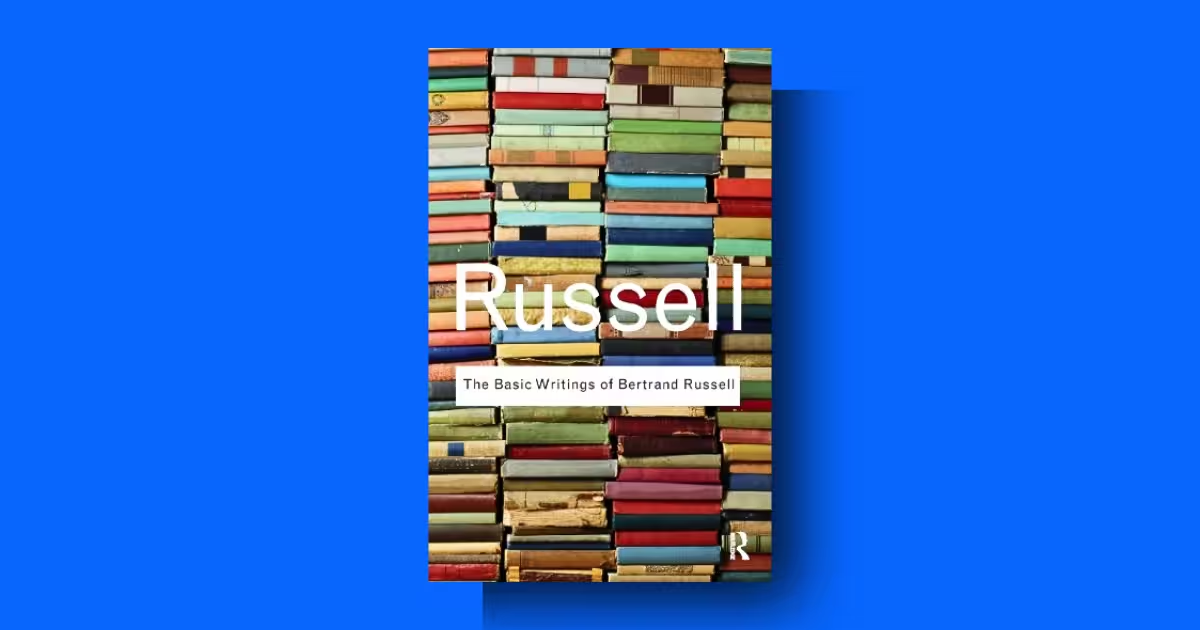
Can one book actually hold sixty years of a single mind, from a boy’s private crisis of religious doubt in the 1880s to a warning broadcast to six million radio listeners about the hydrogen bomb in 1954? I spent the better part of three weeks inside The Basic Writings of Bertrand Russell, and I came away convinced that most of what a general reader needs from Russell really is sitting inside this one volume.
What I did not expect was how unevenly it is distributed. Some of these 81 essays are the best short prose I have read from any twentieth-century philosopher. Others are dense enough that I found myself re-reading the same paragraph three times and still not being sure I had it right.
Overview
The Basic Writings of Bertrand Russell, edited by Robert E. Egner and Lester E. Denonn, first published in 1961 and reissued in the Routledge Classics series in 2009, gathers 81 essays and lecture texts that Russell wrote between 1903 and 1959.
It is organized into 17 thematic parts, moving from autobiography through language, logic, mathematics, epistemology, metaphysics, ethics, education, politics, economics, history, religion, science, and international affairs, and it closes with Russell’s 1954 nuclear-age broadcast “Man’s Peril.”
The autobiographical, literary, ethical, religious, and political sections are genuinely excellent and hold up as some of the clearest philosophical prose written in English.
The four chapters drawn from Principia Mathematica, on the other hand, are close to unreadable without prior training in symbolic logic, and a handful of other technical sections will lose casual readers fast. Treat this as a highlights reel rather than a syllabus, and it is one of the best single-volume introductions to a major twentieth-century thinker you can buy.
Reader recommendation
The Basic Writings of Bertrand Russell is a book that can highly be suggested to:
Readers who want one chronological, one-volume cross-section of Russell’s non-fiction career instead of hunting down a dozen separate books
Students who need a starting map before committing to a full book like A History of Western Philosophy or Human Knowledge
Anyone who wants Russell on religion, ethics, education, and nuclear war in his own words, not paraphrased secondhand
Readers who like their philosophy mixed with memoir; the autobiographical opening chapters are as good as anything in his full Autobiography
The Basic Writings of Bertrand Russell is not suggested for:
Readers hoping for a guided, step-by-step introduction to symbolic logic; the editors deliberately left out the technical proofs from Principia Mathematica at Russell’s own request, so what remains are scope-and-aim summaries that assume some comfort with the subject already
Readers who want Russell’s fiction; only one short satirical piece, “The Metaphysician’s Nightmare: Retro Me Satanas,” represents his story writing
Readers who want Russell’s late-life politics; the anthology stops at 1959, so the Vietnam-era Bertrand Russell Peace Foundation years and the 1961 anti-nuclear arrest are absent from the essays themselves, though the editors’ front matter chronology covers them
Readers who already own several individual Russell titles; you will find real overlap here
Table of Contents
Introduction
The Basic Writings of Bertrand Russell was written by Bertrand Russell (1872 to 1970), edited by Robert E. Egner and Lester E. Denonn, with an introduction by John G. Slater of the University of Toronto. George Allen & Unwin in London first published it in 1961 under the fuller title Basic Writings, 1903 to 1959, running 736 pages, and Simon & Schuster released the American edition the same year.
Russell was a Welsh-born British philosopher, mathematician, logician, and social critic, and by any measure one of the two or three people most responsible for founding analytic philosophy alongside G. E. Moore.
He also happened to be a working journalist, a prison inmate twice over for his politics, a Nobel laureate, and, according to the Swedish Academy’s own citation, someone honored “in recognition of his varied and significant writings in which he champions humanitarian ideals and freedom of thought” when he won the 1950 Nobel Prize in Literature.
That range is exactly the book’s reason for existing. Egner and Denonn were not trying to write a textbook on Russell’s logic. As they put it in their own introduction, they wanted to let readers “survey the status and progress of contemporary thought” through the eyes of one writer who had something informed to say about nearly all of it.
The Basic Writings of Bertrand Russell‘s purpose, stated plainly in both Russell’s own preface and the editors’ introduction, is to give one volume a genuinely broad sample of the man rather than a narrow slice.
Other Russell anthologies existed before this one and picked a lane: Mysticism and Logic covered 1903 to 1917, and Why I Am Not a Christian (the 1957 essay collection, not to be confused with the single lecture reprinted here) focused only on religion. Egner and Denonn set out to do something wider, and to their credit, breadth is the one thing this book delivers without qualification.
Background
A little context on how this particular anthology came together makes the finished product easier to judge fairly. Lester Denonn was not an academic.
He was a New York tax attorney who happened to fall in love with Russell’s writing after a secondhand bookdealer talked him into collecting, rather than just buying, Russell first editions during the Depression.
He earned an MA in philosophy from Cornell in 1924 with a thesis on Plato’s myths before switching to law, and he spent the rest of his life gathering Russell material, eventually compiling the bibliography for Paul Arthur Schilpp’s landmark The Philosophy of Bertrand Russell (1944). After Denonn’s death in 1985, his collection went to McMaster University’s Bertrand Russell Archives, which still holds the largest concentration of Russell’s papers in the world.
Robert Egner, his co-editor, was the professional philosopher of the pair and had already edited an earlier volume of excerpts, Bertrand Russell’s Best (1958).
Russell himself, according to his own preface, had no hand in choosing what went into the book. He simply thanked the editors and noted how strange it felt to read essays he had written “as long as fifty-seven years ago.”
That distance matters. You are reading a writer looking back at his own twenties alongside a writer in his eighties still publishing broadcasts on nuclear war, and The Basic Writings of Bertrand Russell never pretends those two voices are the same person without qualification.
In fact, one of the epigraphs printed on The Basic Writings of Bertrand Russell‘s very first page makes that point directly, in Russell’s own words: “I am in no degree ashamed of having changed my opinions.” That line, more than anything the editors wrote, sets the tone for the whole collection.
The Basic Writings of Bertrand Russell summary: what is actually inside
The 81 chapters are organized into 17 parts, each with a short editorial introduction of its own. I read straight through, and here is what each section actually contains, so that you genuinely do not need to go back to the book to know what you are getting.
Part I to II: the autobiography and the essayist
Part I, “Autobiographical Asides,” opens with “My Religious Reminiscences,” “My Mental Development,” “Adaptation: An Autobiographical Epitome,” and “Why I Took to Philosophy.”
This is where Russell explains, in his own plain style, how a boy raised by his grandmother at Pembroke Lodge after both parents died before he turned four came to reject religion after reading John Stuart Mill’s autobiography, and how his early passion for mathematics collided with his later doubts about its supposed certainty.
If you read nothing else in The Basic Writings of Bertrand Russell, read this section; it is short, moving, and does more to explain the rest of Russell’s career than any biography summary could.
Part II, “The Nobel Prize Winning Man of Letters,” is where the collection’s literary reputation is earned. “How I Write” is a short, practical essay on prose style that still gets quoted constantly online, and for good reason. Russell’s advice holds up: “never use a long word if a short word will do.”
Then comes “A Free Man’s Worship” (1903), Russell’s most famous piece of prose and, by his own later admission, one he did not think especially well of.
It opens with a retelling of the Faust legend and argues that a “vision of the good” is worth building even inside a universe indifferent to human hopes, closing with the idea that real freedom lies in choosing “to worship only the God created by our own love of the good.” “An Outline of Intellectual Rubbish” follows, and its first line alone tells you what kind of essay it is: Russell writes that he has “seen the world plunging continually further into madness” while searching in vain for evidence that man is actually the rational animal Aristotle claimed.
The part ends with “The Metaphysician’s Nightmare: Retro Me Satanas,” a satirical short story rather than an essay, which is a nice reminder that Russell could be genuinely funny.
Part III to VIII: language, logic, mathematics, and the theory of knowledge
This is the technical heart of The Basic Writings of Bertrand Russell, and it is also where general readers are most likely to struggle. Part III, “The Philosopher of Language,” includes “Language,” “Sentences, Syntax, and Parts of Speech,” “The Uses of Language,” and “The Cult of ‘Common Usage’,” and covers Russell’s pioneering work on meaning and reference in fairly approachable prose.
Part IV is the section to be honest about. Titled “The Logician and Philosopher of Mathematics,” it includes “Symbolic Logic,” “On Induction,” and, notably, the prefaces, introductions, and part-summaries from Principia Mathematica, the three-volume, decade-long collaboration with Alfred North Whitehead that tried to derive the whole of mathematics from formal logic.
The editors were upfront about the limits here: at Russell’s own suggestion, they left out every symbolic proof and kept only the explanatory framing.
That is a sensible editorial call, but it means these chapters describe what the argument is about rather than letting you follow the argument itself. Readers without prior grounding in formal logic will likely find this the slowest going in the entire The Basic Writings of Bertrand Russell, alongside “Dewey’s New Logic” and “The Validity of Inference.”
Parts V and VI, “The Epistemologist” and “The Metaphysician,” are shorter and more readable, covering knowledge by acquaintance versus knowledge by description and Russell’s signature theory of logical atomism. Part VII, “The Historian of Philosophy,” samples his surveys of Aristotle, Aquinas, and nineteenth-century thought, and reads far more easily since Russell is explaining other people’s ideas rather than defending his own formal apparatus. Part VIII, “The Psychologist,” covers his behaviorist-influenced views on mind and matter across three essays, including “Truth and Falsehood.”
Part IX to XIV: ethics, education, politics, economics, history, and culture
This stretch of The Basic Writings of Bertrand Russell is where Russell the public moralist takes over from Russell the technical philosopher, and the writing noticeably loosens up. Part IX, “The Moral Philosopher,” includes “Styles in Ethics,” “The Place of Sex Among Human Values,” “Individual and Social Ethics,” and “‘What I Believe’,” the 1925 essay that Russell wrote to lay out, in his own preface’s words, “forces making for happiness, and forces making for misery” in human life.
This particular essay has real historical weight: it was one of the books cited in the 1940 New York court proceeding that blocked Russell’s appointment to teach philosophy at the City College of New York, a case the editors’ own headnote references directly.
Part X, “The Philosopher of Education,” draws on Russell’s years running Beacon Hill School with his second wife Dora Russell between 1927 and 1935, and includes “Education,” “The Aims of Education,” “Emotion and Discipline,” and “The Functions of a Teacher.” Part XI, “The Philosopher of Politics,” opens with the same lecture Russell delivered as his Nobel Prize acceptance speech, “Politically Important Desires,” alongside “Why I am not a Communist.”
Part XII covers economics in three shorter chapters, and Part XIII, “The Philosopher of History,” includes the 1904 essay “On History,” which opens with one of Russell’s most-quoted lines about why the study of the past is indispensable to what he calls “citizenship of the intellectual commonwealth.” Part XIV samples his writing on China and comparative civilizations, drawn from his year teaching in Beijing in the early 1920s.
Part XV to XVII: religion, science, and the nuclear age
The religion section is probably the single most searched-for part of this whole The Basic Writings of Bertrand Russell, and it does not disappoint. Part XV, “The Philosopher of Religion,” includes “The Essence of Religion,” “What is an Agnostic?,” “Why I am not a Christian,” and “Can Religion Cure our Troubles?”
The centerpiece, “Why I am not a Christian,” is the full text of the lecture Russell delivered at Battersea Town Hall on March 6, 1927, under the auspices of the South London Branch of the National Secular Society.
Reading the actual lecture rather than the internet’s condensed version of it is worth the price of the book by itself; Russell spends real time carefully defining what he even means by the word “Christian” before making his case, noting that “you must have a certain amount of definite belief” before the label properly applies to you at all.
Part XVI, “The Philosopher and Expositor of Science,” covers relativity, scientific method, and non-demonstrative inference across six essays. And Part XVII, “The Analyst of International Affairs,” closes the book with eleven essays on the Cold War and the nuclear standoff, ending with “Man’s Peril,” the text of Russell’s BBC radio broadcast from December 23, 1954.
That broadcast, heard by more than six million listeners according to McMaster University’s Bertrand Russell Archives, helped set in motion the 1955 Russell-Einstein Manifesto and the Pugwash Conferences on Science and World Affairs.
It closes with what is probably Russell’s single most quoted sentence: he appeals to listeners to “remember your humanity, and forget the rest.” Placing that broadcast as the book’s final chapter is, whether the editors intended it this way or not, a genuinely powerful way to end a volume that opened with a small boy’s private religious doubts.
The Basic Writings of Bertrand Russell Analysis
Judged against its own stated purpose, the anthology mostly succeeds. Egner and Denonn said they wanted a “useful, definitive sampling” that would let a reader see the full range of a man who wrote on nearly every branch of philosophy except aesthetics, and on that count, the book delivers.
You genuinely do get logic, ethics, politics, education, religion, history, and science, all from one writer, all in his own words, and all with enough editorial framing at the start of each part to orient a reader who has never picked up a philosophy book before.
Where the evaluation gets more complicated is on the question of whether the selections themselves are equally well supported by evidence and argument, since that varies wildly by subject.
Russell’s essays on religion and ethics build their case the way a good lawyer would, defining terms carefully and walking through objections one at a time, which is exactly why “Why I am not a Christian” still gets assigned in philosophy of religion courses decades later.
The political and historical essays are more openly opinionated and less rigorously argued, which the editors themselves half-admit when they note in the Part XII headnote that Russell “made no major contribution to economic theory.”
And the logic and mathematics chapters are not really arguments you can evaluate as a general reader at all, since the editors stripped out the proofs that would let you judge whether the reasoning holds; you are left taking Russell’s word for it, which is an odd position for a book built around a philosopher famous for demanding evidence.
That unevenness is not just my own impression. The Basic Writings of Bertrand Russell carries a strong 4.37 average from over 600 ratings on Goodreads, and several of the most-upvoted reader reviews there make almost exactly the point I am making: the word “Basic” in the title oversells the whole and undersells the fact that a handful of parts, mostly the autobiographical and literary ones, are doing most of the work that keeps readers coming back.
A 2014 reader review on the blog The Eponymist makes the same case from a different angle, noting that the Principia Mathematica material took several attempts to get through even for a committed reader, while calling the time spent with the rest of Russell “never wasted.”
The introduction by John G. Slater, added for later editions, does real work here that the original 1961 book lacked. Slater, writing from the University of Toronto, gives useful context on how each essay connects to Russell’s biography, which essays Russell later disowned (he specifically said late in life that he did not “think well of” “A Free Man’s Worship,” the very essay most readers come to the book to find), and why Denonn’s decades of quiet collecting made this particular anthology possible in the first place.
If your copy is an older printing without Slater’s introduction, you are missing a genuinely useful piece of scholarly grounding.
Strengths and weaknesses
The single biggest strength, and I want to be direct about this because it surprised me, is how good Russell’s plain prose actually is.
I went in expecting the dry, careful tone I associate with academic philosophy, and instead found essay after essay written with real wit and almost no jargon. “An Outline of Intellectual Rubbish” made me laugh out loud twice, and “How I Write” is genuinely useful writing advice that I now find myself applying to my own drafts.
The autobiographical opening chapters hit harder emotionally than I expected from a book organized by subject headings rather than narrative, and “Why I am not a Christian” earns its reputation; it is careful, patient, and far less combative in tone than the internet excerpts of it suggest.
The Basic Writings of Bertrand Russell‘s honesty about Russell’s contradictions is also a real strength.
Rather than smoothing him into a consistent system, the editors let you watch him change his mind across six decades, from flirting with Hegelian idealism as a young man to abandoning it, from a period of genuine interest in mystical religion during his relationship with Lady Ottoline Morrell to his later hard agnosticism.
That intellectual honesty, both Russell’s and the editors’, is rare in anthologies built around a single figure.
The weaknesses cluster almost entirely around the technical philosophy sections, and I want to be specific rather than just complain in general terms. The four Principia Mathematica chapters (prefaces, introduction, and part summaries) are excerpted in a way that leaves you with the shape of an argument but none of its substance, since every symbolic proof was deliberately cut.
I read “Summary of Part IV, Principia Mathematica” twice and came away with a general sense of what relational logic is trying to do, but I would not claim to actually understand the argument on the strength of these four pages alone. “Dewey’s New Logic” and “The Validity of Inference” have the same problem to a lesser degree.
If you are the kind of reader who wants to be walked carefully through an argument, these chapters will frustrate you, and that frustration is not a flaw in your reading; the editors built the selection this way on purpose.
I also want to flag something a lot of online reviews mention without quite spelling out why it matters: the collection stops in 1959, a full decade before Russell’s death in 1970.
That means the essays here predate his most public anti-Vietnam War activism, his founding of the Bertrand Russell Peace Foundation, and the war crimes tribunal work he did with Jean-Paul Sartre near the end of his life.
The Basic Writings of Bertrand Russell‘s own front-matter chronology covers those years in outline, but none of Russell’s own writing from that final decade made it into the essay selection itself.
If you specifically want late-period Russell, this is not the book, though the Probinism review of his full Autobiography covers that period in his own words.
One smaller, more personal complaint: because the book groups essays by subject rather than by year, you lose the sense of watching Russell’s style change over time unless you keep flipping back to the chronological works list at the front.
I found myself doing exactly that, checking the publication date printed at the end of each essay against the timeline in the front matter, just to keep track of which decade of Russell I was actually reading in any given chapter.
A running date printed at the start of each chapter, rather than only tucked in at the end, would have made that easier.
Comparison with similar works
If you are trying to figure out where this book fits next to the rest of Russell’s output, a few comparisons are worth making. Readers who want the autobiographical Part I expanded into a full narrative should go directly to my review of the complete Bertrand Russell Autobiography, which covers ground this anthology only samples.
If the “How I Write” essay is the highlight for you, the full source collection, Portraits from Memory, has more of the same relaxed, personal writing.
Readers who found the technical logic chapters frustrating but still want to understand what Russell was actually arguing in that area have a gentler on-ramp in my review of Introduction to Mathematical Philosophy, which Russell wrote in prison in 1918 specifically for readers without a mathematics background, and it is a far easier read than the Principia excerpts reprinted here.
For the political and skeptical essays, my reviews of Unpopular Essays, Sceptical Essays, and Free Thought and Official Propaganda go deeper into the skepticism and independent-thinking themes that “An Outline of Intellectual Rubbish” only samples here.
Readers who want more of the nuclear-age Russell than a single closing chapter can get should look at my review of Common Sense and Nuclear Warfare, his full 1959 book on the subject, alongside my reviews of two thematically related books by other authors, Nuclear Weapons and Foreign Policy by Henry Kissinger and The Fate of the Earth by Jonathan Schell, both of which pick up the same existential nuclear anxiety that “Man’s Peril” first put in front of a mass audience.
And if the education chapters interest you most, both On Education and Education and the Good Life expand on the four essays sampled in Part X.
Outside Russell’s own catalog, the closest comparison in ambition is probably Will Durant’s The Story of Philosophy (1926), though Durant is explaining other philosophers rather than being one, and the tone is correspondingly more like a survey course than a set of primary documents.
Conclusion
I would recommend The Basic Writings of Bertrand Russell to almost anyone curious about twentieth-century philosophy, with one honest caveat: read it selectively rather than cover to cover on a first pass. Start with Parts I, II, IX, XV, and XVII, since the autobiography, the essays, the ethics, the religion, and the nuclear-age political writing are where Russell’s reputation as one of the century’s clearest prose stylists is fully earned.
Treat Parts IV through VIII, the logic, mathematics, epistemology, and metaphysics sections, as optional deep cuts for readers who already have some grounding in those fields, or as a preview before committing to Introduction to Mathematical Philosophy or An Outline of Philosophy separately.
General readers and undergraduates will get the most out of The Basic Writings of Bertrand Russell. Specialists in mathematical logic will likely already own the primary sources this anthology only excerpts, and readers who want Russell’s final decade of activism will need to look elsewhere.
As an entry point into one of the most quoted and most misunderstood philosophers of the last hundred years, though, it remains hard to beat.







